
The quixotic creations of Bob Cherry
If you ever have any doubts about the quality of service at our local information centres, try going to the tourist information office at The Rocks in Sydney and ask about gardens to visit in the area. If you wandered into our I-sites, it would be reasonable to expect them to come up with maybe six or more options which would include a mix of both private and public gardens. Not so in Sydney. The staffer resorted to Google (which I had already tried at home) and merely pulled up real estate open homes in areas with garden type names. It remains a mystery to us as to whether there are in fact no open garden options beyond the botanic gardens. If there are, we failed to find them.
We did find the Royal Botanic Gardens which are very close to the Sydney Opera House in a magic location. The parking metre fee of about $26 made me wince and the café where we had lunch was downright ordinary. The wonderfully decorative ibis who have clearly adapted to café fare were the best part of lunch. Mark was particularly impressed by the palm collection and chose to linger there, studying mature specimens of varieties he has here to put into his planned Palm Walk but in the end it was the bats which provided the most vivid memory. Many large bats, hanging about in trees. I had been under the misapprehension that bats slept during the day. Not so, at least not these Sydney bats. They merely hang around upside down, bickering, squabbling, fighting and generally making a lot of noise. While the bats are vital for pollinating certain plants in the gardens there, numbers had built up to such a high level that they were also responsible for doing a lot of damage to many trees. I think we were told the current population is estimated to be around 16000, and that was not in a large area. The gardens’ management have permission to try and reduce the population but, this being Australia with a laudable commitment to their indigenous fauna, there is to be no cull. Instead they will attempt to drive the bats out by emitting a particular frequency of sound which only the bats can hear. Lucky neighbours. The bats do not apparently fly very far so upwards of 16000 displaced bats are likely to settle nearby.
We had to drive upstate to find a garden – in this case, one created by leading Australian plantsman, Bob Cherry. The garden he and his wife, Derelie, own is called Paradise and is located in Kulnura. Readers may not know the name Bob Cherry but many will know of Paradise camellias, particularly the Paradise sasanquas which completely dominate the markets both in Australia and New Zealand. However his interests go well beyond camellias and he was working with bidens, amongst many other plants, in search of new garden varieties. What is a bidens, you may ask? Closely related to cosmos and the orange and yellow so-called cosmos that turned up in a packet of pink and white cosmos seed here are in fact bidens. There are also common weeds that are bidens. Beyond bidens, begonias, Camellia sinensis, michelias, polyanthus and many other plant varieties were undergoing the Cherry touch in the quest for better garden plants.

Camellia changii - reputed to flower throughout the better part of the year
Bob has made over 40 trips to China since it opened up to the west in the early 1980s and has been responsible for introducing a wide range of new species and plants to the west. We were fascinated to see Camellia changii in flower – in early March. Apparently it flowers all year round and its March flowers were certainly eyecatching, being a true scarlet red with no pink tones at all. Camellia changii is also sometimes referred to as Camellia azalea, although I have failed to find any explanation for that name. In the wild, changii is rated as extremely endangered but it has been distributed around the world and it opens up possibilities for breeding a new race of camellias that flower outside the time when petal blight hits. Of course they don’t have petal blight in Australia. Yet. Bob told us that he point blank refuses to visit New Zealand during camellia season. He thinks it is probably only a matter of time before petal blight reaches Australia but there is no way that he wants anybody to be able to claim that it was first found in his garden or nursery.
Bob and Derelie garden on a pretty grand scale and, typical of most Australasian gardens, they do it themselves with minimal input from outside labour. We didn’t even look at Derelie’s extensive rose gardens, but there is an extraordinary range of woody trees and shrubs, including some of the best foliaged Michelia yunnanensis (syn. Magnolia laevifolia) that we have seen. But the other stand out features of this garden called Paradise were Bob’s structures. I am not sure I can convey the full scale of these. We built a pretty large brick wall here in our garden and it took 16000 bricks. Bob has so far used an estimated half a million bricks on his structures. And that does not include the extensive stonework and ironwork. He gets in a brickie whenever his budget allows but he does all the stonework himself. We are not talking brick paths and dinky little structures here. This is grand vision stuff. The pillared walkway shown in the photograph is as yet unfinished. There are now 50 of these massive brick columns and it is to be an extension of the wisteria walkway. There is something bravely compulsive about some of the constructions – a vision the creator is determined to get well underway, knowing that he may never see completion. His property is on the market and he yearns for retirement to a smaller piece of land in Tasmania. Bob Cherry is one of the gardening world’s modern quixotic gems.
Derelie has published a book on the garden which is available in New Zealand. “Two Dogs and a Garden” is a beautifully produced book, full of pretty photographs (very pink, but how could it be otherwise when camellias play a large role in their lives?) and a personal interpretation of the lives they lead in their own piece of paradise.
Finally back to Sydney, we were delighted by the crepe myrtles used as street trees and in full flower in Chinatown. The crepe myrtle or lagerstroemia is a small tree, mainly from Asia, with beautiful bark. They can look remarkably dead when they are dormant in winter. We saw some in northern Italy, completely dormant, with bark which resembled piebald ponies. They will grow here, but they rarely flower well. We are just a bit too wet and lush for them. They tend to do better in drier climates with hot summers and more seasonal variation than we can give. Being a small tree with a light structure, they make a well behaved street specimen. In flower, they look a little like trees covered in crepe paper blossoms which seemed entirely appropriate to the ambience of Chinatown.
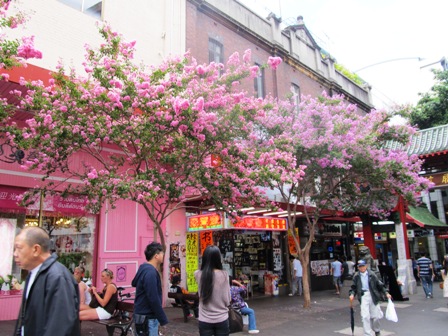
Crepe myrtles in Sydney�s Chinatown
-39.042098
174.300314



 Tikorangi The Jury Garden