Category Archives: Garden lore

Wisdom and hints

“Nature does not complete things. She is chaotic. Man must finish and he does so by making a garden and building a wall.”

Robert Frost (1874-1963)
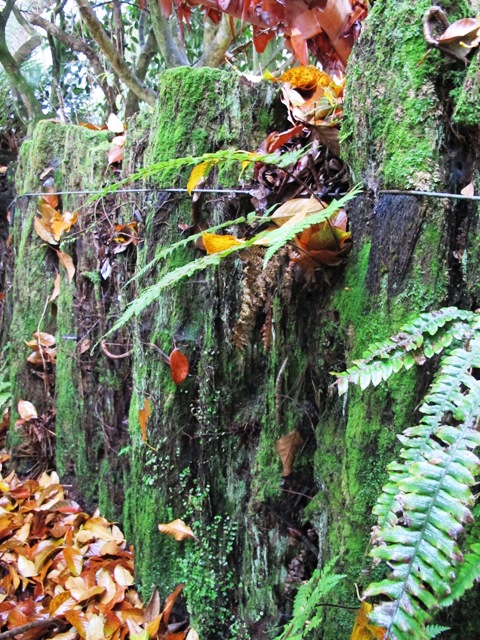
Garden lore: ponga retaining walls

Ponga retaining walls

The one truly New Zealand DIY retaining wall must be pongas – or tree ferns as they are known internationally. If you have a source of similar thickness ponga logs without having to raid native bush reserves, they can offer a surprisingly long-lasting retaining wall. These have been in place for well over 20 years, maybe closer to 30, on a vertical bank that is about 1.3 metres high. They are held in place by lengths of non-rusting fencing wire secured to waratah standards that have been driven into the bank behind.

We think a key to longevity may be the way the pongas are placed. If they are all upside down from the way they were growing, they are then dead and will eventually rot, though this happens very slowly. If they are placed the right way up, as some of these are, then they have the knack of springing back into growth from time to time. It means you have to stop them growing back into trees and trim off all the foliage every few years, but effectively you have a living wall.

The most common tree fern in NZ is Dicksonia squarrosa or wheki. It is more prized overseas and Britain’s Royal Horticultural Society has even given it an award of garden merit. As a retaining wall, it gives a natural look. In shaded areas, ferns and mosses will colonise over time.

First published in the Waikato Times and reprinted here with their permission.
Garden Lore

“When Wordsworth’s heart with pleasure filled at a crowd of golden daffodils, it’s a safe bet he didn’t see them two weeks later.”

Geoff Hamilton (1936-1996)

Kereru in the apple trees

Kereru in the apple trees

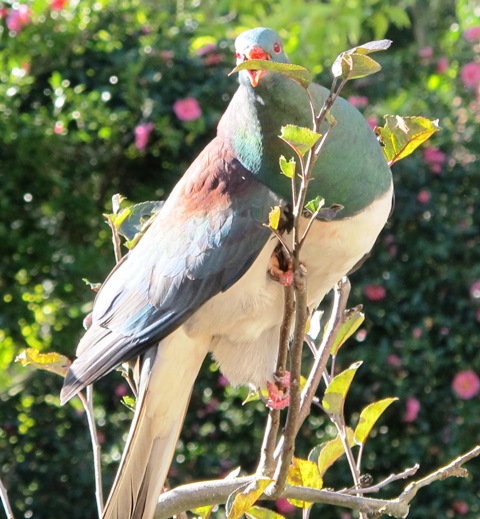
New Zealand’s native wood pigeon. the kereru

The kereru in the apple trees just outside our back door has returned. This is a seasonal appearance. It flies in every day to spend much of the afternoon munching away on the remaining apple leaves. As the trees close down for winter dormancy, the sugars concentrate in the foliage. The kereru never comes in to feed from them until late autumn or early winter but it is pretty enthusiastic now. We rarely see more than one at a time in these trees at a time although we know we have more than just the one as a regular on the property. I see they can live to be 20 years old so perhaps it is just this one that has discovered a taste treat. It is determined and will try and out-stare both humans and dogs until we get within a metre or two before it abandons ship to crash away. At 650 grams average weight, kereru do a lot of crashing at both take off and landing.

Along from the apple trees, we have planted both red and yellow guavas. They are the South American Psidium littorale, not the tropical guava. These were a nostalgic planting specifically to feed both kereru and grandchildren alike. The latter have yet to make an appearance but the kereru are appreciative.

As far as we know, our kereru stick around all year, feeding from a variety of berries, fruit, seeds, flowers and leaves. While they are usually solitary birds, we have counted up to 15 at once on a memorable occasion. Various reasons are given for the national decline in numbers but none of the experts seem to add extremely poor nest building to that list. When it comes to nests and ensuring the safety of their one, solitary offspring at a time, these birds must be contenders for the title of NZ’s worst nest builders.

First printed in the Waikato Times and reprinted here with their permission.
Garden Lore

“How magnificent it sounds! That is the fun of writing of one’s garden: a steep bank can be a cliff, a puddle a pool, a pool a lake, bog and moraine sound as though a guide were needed to find your way across them, and yet may be covered by a sheet of the Times. My Dolomites like within the compass of my outstretched arms.”

Edward Augustus Bowles My Garden in Spring (1914)

The death spiral

The death spiral

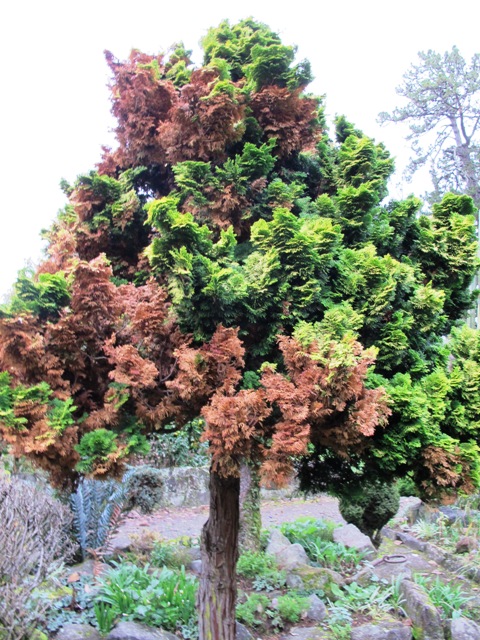
This is not a happy tree and that is not autumn colour you are looking at. It is a slow death spiral unless we can intervene. Despite sharing the same reservations as most New Zealanders about variegated yellow conifers, we regard this one as special and wish to keep it. It is Chamaecyparis obutusa lutea nana and after about 40 years, it is a handsome, small feature tree in our rockery, not much over two metres tall.

The spiral-type pattern of the dead sections is a sign that it is a root problem and that, so far, only the part of the root system that affects those sections of the canopy is failing. If one solid section of the tree was affected, it can indicate that the tree is dying from top down and that it may be possible to cut out the infected area. But the overall patchiness shows it is dying from bottom up.

While we are increasingly reluctant to reach for the chemical arsenal, the first step here is to saturate spray for phytophthora, a varied pathogen that attacks root systems. It is a problem in vineyards and a form of it caused the potato famines in Ireland. If that fails, the last ditch attempt will be with Trichodowel – fine pieces of dowelling, each impregnated, according to the packet with “not less than 100 million Trichoderma viride spores” (who counted?). The dowels are designed to be inserted into the trunk or branch where the good spore can multiply and maybe defeat the baddies. If it was a silver blight problem, we would use these first but it is either/or because the anti-fungal spray will kill the beneficial fungi.

If it wasn’t a valued feature plant, we would let nature take its course and we would not replace it with another woody plant which may suffer the same fate.

First published in the Waikato Times and reprinted here with their permission.
Garden Lore

“He that plants trees loves others besides himself.”

Thomas Fuller Gnomologia (1732)

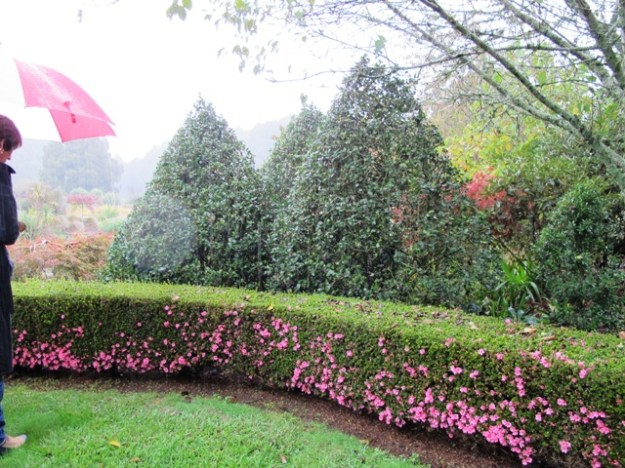
Tightly clipped azalea hedge

Tightly clipped azalea hedge

Azalea hedges
I finally came across a gardening idea I have read about, even suggested, but had yet to see in person – a tightly clipped azalea hedge. This is in the garden at Wairere Nursery in Gordonton and it is delightful. It is Azalea ‘Kirin’ and the flowers were just opening a few weeks ago. It will be a swathe of colour as the season progresses.

If the pretty candy pink flowers are not to your taste, ‘Kirin’ one of the Kurume azalea group – small leafed, small flowered azaleas from the Kurume area of Japan. There is a range of colours in the Kurumes – well, azalea colours so we are talking white, pinks, salmons, lilacs through to deepest pink almost red. The Kurumes tend to have much smaller leaves than the Gumpo hybrids which is why they clip better as a hedge. When not flowering, it will look similar to a clipped buxus hedge – from a distance at least.

The beauty of azaleas for hedging is that they only need clipping once, maybe twice, a year and sprout again from bare wood so can take a hard hack if needed. The more you clip, the denser the hedge will be but you need to time it right so that you are not cutting off the flower buds. The flowers are nature-friendly, unlike buxus which contributes next to nothing to insect and birdlife, and they will light up a dark winter’s day, even more so if you go for colour rather than restrained white. The problem will be finding enough plants of one variety if you plan a longer hedge – you may have to be patient but the wait will be worthwhile to get such a pretty and practical effect.

First published in the Waikato Times and reprinted here with their permission.
Garden Lore: May 23, 2014

“Momordica – Cucurbitaceae – The Squirting Cucumber. An annual gourd-like plant, with woolly leaves, and yellow flowers, the fruit of which resemble a small cucumber; and which, when ripe, bursts the moment it is touched, scattering its seeds, and the half liquid, pulpy matter in which they are contained, a considerable distance. This quality made it a favourite, in gardens, a century ago, when some people were yet in a state of sufficient barbarism to find amusements in the annoyance of others; but it has now deservedly fallen into disrepute, and is seldom grown.”

Jane Webb LoudonThe Ladies’ Companion to the Flower Garden” (1840)

Vegetable time bombs, we call them

Vegetable time bombs, we call them

Garden Lore: Magnolia Little Gem

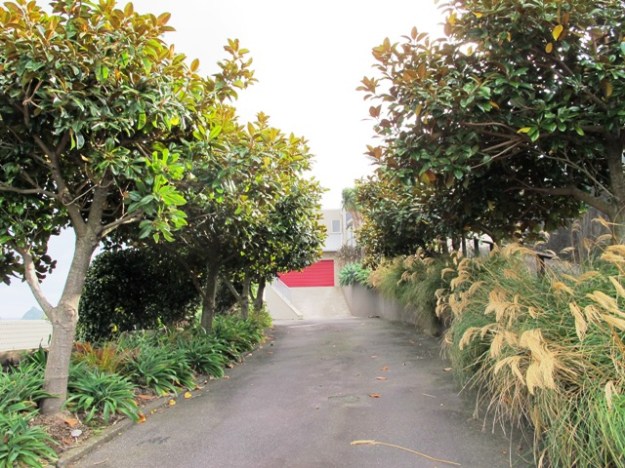
I stopped to photograph this driveway in town because it is like a vegetable time bomb waiting to give its owners no end of problems. What you are looking at is a narrow driveway flanked on either side by avenues of Magnolia Little Gem. At this stage, it still looks quite attractive. Little Gem is a good looking plant with glossy, dark green leaves and brown felted indumentum beneath. In summer, it will sporadically produce attractive white flowers. The mistake often made is in thinking that the descriptor “little” in its name, means it will stay small. While it will not get as large as some of the other grandiflora magnolias, it is still going to be an 8 metre tree and have a spreading canopy. You can already see it spreading.

In narrow spaces, you need narrow, columnar trees (technically ‘fastigiate’) which can give height and structure, without width. If you are going to choose a plant which forms a canopy, you need to keep the branching above the height of vans and small trucks – probably 3 metres up. Clip and shape from the very start so that you don’t have to undertake radical work when the trees become a problem.

It takes a lot more effort and expense to remove established trees which have outgrown their allotted space than it takes to plant them in the first place. It is better to get the selection right at the start.

First published in the Waikato Times and reprinted here with their permission.