Tag Archives: Abbie Jury

From the nurseryman’s pen – the yellow pohutukawa

Metrosideros excelsa aurea

The much more common red Metrosideros excelsa

The yellow pohutukawa are flowering in my home town of Waitara. Metrosideros aurea. This is not without a tinge of sadness because the four biggest and best specimens on the bank of the Waitara River were felled – in our opinion unnecessarily – by a stubborn regional council despite a strong community effort to try and save them.

The letter reproduced this year in NZ Gardener

I have written about the yellow pohutukawa before, but my interest was piqued by a 1968 letter reproduced in the September issue of the New Zealand Gardener magazine. The letter writer was Victor Davies, who headed the powerhouse nursery Duncan and Davies and who was responsible for introducing the tree to mainland New Zealand by putting it into commercial production. I think we can take the letter as the most accurate historical record of that process.

It is interesting reading it 50 years later and realising how much times and attitudes have changed. The tone is a bit redolent of the old blankets, beads and muskets method employed by early colonialists to get down on treasures held by indigenous people. That is not a criticism of Sir Victor. It is just the way things were done.

A surviving yellow pohutukawa in Waitara

Sir Victor heard about the tree and was greatly interested because all the known pohutukawa on the mainland were shades of red. He could see the commercial potential of a yellow one so he tried repeatedly to get plant material. He thought he was successful when he managed to get somebody to send him scion wood. When the plants flowered five or six years later, they were all red. This may not be a surprise to many of us. In his own words, “After complaining, the reply I had was that as the tree was tapu they would never get any more material for me.” Personally, I think he was lucky to get a reply but his use of the word ‘tapu’ back in 1968 was interesting because not many Maori words had been incorporated in New Zealand English back then. ‘Tapu’ translates, more or less, to sacred. The yellow pohutukawa were a taonga – a sacred treasure to the original people of the land.

Undeterred, Sir Victor kept trying. Through a third party, a ‘friendly’ Maori was found who supplied material for twelve grafts – six red and six yellow. Allegedly, supplying the mix of red and yellow scions circumvented the tapu restrictions. Hmmm. Pretty dodgy, that.

Sir Victor goes on to say that they raised many thousands of seed and they all flowered true to type without any variation so the yellow form was deduced to be a stable species. I am sure the nursery would have sold thousands of plants too but not a single cent would have been returned to the original owners of the sacred tree.

The red pohutukawa make better landscape trees but the yellow is certainly an interesting variant, plus power lines

Some of those trees were planted in Waitara, the closest town to Duncan and Davies Nursery and the surviving plants are what I photographed yesterday. Victor Davies was renowned for many traits, amongst them his remarkable sales ability. And the 1968 letter is headed “The Golden Pohutukawa” and he describes the flower colour as “dull gold”. There is a marketing ploy. Not gold, pretty lemon yellow. It is certainly lovely viewed close up but it doesn’t show out in the landscape as do the more common red forms, Metrosideros excelsa.

Christmas is coming and the red pohutukawa are widely known as the New Zealand Christmas tree.

Down in the water meadows, the Higo iris bloom

Higo iris float above a sea of dandelions in the Wild North Garden

I really like that the Japanese Higo iris are such a big feature of our December meadows yet they almost certainly descend from the Japanese quest for a perfect, single bloom as a focus for contemplation. It is such a wonderful contradiction – that quiet refinement, simplicity and elegance that the Japanese traditionally bring to flowers generally and the wild abandonment of our Tikorangi meadows.

Smaller flowered, white Higo in the park meadow

Higo are not a separate species of Japanese iris. They are hybrids, bred over 500 years, originating from Iris ensata. There are three groups of iris from these breeding lines – Edo, Higo and Ise but the best known are the Higo. Our Higo were given to us by Auckland plantsman, Terry Hatch of Joy Plants, and apparently originated as wild collected seed. Mark had a discussion with Terry about wanting to try naturalising Higo by the stream but the finely bred, named cultivars were not sufficiently robust to survive in a situation of benign neglect. Terry offered up a tray of about 700 germinated seedlings which seemed a bit of overkill at the time. Now we bless him every year. Not all 700 survived, I hasten to say, but we had plenty to play with.

and a much larger flowered white Higo iris 

The blue is less dominant than the purple shades of Higo 

Because our plants are all seedlings, we have a fairly wide range and some clearly show their I. ensata heritage. Others are pure white, pink, almost pure blue and the whole range of violets, purples and lilac.

More Higo iris

I see the oldest plants are now in their ninth year or so of being planted on the banks by the stream and ponds and they perform reliably every year. Given they have stiff competition and receive absolutely no care or intervention, that makes them very robust plants. I tried some in a mixed border at one stage but they were too strong a grower with leafage that swamped out surrounding plants during summer and autumn so I removed them.

Can we have too many Higo iris?

A few years ago, I planted the last of the neglected pots from the nursery down in the area we call the Wild North Garden and this year, some are starting to bloom. They are much more rewarding than the Louisiana iris we grow where the leaf to bloom ratio is too high.

Seedling variation in the Higo iris

From mid to late November through until Christmas, the flowering of the water iris is such a delight. Like over the top butterflies, they float in the air above a sea of buttercups, dandelions, daisies and wild grasses and they truly make my heart sing.

In the park meadow. The Wachendorfia thyrsiflora with its tall yellow plumes has a death sentence on its head – too free with its seeds to keep it by a waterway 

The Wild North Garden – I am waiting for more Higo iris to bloom

Seven long years to bloom and then it dies – Cardiocrinum giganteum

The giant Himalayan lilies are coming into bloom. Cardiocrinum giganteum. It is the biggest of the lily family, hailing from areas like Tibet, Bhutan, Assam, Myanmar, Nepal and Sikkim.  It feels a bit of a triumph that we now have this bulb naturalised here. We haven’t planted any for many years and just allow them to grow where they pop up from seed.

The largest lily of them all – Cardiocrinum giganteum

These are not lilies for the home gardener on a small urban section. The flower spikes often reach three metres here and have been recorded at up to five metres. Fortunately, the stem is such that they can hold themselves up.

Usually six years of foliage and in the seventh year, it puts up an astounding flower spike

The main obstacle for most gardeners is that the bulb takes about seven years before it flowers and then it dies. Fortunately it makes offshoots around the main bulb as well as setting seed but those offshoots can take another five years minimum before they flower and the seeds take seven years. These are not lilies for the impatient gardener. And, while very fragrant, the flowers are a long way up so unless you have a grove of plants flowering at the same time, you are unlikely to get the benefit of scent. In the intervening years, they just form a clump of large, heavy textured, heart-shaped leaves that are reasonably anonymous.

Typically, these plants need cool, open, woodland conditions with soils which never dry out and are rich in humus. Those are pretty specific conditions.

The top photo is one of those really, seriously peculiar plant combinations that are a characteristic of many New Zealand gardens – a self sown Cardiocrium giganteum from the Himalayas, flanked on the right by Pseudowintera colorata (commonly known here as the mountain horopita or pepper tree) with Dracophyllum latifolium behind (both NZ natives) and then what we know as Aloe bainseii but is now, apparently, Aloidendron barberae – the tree aloe from southern Africa. It is a veritable United Nations of plants here.

Tikorangi Notes: underplanting, gardening with perennials and the magnificent nuttalliis

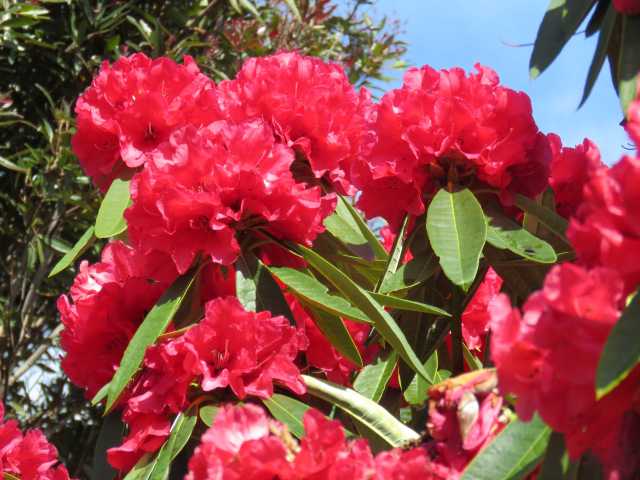
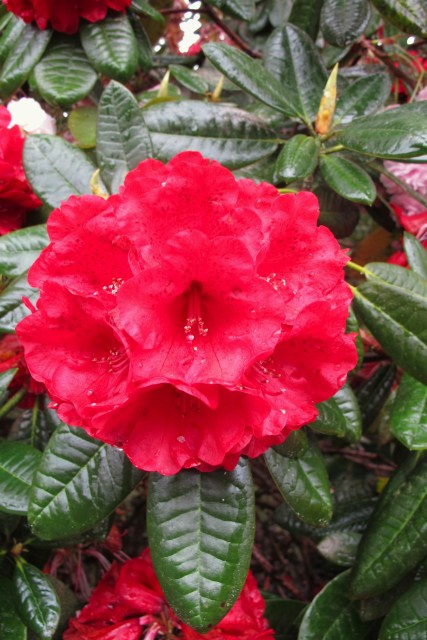
Pretty Rhododendron Yvonne Scott (nuttallii x lindleyi x dalhousiae) with a named clematis but I have lost its name – relevant to the last para on this post and a prettier photo to lead with than the mishmash of a garden bed below 

Not good at all. The addition of roses was a particularly ill-considered decision

I spent a good four or maybe five days taking this unsuccessful garden bed apart. It was first planted about 14 years ago and the original idea was that it continue the theme of the driveway border – mixed shrubs with predominantly hellebores as underplanting. It has never thrived and over the years, its treatment has followed a pattern that many will recognise – random attempts to spark it up that have made it messier and more disjointed.

I lifted everything except the Queen palm (Syagrus romanzoffiana), an attractive Viburnum sargentii ‘Onondaga’ and Camellia minutiflora. The location is too sunny for the hellebores and they were not thriving, so I planted them elsewhere. And I found why the plants at one end had never thrived. I could only get the spade half way in before I hit what might as well be bedrock. It was the old driveway with very heavily compacted road metal. I recalled that Mark had got the nursery staff to plant that bed when it first went in. Now, our nursery staff were whizzybang at speed-potting plants and doing the hard graft of keeping a production nursery going but gardeners, they were not. I am guessing they chiselled holes just large enough to fit the plants in. No wonder so many failed to thrive. There was nowhere for them to get their roots down.

The aim is to have a carpet of harmonious under planting by the end of summer

I took out any larger stones and rocks I could get out, dug the soil and incorporated compost at a rate of a small barrow-load per square metre. There is still not a great depth of soil but what is there should be better and I won’t try growing any more deeper-rooted plants at that end. When it came to choosing what to replant, I fell back on my mixed border philosophy. When there is a mixture of shrubs in the upper layer, it is better to choose some uniformity in the ground cover layer. The opposite is also true: where there is uniformity in the upper layer of shrubs and trees, it is more interesting to use a mixture of plants at the ground level. It may be a sweeping statement (well, it is) to say that only landscapers, non-gardeners and novices go for regimented simplicity of matching upper layer plants and a single choice ground cover – tidy, visually effective in the immediate stage but essentially dull.

A totally reliable stoeksia that is particularly amenable to being divided and transplanted

Given the feature shrubs and palm are interesting in their own right and the presence of assorted seasonal bulbs, I chose to replant at ground level with the reliable, long flowering blue stokesia which thrives with us, a ground-hugging blue campanula and two forms of our native brown carex grass.  The upright form is Carex buchananii , I think, but I am not sure what the fountaining version of it is called. They are to form the carpet. I like the combination of blue and the mid-brown carex. Then I mulched it all. Now all it has to do is to grow.

May 2019

November 2019

It is quite gratifying to see how much the grass garden has grown since I planted it at the end of May. I am hoping that it will have closed up quite a bit by the time autumn comes. There have only been a small number of deaths amongst the plants – all were  Astelia chathamica and fortunately, I have more plants to hand that I can move to the gaps. The advice from colder climates is not to move perennials in winter because they are not growing and the risk is that the roots will rot out over winter. With our mild winters, this advice does not generally apply here but that may be the case with the astelia. The divisions all had roots when they went in but it may be that some did indeed just rot out before they came back into growth in spring.

My main task in this new garden is staying on top of the weeds. Considering it is new ground, there is not a big weed problem at all and I am determined to keep it that way as it gets established. Weeds getting a hold amongst the fibrous roots systems of perennials and grasses can be a maintenance nightmare. It is better by far to keep them out from the start, as far as humanly possible. Because it is all ground that has been freshly dug this year, it is easy to hand pull those pesky weeds that do try and make an appearance.

Eighteen months to fill in seems a quick result

Even more rewarding is to see the caterpillar garden hitting its stride – nicely filled out, floriferous already, weed-free and colour-toned as I want it. It has taken about eighteen months to get it to this stage. Gardening with perennials is very different to gardening with trees and shrubs. As long as you have plenty of divisions and the ground is well-prepared, the plants can rocket away and fill spaces quickly.

Species selection of R. sino nuttallii, singled out for its unusual pink flush

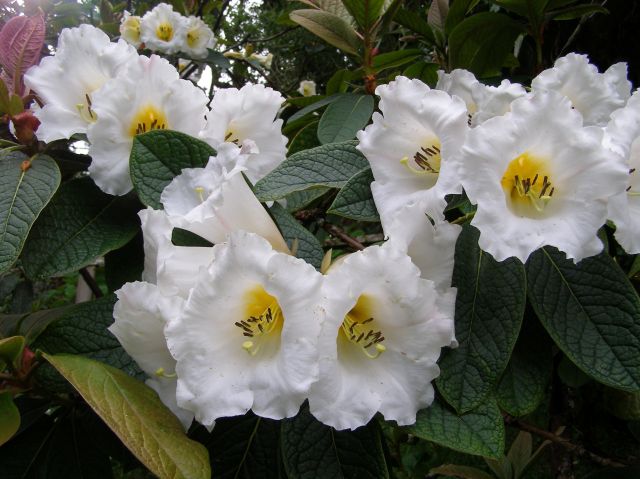
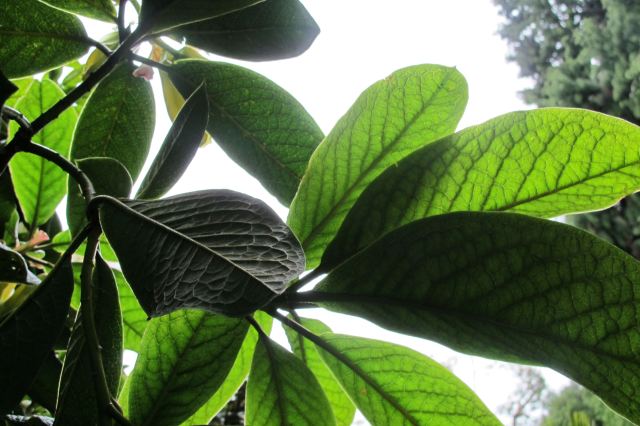
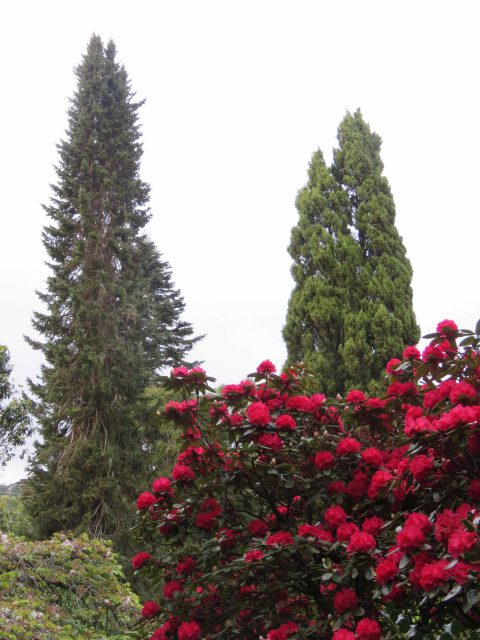
However, no perennial can compete with the sheer magnificence and stature of the nuttallii rhododendrons that flower for us at this time of the year. These are not often commercially available – at least not the sino nuttallii species. You may sometimes find some of the hybrids around that are nuttallii crossed with lindleyi, sometimes with the addition of dalhousiae. If you find ‘White Waves’ on offer in New Zealand, it is proving to be one of the best of the hybrids we grow – reliable and a good survivor as well as very showy indeed. “Mi Amor’ is also available for sale. The hybrids have smaller leaves than the nuttallii species and are not all as strongly scented  but you may just have to take what you can find if you want to try growing these choice rhododendrons.

Rhododendron nuttallii x sino nuttallii – so the Tibetan form crossed with the showier Chinese form


Knitted smallgoods!

Away from gardening for this post. Our local town of Waitara never fails to surprise me. Over the last four decades or so, Waitara has suffered the fate of many small towns with a decline in retail outlets. Most of the main street retailers seem to be either takeaway food outlets or charity shops now with a fair representation of empty premises. So it was that  I had failed to notice the window display in the disused butcher’s shop. Knitted meats!

Red saveloys, larger brown salamis and strings of sausages – pink for uncooked, appropriately beige for pre-cooked barbecue ones

I may have laughed out loud. Here is whimsical folk art on the main street. The windows were pretty dirty and the light conditions were less than ideal, but I offer the best of my photos for your amusement. I think it was the strings of sausages (both raw and precooked and labelled as such), saveloys and salamis that amused me most.

Others may be more impressed by the mince. Or maybe the bacon or chops. All presented on clear plastic trays and covered in cling film as the real produce usually is. It all just seemed like an idea off the square to fill an empty display window but with a debt to historical context. Waitara grew to be more than just a coastal cluster of houses because it had a huge freezing works (meat killing and processing plant). First started in 1881, the permanent closure of the works in 1997 dealt a body blow to the town which took well over a decade to recover from the shock and disruption.

The window on the other side of the locked door contains an eclectic mix of seaside accoutrements plus penguins. A knitted diorama, no less. This may appeal more to children but it was the unexpected cultural and historical context of the knitted meats that took my fancy.


Tikorangi Notes: a folk art garden, bearded irises, macadamia nuts and a bit of advice

Pat and Brian’s garden 

Either Pat or Brian – or both – like a bit of symmetry in places

I called in to see a local friend and as we walked around her garden, I figured that what she creates is a form of folk art. Hers is a heavily ornamented and decorated garden and regular readers will know that this is not my style at all. But I find Pat’s creative instincts charming in context. Many of her garden pieces have a story to them and they all have meaning for her. She doesn’t just buy something and place it in the garden. She repurposes, restyles and recycles items that others would dump and they bring both her and her husband a great deal of pleasure.

Rusty old cream cans repurposed to grow air plants 

Washing machine bowls reused as strawberry planters

Pat does not know the names of any of her plants and she has no botanical curiosity. But, and it is a big but, she has an eye for good plants and she has always been willing to buy plants that take her fancy. While she may not know the names, there are some interesting plants and a wide variety within her garden.
Above all, I think I like her garden because there is personal joy in it for both her and Brian. It is not a show garden but they keep it very tidy indeed because that is how they like it. I have been into a few gardens in my time that I would describe as joyless places, done for show and admiration from others, but more like a chore for the owners than a source of personal delight. Give me Pat’s folk art instead any day.
My blue-purple bearded irises are all in bloom. We are not bearded iris territory – they are better in drier climates with hotter summers than we get – and it is not easy for me to find good places for them. I was given a number of excellent named varieties several years ago but I see I only have one variety left and I have lost the name of it. It has a large flower and is very pretty, arguably much more so than the smaller flowered, robust one that forms most of my patch. But that is looking at the blooms as specimen flowers. Grown as a bed of several square metres, the plain Jane, utility variety is a way better performer. The big powder blue needs staking or it starts to lean and then the blooms get damaged very quickly. There is a lesson there if you are buying bearded irises. If you want to grow them as single specimens and are willing to stake and support them, then go for the big flowers if that is what appeals to you. If you want to do a bed of pretty colour, choose smaller flowered varieties that can stand up straight on their own.

Decorative pink racemes of macadamia flowers. The white flowered forms we have are nowhere near as eyecatching. 

Our macadamia trees are flowering and the nuts are dropping. There are reasons why these nuts are expensive to buy and it is to do with the cracking of them, I am sure. Astonishingly, the rats can bore into the rock-hard shells but it takes careful positioning and a sharp hammer blow for humans. We have tried a range of different macadamia nut crackers but they are tedious to use when you have to load the nuts one at a time and then separate them from their shells.

A simple mat but a gamechanger when it comes to cracking macadamia nuts

I love social media. It makes my world larger, as I say. It was Twitter that delivered me a recommendation last week that is a game-changer when it comes to cracking macadamia nuts. Get one of the doormats with round holes in it, was the advice. We just happen to have what I assume is calf matting that serves the same purpose – holding the nuts in place so they don’t skitter away or worse – fly into windows and break them (this has happened before). Now, we can crack up to 100 nuts at a time and have them stay in place. True, it takes 100 hammer blows to crack 100 nuts but then lift the mat, remove the kernels and sweep away the shells and Bob’s your uncle. I am picking up the falling macadamia nuts with a great deal more enthusiasm.

Finally, two pieces of seasonal advice. In New Zealand, the weeding round right now (that you may or may not be doing but we certainly are) is arguably the most important one of the year. The weeds are romping away but not many are setting seed yet. If you can get them out now – right now – you will reduce future weeding. And get mulch onto any bare soil before it really starts to dry out. That will also contribute in a major way to stopping more weeds from germinating.

We don’t clip many plants but this little camellia collection makes a focal point at our entry

If you are pruning or clipping, keep a close eye out for birds’ nests. Our feathered friends go to a huge amount of trouble building nests and while I may moan about the sparrows and blackbirds, there is something very sad about committing the ornithological equivalent of infanticide. We are currently doing the annual clip and shape on the camellias and michelias that we like to keep as defined forms. Hedges were done last month.

Mine No Yuki received her annual trim this week

Plants that disappoint

Four years ago

Four years ago, I wrote of this roadside shelter belt:

“Finally, coming home, I stopped to record the effective trimming of this Cupressus x Leylandii down the road. It was just an ordinary shelter belt until the lower canopy was recently lifted, exposing the trunks. The fact the branches have been trimmed reasonably flush helps but it adds a whole new dimension, being able to look through. It has turned an unmemorable shelter belt into something much more graceful and distinctive.”

And today. Cypress canker.

Sadly, it did not stay that way. Now it is a prime example of canker, a common problem in cypress and why the quick growing Leylandii has fallen from favour.  Canker is a fungus (two forms of seridium, in NZ at least), incurable and untreatable. It may or not be related to the limbing up carried out earlier, but it is all a bit academic now. Taking out the dying hedge is going to be a major operation for the property owner at some stage in the future.

Cypress canker

Some cupressus species and named varieties are much more susceptible than others and if you are thinking of planting any, it would pay to do an online search. There is a handy reference here from Agriculture Victoria. The names many of us know like ‘Leighton Green’, ‘Castwellan Gold’, ‘Naylors Blue’ and ‘Swanes Golden’ are all particularly susceptible. Best not to plant them in the first place, would be my advice. The cost of removal is going to be hugely greater than the cost of initial purchase.

The sparrows are stripping the flower stems bare as they open

While on disappointing plants, it is the pesky sparrows that are making me think there is no point in growing Stipa gigantea. I have used it quite extensively in the new grass garden and I will give it another year to see if sheer quantity can defeat the sparrow population. But the signs are not looking good and I may have to replace it with something else. The flower spikes are barely forming before being stripped by sparrows and bare stalks don’t do a whole lot for the garden aesthetic.

This is how I envisaged my Stipa gigantea would look

The whole point of Stipa gigantea is the gentle waving flower and seedhead which is very tall and golden – hence its common name of golden oats or giant feather grass. It appears to be compulsory in every modern British garden which is where we first saw it. And my friend Robyn Kilty praises its virtues in her little garden in Christchurch. It is a tidy grass with attractive glaucous foliage, easy to multiply by division and appears to be sterile so doesn’t set seed like many of the grasses.

I will be disappointed if I don’t get my sea of ethereal, waving golden orbs. I blame the early settlers. Could they not have left the sparrows (and blackbirds, many common slugs and snails, rabbits, ferrets, stoats and a host of other bothersome introductions) back in Old Blighty?

Look at the stipa in the background. I wanted that height and gentle movement

Postscript: while on disappointing plants, my Stachys Bella Grigio died completely. As predicted by a number of people who had a similar experience with this new release a few years back.