‘Tis the season for Magnolia doltsopa to bloom. It being midwinter, this immediately means it is a plant for milder climates and it has been a popular plant purchase in our area for many years. It used to be known as Michelia doltsopa but michelias have been swallowed up into the bigger family of magnolia now.
M. doltsopa, on the main street of Whaitara
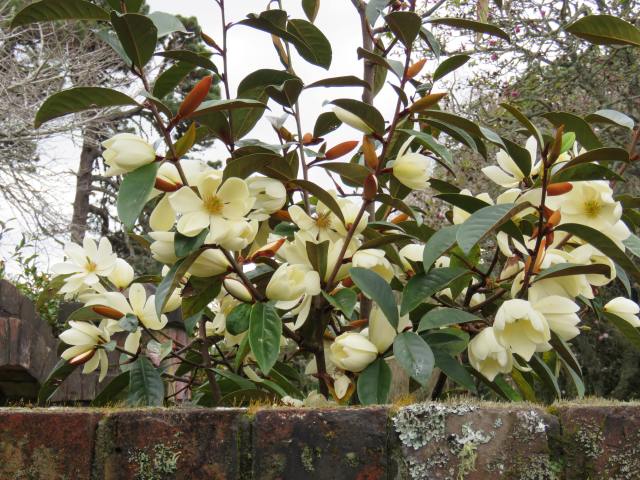
The Whaitara doltsopa is growing behind a hedge so I had to peek in from the gateway to confirm from its bottom branches that it is in fact doltsopa, probably ‘Silver Cloud’.
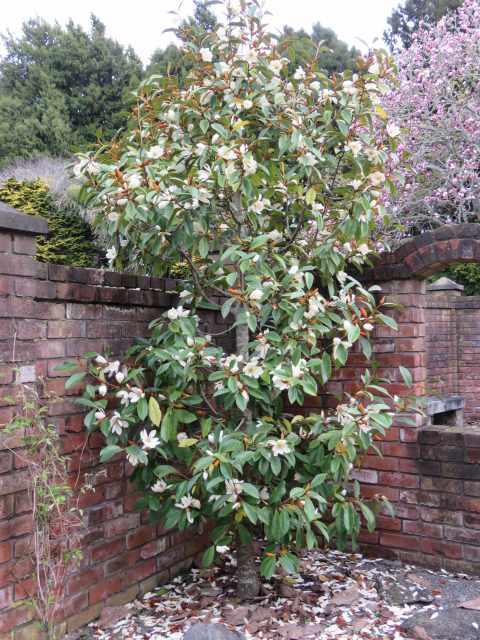
As I scan the roadsides looking for deciduous magnolias opening their early season blooms, it surprises me how often the immediate take from the car window is to wonder what is the white deciduous magnolia flowering now. In fact, on second look, I realise it is the allegedly evergreen M. doltsopa. Often the lowest leaves on the tree are hanging on for grim death while all the exposed branches further up have abandoned the effort. The fresh foliage will start to show over the next few weeks and what is happening is that the tree is opening its flowers and dropping its leaves at the same time. Semi-deciduous rather than fully deciduous in that it drops an almost full set of leaves for a very short space of time.
I watch this doltsopa in Fitzroy each year. I am not sure it is a good advertisment for the species.
I have not put a lot of thought to M. doltsopa over the years, I admit. It is an evergreen species that comes from the eastern Himalayas (low altitude, I assume) and north eastern India. Being a species, in the wild it will spread by seed and those seedlings can be variable. There was an importation of doltsopa to Taranaki, the area where we live, at some stage in the late 1950s, maybe early 60s. We don’t know if they came in as seed or as small plants but Felix received one or two and the magnificent specimen in our park dates back to there. There are a few others of that importation around the province, mostly in private gardens of the day.
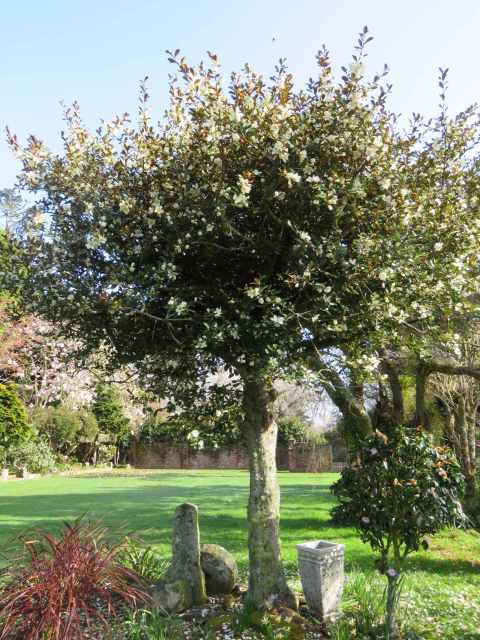
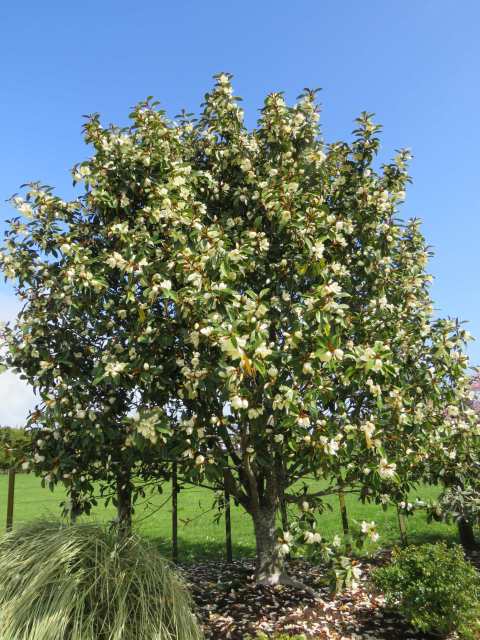
Not for the faint-hearted gardener. All those white blooms are from one plant on a single trunk of Magnolia doltsopa in our park.
Our form of doltsopa, loosely referred to as ‘Rusty’, has very good flowers in size, form, abundance and fragrance.
Of the ones I have seen, I think we got the best form. It is H U G E, so big that we never propagated it to sell because there aren’t many people who have the space of a small town section or more to give to one plant. Cambridge nurseryman, Peter Cave, sold a few under the name of ‘Rusty’ on account of its significant feature of furry indumentum that is not seen on most of the other forms of the same species. ‘Rusty’ never defoliates, has very large flowers and the desired fragrance.
The Rayner form of doltsopa
I photographed a different doltsopa seedling from the same batch imported 60 years ago in a friend’s garden, though this is not the original plant. It is referred to as the Rayner form, on account of the original plant being in the Rayner’s garden of the day in central Taranaki. It is big, it keeps a full set of leaves but the flowers are not as large as our one and it lacks the appealing indumentum.
Our specimen of ‘Silver Cloud’. The flower is a good size but rather too floppy in form. Again this is a lower branch. The higher branches are partially defoliated.
I think most of the defoliated plants I see around are a named clone, ‘Silver Cloud’, selected by the once important nursery, Duncan and Davies, for slightly easier propagation properties and its large flower. I thought it was meant to be smaller growing too but then I photographed this one (below) in the same garden as the Rayner form and I am not sure I would call that smaller growing.
M. doltsopa ‘Silver Cloud’ in Glyn Church’s garden is not exactly smaller growing but at least it is not as badly defoliated as many of the others I have seen.
Back in earlier days, before ‘Silver Cloud’ was widely available, doltsopa seedlings were being sold. By seedlings, I mean plants raised from seed so showing variation whereas every ‘Silver Cloud’ in existence should share the same plant genes as the one original plant because they are propagated by layering or budding, not raised from seed. We know about the next generation of doltsopa seedlings being raised and sold because Hawera nurseryman and friend of Mark’s dad Felix, Roly Barry was collecting seed here from both ‘Rusty’ and ‘Silver Cloud’ which were then planted side by side to increase seed production by cross pollination.
Mark’s Fairy Magnolia White® is half doltsopa – probably the good half.
Mark’s hybrid which is named Fairy Magnolia White® is half doltsopa. When it came to describing it, Mark has always referred to it as ‘a garden-friendly doltsopa type’. I usually try and avoid shameless self-promotion even thought this is my own site, but after surveying all the doltsopas I pass around and about, I will say that I think Mark’s ‘Fairy White’ is a superior garden plant all round. It never defoliates, it prunes well, it flowers prolifically amongst healthy foliage and its flowers are not only well-formed and very pretty, they are also very fragrant. I would plant it ahead of ‘Silver Cloud’ any day.
Fairy Magnolia White® does not defoliate and can be clipped or pruned to keep it a more manageable size.
Written for and first published in the Royal Horticultural Society yearbook of the Rhododendron, Camellia and Magnolia Group 2025.
Over our years of experience with the michelia group of the magnolia family – en masse, so to speak – we have learned that we can treat them as we treat camellias when it comes to clipping and pruning in our climate. I italicise those last words because I hesitate to advise gardeners in more extreme conditions.
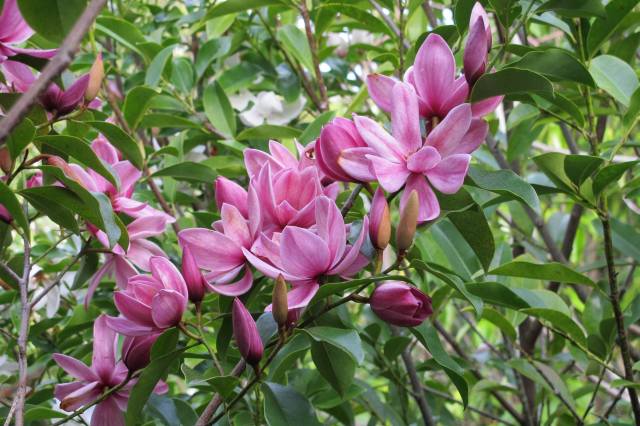
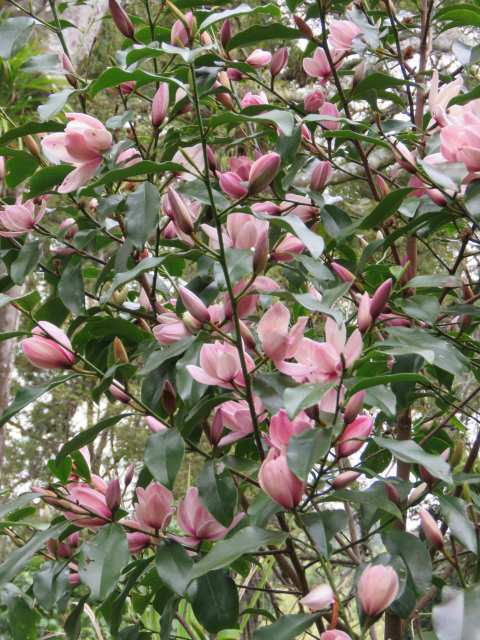
In a world where hardier michelia species are generally white or maybe cream, this is an example of Mark’s breeding programme getting more colour options into the future.
We have a very soft climate. We are never very hot and never very cold, regular rain falls all year round but our sunshine hours are high and we are on friable volcanic soils. If that sounds like gardening paradise, it probably is, as long as you can cope with the wind we get here on the west coast of the North Island of Aotearoa New Zealand.
We also have an abundance of michelias to work with, as a result of my husband, Mark Jury’s breeding programme with the genus down the past 30 years. We have never kept track of the numbers raised here but it will be in the thousands. From those, three have been released under the Fairy Magnolia™ branding; there are two more in the pipeline for release shortly and we are in the process of selecting maybe another three. That leaves many, many seedlings that have been rejected along the way, including entire crosses that he has decided are not worth pursuing. Most get cut out but some we have utilised as screen hedging and shelter belts. There is no shortage of raw material here.
I often claim that we don’t do a lot of heavy clipping and shaping; I have seen Italian gardens and compared to them we are minor players indeed. We do a lot of pruning because our garden is mature and is strong on trees and shrubs which take management down the decades. When it comes to detailed clipping and shaping, it is mostly on camellias and michelias.
Fairy Magnolia® ‘Blush’ soon after planting, circa 2005
And in 2012
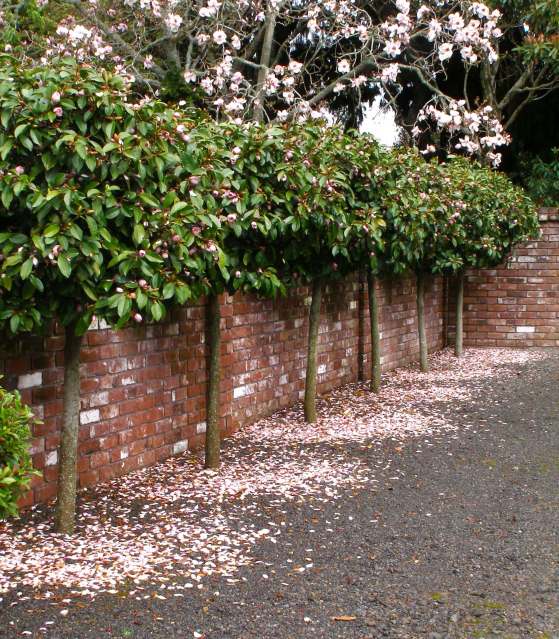
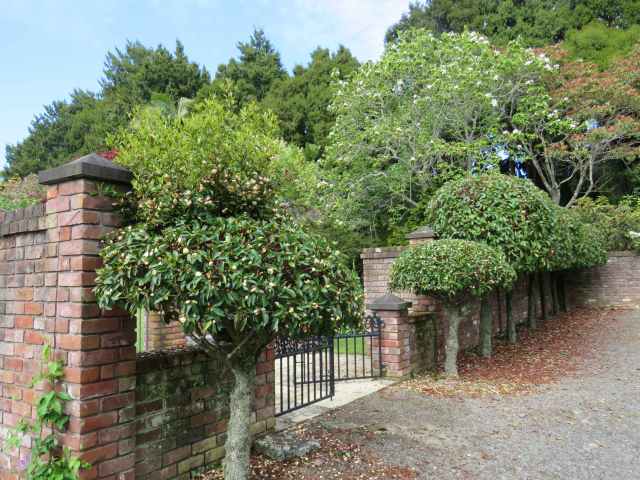
We started with Fairy Magnolia® ‘Blush’, planted twenty years ago in front of our brick wall. These were original stock plants grown in large containers in the nursery so they went into the ground with big root systems. We gave them a season to get established and then started shaping to lollipops. They have grown a little larger over the years but not hugely so. Every spring, as flowering finishes, we clip them hard, removing somewhere between 30% and 50% of their foliage.
Pruning in 2013. We remove more these days to keep them to size.
More or less frozen in time by 2020. The untrimmed section on the plant in the foreground is to allow the blackbird babies in a nest time to fledge and fly. We try to avoid ornithological infanticide – a hazard of early spring pruning.
We clip for future blooms so we only clip once a year, as they finish flowering. By the end of summer, they can be a bit woolly in appearance but if we cut again then, we would be removing many of the flower buds. If you want a sharp form all year round, don’t start with plants you want to flower well, at least not michelias or camellias. We use secateurs to trim. Hedgeclippers may be faster but they cut all the external leaves, the edges of which then go an unsightly brown. There is only a day’s work in clipping this row and cleaning up.
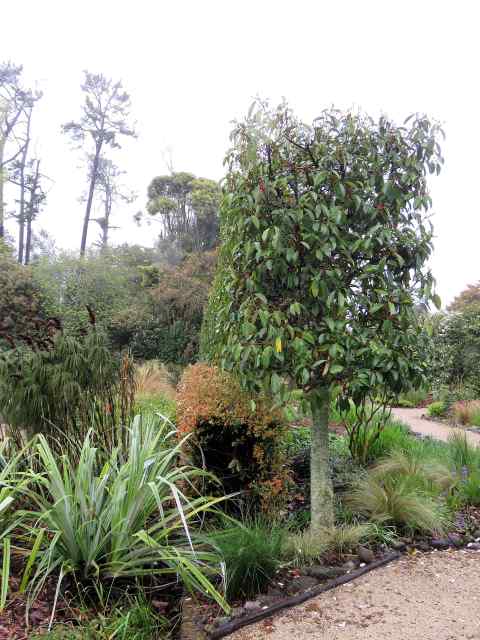
We have two smaller umbrella shapes which will now be well over 20 years old. The variety is to be released internationally this year under the name of Fairy Magnolia® Petite Peach. The photo above shows how much growth we are removing each year to keep the plants to a set size.
Fairy Magnolia® ‘Petite Peach’
If you want to create standardised lollipops, be patient. Let the plants become well established and growing strongly before you start serious shaping. You need a strong central leader to hold up the weighty head. Too often, I have seen plants in garden centres that have been *trained* to standards with a spindly trunk and all side growths removed, so it is entirely dependent on the strong stake holding it upright. You will have a higher success rate if you start with a plant which has a central leader as well as multiple side growths which you can trim but not remove entirely until later. Reduce particularly strong branches which are competing with the central leader but those side growths give the plant more strength and vigour. The leader doesn’t have to be dead straight to start with. What looks like a kink in a stem that is one to two centimetres across will have disappeared by the time it is five to ten centimetres in diameter. Don’t stake unless you have to. Long term, you want the plant to stand straight on its own and plants that are staked from the start come to depend on the stake rather than developing their own strength in the roots and stem. Once the plant has reached the height you want, then you can start serious shaping and when the central leader is strong, you remove all side growths below the top knot.
The side-on view shows the width we are keeping these plants – Fairy Magnolia® ‘White’
They were somewhat large plants on our very small tractor when we moved them from the open ground in 2015
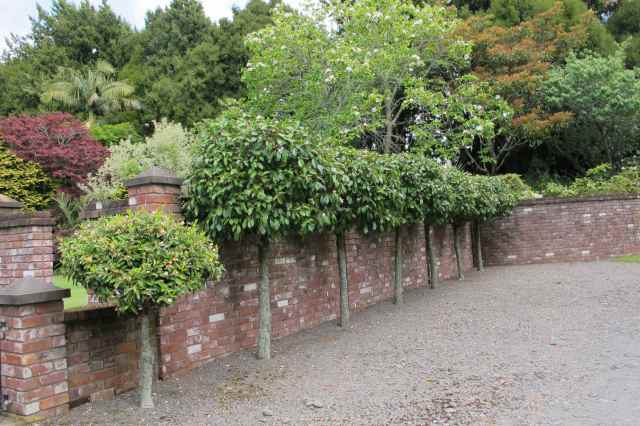
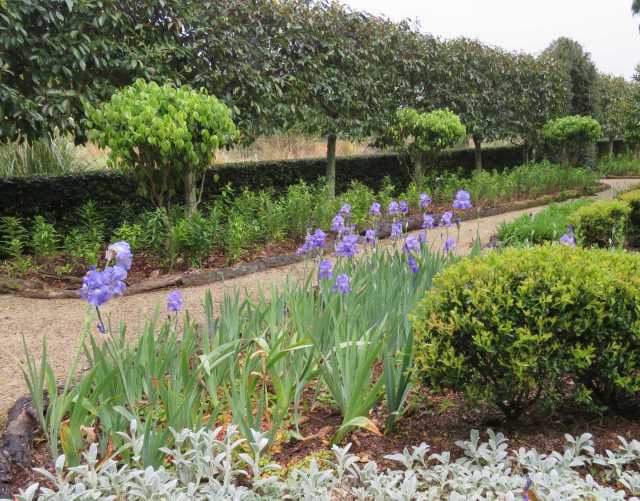
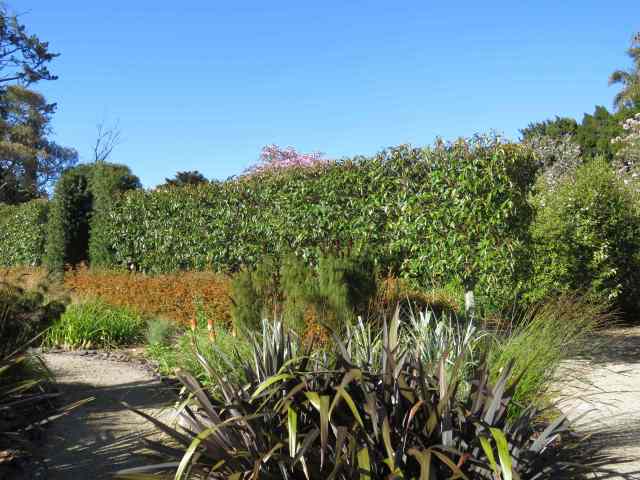
Our pleached rows of Fairy Magnolia® ‘White’ have taken patience. Pleaching is basically a hedge on stilts. These came in as large plants we dug out from the field where they were growing in 2015. They have looked good and flowered well in the intervening decade but it took until last spring’s pruning for me to look at them and sigh with satisfaction. At last we had that two dimensional plane sitting above the camellia hedge below that we had envisioned from the start.
We have two matched lengths either side of a central court garden, trimmed flat down the length
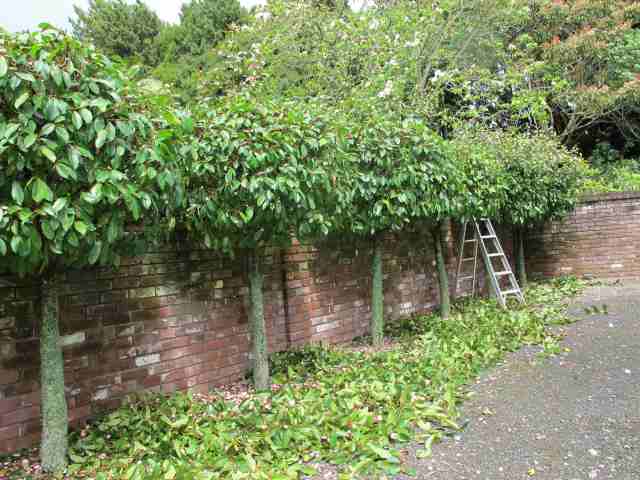
Again we trim hard once a year, as flowering finishes, using secateurs and loppers to remove probably 40% of the foliage to freeze them in size and to create the form we want. They are bigger plants and surrounded by gardens, so trimming them is more challenging and slower than the aforementioned lollipops. Good ladders help. We bought both an orchard ladder and a platform ladder and I see our gardener, Zach, has both of these out when it comes time to trim the pleached rows.
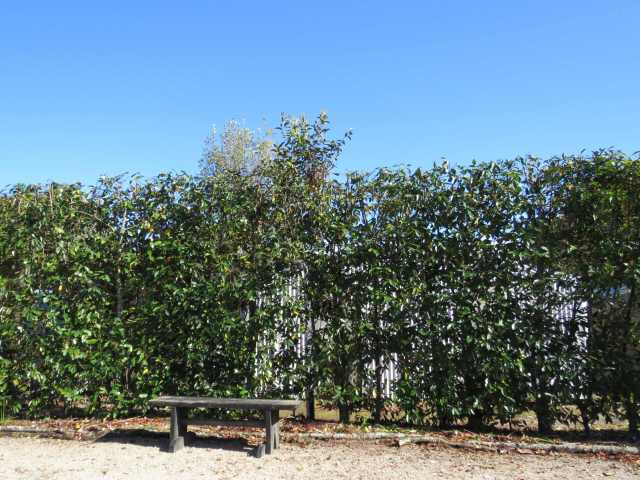
A tall hedge of michelia seedlings straight after trimming in October (above) and nine weeks later below, showing how quickly the new growth fills the gaps. The untrimmed tuft on top in the photo above is because of a bird’s nest. When we trim and prune in spring, we are mindful that it is nesting season and work around any we find.
We also use michelias as tall screening hedges kept to about three metres and these, too, get trimmed after flowering. They can look a little sparse when first done but it is only a matter of six weeks before the flush of new growth fills in the spaces.
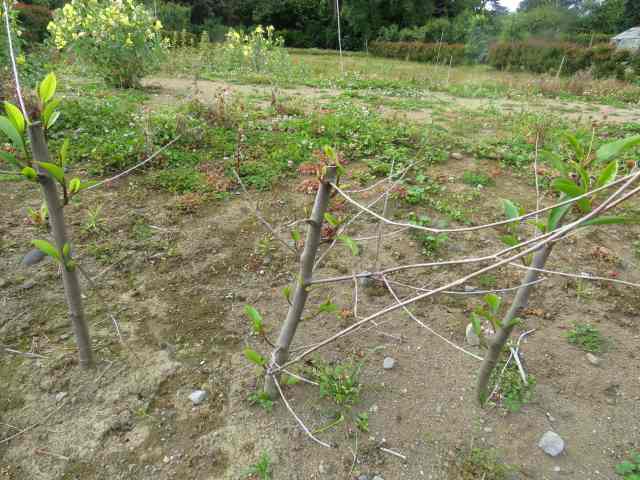
The same hedge as planted in 2017 – seedlings cut hard back to allow them to grow afresh.
About once every five years, these plants need to be picked over more thoroughly, to take out dead wood in the middle where branches have not resprouted. It saves them from getting woody and ugly over the longer term.
Magnolia laevifolia ‘Velvet and Cream’ was cut back hard to bare wood in 2023 but was bushy and flowering again the next season.
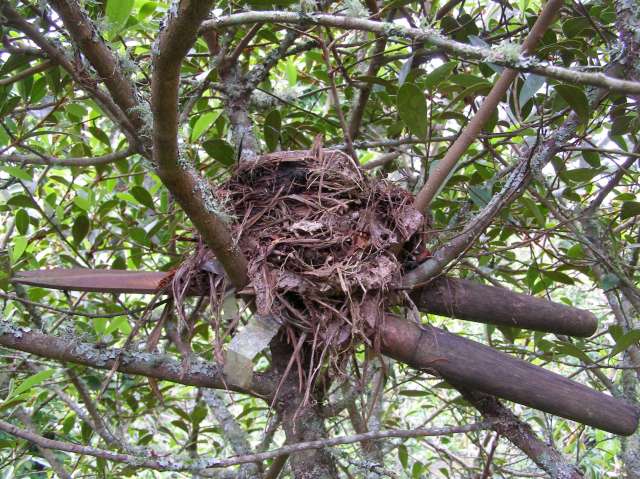
I only include this photo because it still makes me laugh. We used to trim with hedge clippers. When I found these making a handy platform for a bird’s nest in the M. laevifolia. Mark’s comment was, “Oh. So that is where I lost them.”
Well established plants that are growing strongly can be trimmed back to bare wood, as can camellias and rhododendrons. It is a last resort when a plant has got away on us but we have done it successfully, notably on M. laevifolia. The plants may take another year or two to flower again but they will reshoot from bare wood.
Michelias can be pollarded and respond by putting up straight shoots.
Unexpectedly, michelias also have potential as a coppiced crop, or what we refer to as a sustainable wood-lot, much as hazel is used in the UK. We found this out by chance when we were running low on winter feed for our very small number of beef cattle – more a group of cattle than a herd. Mark started trimming michelia branches as stock food (do NOT try this with rhododendrons which will kill animals) and they were perfectly happy eating the foliage. The plants which were cut to the ground, allowing us to use the trunks for firewood, responded by reshooting from the base with very straight stems.
Another of Mark’s oretty seedlings
In our climate, michelias can set prodigious amounts of seed. In fact, setting too much seed is one of our most common reasons for rejecting a cultivar as unsuitable for commercial release. They are not as prolific in harder climates but if you can find one that sets seed, raising the seed is not difficult and the results are reasonably quick, by woody tree and shrub standards. You will get seedling variation; if you want a hedge of identical plants you need to buy or propagate by cutting or grafting to get them all the same. We like the seedling variation which makes for a more interesting, though less formal, flowering hedge. If you are using seed from the same source, the variations are more likely to be subtle, not radically different. It is likely that Magnolia laevifolia will be the most common seed setter in the UK and Europe. It clips well but can be slow to get established. If you can find a hybrid that sets seed, it generally brings a degree of hybrid vigour.
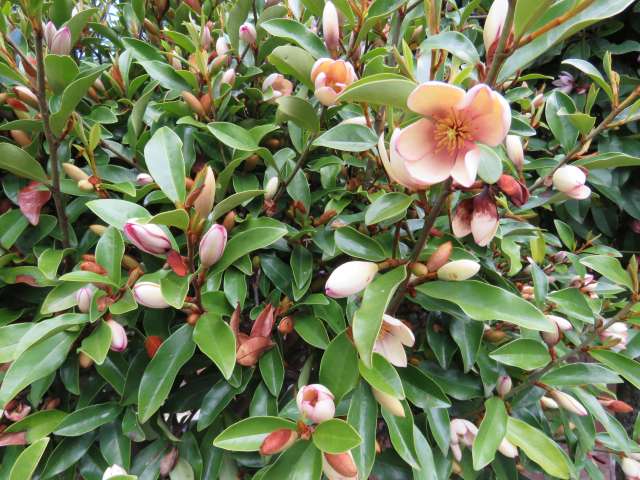
Fairy Magnolia® Cream is strongly scented
With most michelias, there is the added bonus of scent. In our humid climate, camellias are ravaged by camellia petal blight and we no longer get the mass displays on the reticulatas and japonicas. To some extent, the michelia group have filled the gap and they are rewardingly free of pests and diseases.
A note on nomenclature: Michelias have been reclassified as magnolias so all species are now listed as magnolia. The Jury hybrids are sold under the trademarked name of Fairy Magnolia®. For purposes of clarity, we continue to refer to them as michelias in common usage, to differentiate them from both deciduous magnolias and other species of evergreen magnolias, particularly M. grandiflora.
We have a matched pair of Fairy Magnolia® ‘Cream’ at our gateway which we prune to restrict each year. The photo below shows it growing as a roadside plant with no pruning. We can’t allow our gateway plants to get to that size in the space they are in so we are pruning to freeze them in size.
Pleached Fairy Magnolia Whites in a row shaped to a flat plane. We have two such rows.
Behold our pleached rows of Fairy Magnolia White! I am delighted. A goal has been achieved. It has taken 10 years and that was starting with big plants. In retrospect, I admit that it seems quite a long time but such is the way of gardening. It has looked fine and established for maybe 6 or 7 of those intervening years but finally, we have it how it was envisaged.
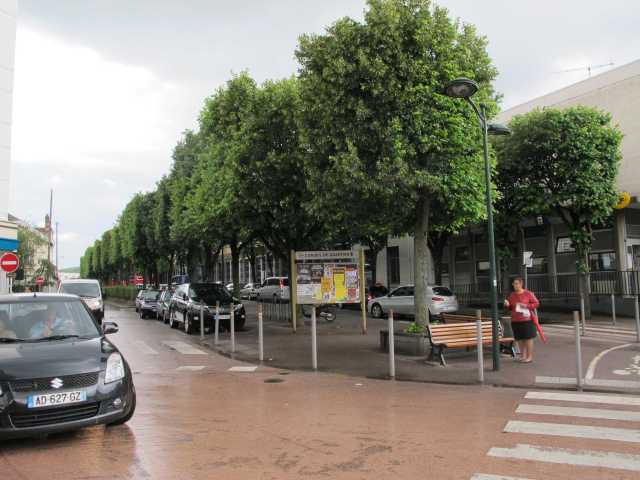
Pleached street trees in Vernon
Pleaching is creating a hedge on stilts where the foliage is knitted together to form a length that is more or less flat on two sides but uninterrupted in its length. I photographed pleached street trees in Vernon, the small French town closest to Giverny back in 2014 but I think it was Mark who drew my attention to them because he already had the plan of pleached rows defining our summer gardens, on which we had started the groundworks back at home.
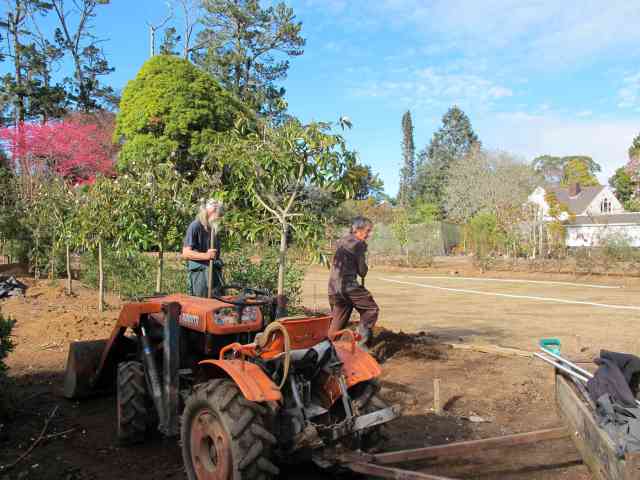
Lloyd on our baby tractor, moving in trees one at a time back in 2014
The start of the summer gardens, when we were all a decade younger. You can see the peg in the ground – they were working to string lines to get the spacings even and straight.
So it was Mark’s vision and his and Lloyd’s hard work that saw large plants going into the new ground in the spring of 2014 and autumn of 2015. We already had the plants growing in a field on our property across the road. They were our original stock plants from when we first released Fairy Magnolia White and they were trained to a strong central leader or trunk. It was no mean feat digging them and getting them across the road and planted but Mark and Lloyd were 10 years younger then. As an aside of useful advice, as soon as they were planted, Mark removed about a third of the foliage, which seemed brutal at the time but was all about reducing the stress on the plants after transplanting.
This is what it looked like a month ago when Fairy Magnolia White was in bloom
In the years since, they have been trimmed once a year – as flowering finishes – to get them to the form we want but it was when our gardener, Zach, joined us that it all started to come together. This must be the third or maybe fourth year that Zach has trimmed them and he has it just right now. As garden tasks go, it is not a massive job – I think it only took him just over two days – and the heaviest part is managing the ladders, which are large. But it is a skilled, precise job. It is all secateur and handsaw work – not hedge clippers.
Squared off to be narrow in width, as viewed from one end of a row
It will look sharper when the hedge of Camellia Fairy Blush beneath also gets its big trim this week and the gap between that hedge and the pleached michelias above is fully defined. I was impatient to record my delight with the clearly defined, more-or-less two dimensional appearance (height and length but little width).
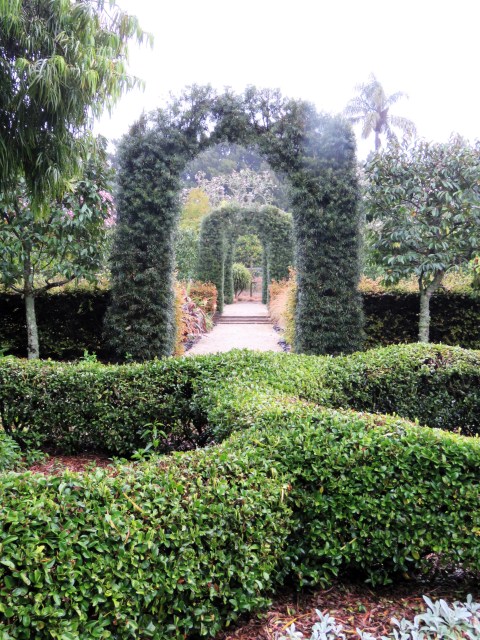
We have three archways of Podocarpus parlatorei. This front one still needs to thicken in the middle but it is getting there.
Credit to Zach, too, for creating the archways of Podocarpus parlatorei in the same garden. Mark had always planned either arches or gables – to echo the gables on the house. Realistically, had it been left to us, I am guessing we would probably have taken the easier route and just trimmed to tight columns but Zach has trained them over to be arches and they have almost filled out to final thickness. They are tied in, in case you are wondering how he did it. The key is getting it tied in when the new growth is soft enough to bend. When it has hardened, it will break. The podocarps are trimmed annually but he has kept the arch tied and trimmed every few months. Again, getting the ladder into place is the most onerous part of this task. Mark, Lloyd and I are all getting a bit old to be carting the largest ladders and working at height. This is just yet another reason why I appreciate younger generations.
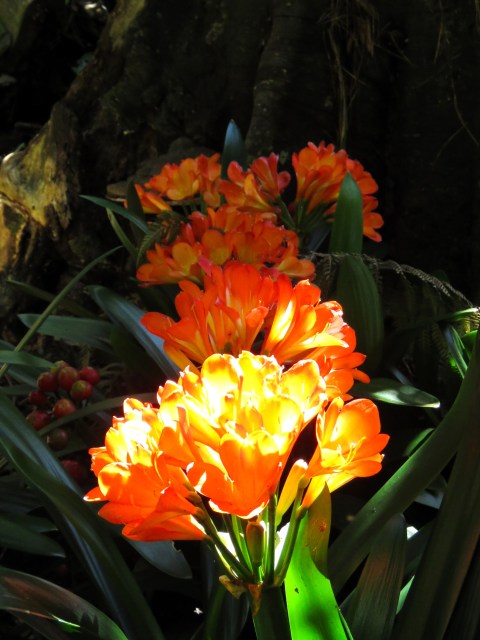
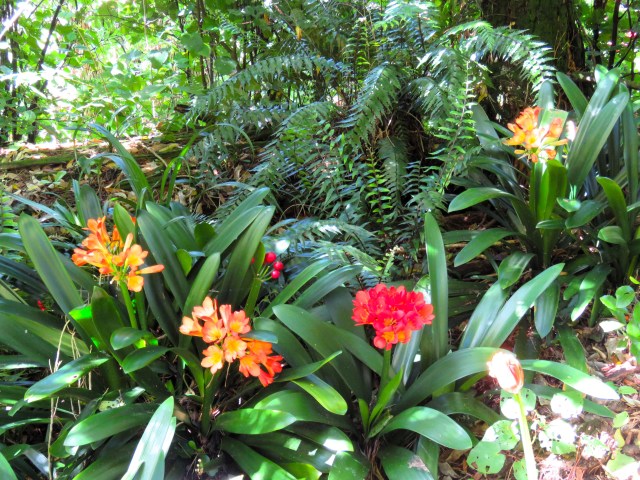
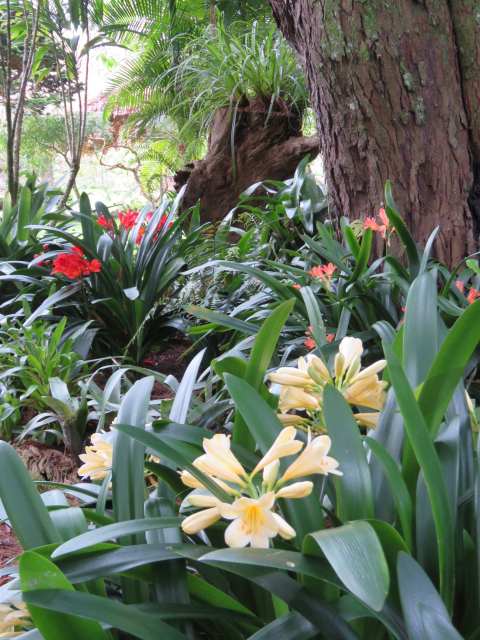
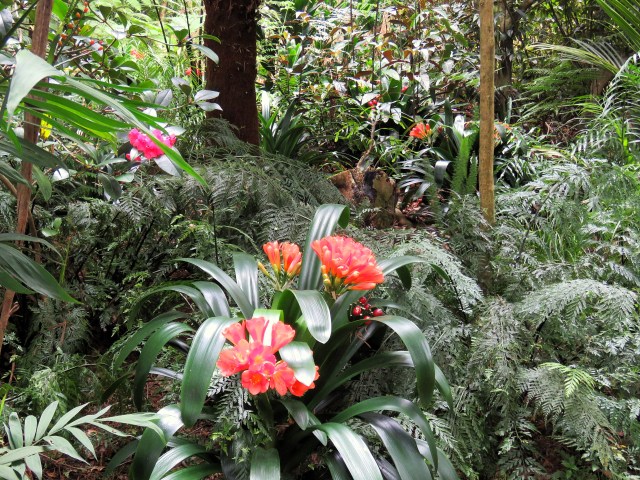
Time, too, has seen our clivia plantings go from strength to strength and they are certainly starring this spring. You can have too many clivias in a garden; the orange and red ones are very strident. I am not a fan of mass plantings of clivia but we have integrated them amongst other plants in shady areas and they glow. Ours are almost all seedlings raised here from controlled crosses. This means that Mark has taken the pollen from ones he thinks are good and used the pollen on other selected specimens, marked the pollinated flowers and gathered the ripened seed to sow in nursery conditions. It is quite a bit of faffing about but increases the likelihood of getting superior seedlings rather than leaving it all to Nature. We now have so many that we just weed out seedlings and thinnings.
Mixed colours and mixed plantings are our style, not blocks of single coloured clivias
The reason why clivias are usually expensive to buy is that they are slow growing. It takes much longer than most common perennials to get them large enough to set flowers and sell in garden centres – years more, in fact.
Gardening really is about the longer game but it is particularly rewarding when you see visions realised and areas that get better as plants mature.
* The heading is a reference that it is likely only New Zealanders will understand. Cheese. Yes cheese. A reference to a long running advertisment for a brand of tasty cheese.
Fairy Magnolia White on the left, ‘Bubbles’ top right and the first flowers to open for the season on Fairy Magnolia Cream bottom right
In the early stages of the magnolia season, our display is dominated by red deciduous magnolias and white michelias. The other colours come later in the season and that is particularly true of the michelias, where we now have significant variations.
Michelias are now classified as a subsection of magnolias and technically are named Magnolia xxxx but we still find it helpful to refer to them as michelias for clarity. They are, of course, evergreen but not with the big leathery leaves of the American Magnolia grandiflora types.
Magnolia x foggii ‘Bubbles’
It was finding M. ‘Bubbles’ in bloom with flowers at a height I could pick that started me lining them up. Back in their day, ‘Bubbles’ and its sister seedling ‘Mixed Up Miss’ were breakthroughs in the world of michelias. There is a third named one in that set but I have only ever seen ‘Hint of Pink’ in Auckland Regional Botanic Gardens. They were the work of the very late Os Blumhardt – a notable plant breeder who lived in Whangarei and is probably best known internationally for his successful deciduous Magnolia ‘Starwars’.
He didn’t raise many michelia seedlings, as far as we know just the one batch. I see we first started selling ‘Bubbles’ and ‘Mixed Up Miss’ around 1992 and we would have been onto them pretty early because Os was a personal friend and very generous with his plant material. He probably did the cross in the late 1970s, maybe early 1980s and he provided the inspiration to Mark to see what he could do with this plant family.
‘Mixed Up Miss’ at Auckland Botanic Gardens. The flowers are small and so high up on our tree that I can’t photograph it
In their day, they were terrific. ‘Bubbles’ was harder to propagate from cutting and had larger flowers and foliage. ‘Mixed Up Miss’ was the perfect nursery plant – easy to propagate, set flower buds on a young plant and looked extremely attractive and neat standing about a metre high in its pot. It has smaller flowers with slightly more colour but there isn’t a lot in it.
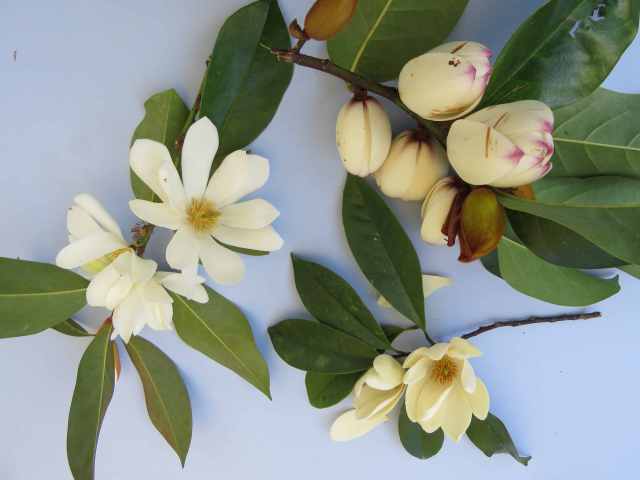
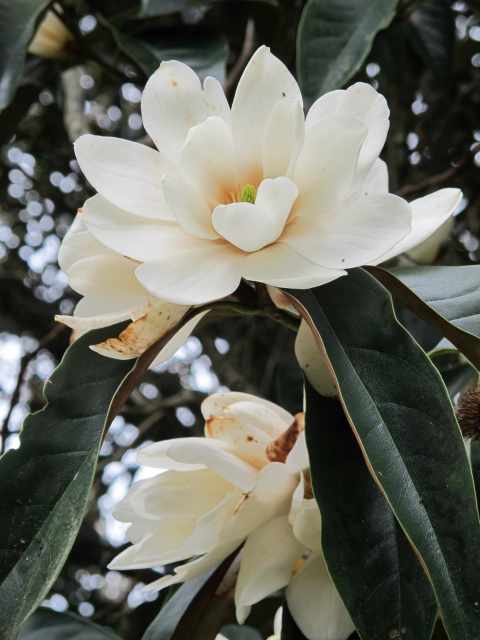
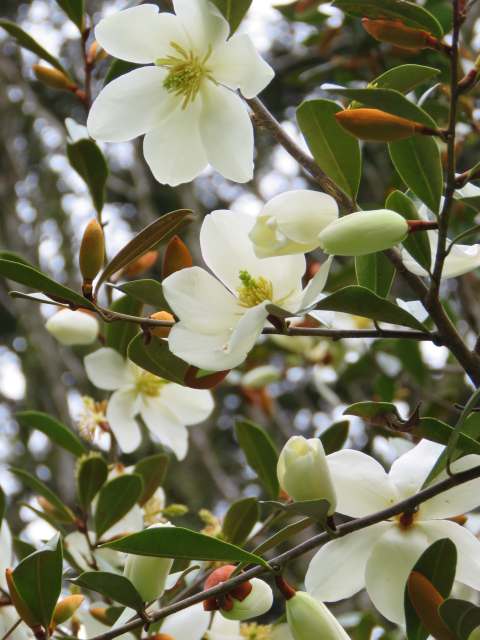
M. doltsopa flower
Os was doing this work before M. laevifolia (formerly known as M. yunnanensis but more widely marketed under a plethora of names including ‘Honey and Cream’) was even in the country. He used two of the common species that were here – M. doltsopa and M. figo. In the world of magnolias, this particular cross is referred to as x foggii (after American breeder John Fogg who is credited with the first hybrids from this cross in 1972).
All that white in the centre is our Magnolia (michelia) doltsopa. Yes, it is somewhat large
M. doltsopa is a variable species. I only have photographs of our specimen which is spectacular and takes up an area of space roughly equivalent to a small, urban apartment block. They are not all as huge as that but they do have large flowers.
Magnolia (michelia) figo.
M. figo will be better known to many readers. It is smaller growing and sold widely, particularly favoured in warmer areas. Its flowers are verging on insignificant to the point where I have never bothered photographing them so I had to grab an image from Wiki Commons. It is a handy, evergreen plant that you can keep compact by pruning often, although its foliage turns rather yellow in full sun. It is mostly grown for its strong fragrance which has always reminded me of Bubblegum chewing gum so loathed by my mother. It only gets fragrant in the late afternoons and evenings, though.
‘Bubbles’ in the centre after 35 years or so. It is in full flower but not exactly a showstopper
For comparison, Fairy Magnolia White in flower with Camellia yuhsienensis in front. The larger, more open flowers are much more distinctive
These new hybrids of Os’s were a breakthrough in terms of more user-friendly garden plants. Alas, some plants get significantly more spectacular with age but others don’t. And on a property with literally hundreds of white michelias from Mark’s breeding programme, you would not look twice at our specimens of ‘Mixed Up Miss’ and ‘Bubbles’. Picking flowers of ‘Mixed Up Miss’ defeated me because I would have to carry a ladder to the farthest reaches of our park where it is now very tall and leggy. You could keep them more compact and bushy by frequent pruning if you are in a smaller garden but the following generations of hybrids are a significant improvement.
Magnolia laevifolia (formerly Michelia yunnanensis) ‘Velvet and Cream’
Mark has used both ‘Bubbles’ and, more often, ‘Mixed Up Miss’ extensively in his breeding but he also had the huge advantage of being able to add in M. laevifolia. While he has tried a few of the other species michelias we have in this country, it is line breeding with those early x foggii hybrids (so doltsopa and figo) with laevifolia that has given the huge range in flower colour and growth habit that he has reached in his later generations of michelia hybrids. The first three releases are all under the brand of Fairy Magnolia (White, Cream and Blush) and are now widely available here and overseas.
Mark’s Fairy Magnolia Cream on the top left with Fairy Magnolia White below and a random selection of seedlings which are also coming into flower. There is a whole lot more to selecting a plant for release than just a pretty flower but even that is difficult when looking at 80 or 100 plants of the same cross, all of which are white.
None of the later selections are on the market yet although there are three coloured ones being built up for release and there will likely be another three to follow at some stage when we have made the final selections. It is not a quick process so don’t hold your breath.
Yes, we have colours coming through. Not all michelias are white or cream.
Fairy Magnolia Cream and Fairy Magnolia White. Blush has yet to open its pale pink flowers.
Following on from my post last week on the rainbow colours of midwinter, I did indeed buy a packet of marshmallows. To focus my thoughts on the pretty pale pinks and whites, you understand.
Flowers listed in the footnote below
A bleak day on Thursday had me out picking flowers in marshmallow hues. I was going to aim for a comprehensive representation of all candidates but decided part way through that this was unnecessary. Suffice to say, there was plenty to choose from and that right on mid-winter.
The centrepiece, I decided should be three of Mark’s cultivars. Fairy Magnolia White is well into bloom and a delight to us. We are proud of this one. Daphne Perfume Princess is in its full glory and the scent as we walk along our driveway is a pleasure. Camellia Fairy Blush never fails to please us, even after many years. It was one of the earliest plants Mark selected, named and released, if not the very first.
Fairy Magnolia White
Daphne Perfume Princess
Camellia Fairy Blush
I separated the named camellias from the seedlings. We use many unnamed seedlings in the garden because we raise most of our own plant material here and always have done. It is how we can afford to garden on the scale we do.
The named ones from left to right are C. gauchowensis, C. transnokoensis, Fairy Blush, Silver Dollar, Tiny Star, C. yuhsienensis Sweet Jane, Superstar and Showgirl.
The bloom shown face down is from Silver Dollar – one of the best, compact white sasanquas we know. Sometimes, both Mark and I get assailed by memories of our years retailing plants from here. Anybody who knows camellias will also know that many of the excellent white camellias open from a pink bud. Back in the days when ‘ladies who lunch’ (better known these days as ‘Karens’) were all madly planting their clichéd white gardens, I met more than I care to remember who wanted white camellias. Pretty much any white camellia would do but woe betide a pink bud. In vain would I assure them that the display was totally white, there was not to be a hint of pink in their pristine white garden.
We do not miss retail. In hindsight, I am somewhat surprised at the courtesy and politeness we maintained in the face of severe provocation.
Magnolia campbellii
Thinking marshmallow hues, I photographed the Magnolia campbellii by St John the Baptist Anglican Church in Waitara. Is there anything more pink and white than this sight? Our plant here has yet to open its first bloom for the season.
That starter pack of marshmallows is going rather a long way. Mark and I are still eating our way through them a week later, even though they are sitting in glass jar on the bench tempting us each time we pass. I can report that marshmallows last longer than chocolate in this house.
Footnote: The plant list in paler pinks and whites shown above includes the following: luculia pink and white, Primula obconica, polyanthus, gordonia, Crassula ovata, daphnes, montanoa, ox-eye daisy, Cyclamen hederafolium, galanthus (snowdrop), leucojum (snowflake), rose, nicotiana, vireya rhododendrons, azaleas, hellebores, begonia, Japanese anemone, michelia and camellias.













 Following on from my post last week on the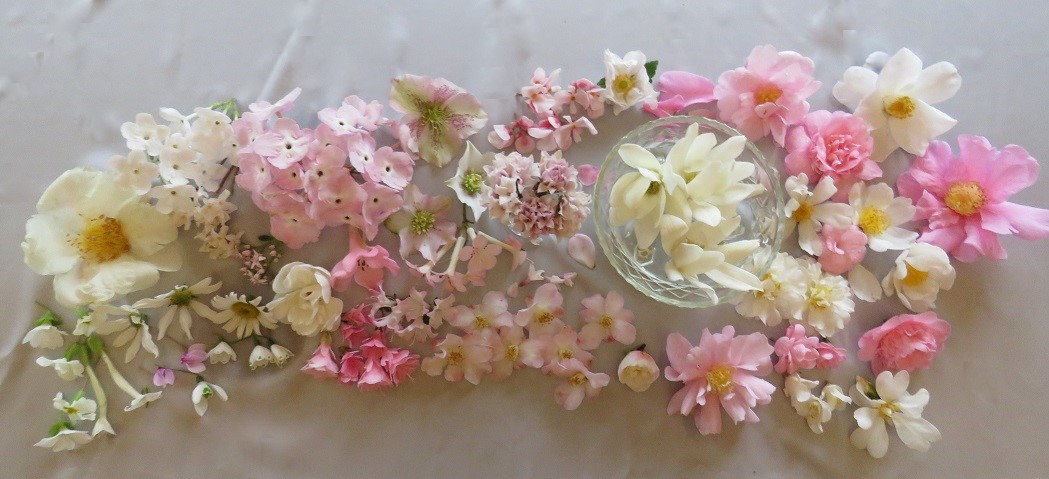
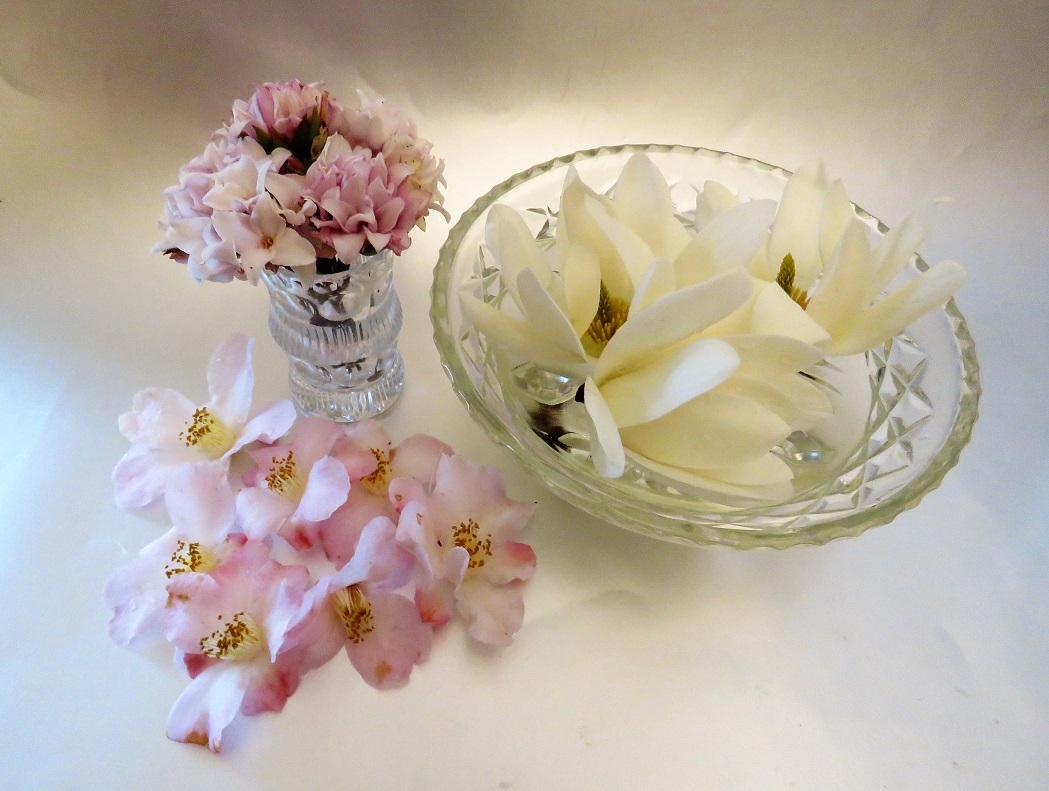 The centrepiece, I decided should be three of Mark’s cultivars. Fairy Magnolia White is well into bloom and a delight to us. We are proud of this one. Daphne Perfume Princess is in its full glory and the scent as we walk along our driveway is a pleasure. Camellia Fairy Blush never fails to please us, even after many years. It was one of the earliest plants Mark selected, named and released, if not the very first.


 The named ones from left to right are C. gauchowensis, C. transnokoensis, Fairy Blush, Silver Dollar, Tiny Star, C. yuhsienensis Sweet Jane, Superstar and Showgirl.


