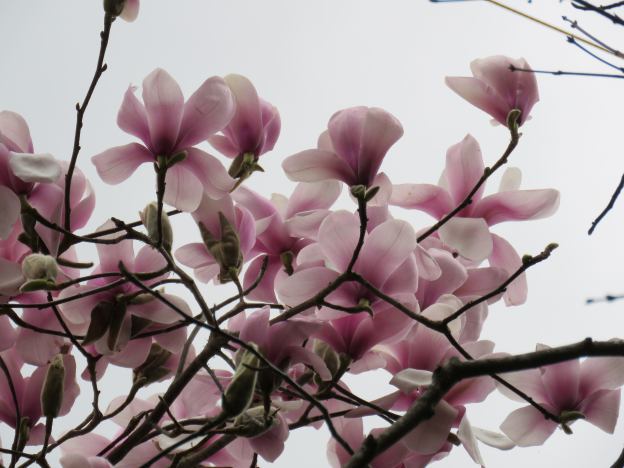
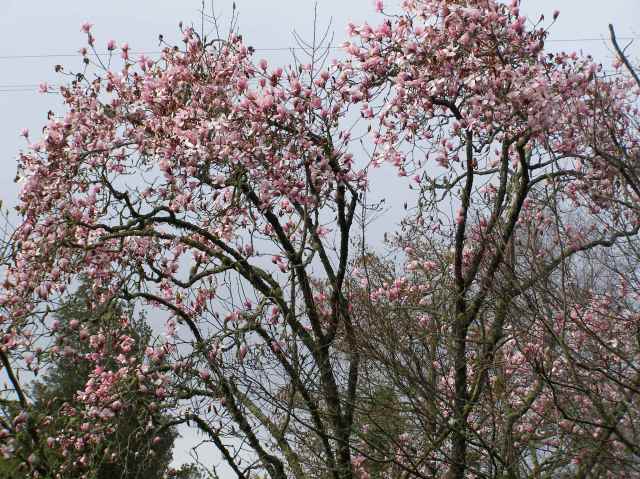
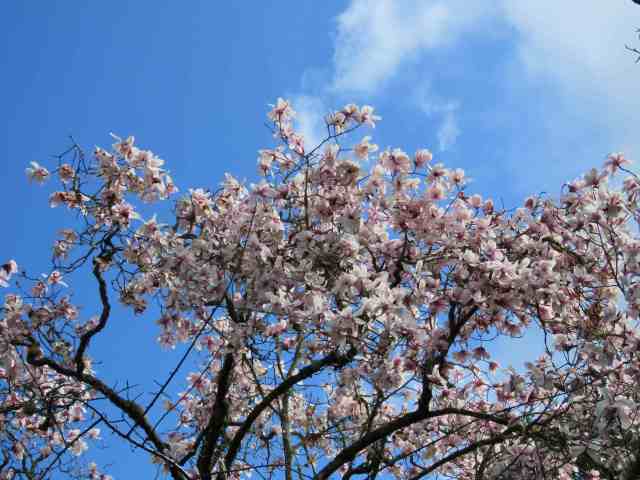
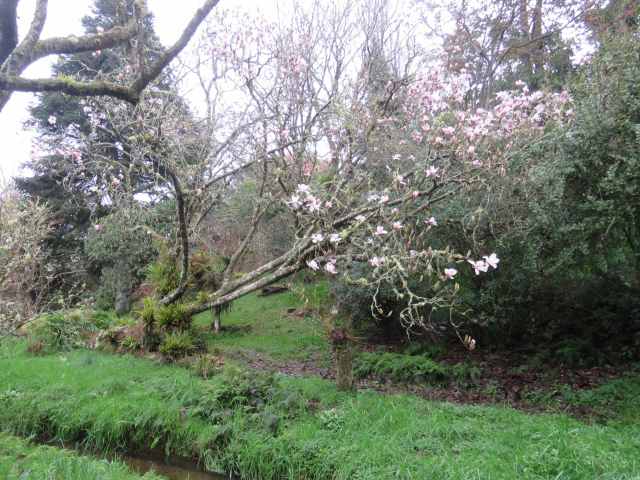
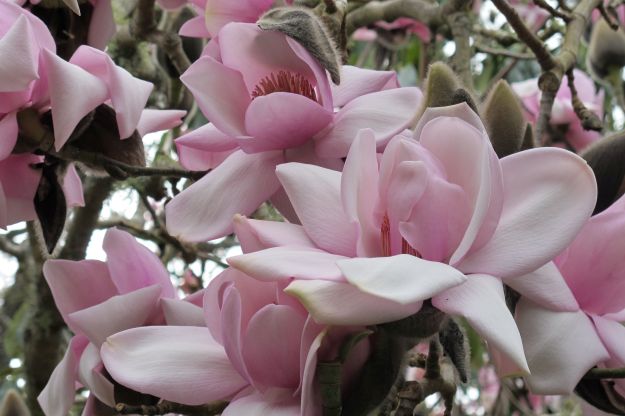
When the Magnolia sargentiana var. robusta fell over in July 2023, we were a bit sad. Not distressed or devastated, you understand, but disappointed. It is always sad to see a big tree fall, especially when their demise is unexpected. At its best, M.sargentiana var, robusta was as pretty a sight as you could wish for in a magnolia.
Sargentiana var robusta in a good flowering year, before it fell.
The colour can vary from appearing pink all over to white flushed pink.
I say at its best because our tree was a bit biennial. It only wanted to flower in profusion every second year with a rather weak attempt in its off years. Its flowers are also anything but robust being very light in texture – sometimes likened to paper tissue. The are good reasons why both Felix and Mark bred magnolias with heavy textured petals; in our climate with rain that is often torrential in spring and strong equinoctial winds, light textured blooms do not fare well. A single storm can take out the whole display.
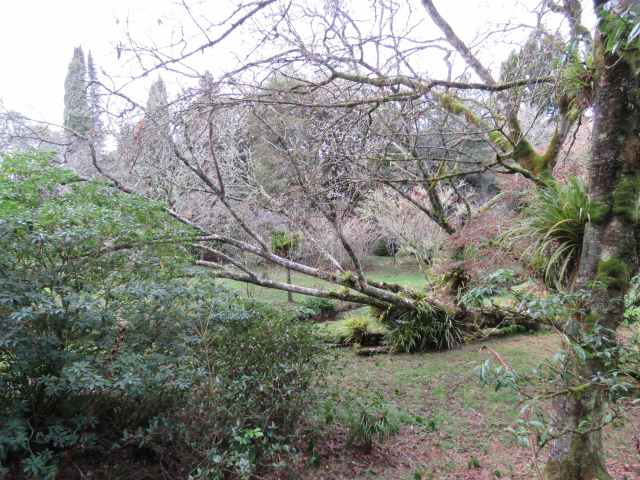
The sad sight in July 2023
We left it untouched and it flowered again a year later in 20024
This tree was imported by Mark’s dad, Felix, sourced from the famous Hilliers Nursery in the UK, back when plants were easily moved around the world, with few, if any, restrictions. It was in the 1950s when Felix was first planting up the park so this specimen would be around 70 to 75 years old. It will have had wet feet, as we say about plants in sodden ground, because it was planted down by our stream.
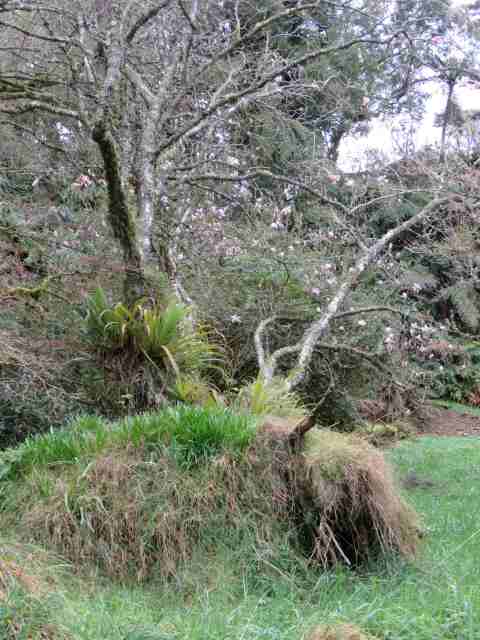
So, fall it did in 2023. It is a big tree but fell alongside the path and stream without impeding access, the root ball half in and half out of the ground. We made the decision to leave it and see what happened. I looked at it this week. There was one chunky branch low down that was coming out at right angles from the main trunk. When it fell, that branch then found itself upright. It clearly preferred this position of dominance because it has grown quite a bit and is forming a tidy new canopy.
The lump in the foreground is the root ball – disturbed but still anchored. The vertical trunk to the left is the branch that we will now save, cutting off the main lengths to the right.
That is the new upright on the right of the photo. But really, I took this to also show the prodigious quantity of astelia epiphytes that establish on our older trees – signalling a climate that is both mild and with adequate rainfall all year round. The seed is spread by birds.
We are now at a point where we think it will be fine to cut the rest off and just leave the upright section which is close to the roots. We won’t be doing anything about the big, chunky mound of roots. They can just stay – a bit of natural contour.
It is pleasing to realise we can keep the tree. M. sargentiana var. robusta is not the sort of magnolia most people would decide they simply must have. Nor is it suited to small gardens. But it belongs in magnolia collections and the tree is part of our own garden history.
Magnolia ‘Mark Jury’, believed to be a chance seedling with M. sargentiana robusta
Besides that, the species itself – though not this particular tree in our park – is thought to be one of the parents of the beautiful tree Felix received from Hilliers that was meant to be ‘Lanarth’ but wasn’t and he named after his youngest son, so Magnolia ‘Mark Jury’. That tree, also still in our park, turned out to be Felix’s special plant – his secret weapon, Mark says – which he used in the parentage of six of the eight magnolias of his that were released commercially. In turn, some of Mark’s hybrids also descend from those. The rest, as they say, is history.
Autumn can be a magical season here. It is not guaranteed but, more often than not, we get warm, sunny, calm days with cool night temperatures. And dry. Ours is not a climate noted for extended dry periods but when it does happen, it is in autumn. These are perfect conditions for the autumn bulbs.
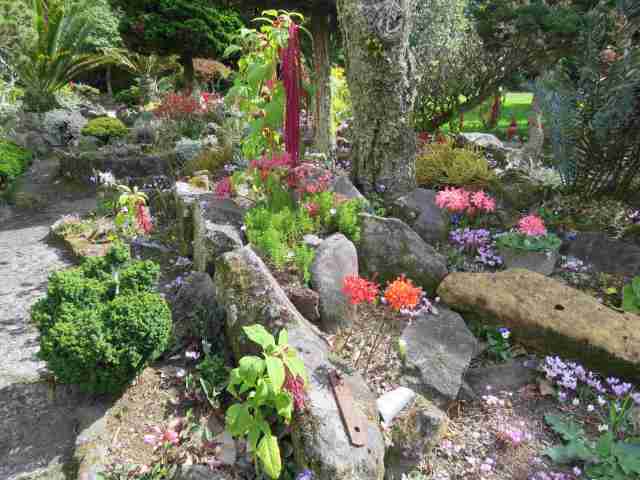
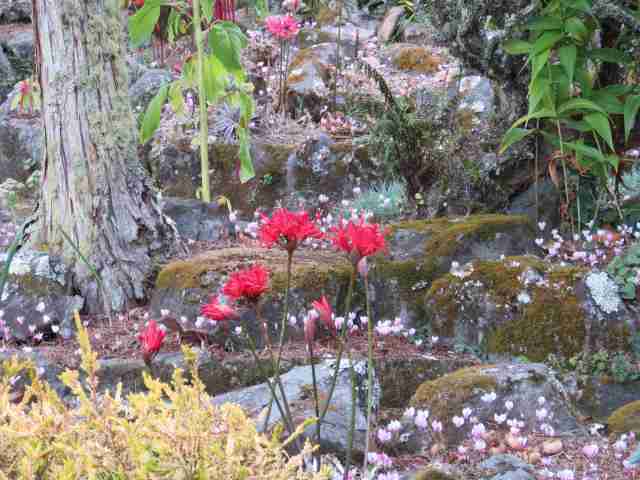
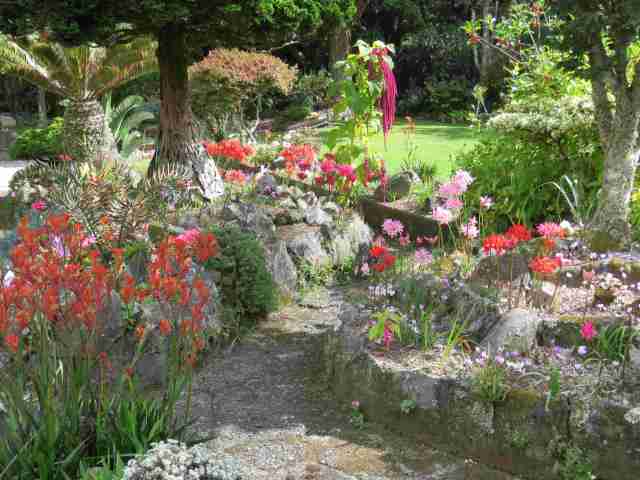
We say of our reasonably expansive 1950s rockery that it peaks in two seasons – autumn and again in early spring. We are entering the autumn peak but it is perhaps more in quantity than range of different bulbs.
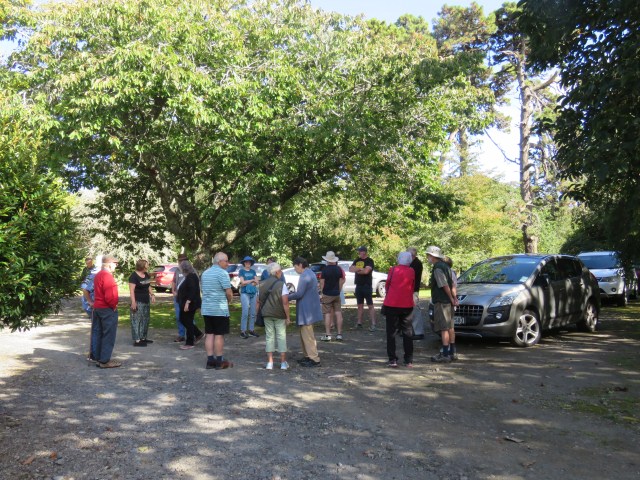
We don’t accept many groups these days, but the Pukeiti members’ visit came from a special request, even though their visit was a few weeks too early to catch what we would describe as the autumn season.
We had the Pukeiti members visit three weeks’ ago and, as I commented to them, when it comes to bulbs, what they are looking at here is over 70 years of building up the volume. Mark, like his father Felix before him, started with just the bare minimum – one if it was an expensive bulb, maybe 3 or 4 if it was cheap enough and available to buy. Otherwise it would just be gifts of interesting bulbs from other gardeners. Over the years, we have lost a fair number of bulb varieties that did not like our conditions, but those that survived and increased have often thrived.
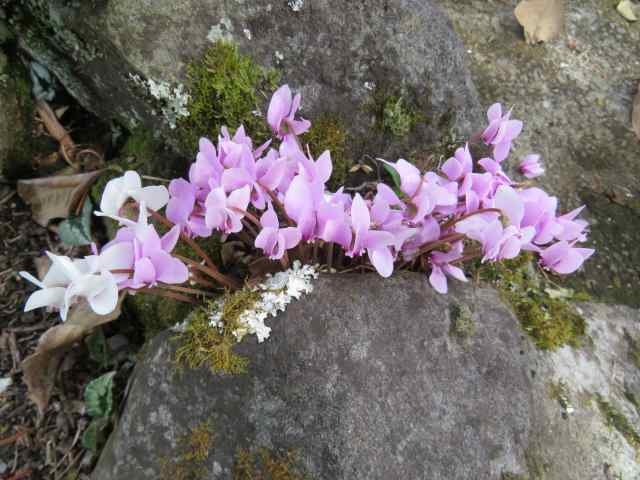
Cyclamen hederifolium, happily naturalised and seeding around but in a non-threatening way
The rockery is a carpet of Cyclamen hederifolium, in shades of pink and white. Sometimes referred to as the ivy-leaf cyclamen, it is native to the Mediterranean area and one of the most amenable and easy to grow species. These days, we mostly let them seed down in situ and from time to time, I will lift clumps of tubers when they get too congested. We have also had success naturalising them on bulb hillsides in meadow conditions but we need to get the summer cut on the grass done at the right time so we can see the flowers. Somewhat to Mark’s surprise, just scattering seed proved as effective as planting tubers but it does take a few years for them to get enough size to be visible.
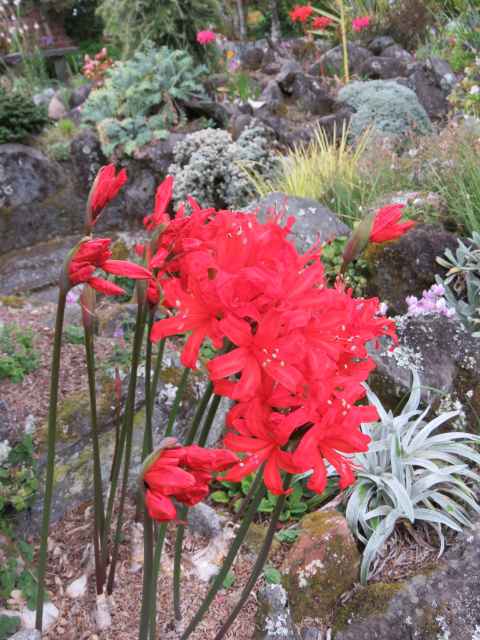
The nerines have just their peak. We do a good line on nerines – well, a rockery filled with them really and we have managed to keep the colours separate. Most are hybrids based on Nerine sarniensis, Felix started with a few good ones, although we don’t know how he came by the Inchmery nerines from Exbury. From there, he and then Mark started trying out controlled crosses to build the range we have today. They are the absolute stars in the autumn rockery, underpinned by the carpet of cyclamen.
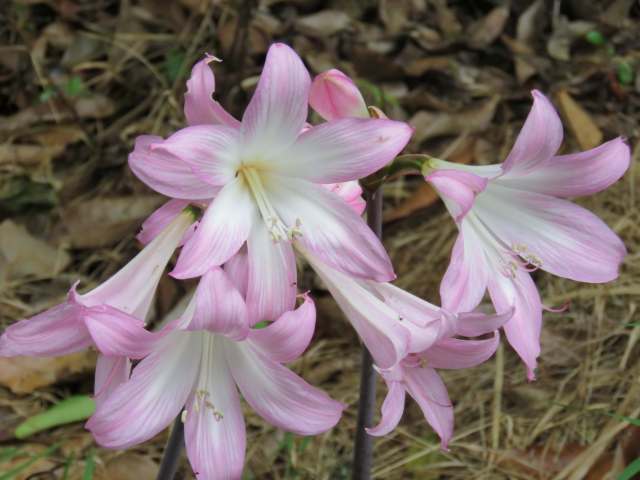
Belladonnas are somewhat under-rated as an autumn bulb – too vigorous in growth habit and too much foliage for the rest of the year, but they certainly put on a great show in bloom with absolutely no care or attention.
Most of the big bulbs of summer have finished, but I will eat my past words on the short flowering season of belladonnas. I have never tracked them before but seven weeks in full bloom and still going is not a short season at all, by bulb standards. We just take them for granted, really, and fail to recognise what a hard working family they are.
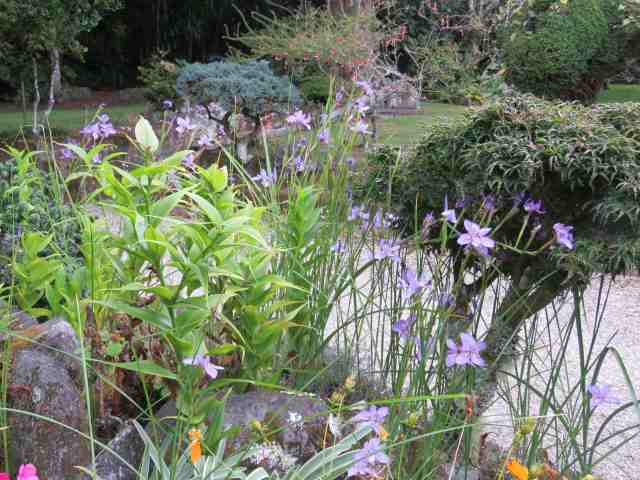
Moraea poystachya in blue, choosing where it prefers to live. It particularly likes cracks in concrete.
The moraea family is a large one of many different species, the most common being M. villosa and M. aristata – the spring flowering peacock iris. Some are invasive and some are not worth having, but in autumn each year, Moraea polystachya delights us with its blue iris flowers. It sets plenty of flowers down the stem, unlike many bulbs that set just one bloom per stem. It seeds down but not badly enough for us to decide it is invasive and dangerous. It is just gently spreading and generally delights us,
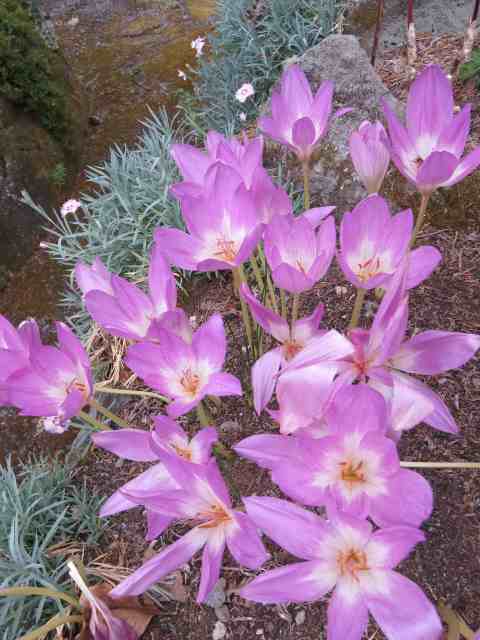
Having different species of colchicum means the flowering season is extended by several weeks.
Beyond that, the second species of colchicums are in full bloom now (either C. autumnale or C speciosum – one flowers earlier and one flowers now and one day, I will find out which blooms first). So too are the true autumn crocus in bloom. There are a fair swag of different species of autumn crocus (NOT including colchicums and sternbergia which are often inaccurately referred to as autumn crocus even though they have no connection to crocus at all). The one we have most success with is blue, almost certainly from the C. serotinus group, maybe salzmanii.
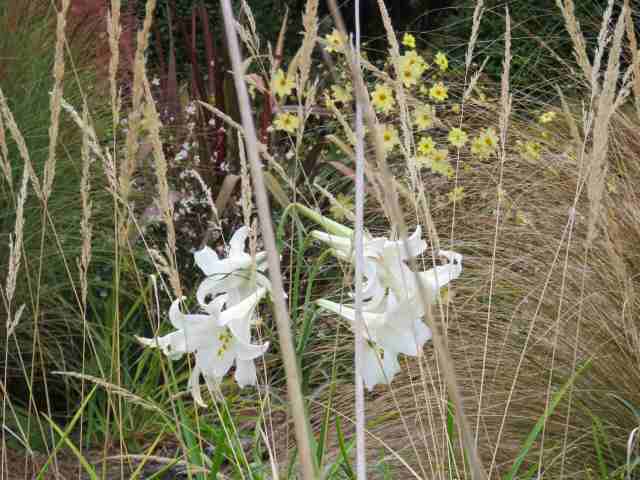
The controversial pure while Lilium formasanum close out the lily season in March. They are controversial because of their seeding ways and indeed are banned from commercial sale but not prohibited in the garden. They do need deadheading, though.
Other bulbs during March that came and went included Haemanthus coccineus, Brunsvigia josephinae and the controversial Lilium formasanum (syn. weedy, also banned from sale).
Sometimes this run of settled autumn weather can last until the shortest day. After a particularly indifferent summer, we have our fingers crossed.
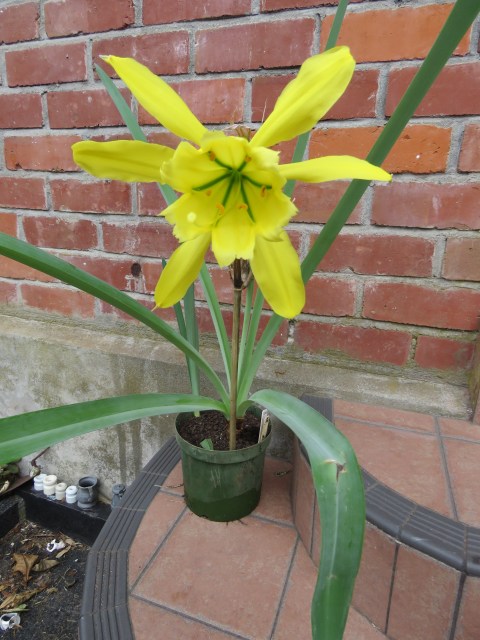
A paramongaia, no less, which does not seem to have a helpful common name
Well lookee here! Zach appeared brandishing this pot from one of our covered houses in amazement. I was equally astonished that Mark could dredge the species name from somewhere in the deep recesses of his memory, loosely connected to his remembering seeing its relative the pamianthe in flower at Jack Goodwin’s and that must have been at least 35 years ago.
This is in fact Paramongaia weberbaueri, native to Peru and Bolivia where it grows in harsh, dry, stony conditions. It looks a bit like a totally over the top daffodil on steroids. That flower is 20cm across and the trumpet is 10cm long. I measured. It must be night-scented because it was very strongly scented first thing this morning but only pleasantly scented later in the day.
Patience rewarded – the first flowering on our paramongaia
It goes so far back here that even Mark, with his elephantine memory when it comes to the source of plants, can’t recall who gave it to him but we have not seen it in flower before. It has been repotted occasionally down the years and we seem to have about 10 plants of it when he will have started with only one. That is enough for me to plant out half of them in the rockery to see it they like our conditions.
We have succeeded with its compatriot bulb, the Worsleya procera as a garden plant; the challenge now is to see if we can succeed with the paramongaia in the garden. This may take time. Ask me in ten or twelve years if we have them flowering in the rockery.
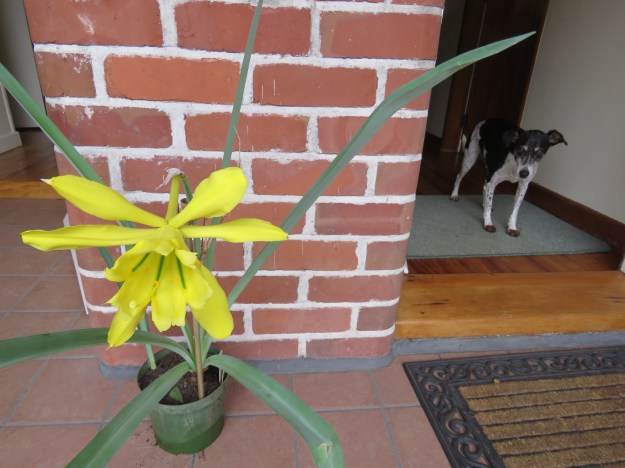
Even elderly Dudley may have been surprised by its appearance on the doorstep.
It is an instant garden approach and sometimes that quick result approach is the very best way to reward effort and encourage further learning.
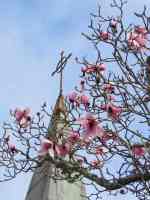
The magnolia in winter
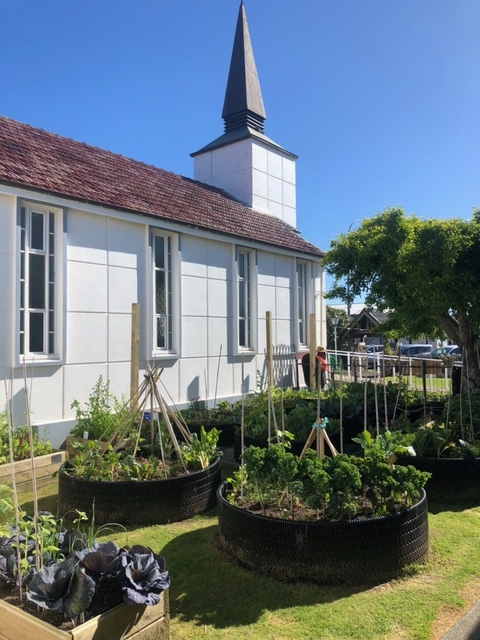
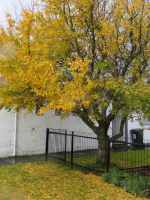
I have various photos of the modest little Anglican Church of St John the Baptist in my local town of Waitara. Until now, all have involved either the splendid Magnolia campbellii which brings me great delight every winter or the golden delight of their Ginkgo biloba. But look! Now they are supporting a community garden and the Waitara Foodbank, Pataka Kai. For overseas readers, kai is the Māori word for food while pataka is a place of food storage or pantry.
The ginkgo in autumn
Just as with Pataka Kai’s free cooking classes, there is a strong element of learning and sharing in their community garden project. This is not just about crisis intervention for those who cannot afford food; it is equally about building community and sharing skills to equip people with confidence and knowledge, now and into the future.
I have no affiliation to any church but their act of making land available for a community garden is Christian outreach at the most local, grassroots level and that is to be lauded. The Magnolia campbellii remains untouched and is on the other side of the church. Where the garden is now, used to just be tidy, mown grass that contributed nothing obvious to the wellbeing of the congregation, the wider community or the environment.
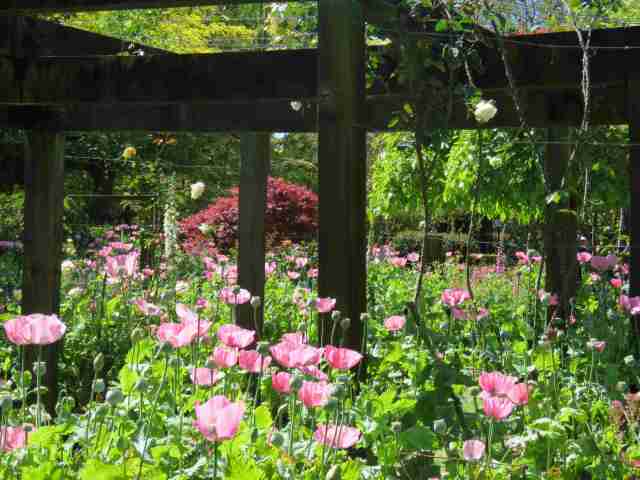
The transient delight of a bed of poppies amongst the roses at Waiongana Gardens
The annual Taranaki garden festival is now well behind us but we did get out to a few gardens. The bed of self-sown pink poppies in Waiongana Gardens was a particular delight in its charming simplicity, even knowing that it will have been an ephemeral affair.
Waiongana’s distinctive log walls
Their log walls are pretty unique and likely to stay that way when you consider the logistics of creating them, needing the raw material, the equipment to cut the logs and then the machinery to move them into place. Who needs insect hotels when you can edge your large property with au naturelle log walls providing habitats and acting as an attractive boundary?
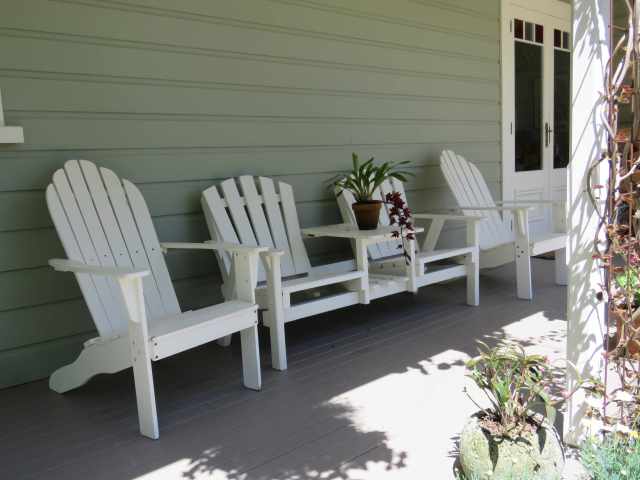
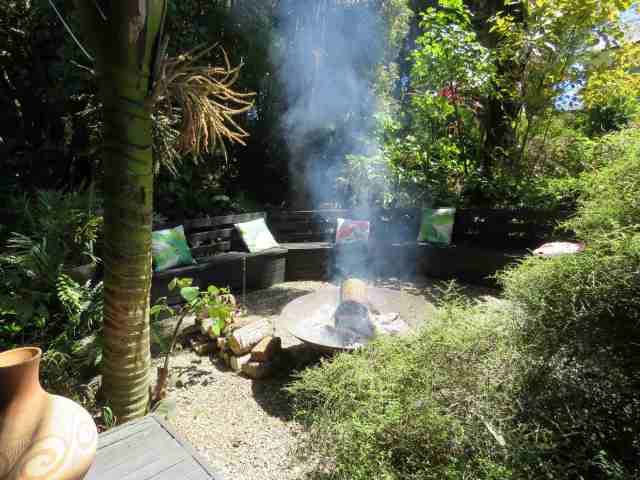
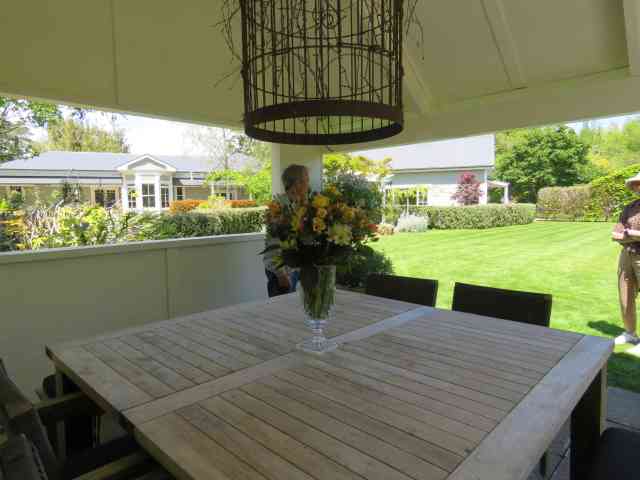
There is a whole lot more to Riverlea, but look at their outdoor seating
Riverlea is a stand-out garden for a number of aspects. I could highlight several but I would single out the placement of garden seating. Mark has always been adamant that gardens should, as he says, ‘make sense’. There needs to be an underpinning logic. He is not big on contrivances. So garden seating should be where you use it, not a single painted chair placed in the middle of a border as a dreaded focal point. Same with gazebos, summer houses – or *pavilions* as the aspirational call them these days. These should have a useful purpose and location, by very definition. Being an ornament or a statement of opulence is not enough, at least in our books. At Riverlea, every space to pause and sit a while, either alone or with friends, impressed with its placement and its welcoming feel. It makes a garden feel occupied, enjoyed and appreciated, personalised.
The devastation wrought by the storms at the beginning of November, particularly in Southland, brought up the thorny issue of trees and power lines. Again. The power was out in some areas for weeks and the photos of fallen trees showed some extreme scenes. We went through Cyclone Dovi a few years ago. That was bad enough but the Southland storms were way worse. Trees and power lines are not a good combination.
I have every sympathy with linesmen who go out in all sorts of extreme conditions to try and restore essential services. I can understand why the lines and power companies do not like trees and would like clearways around every power line.
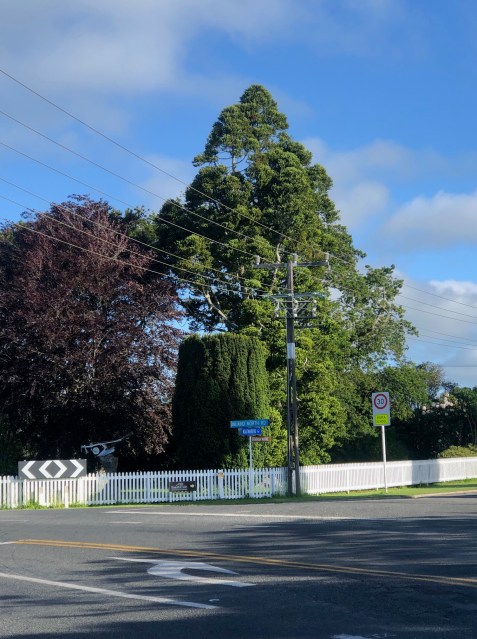
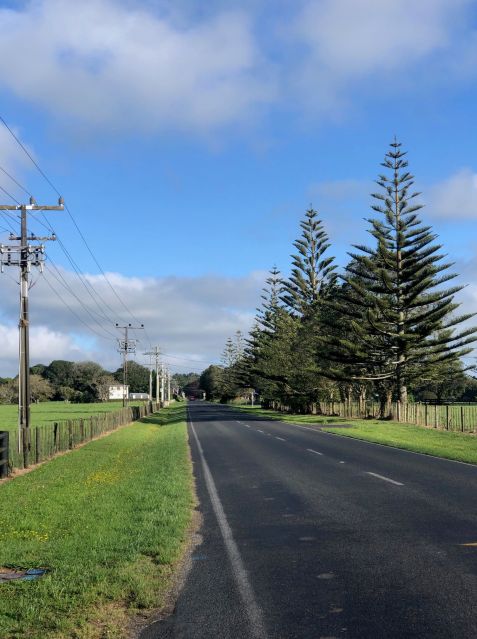
If we must have clearways around power lines, all but the conifer would have to go from our little historic church in Tikorangi,
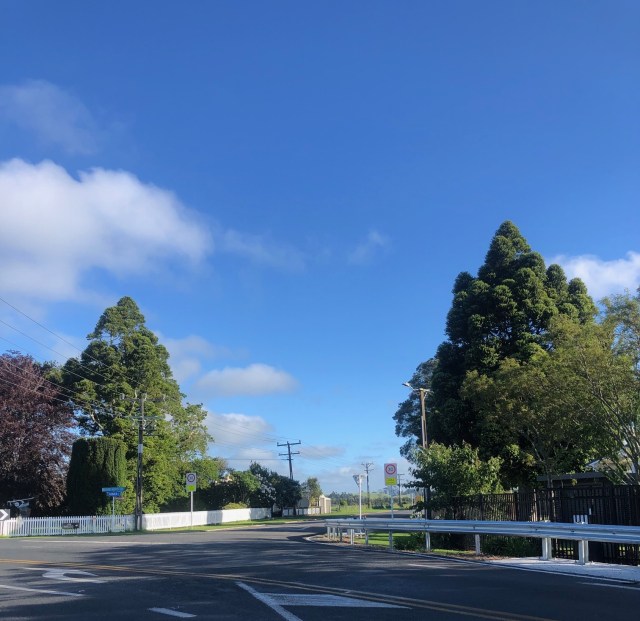
Draw back a little and that is the Tikorangi church on the left and the school on the right. Some of those trees at the school would have to be felled if every tree that could potentially fall on the power lines had to go.
But what would clearways look like? It is one thing to expect trees to be kept out of the lines so that wind won’t blow the branches around and cause damage and power outages. It is quite another if every tree that could potentially fall upon a line were it to be uprooted had to be removed or have the top taken out of it as a precaution.
Clearways for power lines would mean the removal of the Norfolk Island pines on the right in the near future.
Climate change is here. It seems that what it will look like in our country includes extreme storms with increasing frequency. Trees, especially very large, mature trees, are a critical part of attempting to counter climate change. It takes decades for trees to reach maturity. Historically, we have many power lines which were placed where it was most convenient or the cheapest option and now they are in the wrong places, really. I don’t know what the answer is. How do we balance the environmental benefits of large trees with the need to keep electricity supply?
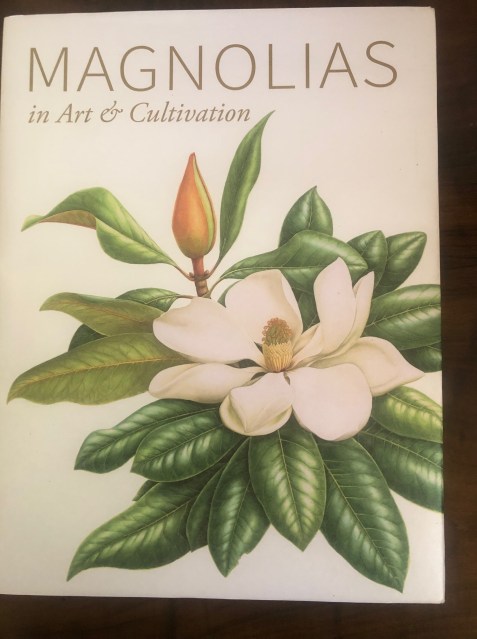
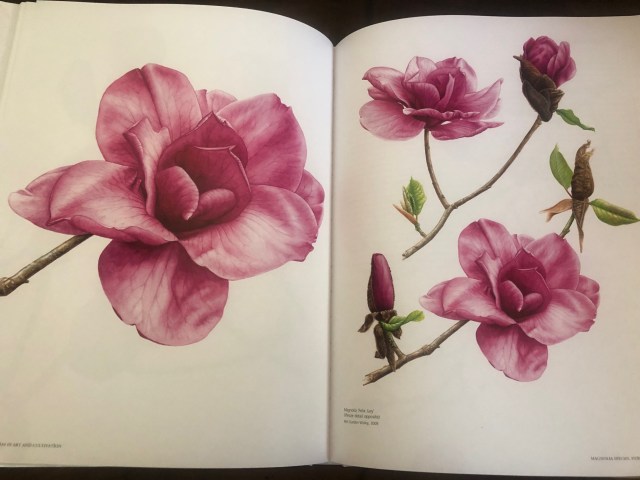
Sometimes life can deliver unexpected delights and so it was with a delivery of a magnificent book sent to us by the UK-based botanical artist, Barbara Oozeerally. There are several pages of paintings of Jury magnolias in a large format book full of exquisite magnolia paintings. It is a book to be treasured. When I wrote to thank her, it transpired that she is a long-time subscriber to this site and her love for magnolias goes beyond painting them. She has a collection of nearly 50 different magnolias in her own garden. If you don’t have space for 50 magnolias in your garden, I can recommend her book to experience the genus vicariously, all year round.
Magnolia ‘Felix Jury’ , as painted by Barbara Oozeerally
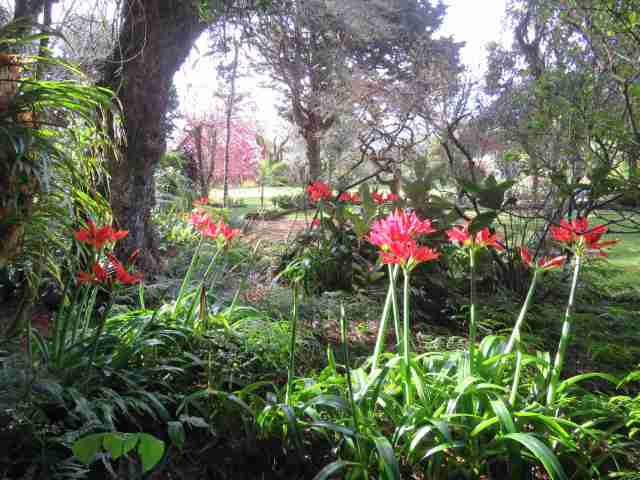
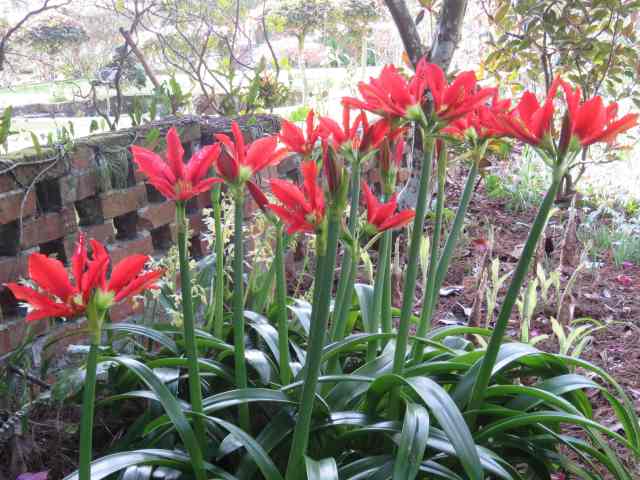
Hippeastrum aulicum – we plant it in semi shade to shaded areas because it will still flower and the dreaded narcissi fly only attack plants in sunny spots
Maybe I will do a monthly post on the bulbs in flower here during each month, I thought in August. I am pretty sure that we have bulbs, corms and tubers of one sort or another flowering twelve months of the year. But August came and went and here we are, well into September and peak spring.
Hippeastrum aulicum
Ah well, there is always some crossover. The narcissi and the Hippeastrum aulicum both started in August and are still in full bloom. The aulicums bring us great pleasure and are a significant feature as winter breaks to spring in our garden but are probably beyond the reach of most people. It is not that they are difficult to grow but they are not widely available and, purchased individually, they will be expensive. Mark’s dad probably started from one or maybe three bulbs, as was his and now our way, and the results here have been achieved over about seventy years of quietly lifting, dividing and planting around the garden, now with many hundreds of bulbs in various locations. Not every gardener has the time, patience and willingness to achieve this, let alone the longevity of stay in one garden location.
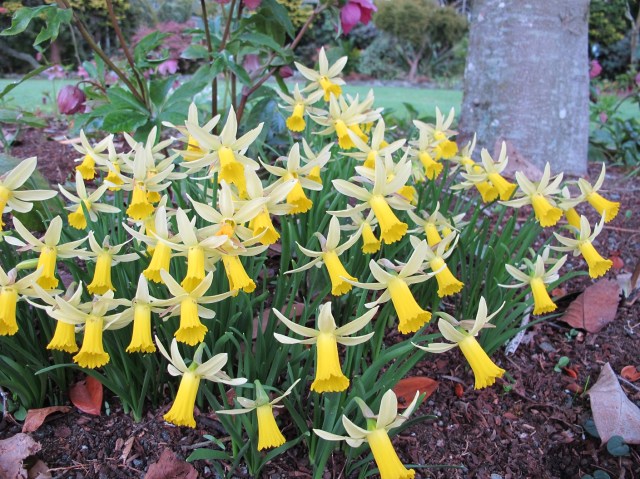
Narcissus Twilight
The narcissi are more achievable and will give a quicker result. We grow as many different types as we can, bar the modern hybrids (the King Alfred types) that are most commonly sold. They are better as cut flowers (the weight of the bloom often bends them over in the garden) and are better in places that don’t have issues with narcissi fly. We favour the earlier flowering dwarf narcissi. Growing a range of different species, named hybrids and seedlings raised here on site extends the season into many weeks from early August right through September.
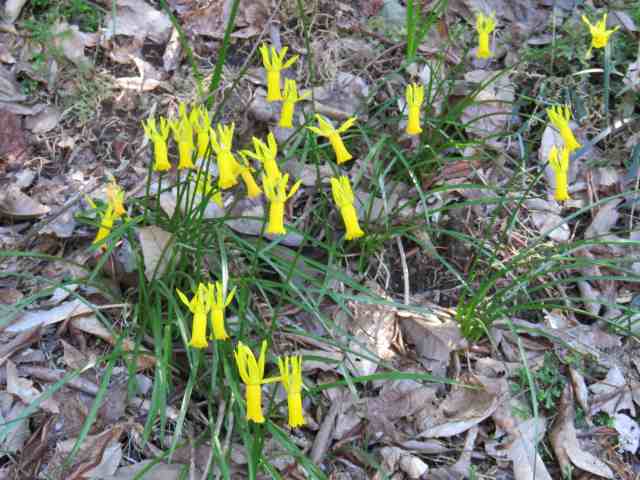
Narcissus cyclamineus seedlings growing on one of our bulb hillsides
We use narcissi everywhere really, the major consideration of sites being that they won’t get swamped by larger growing plants and that they will star as rays of sunshine in their time each year.
Lachenalia aloides
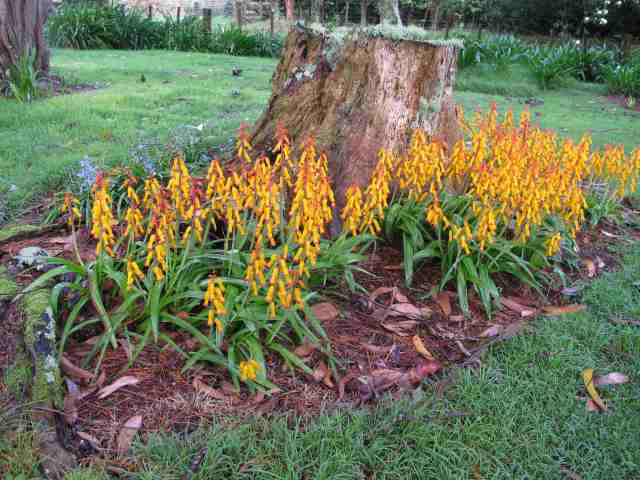
The lachenalias also star through spring. It is the boldest and the brightest that bloom first. Lachenalia aloides is the common form that is widely grown. Cheap and cheerful, might be the best description. Placement is everything when it comes to this bulb. I don’t like it as a garden plant but I think it is great on the margins and in wilder areas.
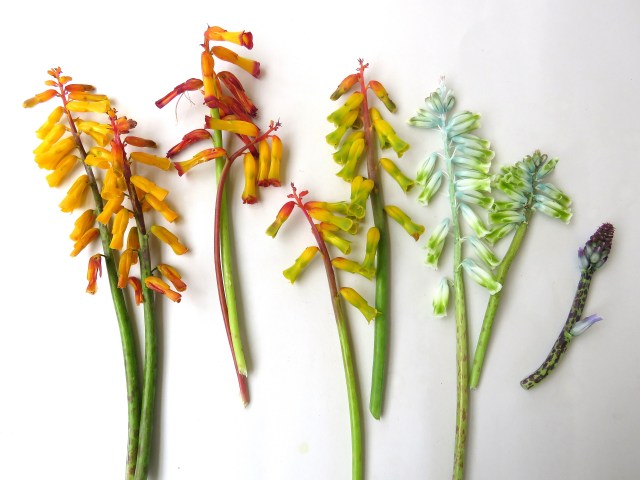
I am officially giving up on trying to understand the plant classification and nomenclature of lachenalias. Last time I looked, these were all forms of the species L. aloides. I even staged a photo to support my comment that a single species can be very variable. So we have straight aloides, quadricolor (already passing over – it is even earlier), tricolor, vanzyliae and glaucina which was barely opening a week ago. Now I look and I see they have been split. Glaucina is back with L. orchiodes, while quadricolor and vanzyliae seem to have been elevated to the status of being in species classes of their own and I have no idea where tricolor sits. They can remain a mystery for me.
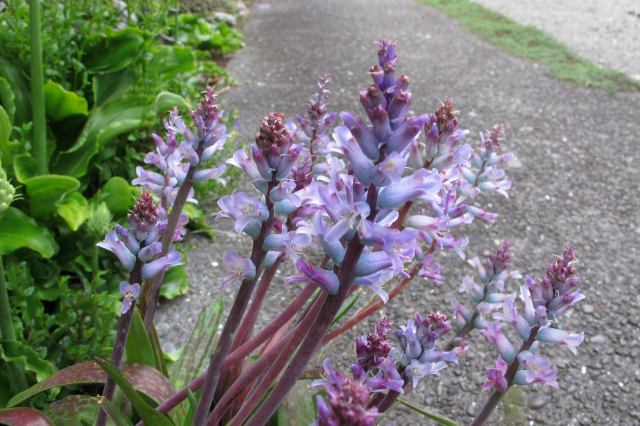
Lachenalia glaucina
From a garden perspective, I always notice that it is the orange, yellow and red lachenalias that flower first (the yellow being Mark’s reflexa hybrid, the red we have is bulbifera). The most desirable so-called blues come later. I say so-called blues because that casual grouping takes in those with the faintest blue genes that are really shades of cream, pink and lilac as much as pure blue. We have gathered every one we could find over the years and by far the most reliable is the aforementioned L. glaucina.
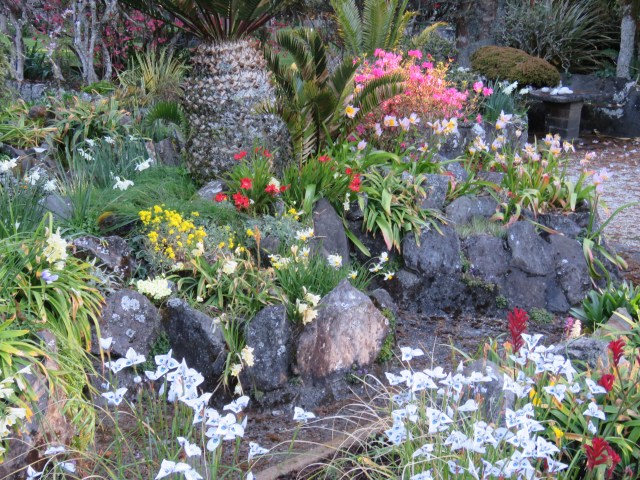
And without writing a book on topic, I can only continue by listing bulbs that I spotted on a perfunctory wander around the rockery and areas where we have done informal swathes of different bulbs. We find the bulbs add depth and detail which we value highly.
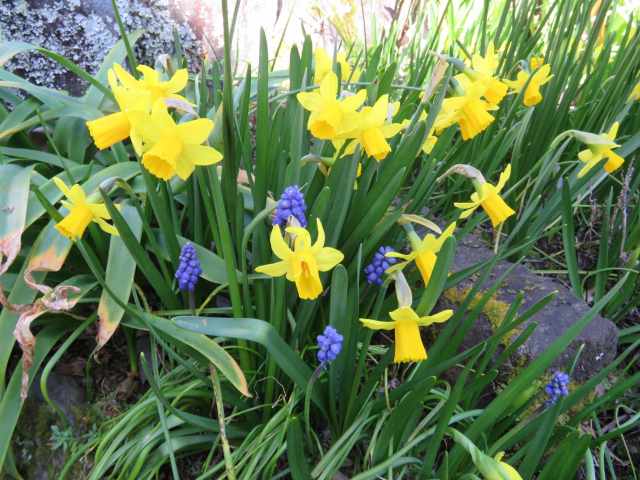
A touch of grape hyacinth is enough. Seen here with Narcissus Tete a Tete.
We are not too snooty about the common bulbs. While the snowdrops finished last month, the undervalued snowflakes (Leucojum vernum) flower on. We are thinning out both the grape hyacinths (muscari – foliage to flower ratio too high in our climate and spreads a bit too much) and bluebells (way too invasive) but not aiming for total eradication.
Once was dipidax, then onixotis but now, apparently a wurmbea
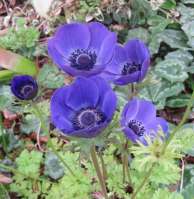
Seedling anemone
The blue anemones seed down and have quietly naturalised in the rockery without being a problem. I once planted a couple of bags of anemones and ranunculus and they all flowered the first year. From then on the ranunculus, the double anemones and all colours except blue quietly faded away but I like the simple blue and I like even more that they are self-maintaining. The Wurmbea stricta which we used to know as an onixotis and before that was a dipidax is another common bulb but one without a widely-used common name so most often greeted with words to the effect of “Is that what it’s called? My mother used to grow that – I never knew its name.” Dutch iris are another early spring option. I like my blue ones but I am not a particular fan of the family generally.
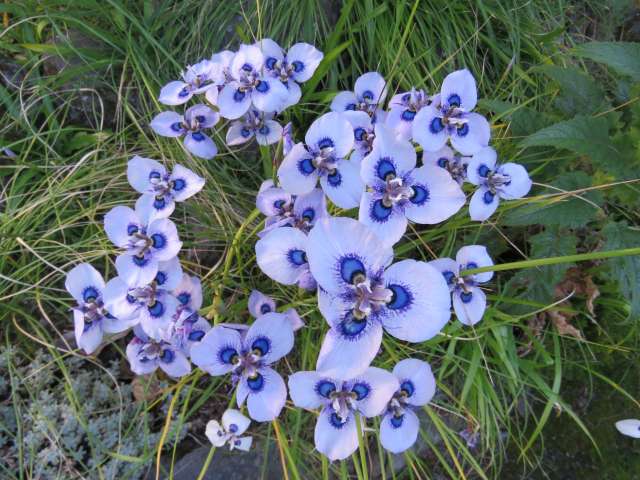
The blue moraea villosa are the most desirable but the white with blue eye are the most common
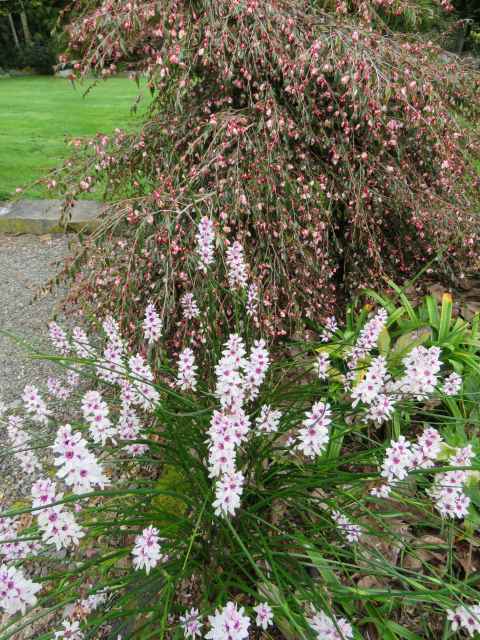
There is a large group of somewhat messy bulbs that are terrific in flower but their seasonal foliage is often dying, either just before they bloom or while they are in flower. So they are not nice, tidy, neat bulbs but they are generally showy. The Moraea villosa float like ethereal eyes of the peacock feather, moving in the breeze and they are a delight, even though I may feel irritation at their messy foliage in a few weeks’ time. The freesias (plain cream ones here), sparaxis, valotta, tritonia, Gladiolus tristis and babianas all fall into the same category and are flowering now. We grow them all, but more in the rockery for choicer ones and in meadow plantings for vigorous ones. Their foliage issues are less intrusive than in a tidy border planting.
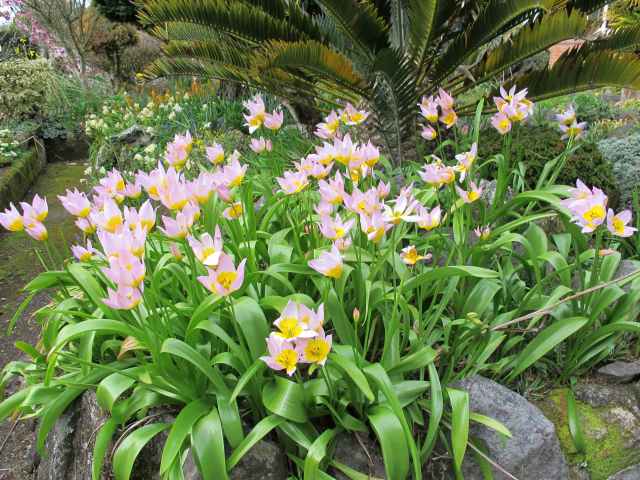
Unlike the Dutch hybrids, Tulipa saxatilis just keeps quietly increasing and returning to bloom every year
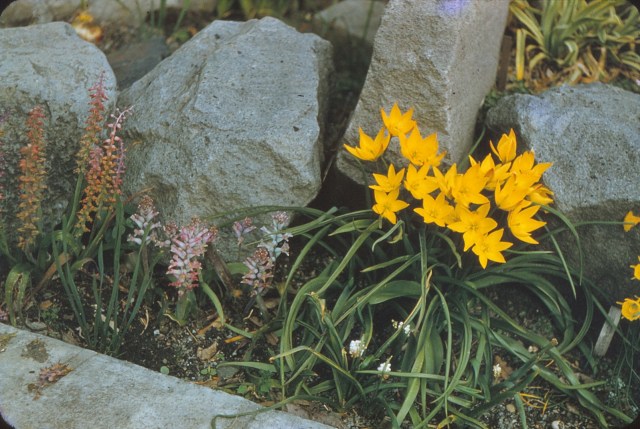
Tulips – we don’t grow the Dutch hybrids but we are enamoured with the Cretan species Tulipa saxatilis. And we have a dainty yellow species that may be a form of T. sylvestris, or it may not. Amongst Mark’s parents’ slides, there was a photo of it in the newly constructed rockery so around 1952 or so. Amusingly, seventy years on, we still have it but only in similar quantity to that in the early photo. It is clearly not going to naturalise and reproduce much here.
We know this is a very early photo because the rocks have not a skerrick of moss or lichen on them.
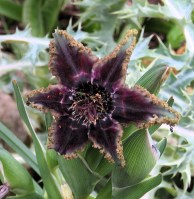
Ferraria crispa
Then there is the Ferraria crispa, the starfish iris which is only worth the space if you are fascinated by oddities and freaks. Erythroniums, dog’s tooth violets which prefer colder, drier winters, are a seven to ten day wonder with us but charming and dainty for that time and no bother for the rest of the year. Veltheimias in pink and in cream are a mainstay for us in both sun and shade, the pleione orchids are coming into flower and Hippeastrum papilio has opened its first blooms – I could go on.
Why did I start with the month that is probably the busiest of the year in the varied world of bulbs? There will be more that I have missed. If I end up having to retire to a very small town garden, there will be no roses, lavenders or easy-care mondo grass. I am pretty sure I will be growing bulbs.
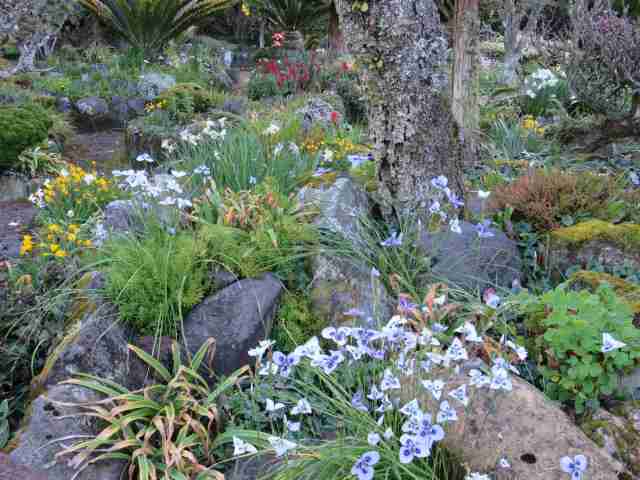
The rockery is at its busiest at this time of year