Category Archives: Garden lore

Wisdom and hints

Garden Lore

“I am sensibly obliged, my dear Lord, by your great goodness, and am most disposed to take the gardener you recommend, if I can…. I have a gardener that has lived with me above five-and-twenty years; he is incredibly ignorant, and a mule. When I wrote to your Lordship, my patience was worn out, and I resolved at least to have a gardener for flowers. On your not being able to give me one, I half consented to keep my own; not on his amendment, but because he will not leave me, presuming on my long suffering. I have offered him fifteen pounds a year to leave me, and when he pleads that he is too old, and that nobody else will take him, I plead that I am old too, and it is rather hard that am not to have a few flowers, or a little fruit as long as I live.”

Horace Walpole, Letter to the Earl of Harcourt, October 18, 1777.

007 - CopySummer pruning

Pruning time is over for most woody plants because cutting back is best carried out in winter and spring but there are a few exceptions. Cherry trees (prunus) are one. These are best pruned in mid summer (so January or early February). This greatly reduces the likelihood of the dreaded silver blight getting in through the wounds. There is no differentiation between fruiting and ornamental varieties when it comes to timing of pruning. Other close relatives which are best summer pruned include plums, peaches, nectarines, apricots and almonds.

Wisterias will need pruning, probably right now. This is not complicated. Just trim back the long growths at this time to keep them under some semblance of control. Hedgeclippers or secateurs are fine. The winter prune is the important one to manage flowering. Remove any growth around the base or it will escape and layer, forming roots as it slithers along the ground.

Roses can be gently summer pruned as you deadhead, to keep a good shape. Take the time to gather up any diseased leaves while you are about it and burn the lot if you can. Keeping up the water and nutrition levels encourages roses to keep growing so new leaves will continue to form, along with more flower buds on repeat flowering varieties.

Hybrid clematis can be cut back very hard after their flowering flush has finished – and by hard, I mean to about 20cm. Feed them and keep them watered and most will reward you with another flush in about six week’s time. This works for most large flowered types and the advice came from a clematis specialist.

First published in the Waikato Times and reprinted here with their permission.
Garden Lore

“I wish the sky would rain down roses, as they rain down from the shaken bush. They would fall don light as feathers, smelling sweet, and it would be like sleeping and yet waking, all at once.”

George Eliot (1819 – 1880).

???????????????????????????????Staking trees
Staking trees and shrubs is often done so badly that it does more damage than good. If you have to stake a plant to keep it upright, don’t force the stake in as close to the trunk as you can get it. This sheers off all the roots in the wedge radiating out from that point. Even moving the stake out a few centimetres can make a big difference to the damage caused.
Keeping trees staked can do more harm than good. A bit of wind rock actually helps the plant to stabilise itself and to develop a tapered trunk as a result. Where you need to stake because it will fall over, keep the stakes low. They should not be more than a third of the existing height of the plant. If you still have a problem with stability, reduce the canopy bulk (called the “sail” area because this is what catches the wind). It is likely that you have a plant with too much top and not enough of a root system to sustain it.

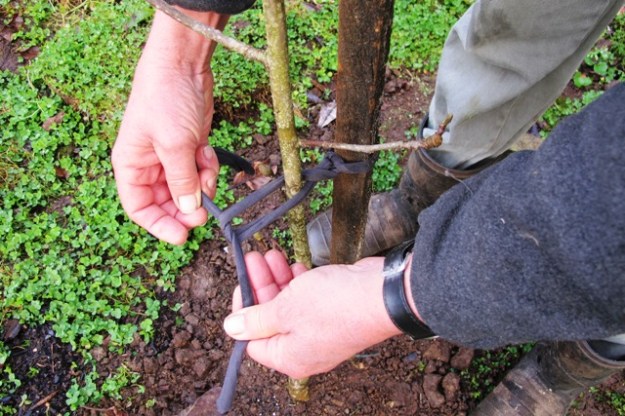
Always use flexible ties of stockinette, old panty hose, strips of rubber from an old inner tube or similar. String and wire will cut into the trunk causing damage and potentially ringbarking it.

The bottom line remains: only stake if you really need to, not as a matter of course. It is actually better for the plant in the long term not to be staked.

First published in the Waikato Times and reprinted here with their permission.

Garden Lore

“I have come to understand the unspeakable loveliness of a solitary spray of blossoms arranged as only a Japanese expert knows how to arrange it…and therefore I cannot think now of what we Occidentals call a “bouquet” as anything but a vulgar murdering of flowers, an outrage upon the colour-sense, a brutality, an abomination.”

Lafcardio Hearn, Glimpses of Unfamiliar Japan (1894).

008 (2) - Copy
Dividing bearded irises
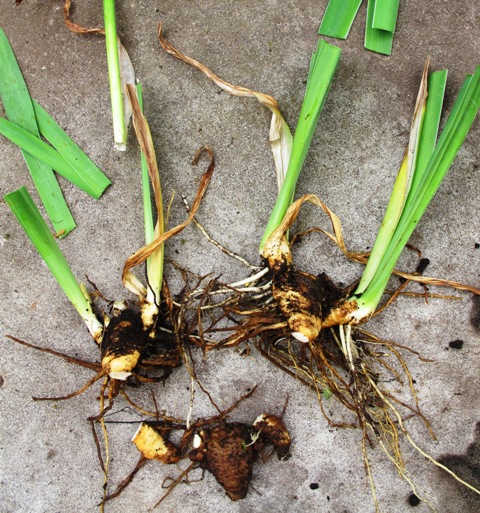
This will be the last call for irises on this page for a while, but if you have bearded irises, now is a good time to divide them. This should be done every few years to avoid clumps getting too congested, at which point they will stop flowering. Make sure you don’t damage the rhizomes as you dig them up. Wash them if need be to see what you are doing. Discard any mushy or damaged sections as well as the darker coloured older sections in the centre which have already done their dash. Fresh offsets (where leaves will now be growing) need to be about 8-10cm long before you cut them off so, if they are smaller, keep the parent rhizome with them. Cut the leaves back to about 15cm to reduce stress. Remove any spent flower spikes. Replant by spreading the roots but keeping the rhizome nestling just on top of the soil where it can bake in the sun.

Timing is not critical but done now, the iris has a chance to re-establish its roots and get a good footing before it has its winter rest. Bearded irises need full sun and excellent drainage to prosper.

First published in the Waikato Times and reprinted here with their permission.

Garden Lore

“The moment trees are in bud and the soil is ready to be worked, I generally come down with a crippling muscular complaint as yet unclassified by science. Suffering untold agonies, I nonetheless have myself wheeled to the side line and coach a small, gnarled man of seventy in the preparation of the seed-bed. The division of labor works out perfectly; he spades, pulverizes and rakes the ground, while I call out encouragement and dock his pay whenever he straightens up to light his pipe. The relationship is an ideal one, and I know he will never leave me as long as the chain remains fastened to his leg.”

S. J. Perelman Acres and Pains (1951).

Following an association of ideas from Collector this week, if you want to camouflage something in your garden, colour it matt dark-charcoal or black. The eye passes over it without registering it because the colour recedes into the background. Too often, gardeners think that if you paint something green, it will meld but it is very easy to get the wrong shade. Blue greens tend to stand out in the garden (which is why glaucous or blue foliage is often prized), yellow greens can look a bit yuck and there are some ghastly synthetic-looking greens. I saw friends get it wrong with a green fence which really, they should have painted black. It stood out like a sore thumb when they wanted it to merge discreetly into the background.

The same goes for plant ties, permanent stakes, supports, ugly tanks or even trellis screening – anything that is necessary but you don’t want to notice. Just don’t go for a high gloss finish.

First published in the Waikato Times and reprinted here with their permission.

Garden lore

“If gardening isn’t a pleasure for you, chances are the work will merely give you a rotten disposition. If you’d rather be golfing or fishing, get a bumper sticker that says so, and forget gardening.”

Elsa Bakalar A Garden of One’s Own (1994)

014
Dividing plants

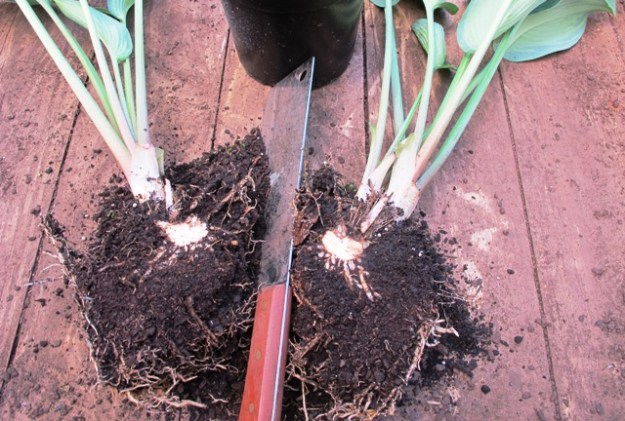
If you have been buying perennials recently, you can often divide these immediately and plant double the number. This is Hosta June which showed more than one growing point. I cut it down the middle, making sure that each side had both leaves (which means growing tips) and roots. I find a meat cleaver is easiest for this operation although a carving knife will do. Some people use a sharp spade but it is harder to get the cut in exactly the right place because you have less control over the spade.

Plants which are in full growth, as most perennials are in spring, will recover more quickly. Just make sure you plant them into ground which you have prepared well by digging it over thoroughly and preferably adding compost or humus. Water the plants in and keep the moisture levels up for the next few weeks. You need to give them a good start because you will have shocked the plant by cutting it in half.

Commercially, these plants are generally divided in winter with much more precision and controlled conditions (which will generate many more plants) but for the home gardener, dividing it in full growth can give good results and it is easy to see what you are doing.

First published in the Waikato Times and reprinted here with their permission.