Category Archives: Garden lore

Wisdom and hints

Garden Lore

“Earthworms are used by research scientists looking to improve human medical conditions because their bodies have many similarities with our own: nervous system, blood vessels, haemoglobin, kidney-like organs prgans producing urine… But don’t get too worried about the weird relations you never knew you had because worms also have five hearts and both male and female reproduction organs, they breathe through their skins and when they want to eat they stick their throats out of their mouths to grab their food. It’s going to be a while before they start moving into houses and driving cars.”

Niall EdworthyThe Curious Gardener’s Almanac” (2006)
???????????????????????????????
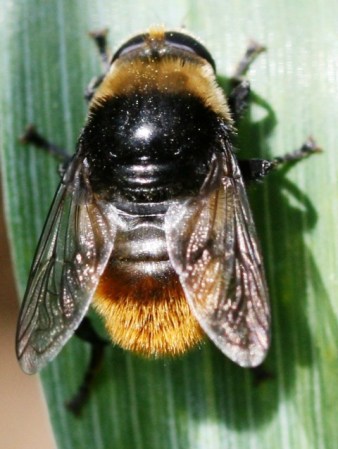
Narcissus Fly

Photo credit: Sandy Rae, Wiki Commons

Photo credit: Sandy Rae, Wiki Commons

Narcissi flies are on the wing now and will be laying eggs in the withering crowns of certain bulbs. Narcissi (daffodils) are a prime target but they also attack hippeastrums, snowdrops, snowflakes, hyacinths and I have seen them attack Scadoxus katherinae. Bulbs which are close to the surface are particularly vulnerable. The fly (which looks like a cross between a very small bumblebee and a blowfly) lays its eggs on the spent foliage. When the egg hatches, the larva crawls down and burrows into the bulb, eating it from the inside out.

Mark stalks them in the rockery every fine day with his little hand sprayer of Decis (a synthetic pyrethroid,the same as is in fly spray) but if you are not inclined to spend the time on the hunt (there is an element of the thrill of the chase going on here), you can take other steps. Remove the dying foliage as soon as it starts turning brown -it has fulfilled its purpose of replenishing the bulb for next season – and lay additional mulch over the bulbs to get a greater depth. If your bulbs are in containers, remove them to a shady position immediately. These varmints prefer a sunny outlook, in our experience. Dig and divide clumps which have become so congested that they are pushing themselves out of the ground and replant them so that they are fully covered. Left unchecked, narcissi fly can multiply to the point where they can decimate a patch of bulbs to the point where you will get no flowers at all.

First published in the Waikato Times and reprinted here with their permission.
“There is a dangerous doctrine – dangerous because it precludes endless gardening pleasures – that every plant in the garden should be disease-free, bug-free, hardy to cold, resistant to heat and drought, cheap to buy and available at any garden center.”

Henry Mitchell Henry Mitchell on Gardening (1998)

073
The gardening basket

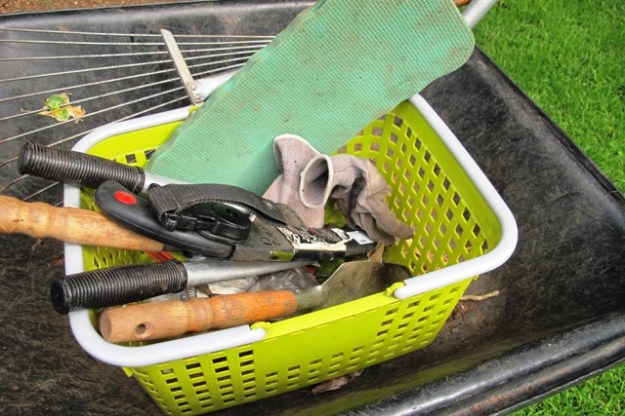
As we feel the intense pressure of getting our garden all groomed for the busiest 10 days of the garden visiting year here, I was thinking how very useful is my gardening basket. Not for me the style of a pretty willow or cane basket or the tradition of the wooden trug – the former is not going to like getting wet while the latter is heavier. I am afraid mine is utility Warehouse plastic, but invaluable nonetheless. I can almost always find my trowel, secateurs, pruning saw, Wonder Weeder, lawn weeder, kneeling pad, garden gloves and other accoutrements because I just toss them into the garden basket and cart it around with me. When I have finished for the day, I put the basket in the barrow and wheel it into the carport ready for the morrow. Being plastic means I can hose it out when it gets grungy. The only drawback is that this means the two men in my gardening life can also find my gardening tools any time they want to borrow something. One returns them, the other does not always return them to the same place.

A gardening basket may be a thoughful gift for children to give a gardening grandparent or mother.

First published in the Waikato Times and reprinted here with their permission.
Garden Lore

“I must confess, much as I love the decorative garden, the vegetable plot is, for me, both a place to relax and, occasionally, somewhere to hide. Yes, I admit, my vegetables are organically grown. I cannot see the point of going to all the trouble of growing them yourself, and then dousing them with poisonous chemicals. Save yourself the bother and buy them from the supermarket, sprayed and scrubbed.”

Beth Chatto Dear Friend and Gardener (1998).

It's compost all the way here, or most of the way at least

It’s compost all the way here, or most of the way at least

Fertiliser

Most plants are in full growth now so it is the optimum time for adding fertiliser. The uptake by the plant will be at its greatest while it is growing strongly. However, you don’t need to fertilise everything just because you can. Apply it where it is needed, not as a matter of course. If you use a mulcher mower, your lawn should never need added fertiliser. When you use compost in the vegetable garden, you may not need to use additional fertilisers.

If you are a consumer, you may be talked into buying a whole range of different types for the garden – one for lawn, another for citrus, yet a different one for acid loving plants like rhododendrons and you will be told that different plants need different ratios of NPK (that is nitrogen, potassium and phosphorus). Being of the KISS persuasion, we just go for something cheap and cheerful for the odd occasions we feel impelled to use additional fertiliser in the garden. With the current research on nitrate run-off, the less is more philosophy is looking ever more appealing.

First published in the Waikato Times and reprinted here with their permission.
Garden lore

“Hoeing: A manual method of severing roots from stems of newly planted flowers and vegetables.”

Henry Beard, American humorist.

003 (2)

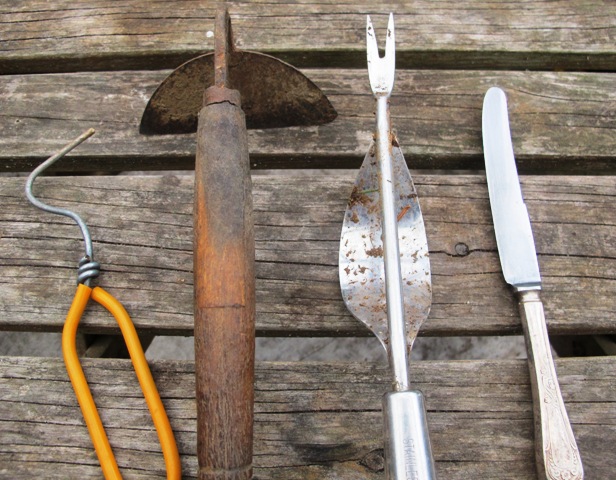
I am a big Wonder Weeder fan. These are the best implements I know for hand weeding, especially in tight spaces. Because the action is to hook out the weeds, it is possible to do it with minimum of disturbance to surrounding plants. It still amazes me that something so simple, indestructible and effective has remained cheap. I own several because they regularly end up going through the compost heap. I have no commercial interest in these but I see you can buy them on line – three for $15 (including delivery) at wonderweeder.co.nz and some garden centres sell them.

Others swear by the Niwashi which is probably somewhat more expensive and less happy about going through the compost. This is a small hand-held hoe. It severs the plants from its roots which will be enough to kill most, but not all, weeds. It is also better than a trowel for cultivating the soil in smaller areas. You need at least a 12cm space between your plants or you will sever them in the process.

For flat weeds in the lawn, or very deep rooted plants like dock, there is nothing to equal the lawn weeder which can hoick plants out, roots and all, in one simple move. If you don’t want a small armoury of specialist weeding implements, an old table knife does the trick once you have mastered the different hand actions required.

First published in the Waikato Times and reprinted here with their permission.
Garden lore

“I am very fond of the Spring-flowering colchicums, but unfortunately slugs are also, and those greedy gastropods and I have a race for who can see the flower-buds first. If I win I go out after dark with an acetylene lamp and a hatpin and spear the little army of slugs making for a tea-party at the sign of the Colchicum.”

Edward Augustus Bowles My Garden in Spring (1914)

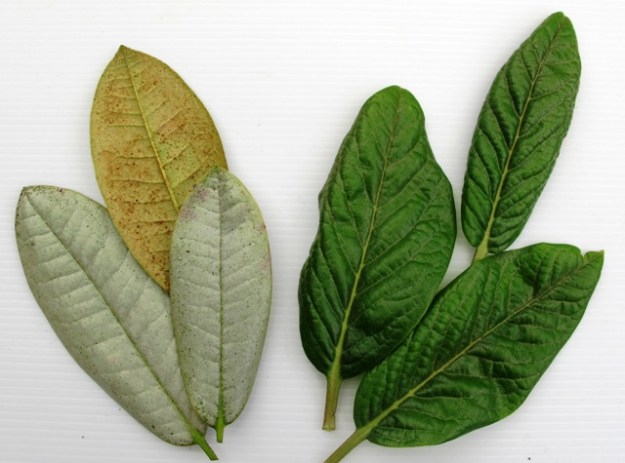
Thrip infested leaves to the left, healthy to the right.

Thrip infested leaves to the left, healthy to the right.

Thrips galore

Clearly last summer’s drought stressed some plants more than we realised at the time. Thrips. We have thrip infestations on plants which do not normally suffer. Plants show the damage as silvering on the leaves. It is common in many rhododendrons but bay trees and photinia are also prone to infestations, along with other plants. You can’t turn the silver leaves green again. Turn over the leaf and you will see rusty looking spots behind. This is the residue of the thread-like thrips which suck the chlorophyll out of the foliage. The damage is done.

Prevention is better than a cure. A strong, healthy plant with plenty of air movement around it and good light levels is better able to withstand attack. There are systemic insecticides you can use which the plant absorbs into its system, killing the thrips from the inside out but you have to wait until the critters are active again – usually late November. The bands sold that you wrap around the trunk of the tree will either be soaked in systemic insecticide or in Neem oil. We have never tried Neem and are surprised if it works as a systemic, but others say it does.

Contact insecticides don’t work unless you can saturate the underside of every single leaf so most organic remedies won’t work. The fresh spring growth will hide a multitude of sins and we are hoping that the thrippy plants will look fine again. Some varieties are much worse affected and generally we choose to remove those and replace with better performing varieties because we do not want to have to use systemic insecticides just to keep plants healthy.

First published in the Waikato Times and reprinted here with their permission.