Category Archives: Garden lore

Wisdom and hints

Garden lore

[My garden] is a confusion of kitchen and parterre, orchard and flower garden, which lie so mixt and interwoven with one another, that if a foreigner, who had seen nothing of our country, should be conveyed into my garden at his first landing, he would look upon it as a natural wilderness, and one of the uncultivated parts of our country.

Joseph Addison, The Tatler (1710)
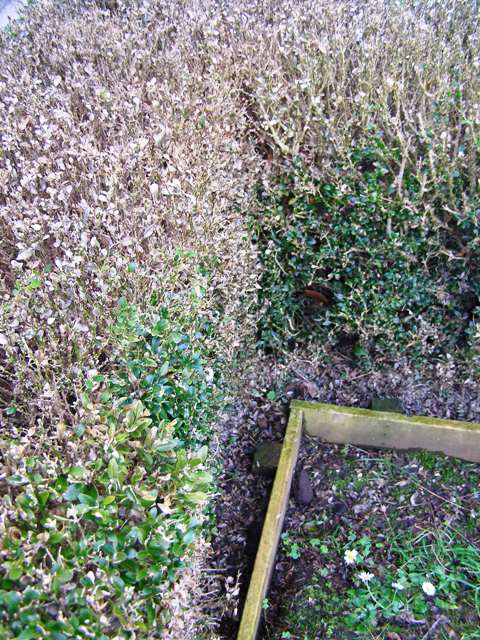
The dreaded buxus blight - but not in our garden

The dreaded buxus blight – but not in our garden

Buxus blight
Judging by all the search engine terms I see leading people to my website (www.jury.co.nz), buxus blight is currently running rampant. In summary, if your buxus has turned brown all over, it is dead. If it has big dead patches and some green left, odds on you have buxus blight. All species of buxus get it but it is worst on the most common ones we use here – B. sempervirens and var. suffriticosa. It is a fungus – cylindrocladium – and it is a problem throughout the world where buxus is grown. Being a fungus means that it is spread by spore and these light little packages of blight can be spread by wind.

You can treat buxus blight but you can’t cure it. As soon as you stop treating it, the dead patches will start again. Untreated, you are likely to lose the lot eventually and it will look most unattractive in the process. I know of people who are keeping it at bay by using copper sprays and there will be fungicides that will knock it on the head for a while. The trouble is that the repeated use of copper sprays is not good for the environment (eventually you can get a build up that kills earthworms) and fungicides are not the nicest of sprays. It is unlikely that natural sprays using baking soda are of sufficient strength to be effective.

In the end, the decision really is whether you are willing to spray your buxus from here to eternity. Be grateful if you do not have the blight.

First published in the Waikato Times and reprinted here with their permission.
Garden lore

“What a pretty flower, I’ve never seen one like it; there’s no one like you, Oriane, for having such marvellous things in your house,” said the Princess de Parme, who, fearing the General de Monserfeuil might have overheard the Duchess, sought now to change to the conversation. I looked and recognized a plant of the sort that I had watched Elstir painting. “I am so glad that you like them; they are charming, do look at their little purple velvet collars; the only thing against them is – as may happen to people who are very pretty and nicely dressed – they have a hideous name and a horrid smell. In spite of which I am very proud of them. But what is rather sad is that they are dying.”

Marcel Proust, Remembrance of Things Past (The Guermantes Way, 1920).

??????????????????????????????? Moving rhododendrons

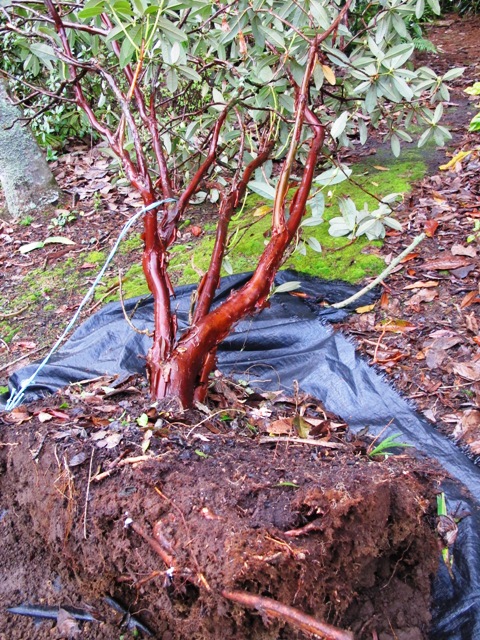
While some plants put down huge, deep root systems, rhododendrons are surface rooting. This means they have a large, fibrous root system close to the surface which makes them relatively easy to move. This plant is getting on for twenty years old. Its root system is over a metre across but only 20 to 30cm deep. It has been moved on a large piece of weedmat to keep the roots and dirt intact. We will prune the top after replanting to compensate for the stress and shock, reducing it by at least 25%. Because it is going into a sheltered position, it should not need staking but it would if it was going into the open because it will take a year or two to anchor itself securely again. Mulching it with compost after planting will protect the roots from drying out and give a gentle feed to the plant.

Now is the time to move large plants so they can settle in before summer. Plants with a tap root – a strong central root which goes straight down into the ground – are usually impossible to move successfully unless they are wrenched well in advance.

First published in the Waikato Times and reprinted here with their permission.

Garden lore

“Woman has no seductions for the man who cannot keep his eyes off the magnolias.”

Anonymous, from Up the Garden Path by Laura Stoddart.

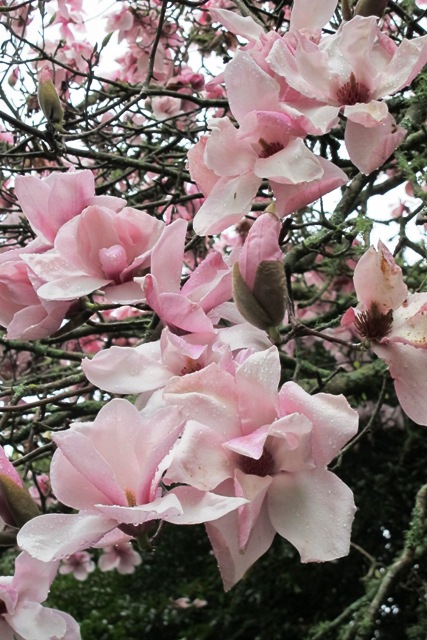
Magnolias and lawn spray do not mix. This one is Sprengeri diva

Magnolias and lawn spray do not mix. This one is Sprengeri diva

Magnolia problems
If you insist on spraying your lawns, and many do, then get onto it straight away. Many of the common lawn sprays are hormone-based. If you delay any longer, you risk causing severe damage to deciduous plants just breaking dormancy. It doesn’t matter how careful you are – spray drifts invisibly and the slightest whiff can damage other plants at critical times. Kiwifruit are particularly sensitive and so are magnolias.

There are two common questions about deciduous magnolias we are asked repeatedly, year in and year out. The first is related to malformed leaves, or sometimes defoliation on one side of the tree. Almost invariably, we find the enquirer has sprayed their lawn for moss and flat weeds. Of course, magnolias are often used as lawn specimens. So if you must spray, get it on as soon as there is a fine, calm day. It should not affect your magnolia at this time of winter. If you leave it until spring is advanced, there will be damage and it can be severe and unsightly.

The second common question is about completely malformed flowers on magnolias. Possum damage. You just need one critter who develops a taste for them and it can take out pretty much an entire season of blooms. It nibbles in from the top to eat the bud so you can’t spot the damage from below.

First published in the Waikato Times and reprinted here with their permission.

Garden lore

“In a marshy spot in the garden we had excavated a pit, forming a pond, around which stood a grove of pine trees. It looks as if, in five or six years, a thousand years have left their mark here – one bank of the pond has collapsed, new trees have sprung up among the old, and such is the air of neglect that all who look are afflicted with a sense of sadness. Old memories come flooding back…”

Ki No Tsurayuki, The Tosa Diary (ca. 936, translated from the original Japanese 1955).

Espalier
Espalier is simply the exercise of keeping a plant to a flat plane so it has height and width but no depth. This makes it an ideal technique for narrow spaces. It does not have to be against a hard surface like a wall or fence, but there need to be cross wires or a frame to tie the plant to. Plants do not naturally grow in a two dimensional shape so you have to prune wayward growths and tie in branches often. It is possible to espalier any woody plant which establishes a permanent structure of trunk, stems and branches but it tends to easier if it has a central leader, is not going to grow too large and has flexible rather than brittle new growth. If it is too brittle, it can snap easily. Camellias are ideal candidates as are dwarf apples, figs or wisteria. I can’t see any reason why citrus couldn’t be espaliered but it is always easiest to start with a young plant. You can’t really rush espalier. It takes time to grow and train a plant properly.

Use a flexible tie, not string or wire which will cut into the bark of the plant. We like the balls of stockinette tie that you buy at the garden centre. Black is the least intrusive colour but they all fade with time.

First published in the Waikato Times and reprinted here with their permission.

Garden lore

“Of all the ugly things, nothing is worse than the variegated conifer, which usually perishes as soon as all its variegated parts die, the half dead tree often becoming a bush full of wisps of hay.”

William Robinson ,The English Flower Garden (sixth edition, 1898).

Crop rotation

Crop rotation has been followed for many hundreds of years for good reasons. Those medieval agriculturists knew a thing or two when they practiced crop rotation, including a fallow year – one in seven, if my memory serves me right. Planting quick maturing green crops and using compost can remove the need for the fallow year (which was all about returning fertility to the soils). The crop rotation part remains important because if you keep planting the same type of vegetables in the same place every year, you will get a build up of pests and diseases.

There is a wealth of information on crop rotation, but in its simplest form, think about plant families, not individual vegetables. There are the solanums (potatoes, capsicums, aubergines, tomatoes), the brassicas, (cabbage, cauliflower, Brussel sprouts, many of the Asian greens and broccoli), legumes (peas and beans), other leafy greens and beets, alliums (onions and garlic), the carrot, celery and parsley family of Apiaceae (or Umbelliferae), and the cucurbits (pumpkin, cucumber, courgettes, melons).

There are six families above plus a few like sweet corn which don’t fit anywhere. Rotate them round the veg patch every year and you will get a break of several years (minimum of four is desirable) before they end up back in the same spot. That simple process will greatly reduce your need to resort to intervention with sprays and powders.

If it all sounds too complicated, just keep the brassicas and the solanums moving. They are the most vulnerable crops.

First published in the Waikato Times and reprinted here with their permission.

.