Category Archives: Garden lore

Wisdom and hints

Garden lore

” These are most anxious times on account of the slugs. Now every morning when I rise I go at once into the garden at four o’clock and make a business of slaughtering them till half past five, when I stop for breakfast.”

An Island Garden by Celia Thaxter (1894)
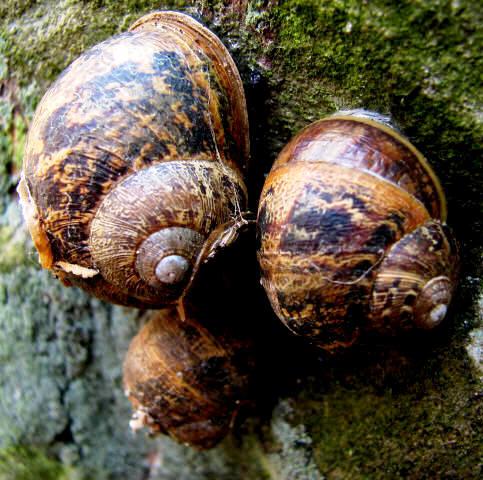
Snails – if you can’t beat ‘em, eat ‘em

If you are inundated by snails, you could consider eating them. They do not have to be ooh la la francais escargots out of a tin. It appears that our common snail here is the internationally edible variety of Cantareus aspersa, formerly known as Helix aspersa. If you are keen to try, it is often recommended that you purge the snails for a couple of days. You can do this by starving them or by feeding them on bread. A genuine snail-eating Italian on Twitter told me that the technique is to bring them to the boil, wash them, boil them again and serve with lashings of garlic butter on a bed of lettuce. If you are squeamish about boiling live snails, the best way to euthanase them may be to put them in the freezer for a short while. The ever-useful internet tells me that each snail weighs about 10 grams and you need at least 6 per serving.

This advice is theoretical on my part. Our accord with the many birds in our garden means that we don’t have sufficient snails on hand to try it out.

First published in the Waikato Times and reprinted here with their permission.
Garden lore

“The gardener has a great faith in names; a flower without a name, to put it platonically, is a flower without a metaphysical idea; in short, it has not a right and absolute reality. A flower without a name is a weed.”

The Gardener’s Year
by Karel Čapek (d. 1938)

001 - Copy

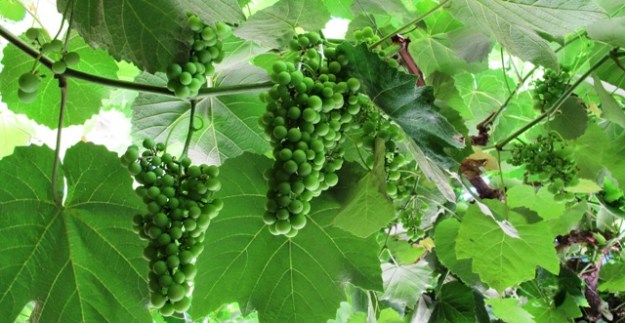
Summer grapes

Grapes are not a fruiting vine that can be left to their own devices if you want a harvest. They need hard pruning in winter and a follow up in summer. If you haven’t yet summer pruned your grape, then get onto it immediately. Cut all the laterals (side growths) back to six leaves. This allows light to reach the bunches of fruit and concentrates the plant’s energies on ripening the fruit rather than supporting extra foliage.

At the first signs of the fruit ripening, get bird netting on. Our feathered friends rarely wait for fruit to ripen to the stage humans prefer. If you can keep the birds from pecking the fruit, it will reduce their attractiveness to wasps.

By far the most successful, outdoor grape variety we have found in our marginal conditions is Albany Surprise. It is an American hybrid and should grow well in areas which are not known for grape growing because of humidity, rainfall and mild temperatures.

First published in the Waikato Times and reprinted here with their permission.
Garden lore

“A well-watered lawn will look great for a week or two, but you will have created a rod for your own back because it will start to expect another dousing. Grass is a tough plant and can survive very long stretches without water. No matter how severe a summer drought, no one’s lawn in Britain has ever died from lack of water. It can survive up to eight months without rain.”

The Curious Gardener’s Almanac by Niall Edworthy (2006)

Summer watering

Readers who have gone for the raised vegetable garden beds should be discovering a major disadvantage around now. Raised beds need a whole lot more watering in dry conditions because they dry out much more quickly than the ground below. Container plants dry out even faster.

Ideally, evening watering is better than morning watering because the cooler night temperatures allow for better absorption. A spray of water is preferable to a jet. Making many slow passes over the surface rather than flooding it allows for better penetration by the water. A good deep watering every few days is much more effective than merely passing over the surface each day. Dig down a little to see how far the water has penetrated. If it is only the top few centimetres, that is where the plants’ roots will be concentrated, making the plants even more vulnerable to drying out.

If you allow your container plants to get too dry, watering becomes ineffective because the water just flows straight through and is not absorbed at all. If the container is too big to sit in a bucket of water for at least 20 minutes, then a small squirt of dishwashing detergent on the top before watering can help absorption without harming the plant.

First published in the Waikato Times and reprinted here with their permission.

Garden lore

” The nonagenarian President of Magdalen, Dr Routh, was once brought the news that the acacia tree outside his lodgings had been blown down by a storm. “Put it up again,” was all he said; and up, of course, it went.”

Oxford by James Morris (1965)

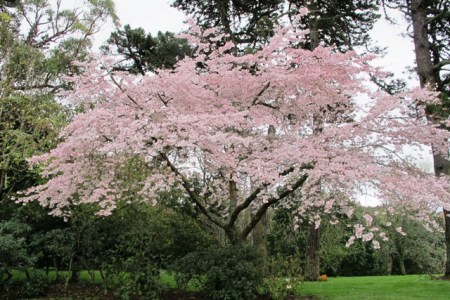
Prunus Awanui, flowering in spring here, has a tendency to develop witches' broom

Prunus Awanui, flowering in spring here, has a tendency to develop witches’ broom

Summer pruning

Now, at the height of summer, is the time to prune prunus, be they flowering cherries, fruiting cherries, plums, peaches, nectarines, apricots or almonds. Naturally you wait until they have finished fruiting for the season where possible. These plants are always pruned when in full growth to stop the dreaded silver leaf or silver blight getting in to the cut surfaces and taking hold. If your flowering cherry had large patches which didn’t bloom in spring and where the leafy growth is denser, then you have witches’ broom and it needs to be cut out now. If you leave it be, it will take over the whole tree and you won’t get any flowers at all in due course. It affects the Japanese type cherries but not the earlier flowering campanulata or Taiwanese varieties.

Make clean cuts with a sharp pruning saw and if you are moving on from an unhealthy tree specimen, then disinfect pruning implements between. Otherwise you can transfer disease. Wiping the cutting blades with meths or chlorine should work.

First published in the Waikato Times and reprinted here with their permission.

Garden lore

” There are some botanical names that are teasers. Where the Polish discoverers or Russian explorers come upon the scene the result is apt to be an appalling jungle of horrors. Michaux, Stribnry, Przewalsky, Tchihatchew are responsible for some real jawbreakers; and when it comes to Michauxia tchihatchewi, exhausted humanity gives up in despair.”

My Rock Garden by Reginald Farrer (1907)

Just a few of my aged concrete pots - far too heavy to use with ease

Just a few of my aged concrete pots – far too heavy to use with ease

Making your own plant containers

I was looking at step by step instructions for DIY concrete pots in a NZ publication and have one word of advice: don’t. I inherited concrete pots from my in-laws, made in the days before mass produced ceramic pots became so cheap and widely available. They look aged and anonymous but over the years, I have found I use them less and less because they are just too heavy to be convenient. If you want that aged look, go back to hypertufa which has been used since 1930 to recreate a weathered stone look. There is plenty of information on the internet but the general recipe for hypertufa is 1 part cement to 3 parts aggregate (often a mix of perlite, peat moss or river sand). It is no more bother than making pots completely out of concrete but much lighter to handle.

First published in the Waikato Times and reprinted here with their permission.