Category Archives: Garden lore

Wisdom and hints

Garden lore

I am strongly of the opinion that a quantity of plants, however good the plants may be themselves and however ample their number, does not make a garden; it only makes a collection.

Colour in the Flower Garden by Gertrude Jekyll (1908).

Dead heading

Plants don’t flower to delight humans. That is merely a bonus for us. Plants are genetically programmed to reproduce themselves and flowering is part of that process. Dead heading plants is therefore akin to contraception – preventing them from setting seed. In many cases, the plant will try again and set more flowers. That is what happens with annuals, perennials and repeat flowering roses. Removing spent blooms will extend their flowering season considerably. It doesn’t work for plants where flowering is set the preceding year (bulbs, rhododendrons and many other woody plants) but interrupting the process of setting seed can make the plant concentrate its energies on fresh growth and setting more flower buds instead. Annuals and biennials die after setting seed. Some plants can set so much seed that they weaken themselves and may eventually die (some rhododendrons and pieris, for example). Plants which are sterile often flower extremely well because they never get past that optimistic first stage of procreation.

First published in the Waikato Times and reprinted here with their permission.
Garden lore

Subjugated gardens abound, and I can see why. Unless discipline is maintained from the moment the spirit-level is laid across the earth, you are nourishing a vast, tactile, heavy-scented siren which will keep you forever in its thrall.

Hortus by Mirabel Oliver (1990).

Choosing plant containers

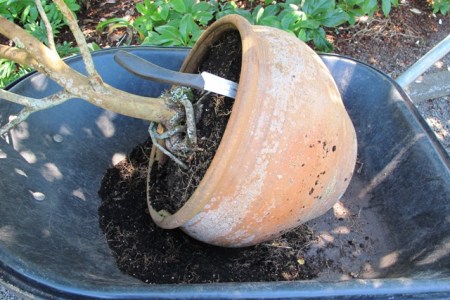
While round bellied pots are often more pleasing to the eye, you will save yourself a lot of trouble if you only plant short term annuals or leafy plants in them. More permanent woody plants fill up the space with dense packed roots and it becomes very difficult to extract them for repotting when the root mass is larger than the opening at the top of the pot. All container plants need repotting at least every two years to stay in optimum health (and who wants an unhealthy looking container plant on display?) but to extract one from a round belly pot requires cutting the roots with a knife until you have it small enough to pull out. Too often you can end up breaking the pot. Straight sided vase shapes or cylinders are a much easier shape to work with for woody plants.

First published in the Waikato Times and reprinted here with their permission.

Garden lore

Garden radishes are in wantoness by the gentry eaten as a sallad, but they breed but scurvy humours in the stomach, and corrupt the blood, and then send for a physician as fast as you can.

The Compleat Herbal by Nicholas Culpeper (1653).

Spring planting – NOW

If you have not planted out your summer garden, now is the time to panic. An unseasonably cool spring may have led many to delay, but delay no longer because the official start of summer is a mere two weeks away. Top priority needs to be given to the plants which require the longest growing season. This includes capsicums, aubergines, both rock and water melons, kumara and even tomatoes. Starting with plants now, rather than seed, is advisable to get a jump start this late in the season. Other techniques are to plant in black plastic (which heats up the soil faster) and to use a cloche for the early stages because this heats up the air around the plant to encourage growth.

Garden lore

The moment the trees are in bud and the soil is ready to be worked, I generally come down with a crippling muscular complaint as yet unclassified by science. Suffering untold agonies, I nonetheless have myself wheeled to the side line and coach a small, gnarled man of seventy in the preparation of the seed-bed. The division of labour works out perfectly; he spades, pulverizes and rakes the ground, while I call out encouragement and dock his pay whenever he straightens up to light his pipe. The relationship is an ideal one, and I know he will never leave me as long as the chain remains fastened to his leg.

Acres and Pains by S J Perelman (1951).

The narcissi flies are on the wing

The inoffensive adult fly (photo credit: Sandy Rae via Wiki Commons)

The inoffensive adult fly (photo credit: Sandy Rae via Wiki Commons)

The Nazi flies are on the wing. That is what we call the dreaded narcissus fly here. It lays an egg in each of the leaf crowns of the bulbs. That egg hatches in to a larva which wriggles down, enters the bulb and eats it from inside out. Narcissus fly loves daffodil bulbs but also attack a range of other bulbs, including hippeastrums, snowdrops, snowflakes and, apparently, hyacinths. Mark stalks them with a little sprayer of the insecticide, Decis, which is just a synthetic pyrethroid, similar to a strong flyspray. If you are not so inclined, remove the dead and withering foliage of daffodils now and pile a few cm of soil or mulch on top. It makes it much more difficult for the fly to find the crown of the bulb. The narcissus fly resembles a baby bumble bee.

Garden lore

There is nothing like the first hot days of spring when the gardener stops wondering if it’s too soon to plant the dahlias and starts wondering if it’s too late.

The Essential Earthman by Henry Mitchell (1981).

Late spring planting
The cool start to spring may have lulled you into a false sense of security when it comes to planting trees and shrubs but the warmer days this week should be warning that it is getting late in the season. If you are still planting, make sure you plunge the plant, pot or bag and all into a bucket of water. Either hold it down until the bubbles stop rising or leave it sitting in the bucket for 20 minutes or more. This makes sure that the root ball is saturated before planting. Just watering on top won’t penetrate if the plant is already dry. The water will just run straight through and not be absorbed. After planting, water again and get up to 10cm of mulch laid on top to stop the soils from drying out too quickly.