Tag Archives: garden quotes

Garden lore

“A well-watered lawn will look great for a week or two, but you will have created a rod for your own back because it will start to expect another dousing. Grass is a tough plant and can survive very long stretches without water. No matter how severe a summer drought, no one’s lawn in Britain has ever died from lack of water. It can survive up to eight months without rain.”

The Curious Gardener’s Almanac by Niall Edworthy (2006)

Summer watering

Readers who have gone for the raised vegetable garden beds should be discovering a major disadvantage around now. Raised beds need a whole lot more watering in dry conditions because they dry out much more quickly than the ground below. Container plants dry out even faster.

Ideally, evening watering is better than morning watering because the cooler night temperatures allow for better absorption. A spray of water is preferable to a jet. Making many slow passes over the surface rather than flooding it allows for better penetration by the water. A good deep watering every few days is much more effective than merely passing over the surface each day. Dig down a little to see how far the water has penetrated. If it is only the top few centimetres, that is where the plants’ roots will be concentrated, making the plants even more vulnerable to drying out.

If you allow your container plants to get too dry, watering becomes ineffective because the water just flows straight through and is not absorbed at all. If the container is too big to sit in a bucket of water for at least 20 minutes, then a small squirt of dishwashing detergent on the top before watering can help absorption without harming the plant.

First published in the Waikato Times and reprinted here with their permission.
Garden lore

” The nonagenarian President of Magdalen, Dr Routh, was once brought the news that the acacia tree outside his lodgings had been blown down by a storm. “Put it up again,” was all he said; and up, of course, it went.”

Oxford by James Morris (1965)

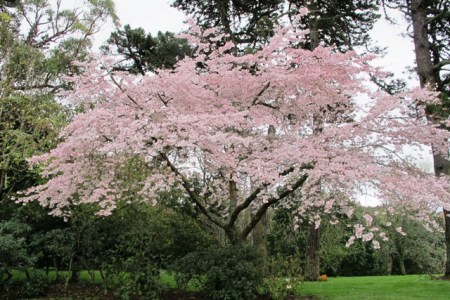
Prunus Awanui, flowering in spring here, has a tendency to develop witches' broom

Prunus Awanui, flowering in spring here, has a tendency to develop witches’ broom

Summer pruning

Now, at the height of summer, is the time to prune prunus, be they flowering cherries, fruiting cherries, plums, peaches, nectarines, apricots or almonds. Naturally you wait until they have finished fruiting for the season where possible. These plants are always pruned when in full growth to stop the dreaded silver leaf or silver blight getting in to the cut surfaces and taking hold. If your flowering cherry had large patches which didn’t bloom in spring and where the leafy growth is denser, then you have witches’ broom and it needs to be cut out now. If you leave it be, it will take over the whole tree and you won’t get any flowers at all in due course. It affects the Japanese type cherries but not the earlier flowering campanulata or Taiwanese varieties.

Make clean cuts with a sharp pruning saw and if you are moving on from an unhealthy tree specimen, then disinfect pruning implements between. Otherwise you can transfer disease. Wiping the cutting blades with meths or chlorine should work.

First published in the Waikato Times and reprinted here with their permission.
Garden lore

” You have only to think of the front gardens you drive past in summer that are planted up almost entirely with dwarfs to realise how lacking in character and individuality they are. Such plants never get off the ground; they are mere colour explosions.”

The Well Tempered Garden by Christopher Lloyd (1973)

Summer lawn care

Set your lawnmower a notch higher for summer, or several notches higher if you are one who scalps your lawn. It is a myth that if you cut your lawn very short, it will need less mowing. In fact if you cut it very short, you weaken the grass growth to the point where it is likely to die off over summer and what you get instead is an invasion of weeds. Paspalum, kikuyu, summer grasses and flat weeds – all will thrive in the vacuum you are creating. Without exception, good lawns and turf are cut a little longer. If you have neglected, long, rank grass (which can happen at holiday homes), don’t try and get it down in one hit. Cut first on the highest setting. Wait a few days and then cut a second time to the desired length. Your grass is less likely to go into shock and die over summer.

First published in the Waikato Times and reprinted here with their permission.

Garden lore

“I asked a schoolboy, in the sweet summertide, ‘what he thought a garden was for?’ and he said Strawberries. His younger sister suggested Croquet and the elder Garden-parties. The brother from Oxford made a prompt declaration in favour of Lawn Tennis and Cigarettes, but he was rebuked by a solemn senior…and was told that ‘a garden was designed for botanical research, and for the classification of plants.”

Is He Dead Yet by Rev Samuel Hole (1819-1904)

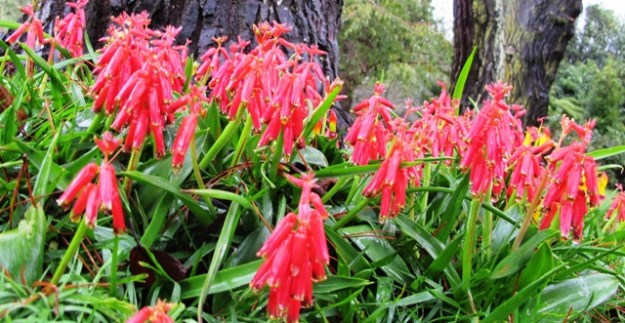
Late winter flowering Lachenalia bulbifera

Late winter flowering Lachenalia bulbifera

Digging and dividing part 2: bulbs

While the season has passed for planting trees and shrubs, think bulbs. All the autumn bulbs will be dormant now but ready to spring into growth with the trigger of summer rains. This takes in bulbs such as nerines, colchicums, many of the species cyclamen and ornamental oxalis. Lift them and spread them or repot them now if they were looking overcrowded last autumn. It is also a good time to do the same with the early spring bulbs such as daffodils, tulips, bluebells, lachenalias, snowdrops and snowflakes. Many of these still have vestiges of foliage hanging on so you can actually find the clump without having to exploratory excavations. If the clump is pushing itself up out of the ground, it is a sure sign you need to thin them out.

First published in the Waikato Times and reprinted here with their permission.

Garden lore

I am strongly of the opinion that a quantity of plants, however good the plants may be themselves and however ample their number, does not make a garden; it only makes a collection.

Colour in the Flower Garden by Gertrude Jekyll (1908).

Dead heading

Plants don’t flower to delight humans. That is merely a bonus for us. Plants are genetically programmed to reproduce themselves and flowering is part of that process. Dead heading plants is therefore akin to contraception – preventing them from setting seed. In many cases, the plant will try again and set more flowers. That is what happens with annuals, perennials and repeat flowering roses. Removing spent blooms will extend their flowering season considerably. It doesn’t work for plants where flowering is set the preceding year (bulbs, rhododendrons and many other woody plants) but interrupting the process of setting seed can make the plant concentrate its energies on fresh growth and setting more flower buds instead. Annuals and biennials die after setting seed. Some plants can set so much seed that they weaken themselves and may eventually die (some rhododendrons and pieris, for example). Plants which are sterile often flower extremely well because they never get past that optimistic first stage of procreation.

First published in the Waikato Times and reprinted here with their permission.