Tag Archives: garden quotes

Garden Lore

Decorum is the refinement of propriety. It is in order to procure stable-dung for hot-beds; it is proper to do this at all times when it is wanted, but it is decorous to have the work performed early in the morning, that the putrescent vapours and dropping litter may not prove offensive to the master of the garden, should he, or any of his family or friends, visit the scene.

John Claudius Loudon Encyclopedia of Gardening (1822)

Urban paving
Urban paving

How to cope with the escalating demand for off street parking is a major urban issue. The severe flooding that assails the United Kingdom with ever-increasing regularity has in part been attributed to the problems of urbanisation and increasing run-off. Water has to go somewhere and if it cannot be absorbed into the ground because of concrete and tarmac, it will either pond, flood or flow until it finds somewhere to go. Urban stormwater systems are not built to drain all the water away, merely the excess water.

There are commercial products designed to give a firm base for car parking while still allowing drainage and ground absorption. Laid properly, the area can still be mowed or raked. Even sealed areas need maintenance, whether by sweeping or the use of a leaf blower. This midway position is a much sounder option environmentally, as well as being softer to the eye than expanses of seal.

First published in the Waikato Times and reprinted here with their permission.
Garden Lore

“Few lend (but fools)
Their working Tools.”

Thomas Tusser Hundreth Good Pointes of Husbandrie (1557)

???????????????????????????????
Garden Lore: Winter Pruning

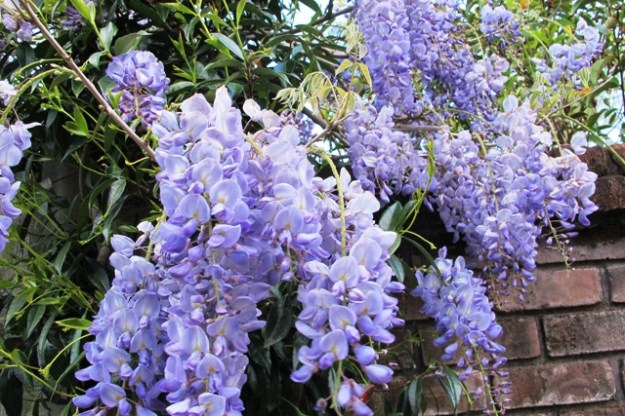
Winter and early spring are the optimum pruning times for most plants. Because the act of cutting back can stimulate plants into growth, timing can be important. Close to the coast, we only get light frosts so we never have to worry too much. But if you are used to waking to white ground and ice on puddles, hold back until the end of the month and leave the hydrangeas and roses until last.

Grapevines, raspberries – indeed all the brambles – and kiwi fruit need annual pruning or they will swamp you with their rampant growth. While pruning is recommended for most fruit trees, it doesn’t usually matter if you skip a year or two.

Always prune wisterias. They are as determined and rampant as kiwifruit. Roses will survive without pruning – although you may rue the day if you allow climbing ones free range and they look better for some care. Hydrangeas are pruned to increase flower size and to stop bushes getting too big. They will still bloom if you don’t prune them.

The critical piece of information you need is whether plants flower or fruit on last season’s new growth or on the new growth that they are preparing to make this spring. If is last year’s growth, as in hydrangeas, wisteria and raspberries, if you cut too hard, you simply won’t get any flowers or fruit this spring. Roses flower on fresh growth so you are pruning for shape and health and can cut back very hard. The same goes for grape vines. One size does not fit all in this matter.

First published in the Waikato Times and reprinted here with their permission.
Garden Lore

“His greatest passion is for transplanting. Everything we possess he moves from one end of the garden to the other, to produce better effects. Roses take the place of jessamines, jessamines of honeysuckles, and honeysuckles of lilacs, till they have all danced round as far as the space allows.”

Fanny Burney (Madame D’Arblay), Letter to her Father (1794).

?????????????????????: ??????????

Laying gravel chip

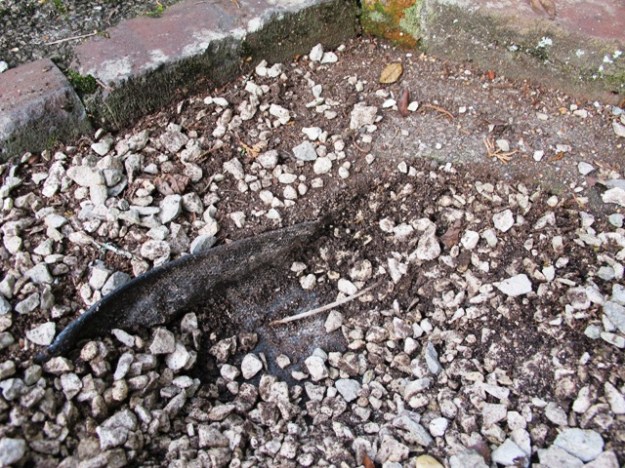
If you are laying gravel or chip, putting down a layer of weed matting first saves a great deal of work in the long run and prolongs the life of the surface. Weed mat allows water to drain through but prevents the mud and soil below from rising up to contaminate the gravel. It also stops weed seeds in the soil from germinating so the only weed germination you will get is what blows in.

We laid this limestone chip maybe 15 years ago. I raked back one corner to show the weed mat secured with a wire hoop. It has kept the chip relatively clean over the years and we still get very few weeds in it. The chip looked alarmingly white when we first laid it on a small square of lawn which we couldn’t reach with our super-duper new lawnmower, but it has mellowed out with time. We excavated down about 7.5cm, maybe 10cm, to allow for sufficient depth so that the weed mat is never visible.

The only maintenance required on this area is removing leaf litter. It was tedious to do with a leaf rake but then we found the leaf blower is perfect for removing windblown litter without disturbing the chip as long as you have a light hand. We plan more gravel paths and will lay weed mat first. It is short term effort for long term gain.

First published in the Waikato Times and reprinted here with their permission.
Garden Lore

“When Wordsworth’s heart with pleasure filled at a crowd of golden daffodils, it’s a safe bet he didn’t see them two weeks later.”

Geoff Hamilton (1936-1996)

Kereru in the apple trees

Kereru in the apple trees

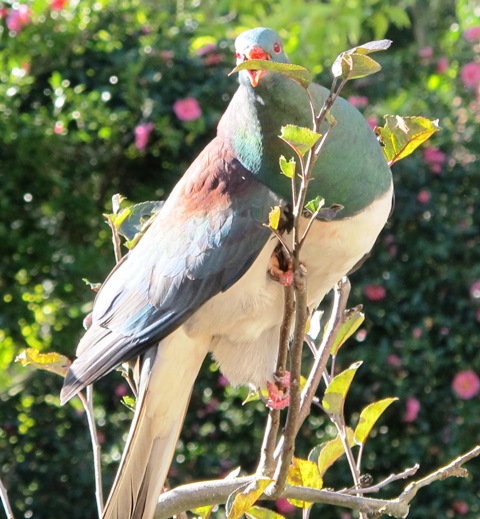
New Zealand’s native wood pigeon. the kereru

The kereru in the apple trees just outside our back door has returned. This is a seasonal appearance. It flies in every day to spend much of the afternoon munching away on the remaining apple leaves. As the trees close down for winter dormancy, the sugars concentrate in the foliage. The kereru never comes in to feed from them until late autumn or early winter but it is pretty enthusiastic now. We rarely see more than one at a time in these trees at a time although we know we have more than just the one as a regular on the property. I see they can live to be 20 years old so perhaps it is just this one that has discovered a taste treat. It is determined and will try and out-stare both humans and dogs until we get within a metre or two before it abandons ship to crash away. At 650 grams average weight, kereru do a lot of crashing at both take off and landing.

Along from the apple trees, we have planted both red and yellow guavas. They are the South American Psidium littorale, not the tropical guava. These were a nostalgic planting specifically to feed both kereru and grandchildren alike. The latter have yet to make an appearance but the kereru are appreciative.

As far as we know, our kereru stick around all year, feeding from a variety of berries, fruit, seeds, flowers and leaves. While they are usually solitary birds, we have counted up to 15 at once on a memorable occasion. Various reasons are given for the national decline in numbers but none of the experts seem to add extremely poor nest building to that list. When it comes to nests and ensuring the safety of their one, solitary offspring at a time, these birds must be contenders for the title of NZ’s worst nest builders.

First printed in the Waikato Times and reprinted here with their permission.
Garden Lore

“How magnificent it sounds! That is the fun of writing of one’s garden: a steep bank can be a cliff, a puddle a pool, a pool a lake, bog and moraine sound as though a guide were needed to find your way across them, and yet may be covered by a sheet of the Times. My Dolomites like within the compass of my outstretched arms.”

Edward Augustus Bowles My Garden in Spring (1914)

The death spiral

The death spiral

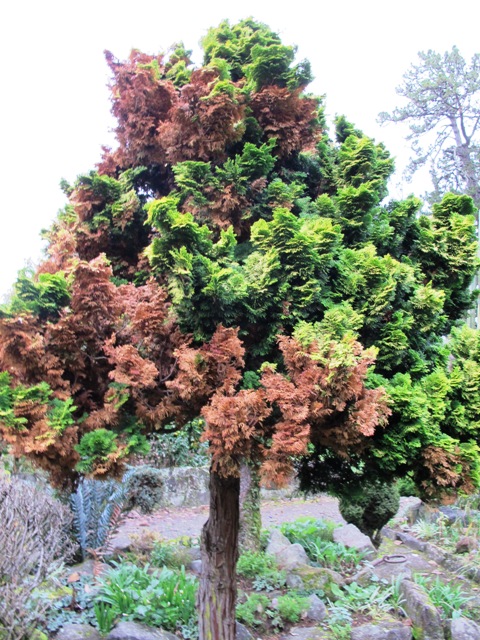
This is not a happy tree and that is not autumn colour you are looking at. It is a slow death spiral unless we can intervene. Despite sharing the same reservations as most New Zealanders about variegated yellow conifers, we regard this one as special and wish to keep it. It is Chamaecyparis obutusa lutea nana and after about 40 years, it is a handsome, small feature tree in our rockery, not much over two metres tall.

The spiral-type pattern of the dead sections is a sign that it is a root problem and that, so far, only the part of the root system that affects those sections of the canopy is failing. If one solid section of the tree was affected, it can indicate that the tree is dying from top down and that it may be possible to cut out the infected area. But the overall patchiness shows it is dying from bottom up.

While we are increasingly reluctant to reach for the chemical arsenal, the first step here is to saturate spray for phytophthora, a varied pathogen that attacks root systems. It is a problem in vineyards and a form of it caused the potato famines in Ireland. If that fails, the last ditch attempt will be with Trichodowel – fine pieces of dowelling, each impregnated, according to the packet with “not less than 100 million Trichoderma viride spores” (who counted?). The dowels are designed to be inserted into the trunk or branch where the good spore can multiply and maybe defeat the baddies. If it was a silver blight problem, we would use these first but it is either/or because the anti-fungal spray will kill the beneficial fungi.

If it wasn’t a valued feature plant, we would let nature take its course and we would not replace it with another woody plant which may suffer the same fate.

First published in the Waikato Times and reprinted here with their permission.