Monthly Archives: January 2012

Tikorangi – the new Texas?

Next door - not quite the Tikorangi locals signed up for when they settled here

Next door - not quite the Tikorangi locals signed up for when they settled here

I can’t honestly say we are thrilled to learn of the deal between Todd Energy and Methanex which will see up to 25 wells drilled to frack the sub strata of the area where we live. Tikorangi isn’t very big and the first three wells are next door to us, with more scheduled to follow on the same site.

But we are pretty much alone in that. Industry thinks it is wonderful. Most Taranaki locals think it is wonderful because it brings jobs and money. The mayor thinks it’s wonderful. Somewhat disturbingly, the CEO of the regional council thinks it is wonderful (I say disturbingly because that is the body tasked with regulating and monitoring the industry’s activities and it is clear that they are very kindly disposed to the key players). The editor of the local paper thinks it is wonderful – which indicates that the paper will maintain its position of being the PR mouthpiece for the energy industry.

The bottom line is that the oil and gas industry may well be good for the national economy. It is certainly very good for the regional economy and means we have a superior class of cafe and restaurant in New Plymouth.
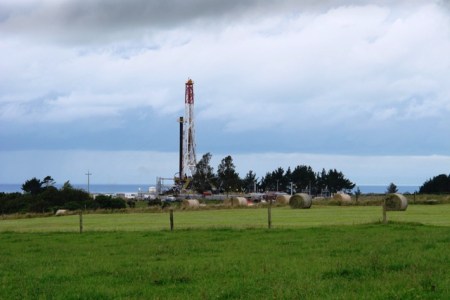
An increasingly common sight in our landscape

An increasingly common sight in our landscape

But there ain’t nuthin’ good for the locals who live by the sites. Nothing. At. All. They are ugly, industrial sites in the middle of rolling, green countryside. Drilling is noisy. The increase in traffic, especially heavy transport, has been major over the years. Flaring is abominable – flaring being the exercise of cleaning up the wells and testing the flows by igniting the gas. Considering there is nothing good for the environment in drilling either, I am somewhat surprised that the industry continues to get away with flaring. Don’t even try and tell me that anything I can do to reduce carbon emissions will help the planet – not when I live in an area where flaring takes place.

Over the years we have seen changes and some for the better. The first well drilled next door to us, maybe three years ago, was flared for many weeks on end. It was so bright, we could see the glow as we drove out of New Plymouth, 25km away. It lit our house all night. But worse was the noise – the constant, unabated, low grade roar which meant that living here was like living on the flight path to Heathrow, but this was 24/7. When you have lived for years in the relative silence and total darkness of the country, flaring has a huge impact on quality of life.

Flaring was greatly reduced for the second well on the same site and I am hopeful that the third currently being drilled (we can hear the rig grinding away in the quiet of the night and the morn), may see flaring reduced further.

Less high handed bullying from the companies is another change. We are lucky. We are dealing with Todd Energy who appear to be one of the better companies to deal with. I had thought the divisive bully-boy tactics of the petrochemical cowboys were in the past now (though only the relatively recent past) until I saw the media statements coming from another company on another site.

But we have also seen changes in the way the councils handle consents and the winding back on the definitions of affected parties. It is very difficult to convince councils that you are an affected party now and if you acquiesce and sign the agreement for one well, essentially you have signed away all rights to object in the future.

I have met with successive mayors and councils over about fifteen years, pleading with them to be more proactive in planning to mitigate the negative effects. They are terribly concerned and sympathetic and nothing happens. Planning, such as it is, remains completely reactive.

I have tried to get District Council to require, as part of the consents process, that sites be screened from public view by planting. I think they should only be visible from the air. High security industrial sites have no place in a rural landscape. Nothing has happened.

Today’s newspaper, where both District and Regional Council hail all the positive benefits of the economic boom gives me no confidence at all that any negative aspects will be even be acknowledged, let alone addressed.
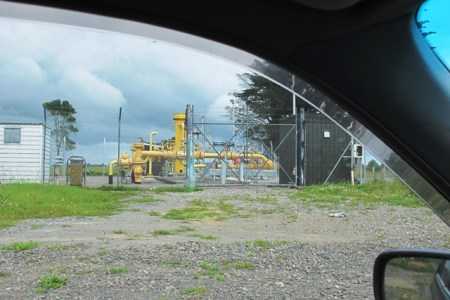
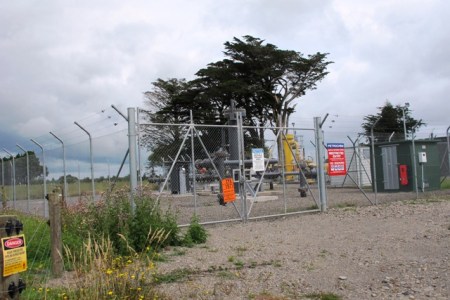
I try not to look but in this case, it is both sides of the road. They should be screened from view.

I try not to look but in this case, it is both sides of the road. They should be screened from view.

So the gentle area where we live, a soft rural landscape with reasonably high density population and a solid core of very longstanding families, both Maori and Pakeha, will just roll with the changes as we have for the past decades. We will be the guinea pigs for fracking here. We will let you know if it does cause earthquakes or contaminate our water supplies. The ground below us is about to be fracked in every direction. We will adapt to the increase in traffic though we probably all hope that the ridiculous practice of laying gas pipelines down our roads and verges won’t happen again (how to cause maximum disruption to the largest number possible and completely without apology!) We will grit our teeth and only complain when the noise incidents get beyond the pale. And some of us will wait.

I think it likely that in a decade or two, all the viable reserves of oil and gas beneath us will be gone. The companies will pull out. The multitudes of small industrial sites I try not to look at will be reclaimed by long grass and then by other vegetation. Processing plants will be mothballed. The traffic will reduce and peace will return. I have to take the long view because the juggernaut that is the petrochemical industry rolls on unchecked in Taranaki in the short term.

The adjacent house is, I understand, still occupied by a very long term Tikorangi resident
The adjacent house is, I understand, still occupied by a very long term Tikorangi resident
Tikorangi Notes: Friday 13 January, 2012

Latest Posts:

1) It is difficult to do justice to the Cyanella capensis in a photograph, but it must be one of the longest lasting summer bulb. It just gently flowers on and on in an unassuming way. “It looks like a blue gypsophila,” was Mark’s comment.

2) The weird and wonderful world of show vegetables – a competitive social phenomenon in the UK which has pretty much bypassed the more pragmatic gardeners in this country.

3) The wonderful world of growing parsnips. Okay, a bit of hyperbole there – just a bit of practical advice on how to grow one of the world’s less glamorous vegetables for winter.


Tikorangi Notes: Friday 13 January, 2012
I guess the one consoling factor in the continued run of dreary weather is that it is not limited to the area where we live! A misery shared is a misery halved, in the weather stakes at least. Even the Australian daughters are complaining about Sydney and Canberra weather and certainly it does not appear to be any better anywhere in the North Island of New Zealand. The raspberries are rotting before they have sweetened. The roses are mush. Anything bravely standing up is beaten down by the intermittent but torrential rain. The swimming pool cover remains resolutely in place. I have not even thought of going for a dip in recent weeks. The only consolation is that we know fine weather will return – it is just a matter of whether it is sooner or later.

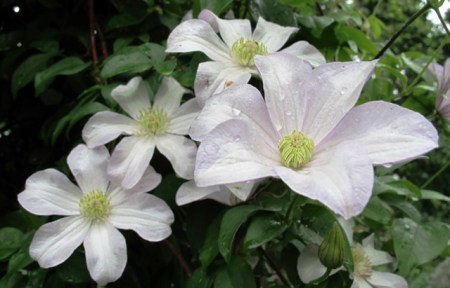
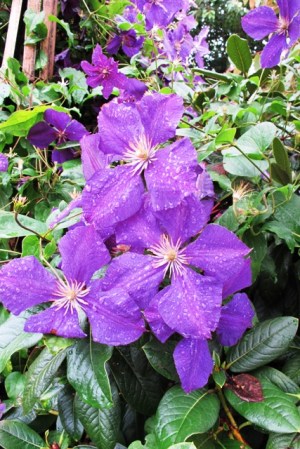
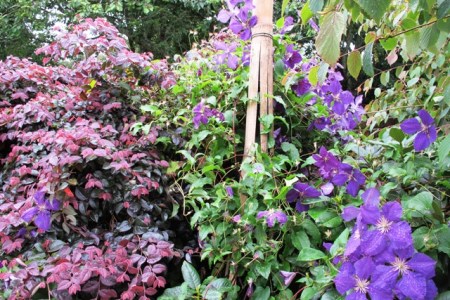
The clematis remain valiant stars in all this dreary weather. We have lost the names on all of them though, should we feel the need, we know how we can get them identified. We have dug out the ones that are too rampant and thuggish in their ways and I remain unconvinced at the idea of ground cover types (too strong and choking). But given something to climb up, we have a range which are quiet and undemanding performers. All I do is cut them down once or twice a year to near ground level. Beyond that, they just get the standard treatment of other plants in the borders (a mulch of compost). I was told by a clematis expert that most of the hybrids can be cut back very hard after flowering, fed, watered and they will return with a new flush of blooms in six weeks time. I haven’t timed it, but it did make me realise that many clematis are not shy and timid plants and can take fairly ruthless handling. Should you feel the need to make a bamboo obelisk (you can just catch a glimpse of one supporting the clematis in the photo below, we gave step by step instructions in an earlier Outdoor Classroom.

The Turk’s cap and trumpet lilies are in flower with the auratums in heavy bud. It is the auratums that are the stars of summer display so we are hoping for better weather in the next fortnight.

Clematis with Loropetalum China Pink

Plant Collector: Cyanella capensis

Cyanella capensis - described by Mark as appearing like a blue gypsohila in the garden

Cyanella capensis - described by Mark as appearing like a blue gypsohila in the garden

There is some debate as to whether this plant is accurately named as Cyanella capensis and whether that is in fact synonymous with Cyanella hyacinthoides, but there is no doubt that it has been a quiet star in the rockery for nigh on two months now. Many bulbs are a wonderful, quick, seasonal flash. Plants like the cyanella which just keep going week after week are considerably rarer.

The “capensis” part of the name gives a clue – South African again, from the Cape Province. It is not a big show-stopper. Like some of the species gladiolus and the ixias, the foliage starts to die off and look scruffy as the flowers open but in this case, the flowers have continued long after the foliage has withered away and disappeared. Each six petalled flower is about 15mm across, lilac blue with golden stamens and masses of them just dance on the leafless branch structure, reminiscent of a blue gypsophila.

We have had this cyanella in the rockery for many years now. I have ferreted around looking for the bulbs to spread further afield but clearly they are of the type which can find its own depth and in this case, that is deep. I have failed to find them. Apparently they are edible and somewhat oniony in flavour, also used in times past as a poultice, so they must be a reasonable size. I may have to have another dig to see. The flowers are pollinated by bees and can set viable seed.

There are different species of cyanella – about seven in fact – and we were given the yellow form, Cyanella lutea but it failed to last the distance with us.

First printed in the Waikato Times and reproduced here with their permission.

The Weird and Wonderful World of Show Vegetables

We are never going to get show vegetables out of our garden

We are never going to get show vegetables out of our garden

There is something wonderfully compelling about the bizarre, the obsessive and the freaky which may explain why even our daughter joined us on the sofa to shriek with laughter at the programme on the Living Channel last Sunday. It was all about growing and showing vegetables in the United Kingdom. Before any readers get defensive, I hasten to add that we have the utmost respect for the skills required and the proud tradition of competing for prizes in various vegetable classes. It is just a tradition which has largely bypassed us in New Zealand so we are bound to find the proud woman holder of the title of World’s Best Potato Grower faintly amusing.

Growing vegetables for show does not have a lot to do with eating them. In fact eating them was never mentioned. Growing 900 onions in the quest for the best sets of five perfectly matched specimens, each weighing 250 grams, does leave one with a rather eyewateringly large excess of produce for ahome grower. And what exactly are you going to do with the other 85 heads of celery which did not make the cut when you selected the best five to show? These are celery plants which have been grown entirely under cover, nursed, mollycoddled, blanched and fussed over until they can reach a massive 150 cm high or even more. They are hardly going to fit in the fridge. But once you have seen them being lovingly washed in a large bath of soapy water and gently groomed with a soft toothbrush, you realise this has nothing to do with home vegetable gardening. It is more akin the vegetable equivalent of the prestigious Crufts Dog Show but without the social pretensions.

There are rigid rules as to what is acceptable and what is not. Immaculate, matched onions are presented with a neat tie of raffia to hold the trimmed top tidily (which sparked a comment from the show host along the lines of: “Nothing finishes a perfect onion like a sheaf of raffia,”) but woe betide anybody who steps over the line to flamboyance. A modest knot may be required, a bow is enough to get you disqualified – or so the husband tells me from another show he watched.

Carrots and parsnips are popular crops but growing them takes special techniques and even then you may not get specimens with precision tapering, let alone perfectly matched sets of three identical specimens. Don’t be thinking that you can win with garden specimens grown in soils. These are grown in drums. First these drums are packed with coarse sand. A tube is then used to extract a perfectly straight column in the sand which is filled with the highest quality, fine garden mix. It has to be sieved garden mix because any untoward chunks could cause the plant’s roots to kink or bend. This is a serious business where timing, technique and crop management is critical. Carrots should have a nicely rounded base and are exhibited without their roots. Parsnips should be perfectly tapered and are measured and exhibited with the long tap root attached in its entirety.

We were riveted, as only holiday-makers on a bleak and windy summer Sunday afternoon can be, to learn that in order to clean and present your carrots or parsnips, you have to gently sponge them in a circular motion. If you rub them up and down, you will scratch the outer skin and cause blemishes. That is a piece of new information which just may or may not be useful at some point in my life.

Presumably it is the exhibitionists who grow the freaks. There was an earlier series on growing extreme vegetables – the parsnip, I was told, grew in a length of downpipe which ran three stories high. In this country, the giant pumpkin growing competitions are relatively common and most of us realise that said competitive pumpkins are not destined for the dining table, being of value only as stock food. Size and weight are everything in the freak classes. Beauty, uniformity and perfection count for nought.

Prize money does not count either. It is fame, glory and recognition. Most of the vegetable competitions in the UK (and there are legions of them) carry prizes of a few pounds only. The costs of competing are hugely greater than any financial reward – best grade seed only, packets of potting mix, washed sand, peat, special fertilisers and sprays and that is just for starters. Mark was a little put out to see that the competitive celery grower had a state of the art glasshouse which left anything we have here completely in the shade despite the fact that we have been professional growers of plants for the last few decades.

This is not to say that we don’t have competitions here. Mark recalls judging the vegetables at some gathering in Otorohanga where he was a guest speaker some years ago. I am sure I must have done it for the local Country Women’s Institute here at some stage. Maybe we are just of more pragmatic stock in this country. I am pretty sure that the vegetables I have seen exhibited here were actually edible and were grown in gardens. This is a very different kettle of fish to show vegetables.

First published in the Waikato Times and reproduced here with their permission.

Grow it Yourself – parsnips

Parsnips are not the most glamorous of vegetables, even less so when old and woody which is usually a sign of being dug too late. But I am very partial to a bit of roast parsnip and they add welcome variety in winter when veg can get a bit repetitive. We are doing a late sowing parsnip seed now for winter harvest. Others will have sown as early as last spring though they are not likely to harvest before winter. They will have considerably larger specimens by then, as long as they do not bolt to seed. From this you can take it that the timing is not critical. They take about four and half months to reach maturity so you can be eating them from July onwards if planting now. It is usual to leave them in the ground and dig as required. They go dormant over winter and frosts are said to enhance the flavour considerably.

The two critical issues are to use fresh seed (parsnip seed does not store well) and to avoid additional fertilisers. Nitrogenous fertilisers will encourage too much top, leafy growth and not enough root development. Fresh manures will cause forked and misshapen roots. Parsnips are a good option where you have taken out a heavily fertilised crop like leafy greens or even potatoes. Don’t add anything extra – there should be plenty of goodness left in the soil. Make sure the soil is well tilled and friable to allow the roots to grow straight. Seed is sown close to the surface and covered lightly. Once it has germinated and is growing away strongly, thin to at least 10cm apart in every direction to allow room to develop. Diseases are not usually an issue and while a few pests can attack parsnips (carrot fly, greenfly and wireworm), this is not usually a big problem.

First published in the Waikato Times and reproduced here with their permission.