Monthly Archives: January 2013

Not one but three new Jury magnolias this year

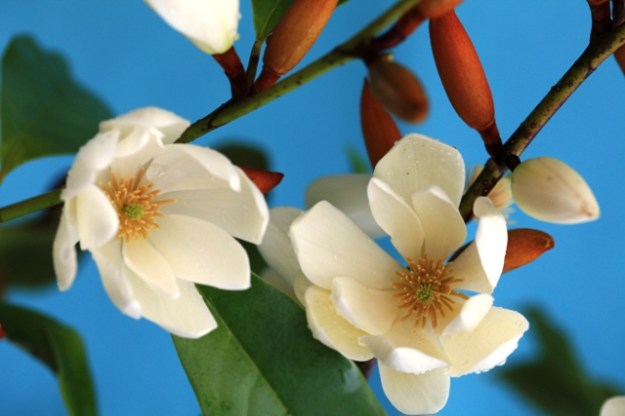
The sublime blooms on Fairy Magnolia® White

The sublime blooms on Fairy Magnolia® White


It is not often that we have three major new releases coming out in one year. And, to be honest, it takes so many years of trialling and then building up that by the time they are released, they no longer feel “new” to us. But there is a surge of pride with these three hybrids of Mark’s breeding.
Magnolia Honey Tulip, our new yellow version of Black Tulip

Magnolia Honey Tulip, our new yellow version of Black Tulip


Mark is very particular about deciduous magnolias and had only named three – all in red tones. The fourth, to be released this year, is his first in the yellows. Honey Tulip™ is a golden honey version of Black Tulip. Given the somewhat floppy nature of most yellow magnolias with their soft petals and tendency to become paler as the flowering season progresses, we think Honey Tulip represents an advance in flower form, petal substance and retention of its colour intensity through the season. In New Zealand, where most yellow magnolias flower at the same time as they come into leaf, it is to Honey Tulip’s credit that it flowers on bare wood. Trials suggest that it will remain a smaller growing tree.

Fairy Magnolia® is the branding attached to our new range of michelias. These have been reclassified as magnolias but we wanted to differentiate these new michelias from the usual evergreen magnolias which are the leather-leafed grandiflora types. These are much lighter in growth and fill a different role in the garden and landscape. The first release was Fairy Magnolia® Blush.

Fairy Magnolia Cream - many flowers over a long season

Fairy Magnolia Cream – many flowers over a long season


Fairy Magnolia® Cream is a free flowering, strongly fragrant pure cream, opening in early spring. While of similar breeding and performance to Blush, its foliage is a brighter green and its peak flowering season extends into months. Each bloom measures at least 10cm across. Cream will take clipping well to keep it hedged, compact or topiaried or it can be left to form a bushy ,large shrub around 4 metres tall by 2.5 metres wide.

Fairy Magnolia® White (pictured at the top) comes down a different breeding chain and is a selection from a run of seedlings we have been referring to as the Snow Flurry series. The fragrant, purest white flowers are sublime, opening from brown velvet buds. It flowers earlier than Blush and Cream, starting in winter, so it is not likely to be as hardy as those two. However, we think it will prove to be hardier than existing doltsopa selections, making a garden friendly, improved substitute for “Silver Clouds”. The foliage is smaller and the plant shows no signs of defoliating after flowering (a major drawback to many doltsopas). It is much bushier in growth and will ultimately reach around 5m by 4m if not trimmed.

All plants will be available in New Zealand in limited quantities and some will be available overseas. These plants are produced under licence (in other words we only have small numbers to sell to personal customers later in the year when we open for plant sales) so ask your local garden centre. Overseas readers may like to check out Anthony Tesselaar Plants for availability.

Magnolia (deciduous) Honey Tulip
Magnolia (deciduous) Honey Tulip


Fairy Magnolia Cream

Fairy Magnolia Cream

Plant collector: Eryngium planum

The hazy blue of Eryngium planum

The hazy blue of Eryngium planum

I thought it was going to be easy to write up eryngiums but it transpires that there are a whole lot of different ones from various habitats and climates. So I will confine my comments to the ones we are growing here. I love these ethereal thistle or teasel-like flowers in the prettiest hazy blue. We have had what I think is Eryngium variifolium in the rockery for a number of years. Despite its decidedly prickly habit and its location too close to the path, the flowers are always a summer delight. When I tried to move it back from the path, I found it had a phenomenally long and tough tap root so it defied my plans. That one has never set seed for us. Some eryngiums are propagated by autumn root cuttings so we plan to try that.

Eryngium planum is taller so needs staking in the garden. It flowers earlier in the season and grows easily from seed. We ordered it through Kings Seeds and this is the first summer we have had a good sized planting of it. I am hoping it will set seed because I think I can use lots of this plant in the summer garden. It doesn’t take up much space so can grow through other plants and the flowers last a long time. Both forms we have are perennials. E. variifolium disappears entirely in winter but neither of us can remember whether E. planum does too or whether it retains a smaller rosette of visible leaves.

Eryngiums belong to the Apiaceae family (with carrots!) not the thistle family. They are often referred to as sea holly but that should more correctly be ascribed to E. maritimum which we have seen growing wild on the coast of Cornwall.

First published in the Waikato Times and reprinted here with their permission.

The answer, as they say, lies in the soil

What is visible above ground is entirely dependent on what is happening below

What is visible above ground is entirely dependent on what is happening below

A reader took me to task for last week’s column, objecting to my careless use of dirt as a synonym for soil. I would argue that “dirt” is merely the vernacular and in no way demeans the gravitas of soil, but it did get me thinking about the natural growing medium beneath our feet. I also found a wonderful throwaway comment in the same book that gave this week’s gardening quote – The Curious Gardener’s Almanac.

Following on from the old adage of “look after the soil and the soil will look after the plants” was a variation on the theme: “Feed the soil, not the plants”. Yes, I thought. That was a message that spoke to me. We swim against the modern tide and rarely use garden fertiliser here, preferring instead to rely on home-made compost.

Garden soil must be the least sexy and interesting part of gardening for the novice. Yet every single experienced gardener, without exception, will tell you that the state of your garden soil is critical to the end result with the plants. It is just that the plants are a lot more interesting so beginner gardeners start with them. There can be an awful lot of fatalities before they work out that the state of the soil may need some serious attention.

The current craze for no-dig gardening is another issue altogether which I may return to in the future. But whether you opt to plant in the ground or on top of the ground, the growing medium that houses the roots of all your plants is critical.

We are in-ground gardeners here and are lucky to be on free draining, fine, volcanic loam which is one of the easiest natural mediums of all with which to work. Others are nowhere near as lucky.

The aim is to develop friable loam

The aim is to develop friable loam

At the ends of the spectrum are the fine, sandy soils (predominantly in coastal areas) and heavy clay. The former is lacking in humus and does not retain moisture or nutrition. The latter holds too much moisture in wet times but can take on a concrete-like consistency in dry times. Clay lacks aeration, making it difficult for plant roots to function well.

Often new housing subdivisions end up with deeply inhospitable soils. In the past, developers were renowned for removing the top soil and then selling it back later when the home owner wanted to start a garden. I have no idea if that is true but where excavation has been necessary, developers are unlikely to understand the need to set the top soil layer aside in order to replace it in its rightful place on top when the site is finally levelled again. They are more likely to mix it all up so you end up with the sub stratas (often heavy clay) dominating the top layers.

If you are new to gardening and are not at all sure what your soil is like, take up walking around your neighbourhood. If you have neighbours, you are sure to find one out in their garden and most will be glad to give you advice. Soil types can vary widely, though if you are in dairying territory, you are likely to have better soils.

If your soils are less than ideal, set aside the prepackaged or processed fertilisers. They are a short term fix for short term plants but won’t do anything at all for your soil structure.

Sandy soils which dry out very quickly lack humus and sustenance for plants. There are probably very few worms, yet these wrigglers play an important role in mixing up and aerating the soil. You can alter the structure, but it takes work and time. You need to load in the compost, leaf litter, grass clippings, seaweed and any other natural material which will add substance to the soil. Keep at it over time too. It is not a one-off task.

Animal manures should be left to age before you bury them in the soil. They are too strong when they are fresh and can burn plants. You can dig a trench and bury your kitchen scraps directly in to the ground. You are just trying to get as much organic material into the soil and then the worms will start arriving along with all the other natural microbial action and insect life of healthy soils.

Clay soils also suffer from a lack of worms but they are not lacking in nutrients as a rule. Basically, the aim is to break up the clay to allow for better drainage, increased worm activity and aeration. Adding gypsum is one strategy. Bringing in very fine gravel or sharp river sand is reputed to help but you are likely to need several centimetres of it to make any difference and it will need to be dug through the clay. Otherwise, do the same as for sandy soils and bring in mountains of humus. Build up your layers on top. The worms will arrive and start to do some of the work for you.

You are trying to speed up a natural process where top soil builds up closest to the surface, giving you friable and fertile conditions in which to grow plants.

None of this is rocket science. It just takes time, effort and a strong back if you are starting with impoverished soil conditions. You often have to take the longer term view in gardening.

First published in the Waikato Times and reprinted here with their permission.

Garden lore

“A well-watered lawn will look great for a week or two, but you will have created a rod for your own back because it will start to expect another dousing. Grass is a tough plant and can survive very long stretches without water. No matter how severe a summer drought, no one’s lawn in Britain has ever died from lack of water. It can survive up to eight months without rain.”

The Curious Gardener’s Almanac by Niall Edworthy (2006)

Summer watering

Readers who have gone for the raised vegetable garden beds should be discovering a major disadvantage around now. Raised beds need a whole lot more watering in dry conditions because they dry out much more quickly than the ground below. Container plants dry out even faster.

Ideally, evening watering is better than morning watering because the cooler night temperatures allow for better absorption. A spray of water is preferable to a jet. Making many slow passes over the surface rather than flooding it allows for better penetration by the water. A good deep watering every few days is much more effective than merely passing over the surface each day. Dig down a little to see how far the water has penetrated. If it is only the top few centimetres, that is where the plants’ roots will be concentrated, making the plants even more vulnerable to drying out.

If you allow your container plants to get too dry, watering becomes ineffective because the water just flows straight through and is not absorbed at all. If the container is too big to sit in a bucket of water for at least 20 minutes, then a small squirt of dishwashing detergent on the top before watering can help absorption without harming the plant.

First published in the Waikato Times and reprinted here with their permission.

Plant Collector: Solandra longiflora

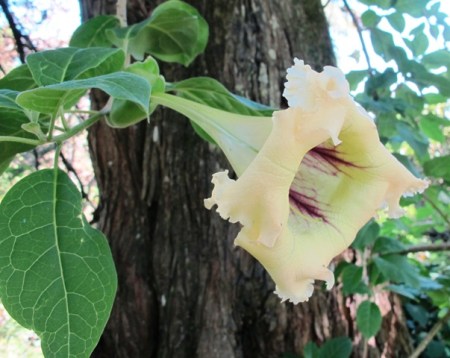
Solandra longiflora or the chalice vine

Solandra longiflora or the chalice vine

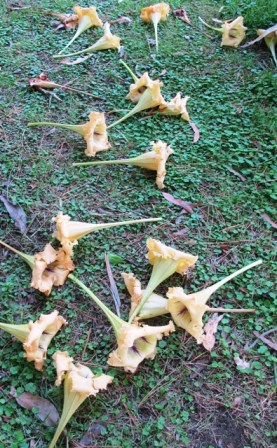
A carpet of spent trumpets

A carpet of spent trumpets

This is not a common plant at all in this country, where it has been identified as Solandra longiflora. All the solandras, of which there are around eight, appear to be variable species so not all longifloras will look the same as ours. However, they all share the common name of chalice vine on account of the large blooms that look like chalices. And they are strong climbers from the more tropical areas of the Americas, in the case of longiflora – the West Indies.

Ours has taken a fair number of years to get a good grip on the large tree we wanted it to grow up and also to produce more than just a few blooms. But this summer it is outdoing itself and we have an abundance of these large trumpets. They are an attractive amber honey colour with dark burgundy striping in the throat. At 25cm long and over 12cm across, there is quite a lot of flower.

The foliage is not exciting and bears some resemblance to woolly nightshade, daturas or brugmansias, this being because they all belong to the solanum family. It also shares some of the chemical compounds of the datura family but this is best left to the indigenous peoples who use it for a variety of purposes. Like datura, it is highly toxic and more likely to cause death in the wrong hands.

First published in the Waikato Times and reprinted here with their permission.