Monthly Archives: July 2018

Not just a fossil after all – the wollemi pine.

Our gifted wollemi

We were enormously touched when friends gave us their wollemi pine to plant in our park, where it has every chance to reach maturity. They had bought one of the first NZ releases of this endangered Australian plant – at a pretty hefty price tag of several hundred dollars – but were relocating from a large country property to a smaller town section and the wollemi would have been highly threatened by future property owners or neighbours, had they planted it in suburbia. In the longer term, it has the potential to reach 40 metres in height. It was a gift of love when they brought it out to us because it was a tree that meant a great deal to them and one that we were honoured to receive.

The wollemi – botanically Wollemia nobilis – is an ancient tree, dating back to the Jurassic period of dinosaurs. Yet it was not even discovered until 1994, when observant bushwalker, David Noble, came across a plant he didn’t recognise in a relatively remote canyon in the Wollemi National Park, a mere 150 kilometres from Sydney. Until then, it had only been seen in fossil form and it was thought to have died out, maybe millions of years ago.

A multi branched wollemi at Sydney Botanic Gardens last week

It is referred to as a pine and in time it produces cones but it has been declared a single species within a genus all of its own. So nobilis is the species. One step up the botanical nomenclature tree is the genus and this plant is so unique it was a given a genus of its own which is the wollemia part of the name. Only on the third step do we start to place its relatives and they are not pine trees (which are Pinaceae); it is Araucariacea which puts it in the same family as monkey puzzle trees and our native kauri. You have to go another step up to the order of Pinales before you get the botanical intersection with pines.

To the layperson, it looks closer to the podocarps – of the Podocarpus macrophyllus type – although they are in the same Pinales order referred to above so no more closely related to the wollemi than the pines are.

The wollemi at the Australian National Arboretum is already mature enough to bear cones

I mention this because it leads me to the story of an old rogue we knew (now deceased) who never felt obliged to follow the law when it came to plant imports. He turned up here triumphantly one day, totally unasked, bearing cuttings that he declared were the wollemi – purloined from the Melbourne Botanical Gardens, from memory. I had seen one of the earliest wollemi plants in the Canberra Botanical Gardens locked in a cage which was an interesting indicator of its perceived value. Mark was sure that the stolen cuttings were in fact a podocarp and to this day, we wonder whether the Melbourne garden staff named one of the podocarps as a wollemi to fool people such as the old rogue who shall remain nameless. If so, it worked.

The Canberra wollemi again – it was home to a rather large, showy, orange beetle which we do not have in NZ, I think.

The story of the discovery is interesting, as is the botany of this ancient plant (and its adaptability and very survival). But also the control of propagation, marketing and sales is remarkable. Getting it into wide circulation is one method of ensuring its continued survival. Intensive searching has led to the identification of fewer than 100 adult plants in a very limited natural habitat which makes it extremely vulnerable in the wild. Its original location remains a tightly guarded secret to protect the remaining trees. With the spread of kauri dieback (Phytophthora agathidicida) in this country where a main disease vector is human footwear, this seems a wise move. I have no idea who controlled the propagation (a lot of it is through tissue culture), distribution and marketing of the wollemi pine but it has been interesting to view from afar. There was a heavy emphasis from the start on “telling the story”, as is oft said, and the pricing has always been high which conferred considerable status on this unique plant. Especially considering it is not instantly appealing as a small plant and it is going to make a forest giant. It was the first new plant species that we were aware of being imported into New Zealand when our borders all but closed down to new plant imports. The fee for risk assessment at the time was around $65 000 and, from memory, it was a Christchurch institution that came up with that money to get it into the country legally. No individual or plant nursery is likely to come up with that sum for a single plant.

We will watch our precious plant grow over our lifetime. The well-established specimens in both the National Arboretum in Canberra and Sydney Botanic Gardens both promise that it will mature into an interesting character plant to match its interesting back story.

This is the Sydney wollemi again, viewed from the other side. I didn’t even register the bedding plants because I was looking at the sculpture.

It is clearly a sculpture with its own history, although I personally have no knowledge of the work of Andrew Fleischmann.
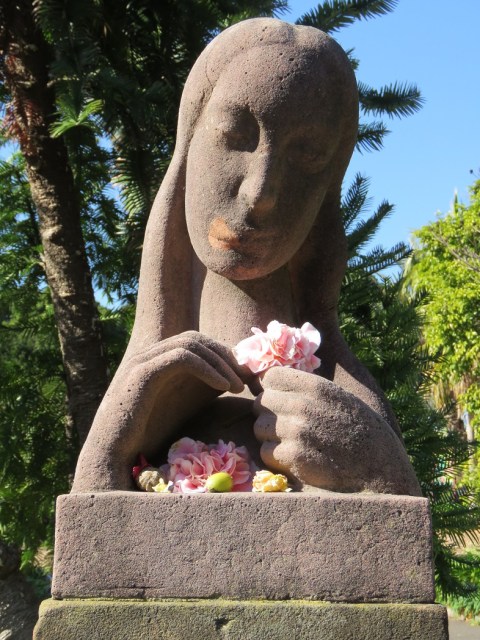
I was completely unconvinced that the addition of the camellias enhanced the sculpture, I am afraid. With bedding plants below, it smacked more of the descent of what I call “naffdom” rendering it merely sentimental. Or naff.

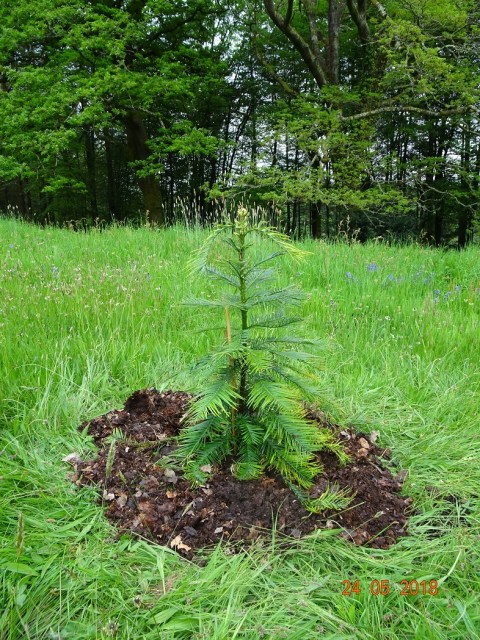
As a postscript, a reader has just sent me the following photo of her wollemi which she was thrilled to be given as a birthday present. This one is growing in the Dartmoor area of south east England. Just as the metasequoia was rapidly dispersed throughout the world after its rediscovery by plant hunters in China in the 1940s (we have an early one from that collection in our park), so too is the wollemi becoming a significant tree around the world.  
In search of more unusual plants

Back in the heady gardening days of the 1980s and 1990s, there were many specialist nurseries carrying a very wide range of unusual plants, mostly selling by mail-order. I described Peter Cave of Cave’s Tree Nursery, Glyn Church of Woodleigh Nursery and Mark Jury as being like the three musketeers but Mark reminded me of Chris and Linda Ryan at Top Trees and the late Os Blumhardt who led the way. Times changed. I think Top Trees may have closed first, followed by Peter, Glyn sold his business and Mark and I were the last of that quartet to stop selling plants, I think.
Since then, it has become extremely difficult to source many of the less common plants that were available and plant sales have become increasingly concentrated in the big box stores who carry quicker turnover stock in a hugely limited range.

You could have knocked us over with a feather when Peter Cave called in yesterday and said he has set up again, producing less common plants by mail-order (limited to New Zealand customers only). Except it is not mail-order any more, it is internet sales. (How funny to be old enough now to remember the days of real mail and the exciting advent of the fax machine!) This should be exciting news for those who often contact us looking for plants that have not been in commercial production in recent years. Now you can check out Peter and Anetta’s website for plants that you won’t find down at the chain stores. Peter has set up again under the name of Peter Cave Nursery.

I quote from Peter’s site:

When I started, importing plants was reasonable and cheap.  Expecting things to change I imported many plants and lots of seed, especially from Asian countries.  I also collected by travelling to China, Korea, Japan and especially Vietnam.   

The Biosecurity Amendment Act of 2003 completely changed that.  Importing a new species now required a $65,000 risk assessment! Slight changes since have meant that in the last 13 years about 5 new plants have come into NZ.  Fines are horrendous so don’t try to smuggle!  Our job is to locate earlier imports and grow these so we have ‘new’ plants.

I was surprised that recent plant imports numbered as high as five. I only knew of the Wollemi Pine. Peter being one of the real plantsmen of our generation, you can be confident that he knows his material well.

Woodleigh Nursery, formerly Glyn Church’s business, is now owned by Janica and Quinn Amoor. While a large range of hydrangeas remains part of their core business, Janica has been steadily expanding the range of other plants as well. Theirs is another online catalogue worth watching closely if you want different plant material that is not widely available from mainstream retailers. Just by way of example, we have just received Camellia irrawadiensis and Isoplexis canariensis from Janica – these are not plants you would expect to find at Mitre 10 or Bunnings.

This is in the nature of a public service announcement. I have no vested interest in recommending either nursery but isn’t it great that there are specialist growers who can offer you plants that you won’t find in everybody else’s garden? I had thought those days had gone.

Peter Cave is not offering magnolias on his new list but credit where credit is due. In the past, it is he who raised Magnolia Sweetheart to grace our gardens. 


Tikorangi Notes: Flowers great and small. With added lemons.

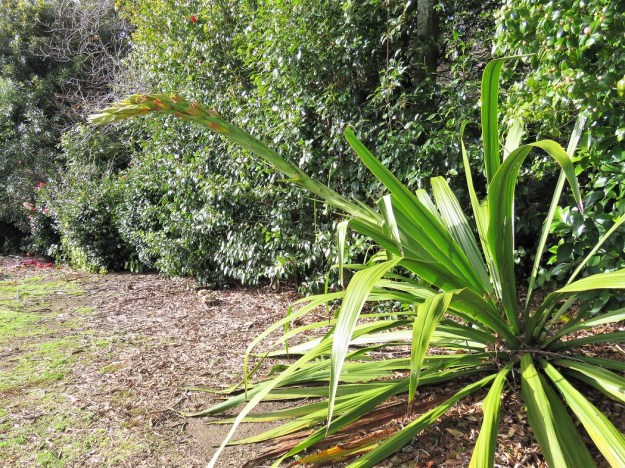
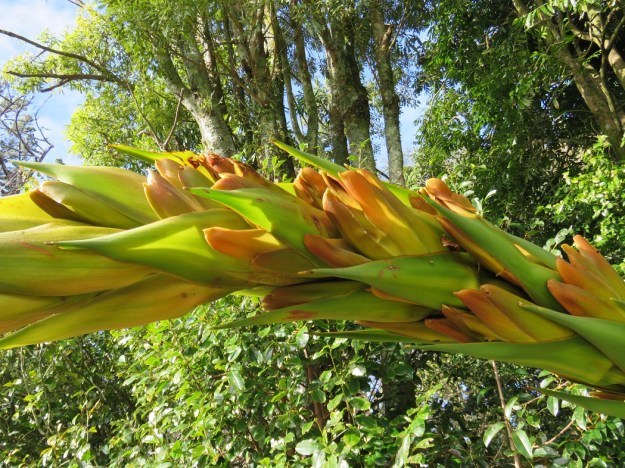
Doryanthes palmeri or giant spear lily. Certainly shaping up to be giant

Behold Doryanthes palmeri! The giant spear lily from eastern Australia. It has never flowered for us before so the three metre, sturdy flower spike is a thrill even though it has yet to open. This particular plant is a nursery relic, by which I mean that it was not planted in this position. More, cast aside from nursery crops (we once produced a few to sell) and left to its own devices. Now the grass garden is planted beside it and it looks quite at home. This is just as well; each pleated leaf is about one and a half metres long and I don’t fancy moving it. I am hoping the flowers will open in the next week or so.

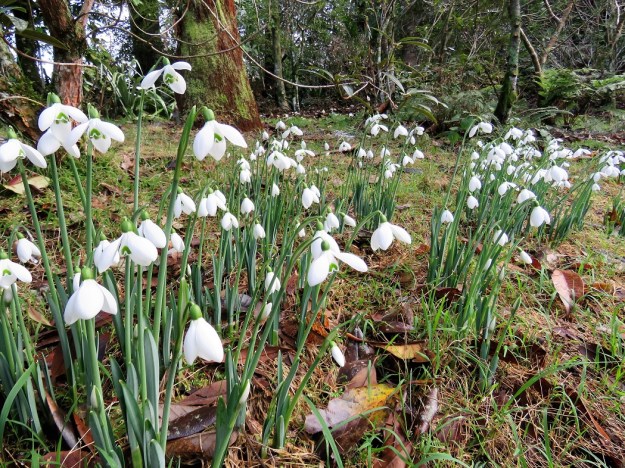
Snowdrop season! Galanthus S. Arnott

From the massive to the tiny, it is snowdrop season here. We are not really-o truly-o good snowdrop territory and Galanthus ‘S. Arnott’ and G. elwesii are the two main varieties that perform consistently well and multiply for us. Mark would dearly love some later flowering ones to extend the rather short season but while he went through a stage of gathering various different varieties, none of the later ones have thrived. Undeterred, he is trying some hybridising to see if he can get some variety but these projects, you understand, never yield instant results. It is more like a ten or twenty year plan, all to get the extended snowdrop season.

Luculia Fragrant Cloud keeps on flowering this season

It was a full month ago that I wrote about luculias. The bright pink ‘Early Dawn’ is well finished, white ‘Fragrant Pearl’ still has a few blooms but the main specimen plant needs some attention (a bit more judicious pruning and more light – it has flowered better in the past). But ‘Fragrant Cloud’ has been in full flight ever since and still looks good. This is the very best I have ever seen it and the scent is divine.

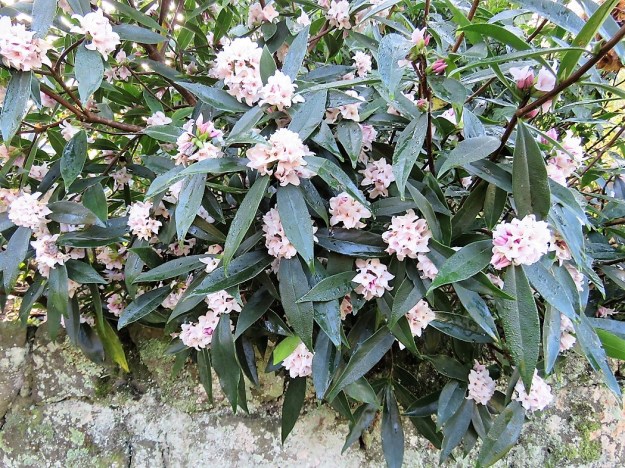
Daphne Perfume Princess

Equally fragrant are the daphnes in full bloom. We grow a number of different daphnes but a fair amount of them are our own ‘Perfume Princess’. Mark has bred other plants that are showier and more spectacular (especially the magnolias), but this obliging daphne represents a breeding breakthrough in some aspects and may well end up as the one he is best known for internationally. It is certainly the one that enabled us to retire early. Given that, we are deeply relieved as each year it proves itself again as a garden plant and a superior daphne which will stand the test of time.

I admit that as this post goes live, we are far from Tikorangi. Well, not that far. Just ‘across the ditch’, as we say, in Australia. While we need passports to travel to Australia it never feels overseas as further, oft more exotic, destinations do. It is just that all three of our children live in Australia these days and we are all joining the celebration of the second birthday of our only grandchild. So not a garden or plants-focused visit but I am sure we will find matters botanical of interest on the way. While I love the place we live, I have been missing the stimulus of travel this year. I need to find somewhere interesting and new for a trip next winter. By the time we arrive home, we should have the first colour showing on Magnolia Vulcan and M. campbellii should be in full bloom in the park. Winter will feel as though it is on the wane.

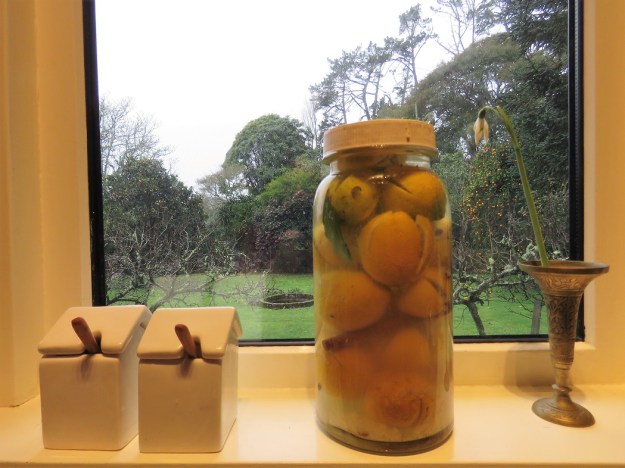
Preserved lemons – the liquid is opaque because some of the salt has yet to fully dissolve

Before we left, I made another jar of salted lemons, having noticed a heavy crop and smaller fruit on our main tree. Smaller fruit fit in the jar better. I prefer to make salted limes but the lime tree is having a year (or two) off fruiting. They are dead easy to do, store for many months in the fridge and are very tasty as a flavour addition. They can make couscous flavourful (though I have gone off couscous since I realised how highly processed this product is), add taste to rice and all manner of stuffings or savoury dishes. I resorted to buying lemons one year, in the absence of a good lemon crop at home, but if you are buying fruit, pour boiling water over them and stand them for a few minutes first. Some are, I read, coated (in wax?) to help their storage life and you need to get rid of any coating or spray residues before preserving them.

Just looking at the jar is like looking at a ray of Italian sunshine on a winter’s day in Tikorangi.


The weight of epiphytes

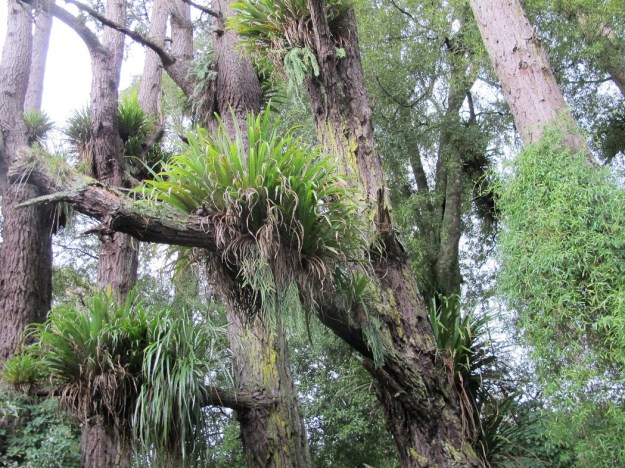
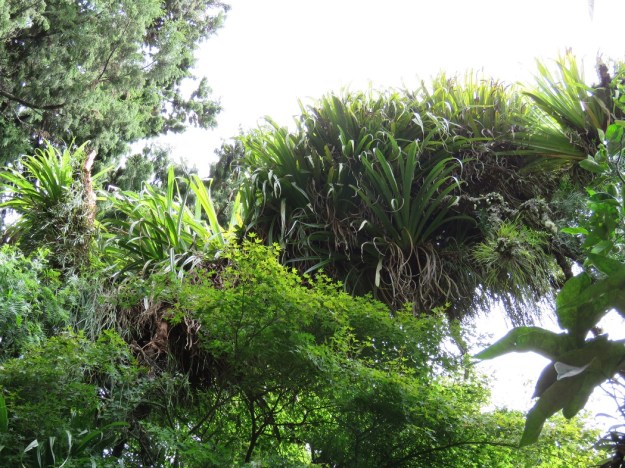
Over a century of epiphytic build up

When branches fall here, they often bring down a mass of epiphytes with them. It seems likely that, in some cases, it is the weight of those that causes the branch to fall. A combination of mature trees and a benign and humid climate means that epiphytes are a significant feature of our canopy. ‘Widow-makers’, Mark says, utilising the term for things that have the potential to fall from above and kill. It is a gender defined term, which I guess comes because it has a longstanding application in forestry which remains a traditionally male occupation.

There is an entire self-sown and self maintaining environment in this one tree

One of the characteristics of New Zealand native forest is the high incidence of epiphytes which are simply organisms (in this case, plants) that grow on the surface of another plant, getting moisture and such nutrients as they need from the air and rain and then from the debris that builds up around them. Because these epiphytes are perched up trees, they are vulnerable to drying out so are more commonly found in areas protected by other trees rather than on solitary specimens standing in exposed isolation. We also get regular rain here and have high humidity levels no matter the season. Add to that the fact that our native forest and bush is almost entirely evergreen. There are very few deciduous natives – a total of only 11 different species that are fully deciduous in winter. Most New Zealand gardens use a wide range of evergreen plants and shrubs, usually outnumbering the deciduous selections. So we have situations that are hospitable to epiphytes.

Add in to that mix, maturity. Because we have many well-established trees here, some dating back close to 150 years, there has been time for epiphytes to get a grip on their hosts.

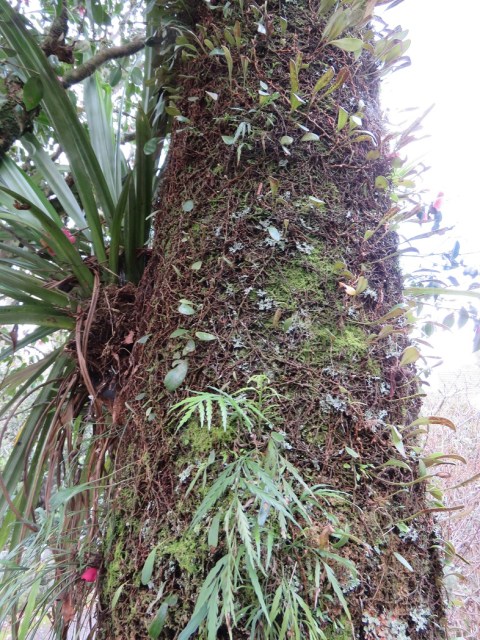
Drooping spleenwort and leather leaf on the trunk of a tall queen palm

Where do these plants come from? Mostly a combination of wind and birds. Some of our trees have entire mixed colonies growing in them. The dominant epiphyte here is the collospermum, C. hastatum, but we have other species of both collospermum and astelia perching up high too. Also assorted ferns, particularly the native climbing ferns, Pyrrosia eleagnifolia or ‘leather-leaf’ fern and Asplenium flaccidum or ‘Drooping Spleenwort’ which is prettier than it sounds. We even get native orchids appearing in these epiphytic colonies but NZ native orchids are perhaps best described as being very subtle in appearance.

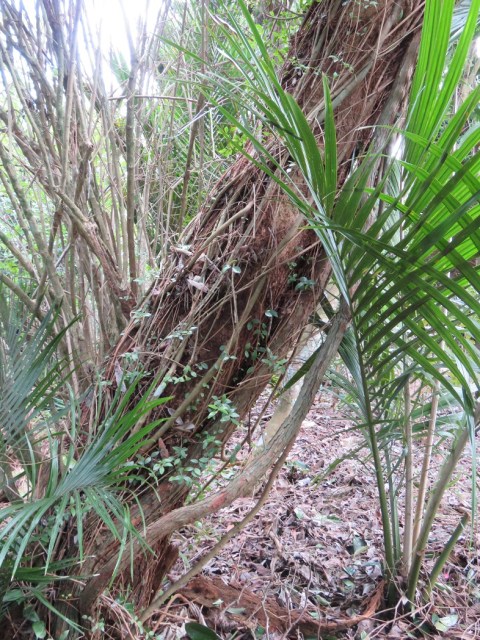
The host tree is leaning badly, the twining vines and thicker trunks are all southern rata

The rata is to the South Island what the pohutakawa is to the North Island, though we do have the northern rata as well. These are all the same family (so all metrosideros) but different species. Think of them being like cousins, perhaps. So the South Island rata is M. umbellata. That rata is an epiphyte, relying on an established tree to climb. Unlike most of the perennial types of epiphyte, it can eventually kill its host. In forest conditions, the rata is so well established by then that it can stand on its own, forming a hollow-trunked tree (the hollow centre being where the host tree has decayed away). We think it far more likely that our rata will not be sufficiently anchored to the ground to stay standing. The nearly deceased host tree – a eucalypt – has developed a definite lean and we think the whole shebang may fall sooner rather than later.

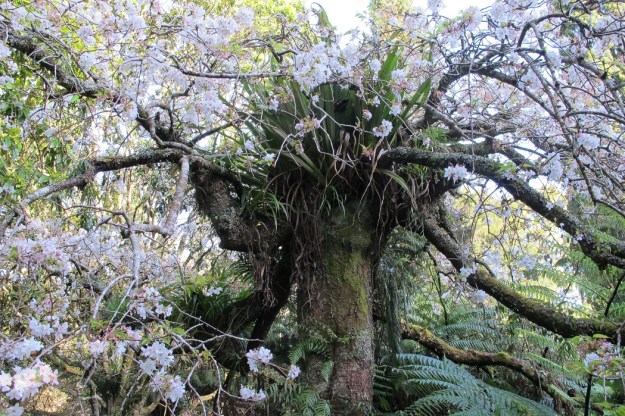
Like an octopus, Prunus yedoensis ‘Ivensii” with epiphytic collospermum

I did get the ladder and do some tree climbing to take out most of the collospermum from the Prunus yedoensis ‘Ivensii’ because I like this flowering cherry and I could see the collospermum were getting the upper hand rather than maintaining an equilibrium.

Generally, we just leave the epiphytes alone. Sometimes the weight will get too much and massive clumps will fall, often bringing down branches on the way. They are usually so heavy we have to dismantle them to remove them. In times gone by, Mark used to follow the Orchid Society practice of gathering up the decaying gigi (fallen collospermum) to use as potting mix for the growing of orchids. That was before the days of granulated bark potting mixes. Left to their own devices, epiphytes are just a part of nature – a naturally occurring matrix in fact. It adds an upper layer of interest to the garden while also creating its own ecological environment quite independent from human intervention.

Whenever we have to do a clean-up that involves fallen epiphytes, we just relocate the largest pieces we can manage to the back areas of woodland where they can continue to provide habitat and add diversity.

Mark is surveying a sizeable branch brought down by the heavy burden of epiphytes

In the meantime, there is another branch waiting to fall…

A quilted flower

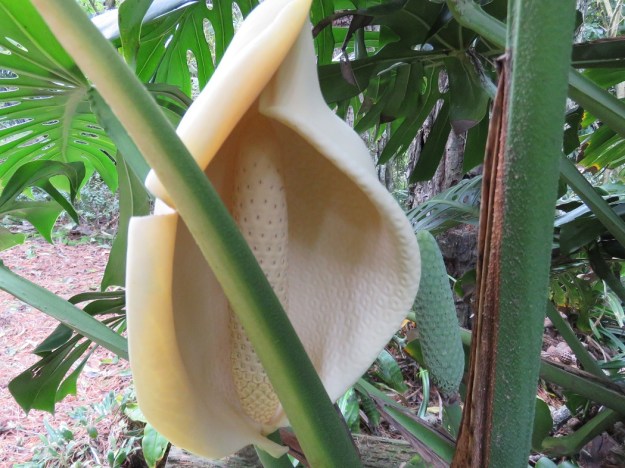
The quilted spathe of Monstera deliciosa with the distinctly phallic green fruit from a previous bloom to the right

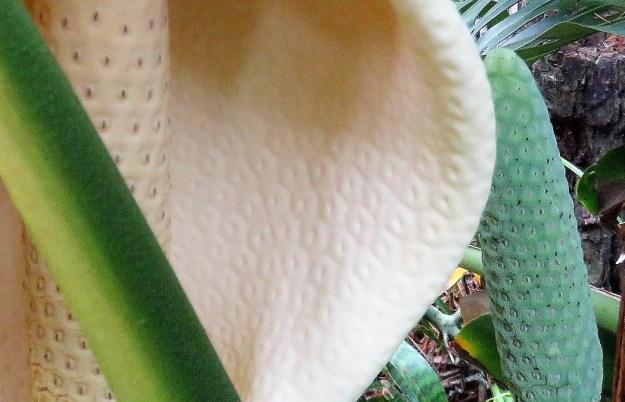
I had not noticed until yesterday that the interior of the spathe on the Monstera deliciosa is delightfully quilted. For quilting enthusiasts, they are hexagons – six-sided figures. The spathe is the curved hood on the flower – botanically a modified leaf but most of us will continue to call it a flower. Some readers will know the monstera better as the fruit salad plant – most often seen as a house plant or perhaps more as an office plant where there is greater space. I would rather doubt that it flowers, let alone fruits, when it is treated as an indoor plant.

We have it as large, shade plant, climbing our trees and furnishing some of the back areas of the woodland gardens where it never gets frosted. It is a bit rampant, a monster even, although easy enough to cut back when it roots its way along the ground. It is more difficult to contain when it romps its way up the trees because it puts out strong aerial roots all the way and our largest ones are now a good ten metres up the trees. Looking tropical, even in the depths of winter. Fortunately, this is not a plant that will smother or strangle its host tree.

Monstera deliciosa can indeed be a monster plant when liberated in the garden

Our plants set fruit but we are not hot enough to ripen them to the allegedly delicious stage. Sometimes we get them to the point where the segments are ripe enough to fall apart, as they do, but the taste, while somewhat ‘tropical fruit salad-y’ in flavour, remains too sharp to eat many. A bit like cut glass, we say, which is apparently to do with oxalic acid. Our guess is that in hotter climes, the oxalic acid is less dominant.

Coming back to the flowers, I hadn’t really noticed how lovely they are until I saw this one yesterday and noticed the matching quilting on the central spadix (which develops into the phallic shaped fruit) and the interior of the spathe which embraces it.

Arum lilies, photographed in somebody else’s garden

“Aroids”, Mark said which had us googling a few other plants with flowers of similar form which were otherwise totally different and yes, they are all members of the araceae family, though not all are members of the aroid sub family.  Arum lilies are probably the best known. Arums are a great deal more prized overseas than in New Zealand. Here, they are seen as an indicator of poor land management (our pioneer roots are as farmers in this country), invasive and widely banned from sale but not on the total eradication list, as far as I know. As a garden escape, the problem with arums is that stock don’t eat them and they are difficult to control once they have established themselves. I once wrote giving advice on how to get rid of them. The coloured calla lilies are still grown as ornamentals but I dug most of mine out this year. I found them shy flowering and they didn’t justify the garden space. Too much foliage for too few blooms.

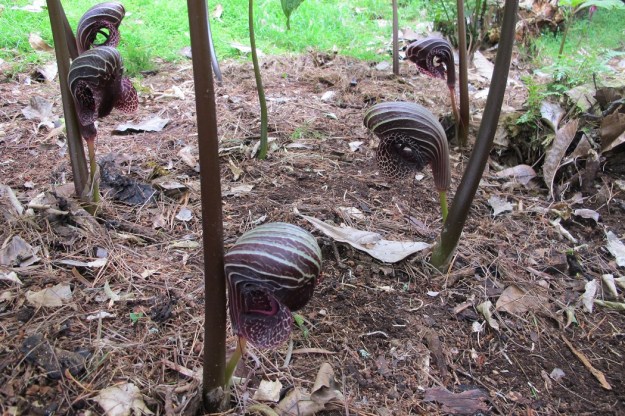
Arisaemas we grow a-plenty. Theirs is a very curious plant group, though not beautful in the usual sense. A. dahaiense

What surprised me more was to find that arisaemas and lysichiton are also members of the araceae family. They have the distinctive hooded flowers, but that is about all that looks the same as monstera or arum. I am sure I have photographed the lysichitons here (unromantically referred to in common parlance as ‘skunk cabbages’) but I can not find the photos in my files. We have both the yellow American species (americanus) and the white Asian species (camschatcensis) which we grow as bog plants.

Alocasias also belong to the same family. This includes taro, which is widely sold in New Zealand because it is a food staple for Pacific Island people, though it has never made its way into the general diet of most others and I admit I have never tried it. It has never been touted as delicious. Should you happen to be in Missouri, the botanic gardens there have the world’s largest collection of members of the araceae family. Munich Botanic Garden also has a splendid collection owing to world expert working there, the ever-handy internet tells me. I was just a bit surprised by the diversity of araceae we grow here. I was looking up the toxicity because some can cause burning of the skin and I wondered if it was connected to the aroids. But no, it appears that it is only a characteristic of some family members – chemically speaking, calcium oxalate crystals in the form of raphides. So now you know. This will explain the sensation of eating tropical flavoured glass shards when sampling the monstera fruit that are less than perfectly over-ripe.

Arisaema sikokianum – not easy to keep going as a garden plant but eye-catching