
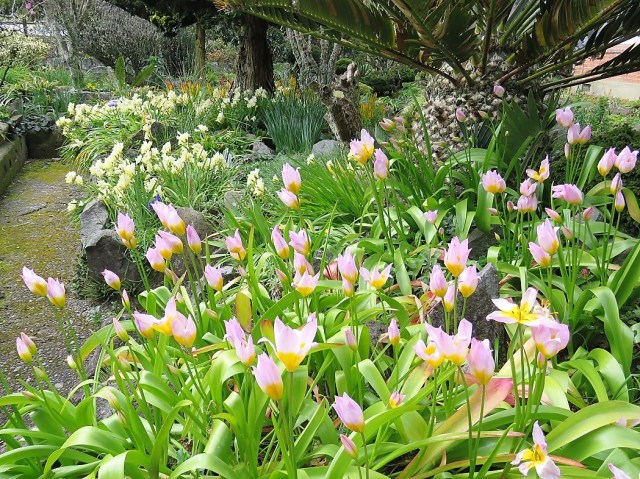
Bulbs play a major role in our garden. We use a huge range of bulbs, many no longer available commercially. Some never were readily available. Very few of those we grow are the larger, modern hybrids which are generally what are on offer these days. We prefer the simpler style of the species or at least closer to the species.
Added to that, seventy years of intensive gardening across two generations has built up the numbers most satisfyingly. Most of our cultivated gardens have bulbs incorporated in the plantings. Or at least bulbs, corms, tubers or rhizomes to cover the range.
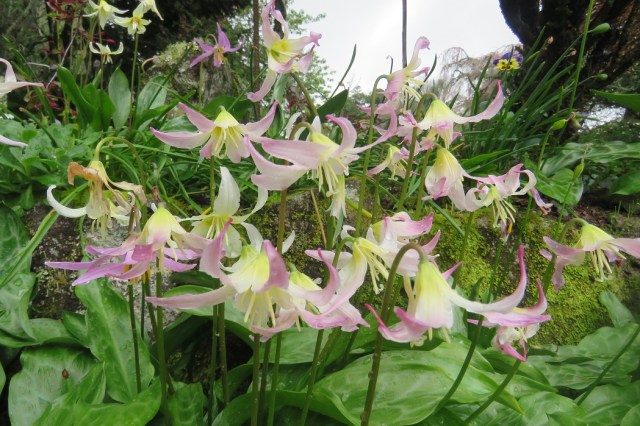
We have a fair few that are fleeting seasonal wonders in our climate but we just adjust our expectations. The cute erythroniums – dog’s tooth violets – are maybe a 10 day delight and can be taken out by untimely storms but that is just the way things are.
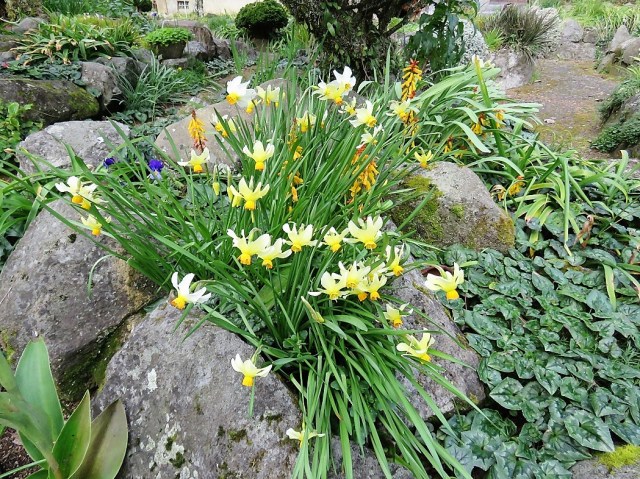
I don’t grow any in containers now although the same can not be said of Mark. His bulb collection is currently sitting in limbo for us all to see the scale as his inner sanctum – his Nova house – is currently being relocated. He hasn’t taken good care of them in recent times but he is determined to keep some of the rarer, touchier varieties alive. It is possible to maintain a more comprehensive bulb collection if you are willing to faff around with growing them in containers in controlled conditions. I am not so dedicated. My interest wanes if we can not grow them in garden conditions.
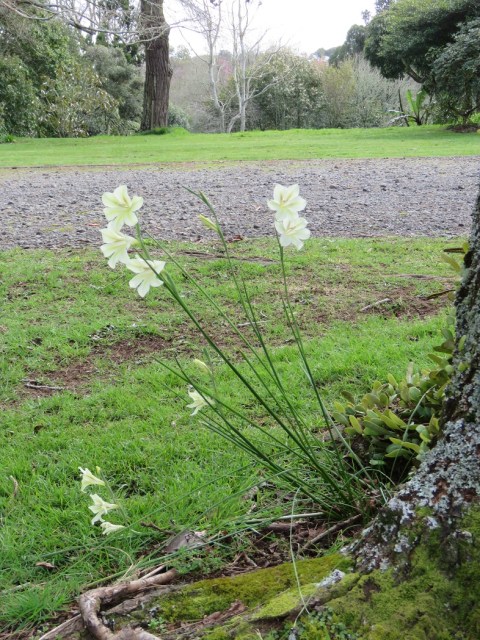
It is the random bulbs beyond the gardens that are currently bringing me pleasure. Some of these have been planted. Some have popped up from our nursery days. When trays of bulbs were being repotted, Mark had a strict rule that fresh potting mix was to be used (granulated bark was our chosen medium). Hygiene, he would explain. The old potting mix was spread around the place and at times it had seed or tiny bulbs within it. I am guessing this is how the Gladiolus tristis, a species gladiolus, came to be at the base of a cherry tree. I certainly don’t remember planting it there and I can’t recall it flowering before.
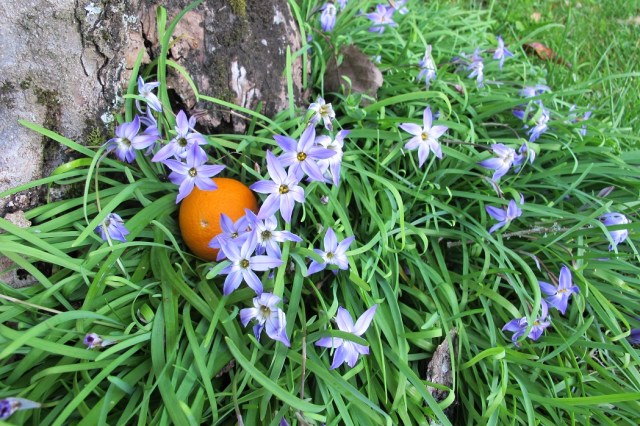
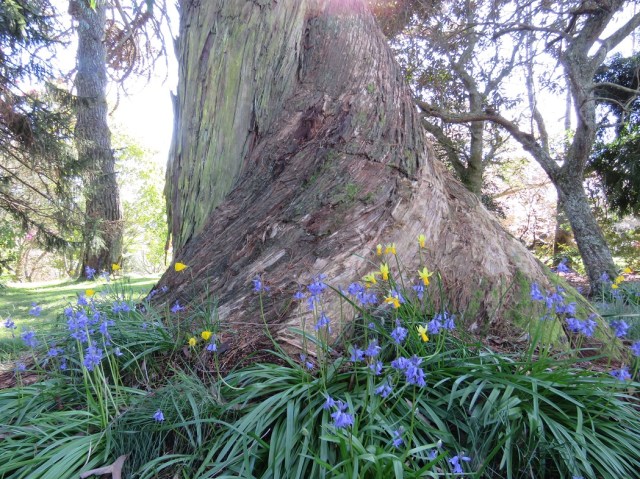
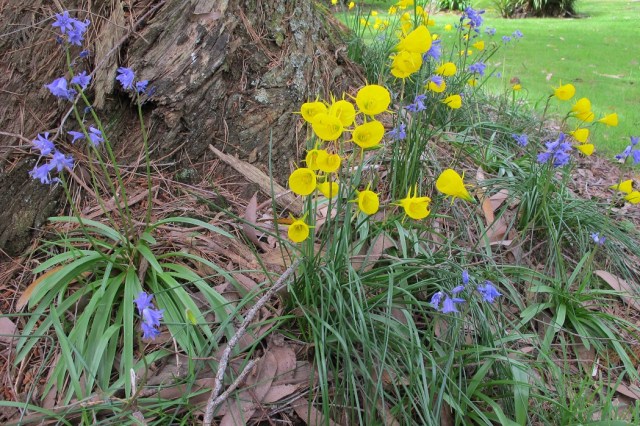
When we plant bulbs beyond the cultivated garden areas, we try and select spots where they can establish in fairly undisturbed conditions. At the base of trees is good, as long as there is plenty of light. Around old tree stumps, on margins that don’t get mown often, or in little spots where we can walk past and be surprised to see them in bloom.
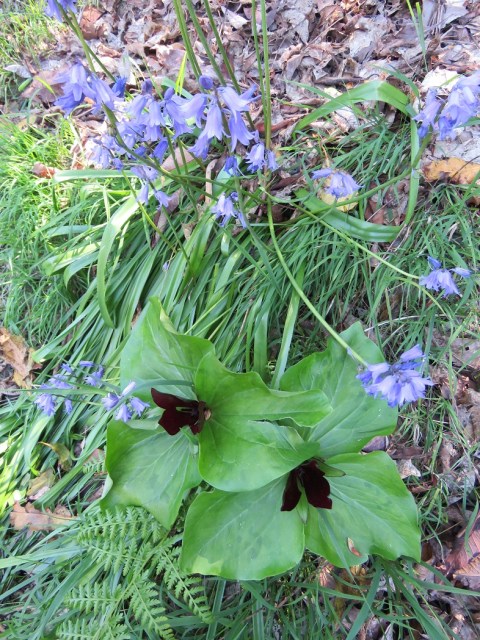
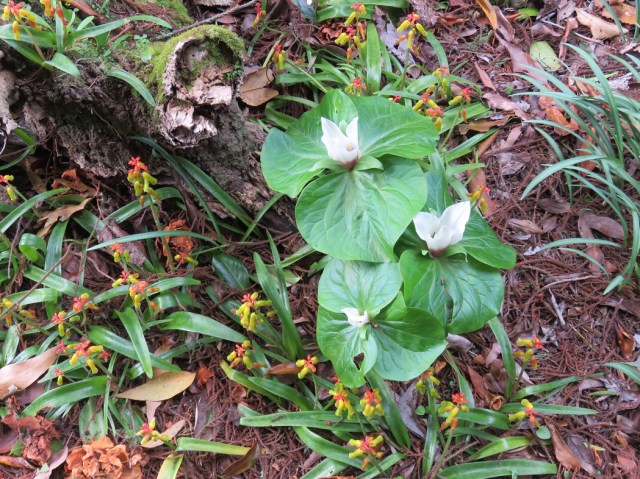
We have rather too many bluebells now, to the point where I often dig out clumps to reduce overcrowding. The Spanish bluebells or the ones that are crosses between the vigorous Spanish and the more refined English species are definitely rampant, bordering on weeds. That sea of blue is very charming in their flowering season but sometimes it is the one seedling escape flowering bravely on its own that makes me smile as I pass.
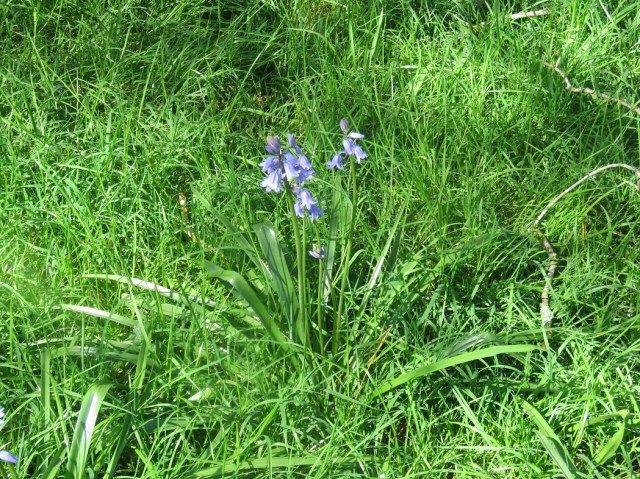
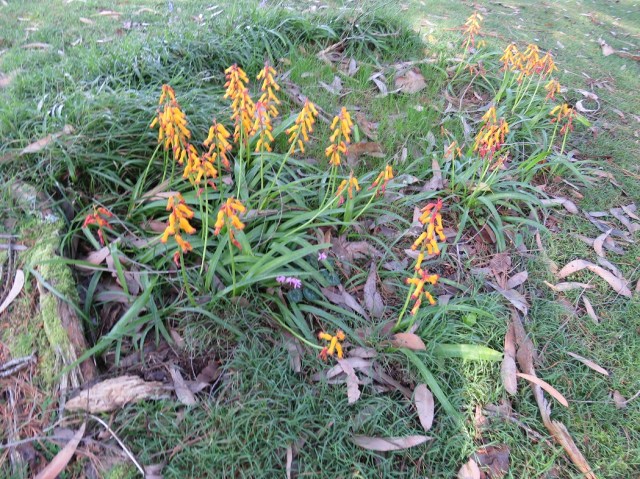
It is both the transient nature and the detail that makes bulbs so interesting in a garden context. Far from simplifying our own garden as we age, the more we garden, the more we like to add fine detail. That is what keeps it interesting for us.
 Tikorangi The Jury Garden
Such a welcome post for me, here in the Tropics!
Ah, but you must be about to enter mango season and we envy you that!
Hi Abbie, your collection of unusual bulbs must be a constant delight. It always amazes me that you can grow trilliums. I always thought they were suited to cooler climates!
They don’t get as big in our conditions but they do at least return every year.
Just wondering are you able to buy some of these beautiful bulbs .
Not from us. We closed down our nursery over a decade ago. Best place to try may be Trade Me where some of the less common bulbs come up from time to time.
Such delightful bulbs. I am afraid I don’t admire bigger better and double moderns that have lost their charm and delicacy . Some not a memory of ‘fluttering and dancing in the breeze’. I wonder if you can tell me about narcissus fly as my old species are hard to flower. What can I do??
Narcissi fly? Called Nazi flies here. There are no simple solutions. You need a multi-family approach. Details here: https://jury.co.nz/2012/07/27/the-curse-of-the-narcissus-fly/
Bulbs are very enjoyable when they increase to large numbers – and that dark-flowered trillium is especially good!
The dark flowered trillium, alas, is much harder to increase. Ain’t that just the way?
T. albidum and T. chloropetalum are the top performers here. Others survive.
Hi Abbie, Beautiful photos! I especially like your bluebells and narcissi under the gum tree. I wish mine would naturalise like that. I can’t imagine ever needing to cull them, but that is probably because I pick some of the flowers for the house. I have a vase of bluebells on my desk at the moment :)
Do you pick ALL the flowers? If you leave a few, they will seed over time. But the bulbs should be increasing. I could give you plenty of you were local!
Hi Abbie, I pick only about half of my bluebell flowers (I can’t resist it to cheer up my desk). The rest I leave in place in the garden under the trees. They have definitely been self-seeding because some white mutants have appeared (not onion weed). Thanks very much for the kind offer of bulbs, unfortunately I am far away in Auckland. Hugs Rose x