
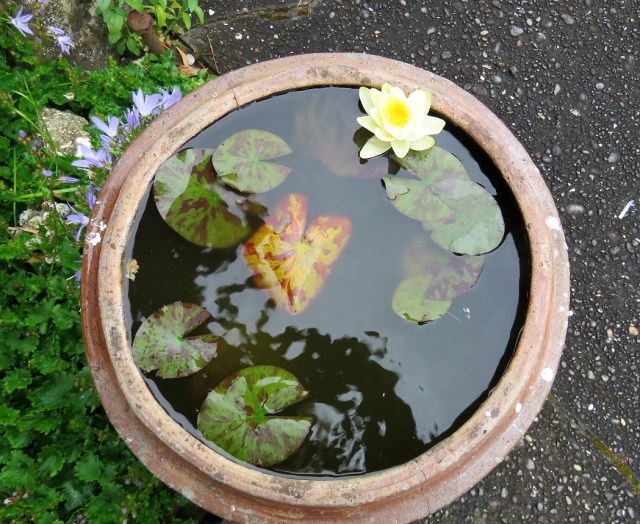
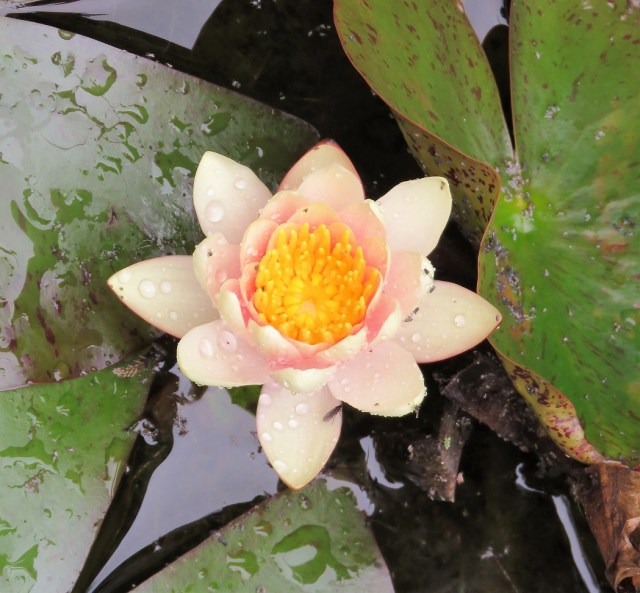
If I believed in woo-woo (or, at least, that plants can sense what humans are saying), I might think that the appearance of this charming, little lemon water lily flower was because of my threats made over the past few months. The plant came into our possession about ten years ago and it has lived in a vintage pot ever since without flowering. Maybe three years ago, I took it out, reduced some bulk, raised it higher in the pot and gave it some new compost mix. Nothing happened. It just put up its usual leaves. I declared this year – probably in its hearing – that this was its last year. If it didn’t flower, I would cast it out and find something more obliging to grow instead.
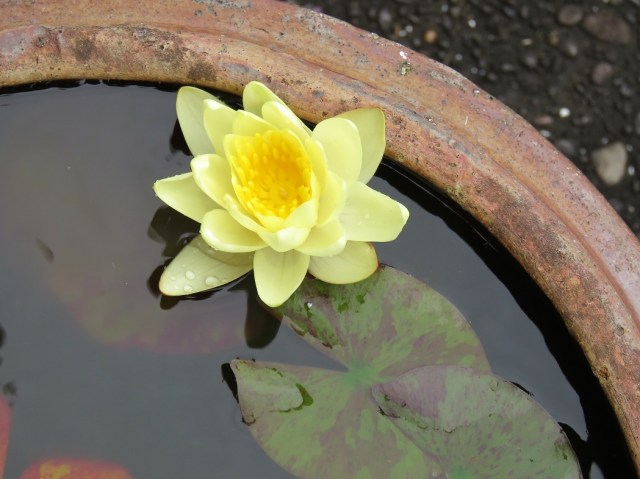
And lo, this flower appeared and it has won a reprieve. It is a very pretty little flower. Water lilies do have lovely blooms with a pristine purity of form.
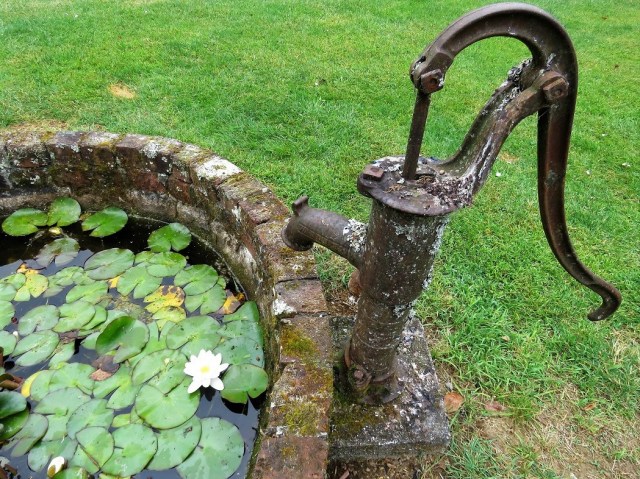
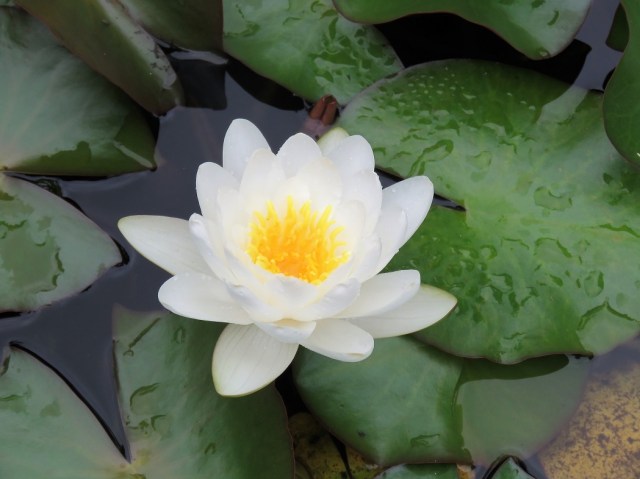
We have water lilies in assorted bodies of water. The purest white one in a round pond on the side law is the best, I think. A white waterlily is the national flower of Bangladesh but looking at the photos, while similar, I think it is a more tropical form than this one.
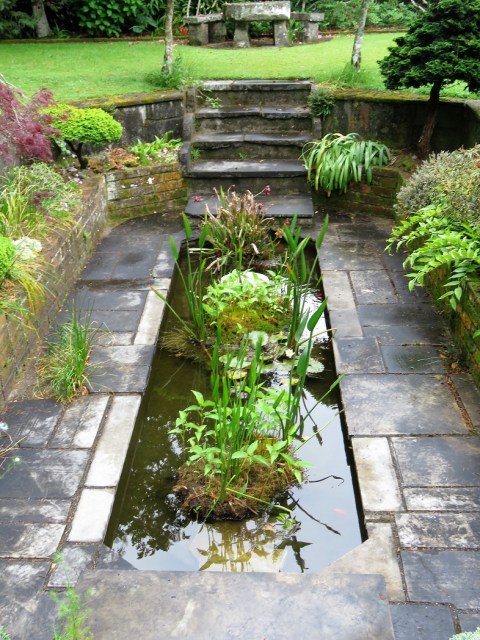
I don’t find them the world’s most exciting bloom but they have an exotic beauty to them. I looked them up to see where their homelands are and I see they are broadly spread across the globe ‘in temperate and tropical climates’ which is pretty sweeping. They are a bit more complex than I expected though, if I am honest, I would admit I have not given them a lot of thought. Their plant family is Nymphaeaceae and I will never remember how to spell that with all it’s ‘a’s and ‘e’s. There are about 5 genera in that family and maybe 70 different species which don’t all look the same as the ones we grow. That is quite a lot of different species. As far as I can see, the ones we see here are from the nymphaea group.
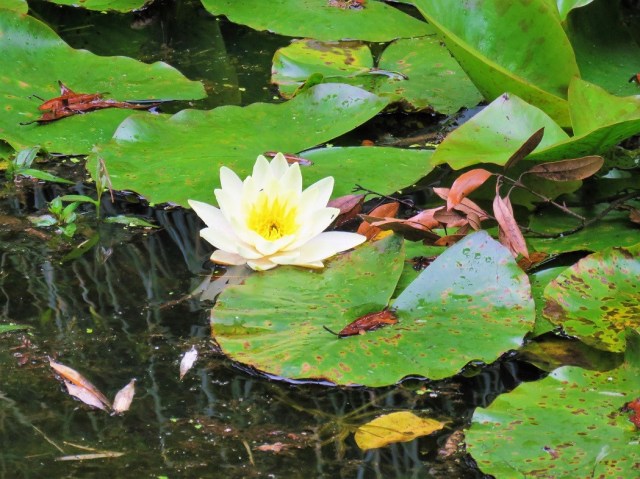
Water lilies grow from rhizomes rooted in soil so they only grow in fairly shallow water. Many years ago, we went to visit two ‘water gardens’. In fact, they were water lily gardens. I can’t recall other aquatic plants. That is where I learned that some varieties can be such strong growers that they will entirely cover the water surface if they are not restricted. A mass of water lilies without visible water reflecting, shimmering and rippling to frame the plant is not actually that aesthetically pleasing or exciting to see.
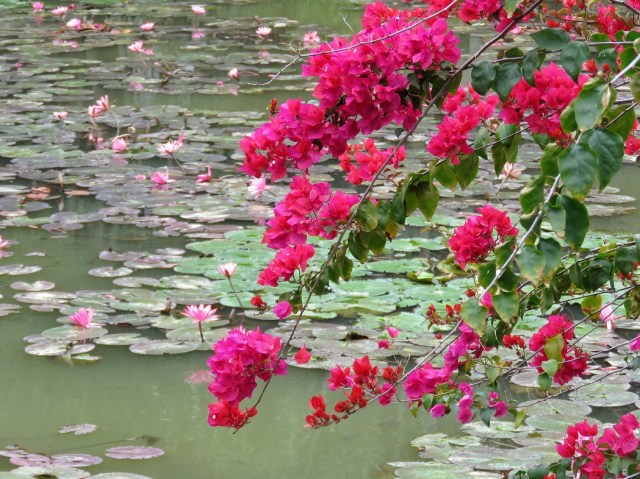
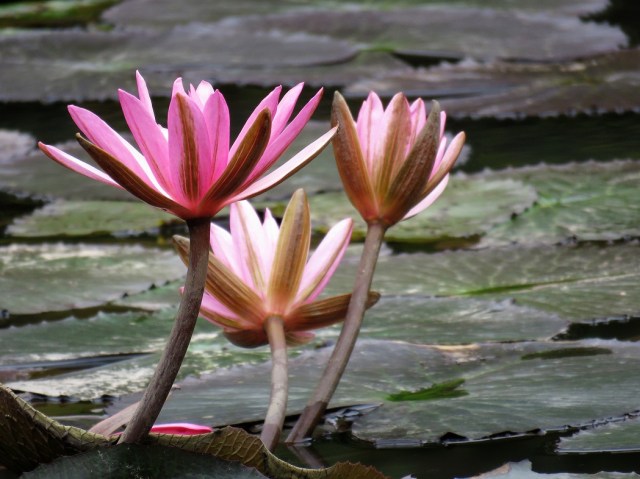
The loveliest water lilies I have seen were in the Xishuangbanna botanical gardens in southern China. They were held up above the water on longer stems and I think this makes them a different genera to the common nymphaea types we grow here. “They’re tropical,” Mark said, but he may have been generalising from the fact that it was hot and many of the plants we were looking at there were very tropical. I have no idea if that type is even in NZ.
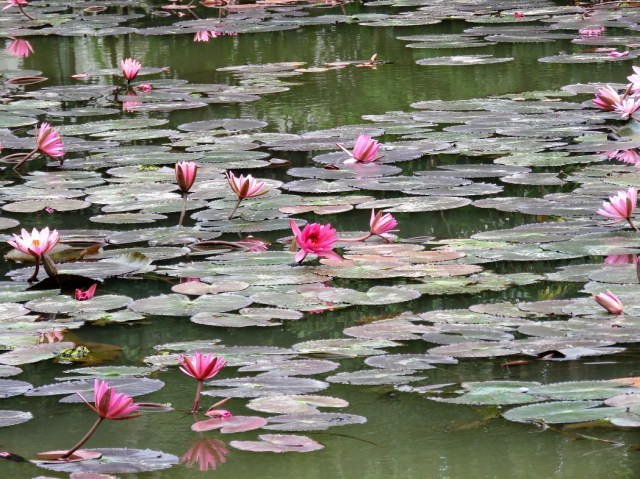
This week at least, I am happy that the pretty lemon one has flowered after a very long wait.
 Tikorangi The Jury Garden
Yes they are here and in different colours. I like the blue one best. The flowers are scented and in good growing conditions the flowers are large. Waterlilies are grown as cut flowers in NZ. The ducks (Paradise) have completely demolished the one I was given and planted in our pond/dam so i haven’t tried again.
I didn’t realise they could be used as cut flowers. Not that I cut flowers often but that is interesting to know.
There’s an interesting book ‘The Plant Messiah’ written by Carlos Magdalena a Spanish horticulturalist from Kew Gardens covers his adventures in search of the world’s rarest species and he talks a lot about water lilies which I found fascinating.
I haven’t come across that before. Thanks.
Simply beautiful. I don’t know if you have been to Wright’s Water Gardens in Auckland. A true sensory experience walking down into the “bowl”. The watergardens have always been on the shabbier side, but wonderful. I never come back from it without buying some of their cut water lily flowers. They are sold closed and are very fragrant, and long lasting – delightful.
No, I haven’t. Must put it on the list for when internal travel becomes easier again.
The tropical ones showing flowers well- raised above the water may be Nelumbo–a different species to Nymphaea. Not ones we can grow in the UK outside Greenhouses probably. Perry Slocum of USA a breeder wrote about about Water Lilies including Nelumbo, the tropical Lotus he grew in USA, for Timber Press in 2005.
Ah, that confirms what I thought. About the name. I am told they are in NZ.
I had to have a laugh at your woo-woo comment. Many years ago we moved to a house which had a very old Rhododendron as a backdrop to the front garden, a John Peel. It had a few straggly flowers for a couple of years and I remember very clearly saying to it in a firm voice that if it didn’t flower the flowing year it was going. Of course it flowered magnificently for the following 18 years that we lived there.
So of course I have used that strategy a few times.
From the look of both flower and leaf the one that got the reprieve could be Nymphaea ‘Marliacea Chromatella’, one of the first hybrids bred by Joseph Latour-Marliac in France (around 1880 I think). We used to have one, but the ducks that frequent our pond destroyed that plus several others, so we only have 4 or 5 varieties now. All are hardy, but they have no doubt been crossed with tropicals in their breeding to get the colour range and 3 of ours grow their flowers on stems that hold them varying amounts above the water. I counted them yesterday: about 100 flowers open at the moment, but a lot more buds showing too. They have never flowered this well before.
100 flowers open at once! I am seriously impressed by that, Tim.
Well, it has to be a sunny day and the sun has to have been on them for a few hours too. They all close at night. But we’re impressed too. They probably cover about 20-25% of the pond surface between them, so still plenty of room for the ducks and the frogs to swim about.
My Mother in law used used to bred water lilies in Tauranga in the 70-80’s, she had the Tropical ones and the ones like yours. She also bred golden fish.