
The countdown is on. This time in seven weeks, we will have the garden open and be in the thick of the garden festival – the Centuria Taranaki Garden Festival to give its full name. We are at that stage of preparation where I am paralysed into dithering inaction and displacement behaviour in the face of how much I want to get done. I am sure others will recognise this state.


I was delighted but puzzled this week to find a camellia that turned out to be one of the yellow species that I didn’t even know we had and that was flowering for the first time. It must be a good 25 years old. We have three other yellow species that bloom and they all have very similar characteristics – pretty rangy growth, small bright yellow flowers in a lantern shape and large, heavy textured leaves. I was trimming back this other plant to make space for the yellow C. nitidissima beside it that was reaching for light, thinking it must just be one of Mark’s seedlings that was very shy on setting flower buds but filling a role in a boundary screen planting. Part way through, I noticed a flower and it was yellow. I promptly felt like a vandal, cutting back the very first flowering, and I looked ruefully at the buds on the branches I had removed with what I now saw as typical flower buds of the yellow species – like little covered buttons.
Its identification is still a bit of a mystery to us. We have lost the label down the years and Mark never kept an accession book. It came from Neville Haydon at Camellia Haven and he will only have had a very limited number of the yellow species that he sold commercially all those years ago. We have C. impressinervis, C. euphlebia and two forms of C. nitidissima syn chrysantha. There is a possibility that this new one, which is quite different, may be C. indochinensis var. tunghinensis. If anybody can confirm this or has past copies of Neville’s catalogue, we would like to hear from you.
As far as I know, these yellow species are not available commercially in this country any more. They are also more interesting – thrilling, even, for plant collectors – than showy as a garden plant. And tropical.

While on camellias, behold the flowers of ‘Hakuhan-kujaku’, also known as the peacock camellia from Japan. It is another one that is more curious than showy, mostly because we find it shy on flowering in a plant genus that is largely grown for generous floral display. But we like it for its pendulous growth habit, its willowy foliage and its understated charm.
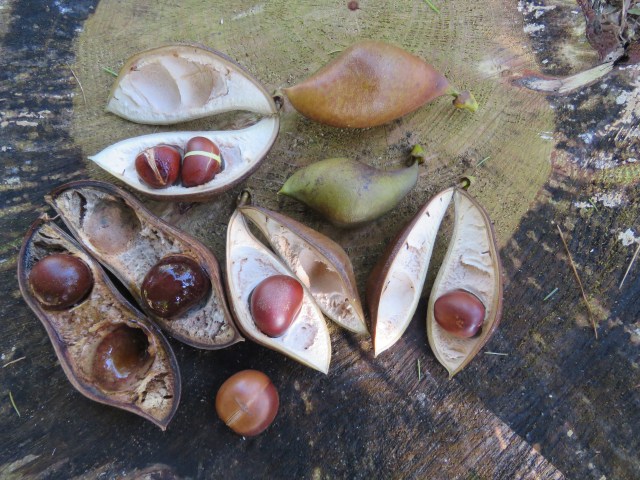
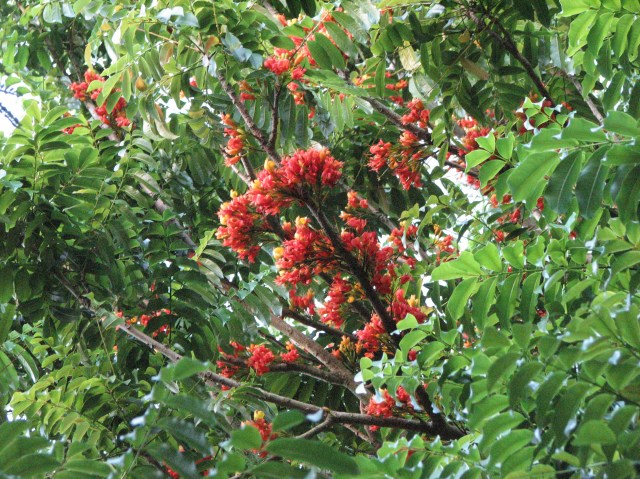
I couldn’t resist doing a small arrangements of seed pods which are extremely decorative. These are from Castanospermum australe, also known as the Black Bean Tree or Moreton Bay Chestnut. Our climate being distinctly cooler than Moreton Bay in Queensland, we don’t get the same level of flowering that it has in its native habitat but we get enough blooms to set plenty of seed and they are as attractive as the flowers, in their own way.

Mark’s michelia seedlings from his breeding programme are all flowering and we are monitoring them closely for any that may be good enough to add to his Fairy Magnolia series. I picked a range of flowers to entertain a northern hemisphere magnolia Facebook page that I belong to. There are many more factors than just a pretty flower when it comes to selecting a plant to release. What is interesting about these is that he started with hardy michelias that are basically all white or cream, bar one that has recessive colour genes in it. There are colourful tropical species but he has never been interested in using them because he is trying to get hardier selections for colder climates, not more tender ones. It has taken a number of generations of hybrids to get this range in colour and form and is an ongoing project. Most of them have strong scent, so that is encouraging because fragrance had disappeared from some of the earlier generations of these breeding lines.
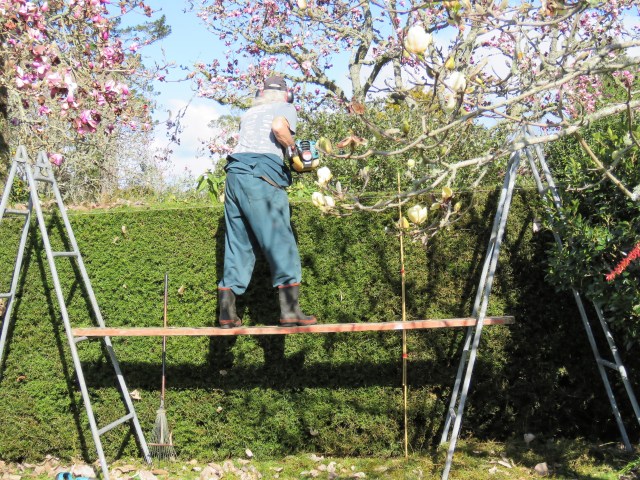
This week has been all about pruning and trimming here. Were we not opening the garden soon, we might have waited a little longer until flowering was over on some of the plants but needs must. And I am reminded of the advice from friend and colleague, Glyn Church, not to leave this task too late because the birds are all starting to nest.
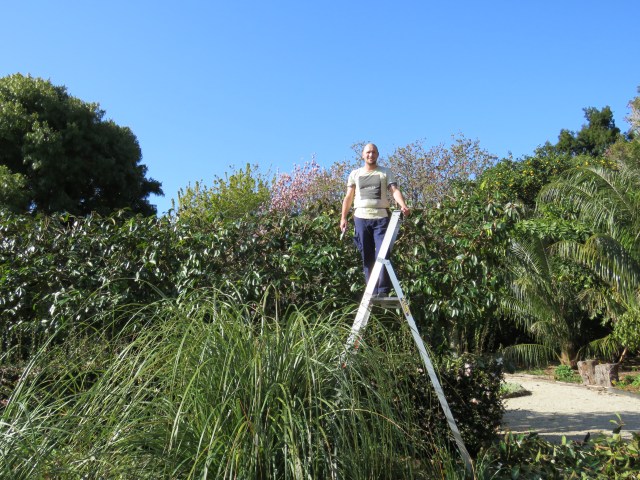
A reminder about the difference between trimming, clipping and pruning. Trimming uses hedge clippers or trimmers and the individual leaves end up being cut, so we keep it to smaller-leafed plants like the totara hedge or the small-leafed camellias we have used for hedging. Pruning is done with secateurs and a handsaw. It takes a lot longer and is all about shaping but it doesn’t cut and bruise the foliage so we do this with the michelias and the camellias with larger foliage. Hacking is bad pruning.
We bought a new hedgetrimmer – a battery powered Makita where the same battery and charger can be used on multiple other pieces of equipment. There was much amusement at the range mentioned in the instruction booklet. A heated jacket, maybe? Or how about a portable coffee machine? But what really took our fancy was the electric wheelbarrow. That would make getting back up from the park or the Wild North Garden with a full barrow much easier at the end of a day’s work.
 Tikorangi The Jury Garden
Camellia tunghinensis, perhaps?
That is the current suggestion. Do you know it?
I recall seeing in the greenhouses of Dr. Cliff Parks’ years ago. It’s too cold where I am for outdoor culture.
That is quite some memory! I know tunginhensis was sold in NZ so there is a fair chance we bought it with the other yellow species.
It wasn’t THAT long ago – maybe ten years? That said, I rarely forget a plant.
I do not think I could recall the somewhat obscure name of an equally obscure species that I have not grown myself ten years later!
But you might if camellias were your primary botanical interest. :)
I find yellow such a welcome and beautiful colour in camellias and am regularly in awe at the beauty of flowers posed online by a lady in northwest Spain. Re hedge cutting, string guides etc: we had a lady come last week to measure an area in the house for bookshelves and Mary thought the laser levels she used would be the perfect guide for the job.
I wonder how much they cost? Could be a great Christmas present for Lloyd. Not just for our hedges but he is the home handyman extraordinaire away from here, too.
Abbie I definitely think you should consider a garden cart or vehicle for getting around your property. My son (and daughter in law) have just bought me a ride on with a trailer. It is tremendously fun apart from being such a time saver.
Oh Lisa, no. We already have a super fancy ride-on that the others use to tow a trolley at times, and a baby tractor (an old orchard tractor) AND a farm bike to tow trailers- though that is not actually ours but just lives here to be used. I feel like we should have enough already!
I understand dithering completely as I have caused early deaths to some poor plants & shrubs etc before they have felt the earth. I only have a small area really so I tend to blame it on advancing years. Pathetic, I know. 😁😄