
I see it is exactly 364 days ago that I published a piece on deciding to establish a tussock walkway. It is entirely coincidence that I return to it today.
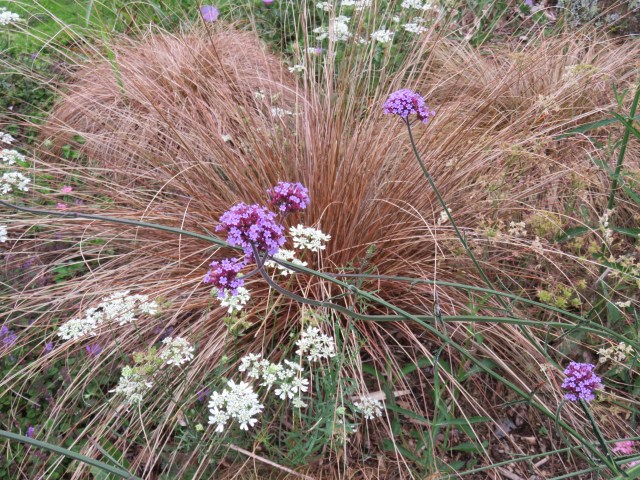
I have no idea if other countries talk about tussock or tussockland. Overseas readers may like to enlighten me. Maybe it is our term and other countries have prairies, steppes and grasslands? Our tussock areas are our native grasslands and I am not even sure that many New Zealanders realise that our native grasses are not only largely unique to us but also varied and interesting with many good garden candidates. Contrary to what some think, a tussock is not a specific grass, it is a term for the growth habit of a number of grasses that include our chionochloa, poa, festuca and – sometimes – carex.

I opted for carex in this area, specifically Carex buchananii and Carex comans ‘Bronze” because I had them to hand. I will admit that they got off to a slow start because I shifted them, divided and replanted in high summer. While well watered-in, they had to endure a long, dry summer and autumn and not all of them lasted the distance. But it will not matter. They are seeding down with great gusto, on a scale I had not expected. Not only do I anticipate it being a fully clothed tussock area by this time next year, I think I will have to thin them. Most of these look to be the more upright C.buchananii at this stage but I am hoping for some of the fountaining C.comans as well.
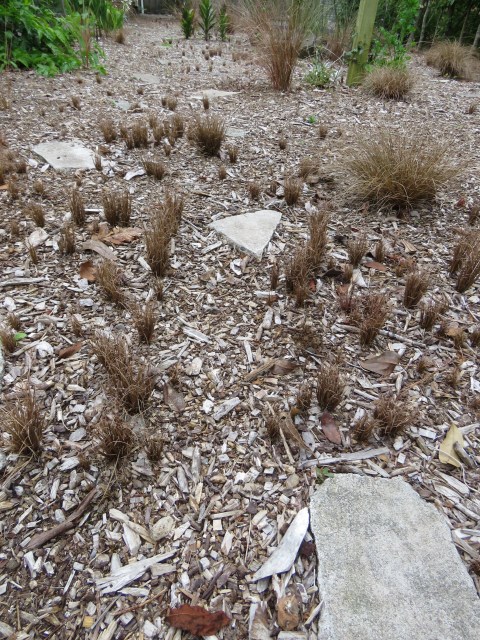
The purity of vision with which I started – that of a rippling grassland of bronze tussock with no defined paths – has been watered down a little. When we broke up the two concrete paths that defined the site of the old propagation house that formerly filled most of this space, I made the call to get Lloyd to lay some crazy paved stepping stones through it and that may be a good call in terms of keeping some clear pathways, given the dense seeding of the plants.
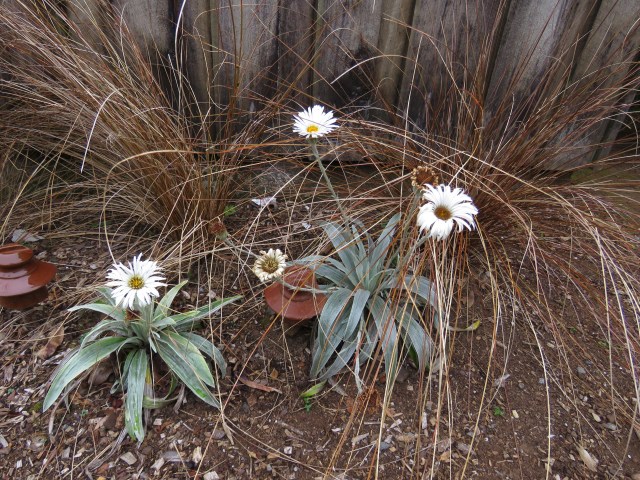
Next Mark asked me, “What are you going to do to add some seasonal interest and colour?” And those words are the death knell of pure visions. I added some celmisias – our native mountain daisy – and I really like the look of those with the carex. There were some legacy plants that survived the removal of the propagation house and I feel Cordyline stricta can stay, even though it is Australian. Another tropical-looking cordyline has popped up and it may or may not be C.petiolaris. A bit of seed is blowing in and I will have to manage Verbena bonariensis and the white nicotiana because, while a few plants are charming enough, we don’t want them everywhere and they seem to want to be everywhere. And I admit I planted a swag of dwarf narcissi. For spring interest, you understand.
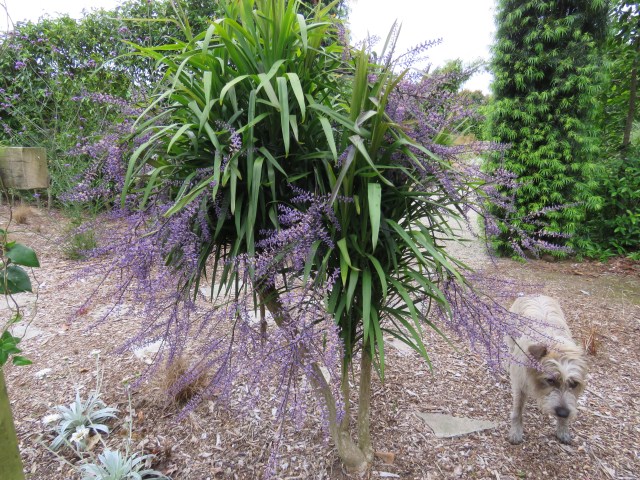
Zach refers to this area as ‘the prairie’, albeit a very small prairie. I shall keep referring to it as the tussock walkway because the grasses at least will remain the dominant plant and they are native tussocks.
 Tikorangi The Jury Garden
Naturalized pampas grass, Cortaderia jubata, as it slowly ages, eventually forms unappealing piles of deteriorating foliage, with a bit of viable foliage protruding from the tops, and may take many years to completely die. We know the unappealing mounds, rather than the viable grass, as tussock. That is likely why we do not use the term for more appealing grasses now that such other grasses are more popular.
Wellnthag is a very different take on tussock to how we use it in this country (though we have an abundance of naturalized pampas!)
It gets my attention when European interns refer to red fountain grass as tussock or tussock grass, because to me, that is no compliment. I remember someone explaining the proper use of the term to me.
Oh for goodness sake! Red Fountain – which is OUR plant but maybe you know that? – is a cordyline and therefore not a grass, let alone a tussock! Please correct them on our behalf.
Oh, not that. It is Pennisetum setaceum ‘Rubrum’. We have a few at work. They last only a few years, and then die sort of slowly, leaving a pile of dead leaves with a few viable leaves on top. It is nothing like the straight species, which does not last as long, but replaces itself with an abundance of seedlings! It is invasive in some situations.
The Cordyline cultivars that are known elsewhere as red fountain grass only became popular here ten years ago or so, and might be known as festival grass.
Yes, it was a decision made by our agents to name it as ‘Festival Grass’ in the US market, given the general lack of knowledge there about cordylines.
Old fashioned Cordyline australis are only now becoming known as Cordyline. They had previously been dracaena palms. I still use the old fashioned terminology, but am often scolded about their identity. Strangely though, I can not convince some people that they are not really palms.
Well some bright spark in the UK marketed them as ‘Torbay Palms’. The vernacular in this country is cabbage trees.
This is irrelevant but amusing. For a while, nurseries here sold an ‘African flame bush’ (which is not African flame tree). It was a hebe from New Zealand that blooms with purple flowers against rich green foliage. African? Flame? Well, at least it was bushy.
Our experience with the self-seeding of those two carex is that we get seedlings by the score from the buchananii, but very few from the comans ‘Bronze’ in comparison. The buchananii is pretty upright in its first year, then becomes a nice widely arching mound once it reaches full size in the next year or so and then deteriorates rapidly. We therefore dig them out after three or four years and replace them with new plants: we always have more than enough available. The comans, on the other hand, look much tidier for far longer, albeit a lot smaller.
Sorry to be so slow in replying, Tim. That tallies pretty much with our experience. Seasons greetings to you.