
As yet more heavy rain falls this weekend on already saturated ground in northern and eastern areas of Aotearoa New Zealand, I make no apology for pulling out photos I have used before, showing alternatives to huge slabs of concrete or paving around homes.
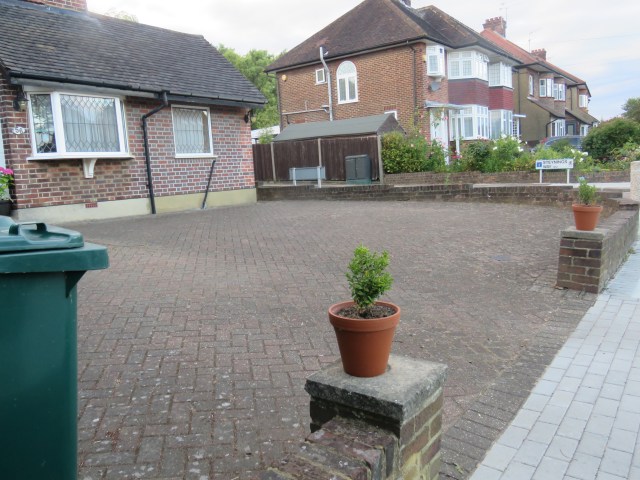
Most of us are not in a position to influence urban planning, but we can have an impact on our own property. Putting in large areas of sealing and paving, mostly to accommodate car parking or to ‘reduce maintenance’, is a significant problem contributing to urban flooding.
I have said it before, if you want a low or no maintenance section, move into an apartment – preferably one with underground carparking so the footprint of the building and housing cars remains as small as it can be. The alternative of concreting or paving your section is not only aesthetically unpleasant, it is environmental vandalism.
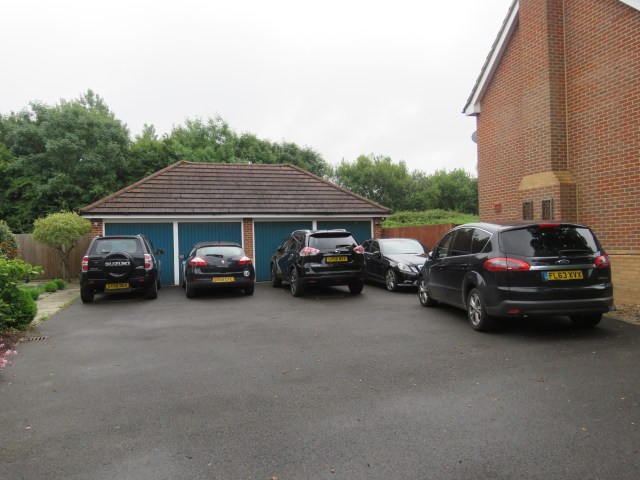
When I took these photos, the concern was more for preserving aspects of nature, providing habitats and food sources for the natural world. This month, it is about drainage, in this country at least. All that rain falling from above has to go somewhere and if you have surrounded your home with impermeable surfaces, it has no choice but to run off and contribute to storm water systems that are overwhelmed. When an area is planted, the ground is permeable and the root systems create little channels for the water to flow down deeper into the soil. Even mown grass will do this, once it is established.
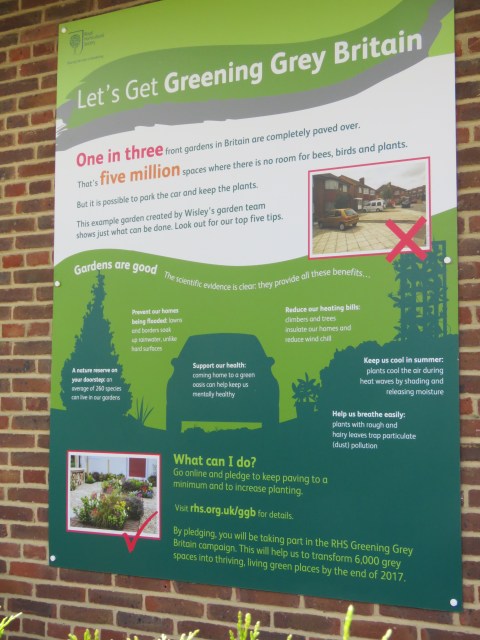
The education boards at RHS Garden Wisley in the UK claim that one in three front yards are fully paved now. Our major urban areas may not be lagging far behind in this country as sections get ever smaller and houses – almost all single storey and detached – get ever larger, leaving little space devoted to wheelie bins and car parking.
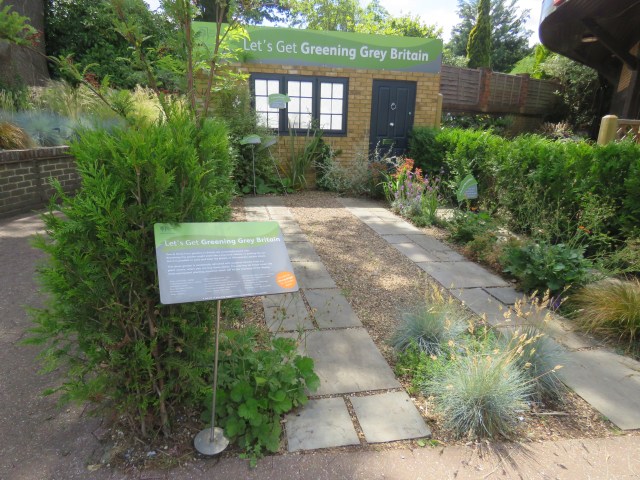
Wisley’s alternative display shows the use of spaced pavers, gravel with plants in it and recommends clipped hedging rather than solid fences on the boundaries. Just don’t lay an impermeable lining below the gravel – often recommended to ‘reduce maintenance’ but entirely defeating the drainage function of this type of driveway. Yes, it will take a bit more work to maintain than just getting the leaf blower out onto a slab of straight concrete or seal on a Saturday morning, but how much more pleasing is it visually? And it will absorb a whole lot more excess water.
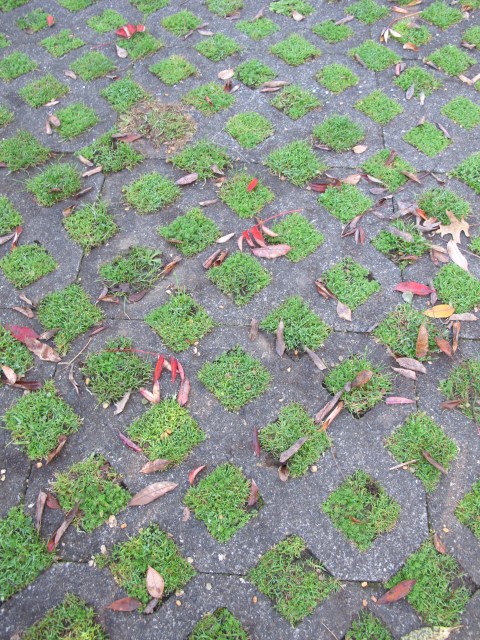
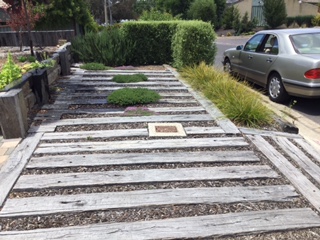
I photographed this driveway in Auckland. It is another alternative, allowing drainage while giving a hard surface on which to park the wretched motor cars that are so demanding on space. Laid properly, it should be level enough to run the lawnmower over it or to allow for sweeping, if need be.
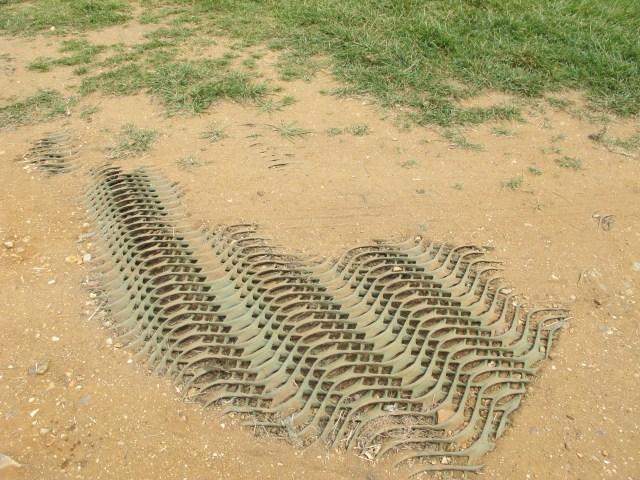
This subsurface reinforcement looks as though it may be made from recycled tyres. It was very dry at the time I spotted it exposed in a few places in a distinctly utilitarian carpark. It is another way to solve the problem of an area that would become a mud bath in wet conditions leading to a rough, rutted surface as it dries. It could be over-sown with grass to be mown in areas where there is lower vehicle traffic – like a front section.
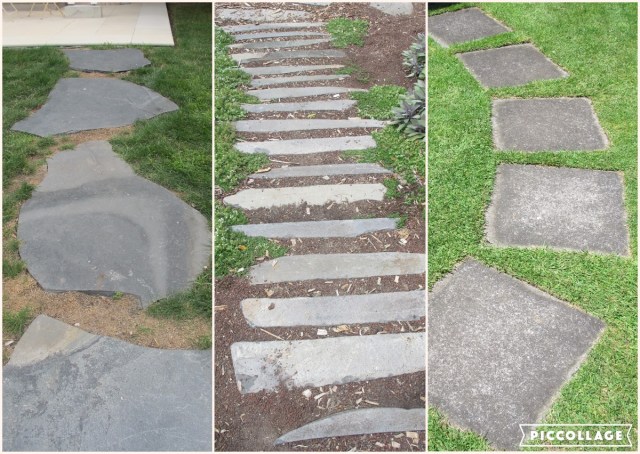
When it comes to paths, there are alternatives to a solid surface and the ones I have photographed are all using paving slabs. The one on the right would take a bit of extra maintenance to keep that sharp look because it involves using an edging tool around each paver but most of the time, the lawnmower would run straight over it. Don’t even think about spraying the edges because it would look awful with a brown, sprayed border around each paver. Again, the laying is important to get a flat surface that doesn’t become a trip hazard.
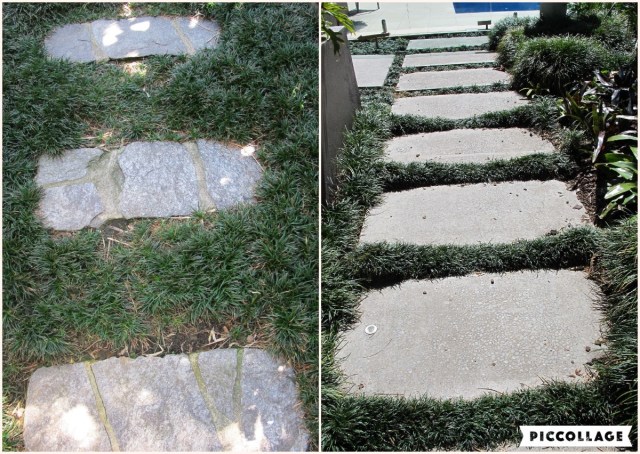
Planting around large pavers in mondo grass (Ophiopogon) gives a softer look that is really pleasing to my eyes. It is also one of the lower maintenance techniques because the mondo grass will choke out most weeds and it is extremely hardy, even to heavy foot traffic. Maintenance is just a matter of getting in and thinning it out when it starts to look too congested, which can be done with an old carving knife or a cheap flax cutter.
Wider pavers give a generous look befitting, even, to a main path to the front door.
When we last lived in a city – and I admit that was loooong time ago – we walked. A lot. It was pre-children so we probably had a lot more time on our hands. Walking in a city is a great way to get ideas, to see what is growing successfully and what is not, to influence your likes and dislikes and to look for alternative ways to accommodate modern life and vehicle dominance without damaging the environment. I don’t think many of us saw drainage as being one of the more confronting aspects of climate change.
Reader Susan has kindly sent this photo of another design that combines functionality with both drainage and aesthetics. Those are railway sleepers filled with coarse woodchip. Fine woodchip runs the risk of either compacting in some conditions or simply floating away in a flood to block stormwater drains.
 Tikorangi The Jury Garden
Dear Abby
<
div>This is another permeab
I think there has been an error in uploading. Can you try again?
SM
<
div dir=”ltr”>
<
blockquote type=”cite”>
It is still not loading. Do you want to email it to me – jury@jury.co.nz?
A very timely newsletter. Also, concrete is one of the most polluting of products in its production. I despair over the number of houses that are adorned with massive, ugly concrete slabs to accommodate their equally ugly and massive vehicles.
That is pretty much where I am coming from!
Hi Abbie, Agree with you on people wanting to tame nature. I am not sure if you heard someone in Judges Bay/Parnell took the opportunity post Gabrielle to cut down a large pōhutukawa tree(NZ Christmas tree), the plan being that contractors clearing storm damage would also clear that away. I’d love to hear they’re doing community service for every year that trees been standing. Call me a Karen.
I saw that report and said something unprintable. Do these people not realisevthat the pohutukawa, of all our trees, is arguably the best at retaining eroding land?
Dear Abbie, I have just read your article on drainage. I have watched the damage in the north with horror and sympathy for those who have houses in areas where no houses should be. I live, 25years now, in a Sth Island valley where floods are regular, the last few exaggerated by â slashâ and houses built on what we used to call flood plains. When I came here people thought I was strange because I spoke to older residents about how many and how severe and if the water has ever come over my bank. My lawyer also checked as Councils do keep records of floods and damage. I am angry how many people sell land; how many developers also in areas like this with no thought of warnings, directing to Council and even Council themselves for allowing houses to be built. All this land ,I believe, should be returned to wetlands to absorb runoff, into biollogical ways to accept these amounts of water. This is been done in the Lake District in England, with areas of wet land absorbing excess water and are now huge areas where plants and animals arereturning to their natural home, including the return of two species of birds thought extinct. Climate change education should include how to live here by using these sorts of methods that we can all do in our gardens; collection of rainwater so there may still be usable water when the Council has run out; growing plants suitable to such conditions , less solid concrete and so on. . Education .education. I am having trouble now trying to think of where these poor people will find good areas for housing, how they wii cover the expense of moving and rebuilding and recover from such a horrendus event that is in no way their â fault.â We need to wake up the government and Councils in NZ and start charging individuals or groups who are, eg Forestry, party to this unnessary destruction. Many thanks for reading this Marianne
Sent from Mail for Windows
Dear Marianne, I know exactly what you mean! There are many areas of our country where building has gone ahead on flood plains, including a large part of our local town of Waitara. Allied to that, farming practice has been to drain wetlands and channel the water so that it flows straight to the coast, rather than being absorbed in the area where it falls. Then there is NZ’s love affair with fully detached, single storey houses which take up a lot of space, even as section sizes get ever smaller. We need to make a lot of changes which means more controls over where housing and infrastructure are located, reinstating wetlands and looking at good designs to build at least double storey homes and maybe semi-detached or even contemporary terrace housing. A lot of it comes back to tightening up the Resource Management Act in appropriate ways because developers have made it clear that they will build anywhere there is a dollar to be made and they will pressure councils to approve such sites.
Dear Abbie, Thank you for replying, I can only think how busy you are..I agrre with every thing you said. I have been reading an article on front lawns in one state in USA where they are now banning grass areas next to roads in built up areas, hoping to reduce the use and run off of water and most importantly the use of a huge amount of chemicals they use for those miles o bright green lawns at the front of the houses. I was impressed that they backed it up with plans for planting the verges and the lawns with drought tolerant plants and grasses; an impressive list also; and a list of organic mulches to put around the plants. They suggest a natural path thru it so you can enjoy emersing yourself in the plants. I like also the building of small terrace type houses in an area shared by tenants for entertainment, growing fruit tees, veges. All rain water is collected and used for, home use; waste water is cirulated thru tiers of ponds to clean and return it for uses such as watering the vege; ornamental planting has to be drought tolerant and mulched. The photos are intriguing. We have a huge water tank for rain and water off the house which may be topped up from the river only if needed; mainly two weeks in Jan. A smaller tank has only rain water we use for drinking ect.Last year I bought two hard plastic, fold up water tanks, 5000l each, sitting on palletts in the garden for $2 week thru Chriscos! We mulch with pea straw and some small sized bark, the paths are gravel or a bigger grade bark. We may have as we did Sep to Dec over 150 mls a day. There is no water lying around, it is soaked away, immediately; nothing is drained into the river. On two areas fo spouting we have 2000l plastic drums with ware for the garden. We buy plants that are hardy, -10 in winter up t 35 in summer and drought tolerant when established. I am finishing up another idea where one spout from the deck goes into a bog garden, made using an old mussel float, under a small bridge; this garden is full of Louisiana Iris which are now climbing out anone of these ideas except for the bib tank are expensive and can be done a little at a time. We often find things at the locall rubbish dump which can hold water or to make a small pond. I think it would be possible to include some of these ideas into the building code, I can see from the photos that you also have lots of ideas like these and I just love the magnolias of which we have quite few of the Jury ones; so excited to buy Genie last year; they do well here in these extremes as do the camellias which we love. Every year when we go to look for more cammelias I am aiways drawn to âFairy Blushâ and every year I buy another! Sorry! It is just so lovely! It must make you feel proud to âgiveâ us these beautiful plants Take care Marianne
Sent from Mail for Windows
So many good ideas, Marianne! You really are walking the talk. Thanks for all the ideas.
New installation of pavement is limited in some neighborhoods in town for these reasons. Most old pavement can be replaced, but new pavement is limited to a ratio of the area of the parcel that it is on. Incidentally, because of subsidence within the Santa Clara Valley that was caused by pumping of groundwater to sustain the orchards a long time ago, percolation ponds collect water from creeks, particularly Los Gatos Creek, and allow it to percolate back into the ground to recharge ground water. Of course, such percolation is becoming obsolete, as less water is pumped nowadays, . . . and the real estate occupied by the ponds is some of the most expensive in America.
Oh Abbie you have obviously not been to Auckland city recently where most new houses are not single detached McMansions anymore that take up the whole small sections, they are instead numerous 2 or 3 story attached dwellings crammed into the same small sections with very little yard at all (if any) and certainly no garden! Only driveway and all impermeable with each dwelling usually only having one or two parking spaces, the only mitigation being undersized stormwater detention tanks, and gross, smelly detention ponds in new large scale developments. Just dire and irreconcilable with days gone by.
I had a horrible vireya buying experience recently with the ones I bought, both potted in a large pot with a lot of growth up top, however the roots were constricted to the max by a seedling plug that they had not grown through! It appeared to have been potted up two times with the roots still restricted by the plug. Luckily there was no rot as often happens with plugs so I am hopeful. They were also under attack by mealybug with their labels and pot rims brimming with them… Anyway I was wondering what in your expert opinion is the most fragrant vireya 🌺
Good design is critical with housing intensification. There are plenty of good models from long experience overseas.
Sorry, I can’t advise on vireyas because I have no udea what is on the market these days. As a general rule, the ones with big, fragrance blooms are much more difficult to grow well, or even keep alive!