

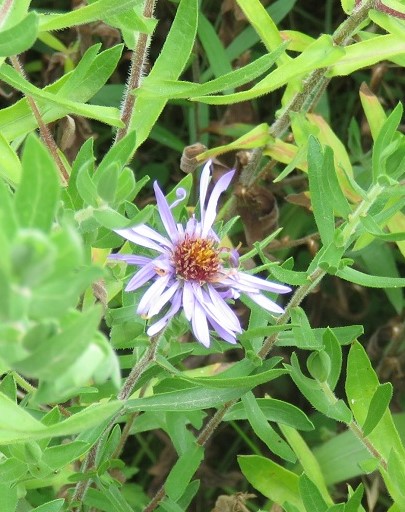
I have spent the better part of the last week digging out an invasive aster. Pretty it may be in flower but I am now aiming at total eradication from the twin borders and I am looking at in askance in the Court Garden.
I don’t know what the species is but I am pretty sure it is a species, not a named hybrid. I see it was back in 2020 when I first decided it could be a problem. I lifted masses of it but left a few bits behind to see if it could stay with closer management. I would have started with just one small pot of it but from modest beginnings and despite some intervention along the way, I could now measure it by square metres. It has to go.
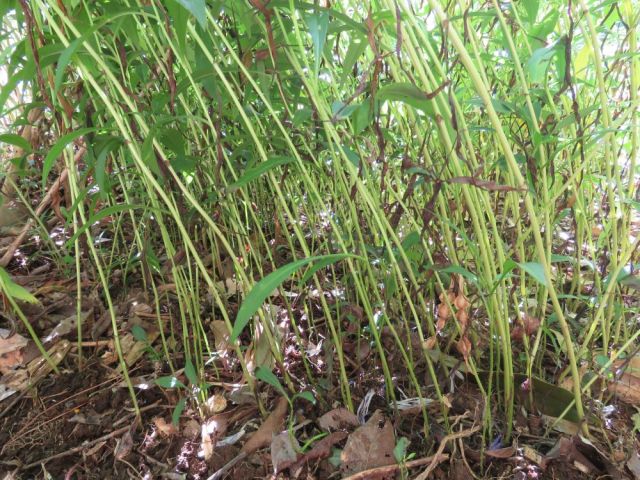
The problem with this aster is not just that it needs staking in our climate because it reaches maybe 1.3 metres high in flower and flops over under its own weight, smothering everything around it. I could have coped with some seasonal staking and restricting its spread from seed by deadheading it, but it is what is happening just below the surface that is frankly alarming. It runs in every direction with huge enthusiasm. I am lifting it out of areas where I never planted, several metres away from the original clumps.
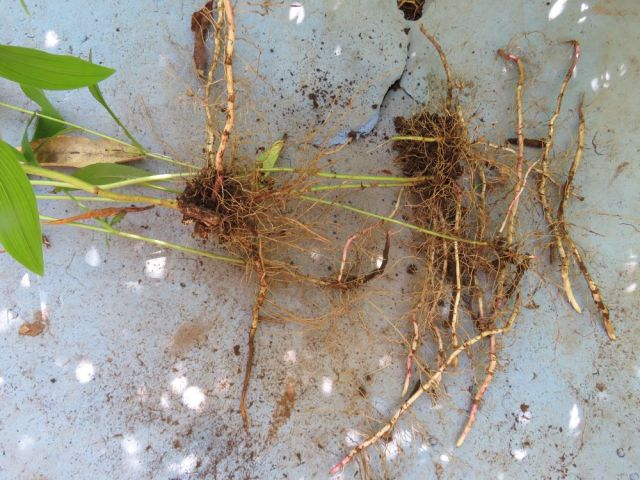
Because it is shallow rooted, I can lift the mats of roots okay and often just grab each runner in turn and carefully pull it out for most of its length – which can be 30cm of runner at a time. The problem is where it has invaded the root systems of its neighbours and the runners break off. It is going to take me years to achieve total eradication from the borders.
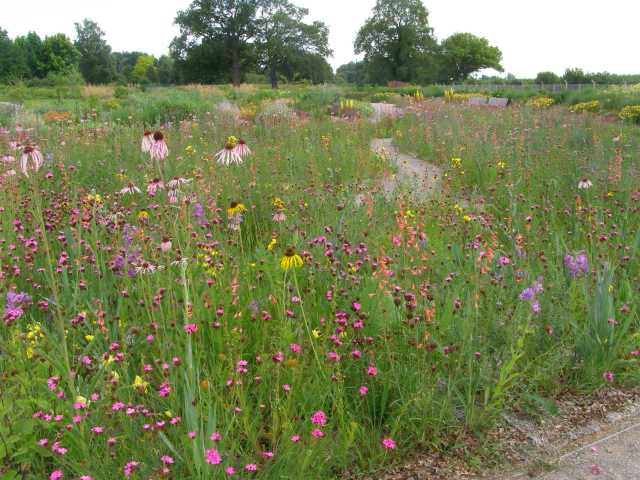
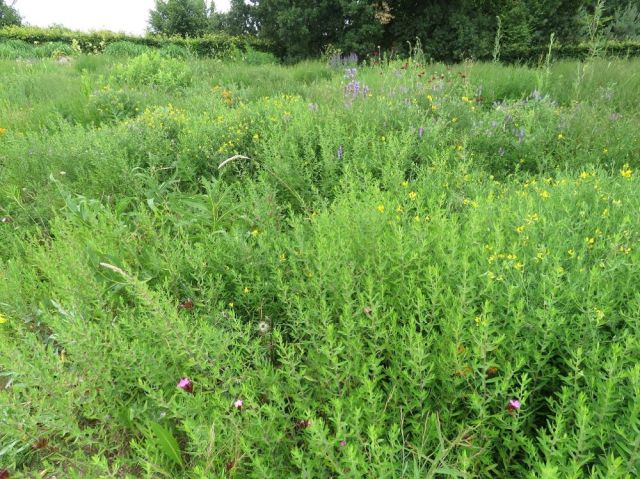
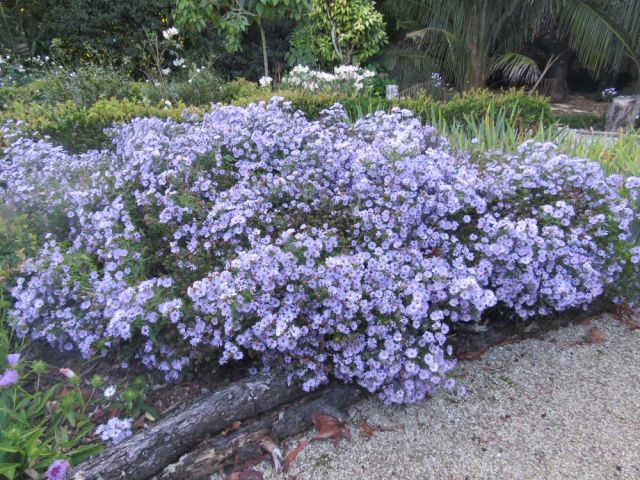
At the back of my mind is what happened to the Missouri Meadow at the RHS flagship garden Wisley, in the UK. When we first saw the meadow in 2009, it was in its second year and remains in our memory as one of the most enchanting plantings we have ever seen. By, 2017 it was a real mess because – wait for it – an invasive blue aster had taken hold and run wild. I would guess the whole garden has long gone now and been replaced by something else because getting rid of just the aster would have been impossible. I don’t know if it was the same aster but I could see that, left unchecked, my twin borders would have gone the way of the Missouri Meadow in just a few more years.
We have maybe half a dozen other named cultivars of asters in shades of blue and pink and they are fine. They are all hybrids, not species, and while they will form a fairly dense surface mat of roots, they are not invasive in the same way. And they do tend to have stronger stems so hold themselves upright, even the ones that are waist height.
Also going from the borders are all the Miscanthus ‘Morning Light’. This is not because they are invasive, although they do seed a little more than Mark thinks they do. I know this because it is I who weeds out the seedlings. Beautiful they may be, especially in flower in late autumn as the sun drops in the sky and illuminates the plumes in the lowering light levels. But they are relatively demanding and, if not managed tightly, they grow too dense and fall apart in heavy rain and wind. Basically, they need to be lifted and divided every three years and root-pruned in the intervening years and that is a big job in densely planted borders.
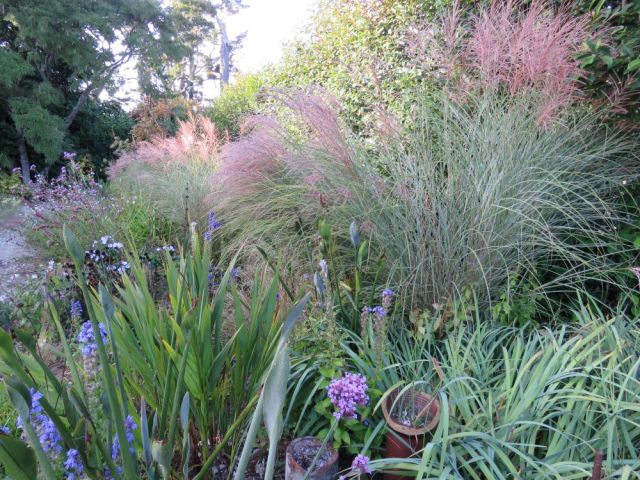
I have used the same miscanthus extensively in the Court Garden and they can stay there, even though the lot need to be lifted and divided this winter. That can be done when the flowering is past its peak. But it is another lesson we learned from several visits to Wisley that led to my decision to get them out of the borders next to the Court Garden. It seemed to us that Wisley had used Stipa gigantea in almost every garden there and, while a most obliging plant with the prettiest flowers of any grass I know (golden oats, is its common name), when it is used in many garden beds, it just ends up making them all look the same. Too much of a good thing. I have generally avoided repeating plants in the different summer gardens so that each one has a different look. Miscanthus ‘Morning Light’ was one of the very few plants I repeated and, with hindsight, that was not a good decision in our growing conditions as far as the twin borders go.
So I have spaces to fill but plenty of other material to use that will be better. The thing about gardening is that it is a constant learning process but that is also what keeps it interesting. A stitch in time may indeed save nine when it comes to sewing; in the garden, removing certain plants in time may avert a takeover that will choke everything else out.
 Tikorangi The Jury Garden
One of the fascinating things about gardening is how plants react to different climates and environments. Miscanthus ‘Morning Light’ does beautifully for me in rural Quebec and your species aster would not go amiss in certain areas of the garden. Our growing season is so much shorter and the temperatures generally moderate, so plants that spread freely are ones I see as a bonus. I can appreciate, though, that your situation calls for different means and methods.
We have so many pest plants in this country that are garden escapes, Pat, so we are very mindful of this. The giant gunneras are totally banned in our area – as in just not permitted to be grown at all – and Prunus campanulata is now banned in a number of other areas. Just as it is a benign climate for growing plants, so too has our country proven hugely hospitable to introduced animal pests that wreak havoc here whereas they are not seen as pests in their home countries – like brushtail possums and rabbits and even goats and deer. And there is a lot of trial and error in determining how plants will perform here.
Some years ago I hiked the Routeburn trek and I remember the issues with possums. I’d love to be able to grow gunnera… just one example of how different our situations are.
I walked the Routeburn when I was 16 and that is almost a lifetime ago! I still remember how spectacular it was. We would quite like to grow giant gunnera too, but can’t fir very different reasons!
Hi Abbie Is there any chance my friend Clare & I could visit your amazing garden tomorrow morning? I was inspired by Fergus at Great Dixter & also yourselves to convert our main lawn into a meadow 3 years ago at our garden in Waikanae, Kapiti. We came via Jen’s Puketarata garden & thoroughly enjoyed exploring & admiring that, then bumped into Jen & Ken? at womad yesterday We head back home tomorrow, Monday, no pressure, just if it is possible… Many thanks Celia Barr-Brown
Get Outlook for Androidhttps://aka.ms/AAb9ysg ________________________________
Sorry to disappoint but I regret we are permanently closed to the public now.
Your garden looks to be a fairytale as usual Abbie. I’m sure the bees and butterflies must throng that blue aster. I have the opposite problem with my asters, all far too tame. Currently doing some cuttings of one I got many years ago that was advertised as a replacement for the banned Mexican daisy. Very nice but doesn’t have that rampant charm. My annual display for this season includes California giant asters, also very nice almost bedding Dahlia sized annuals. I hope you and Mark have been keeping well lately.
Some of the mid-sized asters are good garden plants and not like bedding plants. I bought several from Terry Hatch at Joy Plants a few years ago. All good here, thanks for asking.
Thank you Abbie for the suggestion. I am familiar with aforementioned, however many moons ago him and I had an unfortunate altercation and I would not be able to frequent that nursery again! I do have a few tradescantias, wandering and of the spleenwort varieties from him which I adore. My more recent asters additions have been of the paper daisy variety to try and attract the painted lady butterfly 🦋. Sending love your way 💌
Is one or more of the species of Yucca naturalized there? I read that it naturalized somewhere, but can not remember where. I just remember how odd that it or they would do so without the specific Yucca moth that each species relies on for pollination. (Each of the fifty or so species relies on a specific species of moth.) I was left wondering if the particular moth was also feral in the particular region, and why it would be imported.
I am not aware of yuccas having naturalised here. Plenty of other plants but not yuccas.
It is just as well, and would be weird anyway.
Hi Abbie what are the plants in front of the Miscanthus in the photo – with the blue flowers
Perennial lobelia. Easy late summer colour.
Our feral plant that we are trying to eradicate from a couple of beds and borders at the moment is Anemone x hybrida ‘Honorine Jobert’. It makes we wince every time someone on Gardener’s World shows the viewers how to propagate it from root cuttings! Luckily we don’t have your thuggy Aster: ours are fairly prolific self-seeders, but we love the way they pop up in odd spots with different colours, different heights and different flower sizes. They can then be weeded out or transplanted as suits.
Pingback: Road cones on duty | Tikorangi The Jury Garden