

When the sun returned on Friday, I realised that it was not the rain that had dampened my spirits, it was the low light levels. Clearly, I was never destined to live in northern Europe where I am sure I would suffer from seasonal affective disorder for months every year.
Here in Taranaki, Aotearoa New Zealand, we sit at 39°S which is a similar latitude to California, Ibiza and Sardinia – or Madrid is the usual northern latitude comparator to our country. Not that our climate bears any resemblance to those locations. We are a long, thin country set in the middle of vast oceans which moderates our climate and brings us regular rain – too much rain of late. We have a very clear atmosphere and that clarity of light is apparent in every season where we live. At the winter solstice, we still get around 9 ½ hours of light a day and that is often bright light. No wonder I am accustomed to high light levels.

The return of the sun had me out looking at the tree dahlias. These are difficult plants to accommodate in the garden but they certainly have the wow factor at this time of the year. All summer, I have seen friends posting photos of their prized dahlias and, while I admire their enthusiasm, the big, blousy, summer dahlias do not bring me joy. Too many murky colours and novelty forms for my personal taste. The tree dahlias are a different matter.
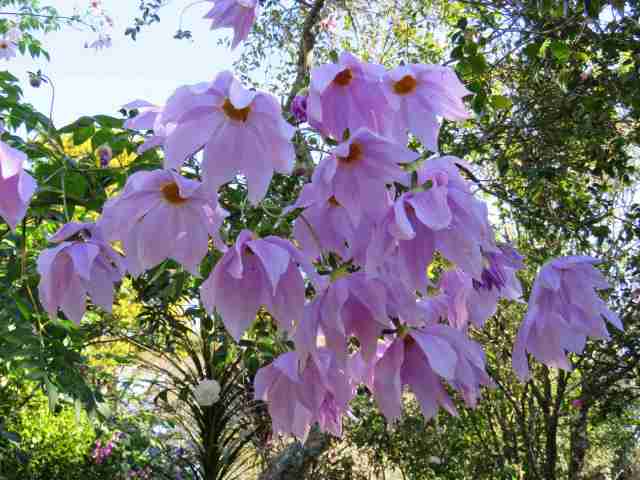
What is not to love about the soaring heights of D. imperialis lilac chalice blooms? When I say soaring heights, because we are growing them in semi shade, they can be stretched up to around 5 or even 6 metres.
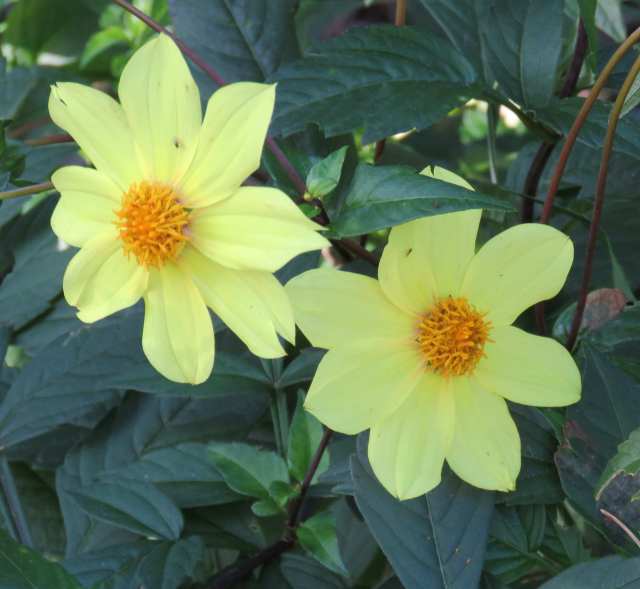
D. imperialis is of course a species and the other species we have, D. excelsa, flowers even later in the season and grows even taller. It is not even showing colour yet. New Zealand plant breeder, Dr Keith Hammett, has done a lot of work over the years to create more amenable tree dahlia hybrids. We don’t have many of them and don’t have the right places to grow many more but I wouldn’t be without his yellow ‘Conundrum’ which flowers pretty much all summer and autumn coming into winter.

‘Timothy Hammett’, named for Keith’s son, is a beautiful and unusual shade of cerise-purple with smaller flowers. Because these tree dahlia blooms have visible central stamens and pollen, they are alive with bees and butterflies at a time when other food sources are getting sparse.

I have long since lost the name of the larger flowered, strong pink one we have – if it was ever named – but it is another worthwhile Hammett hybrid. If you want to know more about Keith’s tree dahlias, this article by him in the April Gardener is well worth reading. There is an impressive flower lay showing the range of colours he has reached in his breeding, starting from just four different tree dahlia species.
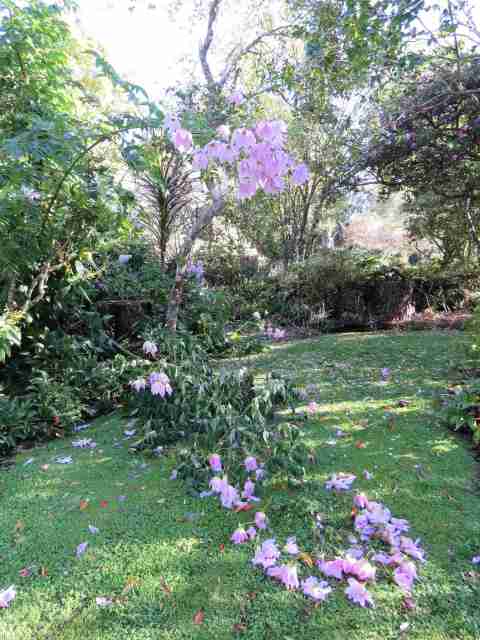
I think we need to lift and divide our plants. This has not been done for many years and the tubers on some are very close to the surface. All we have done is to cut them down to the ground when they have finished flowering and reached their weather-beaten, scruffy stage – that is, if they have not fallen over with their own weight before then. They are brittle and vulnerable, especially the tall species. They are not exactly on a scale that I can stake, either.

I think if we lift them and thin out the tubers, replanting them somewhat deeper than they have been, they may well reward us with sturdier growth and, hopefully, stay upright longer – or at least until they have finished flowering. Until then, I will just enjoy their glorious display as we count down to winter’s arrival. I prefer my life filled with light and colour.
 Tikorangi The Jury Garden
Dahlia imperialis (I believe) used to be popular on the coast near here. I should have gotten copies of it while I had the chance. I have not seen it in quite a while. I know that it must still live in some gardens somewhere. It should be too reliable perennial for them all to die out at the same time. There was a fluffier white sort that was supposedly a cultivar of the same, but could have been a different species.
I think the white form, which we bought as a form of imperialis has more recently been classifies as more likely to be excelsa.
That sounds about right. I remember that it had a cultivar name without a species name, as is more typical nowadays. Perhaps it is more marketable with a fancy cultivar name. ‘Excelsa’ might have been modified to be the cultivar name if the real name was unknown.
No, the white form is a species, as far as I know. Not a cultivar or a hybrid. Just initially confused with the species D. imperialis.
Yes, but Latin names are not as marketable as fancy cultivar names. Dahlia ‘Excelsa’ seems to be more impressive than Dahlia excelsa in italics, uncapitalized and without semi-quotes. Latin is no fun.
Those tree dahlias are impressive plants. We have tried them here in Ireland but our season is not hot enough/long enoudgh to bring them to flower.
Yes, they are not the easiest if plants. Marginal south of here, too, because they are frost tender and colder areas are getting their first frosts already.
love them but am now down to the single white and the winds come every year and knock it about. My sis in law has has the lovely pinky mauve one but I have had no luck with it. She is Sydney I am north of Wollongong. the photo of the dahlia with umbrella reminded me of my Mum. She protected her beloved hydrangeas from Sydney’s heat with umbrellas.
You should have a good climate there for tree dahlias. Worth keeping on trying with the pink?
I’m happy to say that, here in the marginal bottom end of the North Island, our three tree Dahlias have survived the first light frost of the year with no harm to either the flower buds or leaves. The big one (with 10 flowering stems on the tuber) is in a 50 litre plastic pot, which we moved under cover (even though it is nearly 3m tall) before the frost hit. The two smaller (1.5 and 1.8m) were both grown from cuttings this year and are planted next to a stream. I think the flowing water raises the air temperature slightly due to evaporation, so they missed getting frosted thanks to that. The bigger one was bought as a small tuber labelled ‘White Tree Dahlia’ from a local church annual plant fair a few years ago, so we have no idea what species or cultivar they may be.
If it flowers white with a flat flower in a daisy form, it will be the species Keith mentions in his article that he thinks is D.excelsa. White is not common in tree dahlias. I have not seen any others.
I’m very happy to report that the first few buds have now opened and I find that tree Dahlia has a white multi-petalled flower that looks identical to the one in the photo in your 14 June 2020 post, which you referred to as Dahlia imperialis alba plena.
That is what Keith now thinks is D. excelsa and I bow to his knowledge in this field.
Hello,
Kevin from “Town and Country” gave me cuttings of said Dahlia “Imperialis” in the Manawata , the plants are doing really well there, nice sheltered locations and very much part of a secure larger shrub planting scheme similar to yours Abbey and Mark.
The over arching stems did invade the garden paths which was totally fine because the flower became available for up front viewing. Cuttings are super easy to take and large as well. I simply pushed them into a south walled garden bed, lets see how they do…..
Oh that is interesting because I have a friend there who wants to grow them but I thought it might be a bit cold for them. Having spent some years living in Palmerston North, I can recall how much chillier it is in winter there than here.