
It is easier to maintain specific plant collections when you have a nursery. In that situation, special plants are maintained under nursery conditions and given more individual attention and care than in general garden collections. We used to carry a large array of different bulbs when we were doing mailorder and they were repotted on an annual basis, or at least every two years. We only listed bulbs if we had enough stock reserved to keep going for the following years.
We put out our last mailorder catalogue in 2003 – twenty years ago – even though I still get email and phone requests from people wanting to order plants from us! In the years since, I have planted most of the good bulbs in the garden, scrapped some that may have been botanical curiosities to half a dozen afficionados throughout the country but were of little merit as garden plants and the rest have languished under a regime best described as benign neglect. Some have not survived this laissez faire approach but, with an extra pair of hands, we are starting to salvage what has.

Our gardener, Zach, is doing his apprenticeship and one of his modules is on plant collections. I suggested the ornamental oxalis as a well-defined collection he could assemble in one place. There is no doubt that most of these thrive and look their best in containers. I have never forgotten Terry Hatch’s magnificent display of oxalis in pots at Joy Plants and that must be 30 years ago.
For years, I maintained a collection of my favourite oxalis in pots to be brought out when they look their best in autumn and early winter. I hate plastic pots in the garden so they were all in terracotta, ceramic or vintage concrete pots and truly, I just got fed up carting these heavy pots out of the nursery and into the garden and then back again when they were over, not to mention the annual repotting. I gave up and planted them out and let them fend for themselves. The most invasive of them, I put in shallow pots and sank the pot in the garden, but I rarely repotted them.
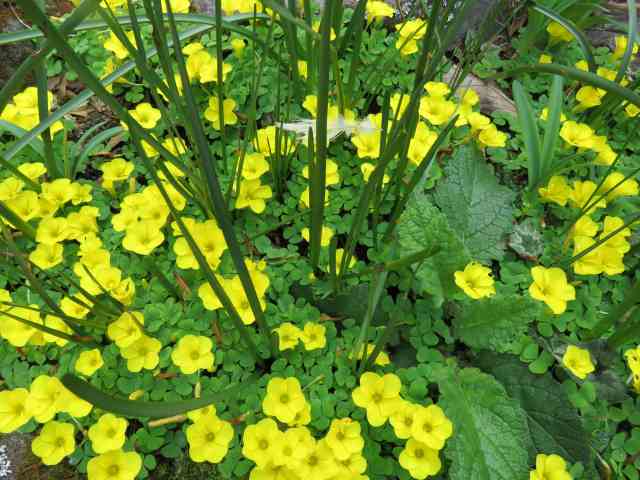
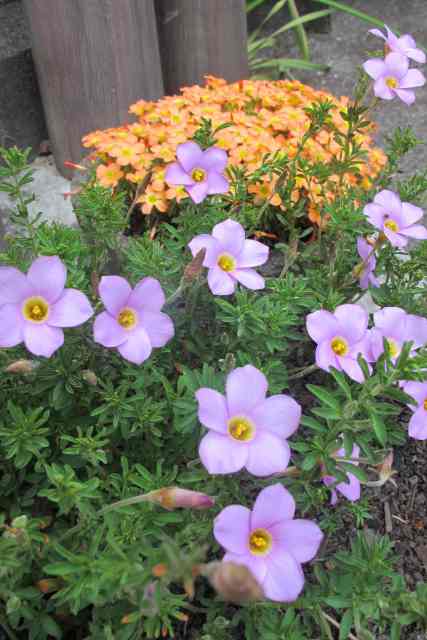
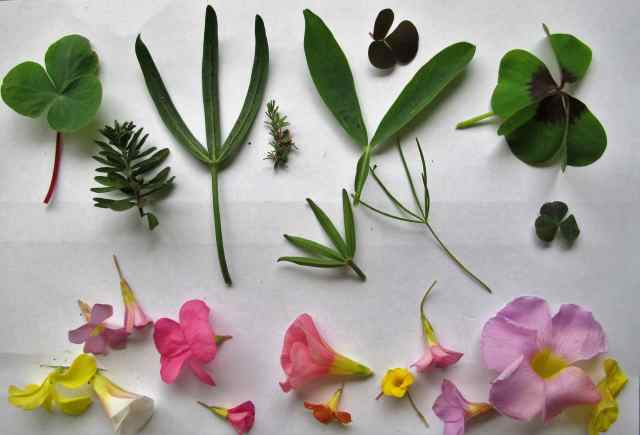
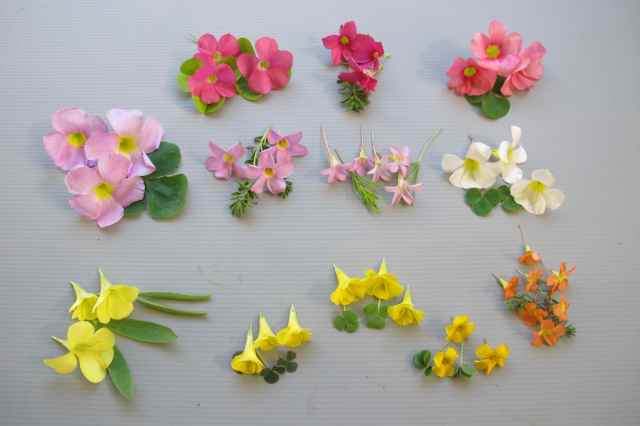
Zach has so far isolated 23 different forms of ornamental oxalis that grow from bulbs. Most are from the garden here and a few he has added from his own stash of plants at homes. (Note: he has just sourced another five from a local market, he tells me.) Amazingly, I think we only lost two varieties in the years between my getting them out of the nursery and him getting them back in again and they weren’t a great loss. I suggested that he also pot up the weedy ones we battle all the time. The creeping oxalis – O. corniculata – which we have in bronze and green is the worst and we have a pink one in a patch of grass that may be O. corymbosa.
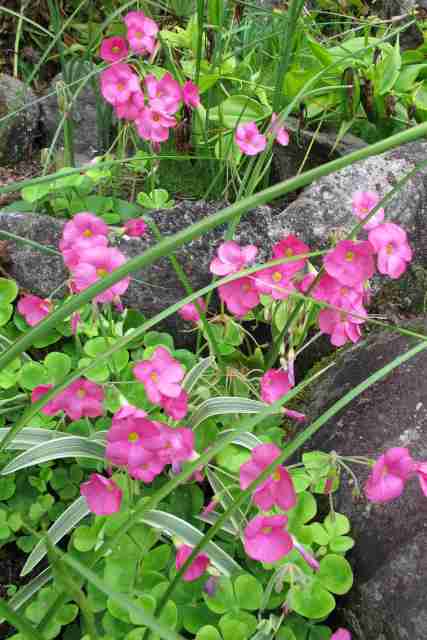
Then there are the more herbaceous oxalis. The best known of these is probably what we call a yam in Aotearoa New Zealand, although technically it is growing from a tuber. Commonly known as oca in Spanish, it is a food crop and one we grow ourselves, semi naturalised in the vegetable garden. Botanically it is Oxalis tuberosa.
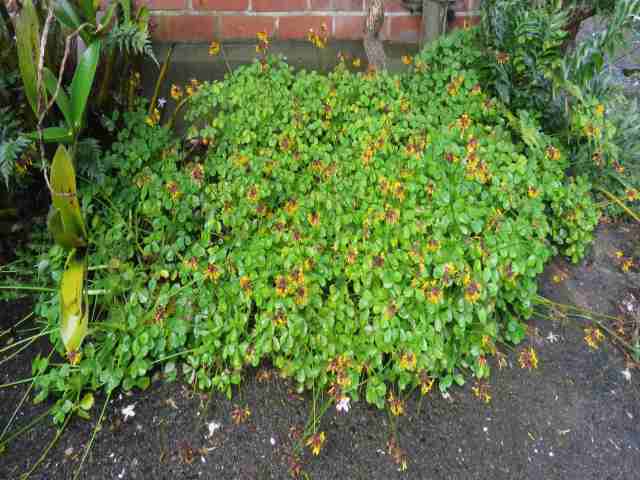
We have Oxalis peduncularis growing in one of those awkward, narrow borders against the house and it looks and grows more like a succulent, flowering for most of the year. Now that I am getting my eye in again, I have spotted another plant that is like a dwarf peduncularis but I have never even thought about what it is because it has just always been there, in its place. It must be another oxalis.
The family is huge overall with somewhere over 550 different species in the wild across most of the world except the polar areas. I have only just discovered that we have a native one – Oxalis exilis. It is a small creeping one and I think it is probably one that I assumed was corniculata, too.
The thing about plants is that the more you learn about them, the more interesting they get. There are many worse rabbit holes in life that one can go down than the intricacies of the oxalis genus. I can see that Zach’s oxalis collection will probably continue and expand long after he has fulfilled the requirements for his level 4 apprenticeship.
I am wondering now whether I can get him onto isolating and sorting the intricacies of the lachenalia collection next. That went pretty much the same way as the oxalis collection when we retired from mailorder but is more complicated because of their readiness to cross with each other and produce natural hybrids. He doesn’t need to do it for his apprenticeship but I think he would find it very interesting and it would be satisfying to sort it out again. At least all the lachenalias are bulbs and there are only about 133 species so that makes it more tightly defined.
 Tikorangi The Jury Garden
very intereting article thanks. have always loved the ornamentals.
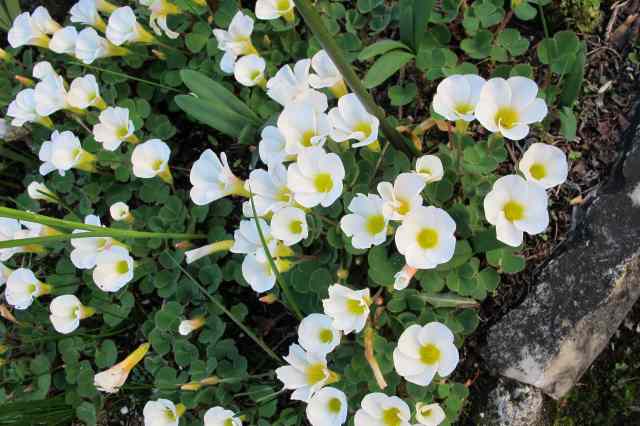
The oxalis are beautiful! You gifted several varieties to Te Henui Cemetery a few years ago (the beautiful white, a peppermint twist one, and I think a pink with unusual bicoloured leaf, and the orange one- the latter 2 lost now). Until your gifting the Cemetery only had 2 varieties that I was aware of- the large flowering lavender one with red stems and the large flowering pink one which grows quite flat and spreading. (I understand that they are the survivors from a collection that Council had at the Cemetery). Your white is truly magnificent – an absolute favourite and I so look forward to it emerging in late April every year. I love that it flowers right through to late September. I recall that you had companion planted the white oxalis with some bearded iris at your place and I have copied! They seem to co-exist well and the iris commence active growth as the oxalis are finishing and vice versa. The large pink oxalis (a Cemetery collection escapee I think) grows in the lawn at the cemetery and flowers happily despite being mown over – I guess the mowing interval is longer in winter and that allows them to reflower between chops! Children adore them and tell me they are the fairies flowers. An Auckland visitor to the cemetery was so taken with the pink one in the lawn that he wanted to go home to replicate the effect in his lawn. His wife was horrified. Such a shame. I think the ornamental oxalis are wonderful as companion plants to perhaps dahlias, lilies, iris or any other summer flowering perennials – they are certainly appreciated at the Cemetery for their winter flowering. And what is wrong with splashes of pretty pink oxalis in the lawn?
I think I recall them in the lawn. So glad these went to a good home.
Hi this is for Zac, just a few of my Oxalis i have in NZ.
https://public.fotki.com/savagegardenz/oxalis-1/
Zach and I had a quick look and that is certainly some collection! Zach says he will have a closer look this evening. Many thanks for sharing this.