
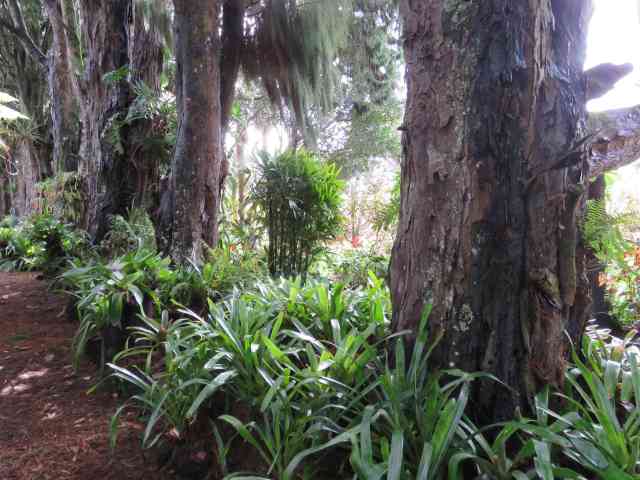
I have been ‘doing the broms’, as we say here. That is the once-a-year thorough workover in the Rimu Avenue. We have complex subtropical woodland planting throughout this area, but in square metreage terms, bromeliads are the dominant plant. This always brings back the memory of the rude old biddy who got into the garden for free on account of being brought here by a neighbour up the road. “I loathe bromeliads,” she declared as she stood in the middle of the Rimu Avenue. “Well you won’t like this part of the garden then,” I replied crisply, getting out of their company as fast as I could. When it comes to insults, I am like an elephant – I never forget.
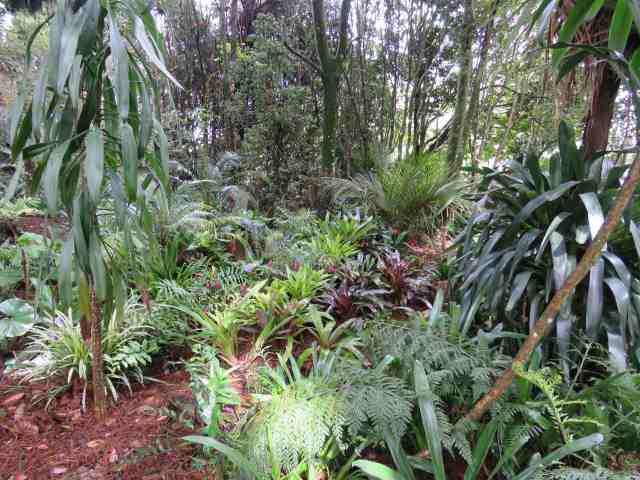
This avenue has long been one of our most admired areas. First started in the late 1950s, by Mark’s dad, Felix and then doubled in length 40 years later by Mark, it is probably unique in terms of an interesting, remarkably sustainable and low maintenance woodland garden adapted to our climate. Because it is completely frost-free, we can grow true subtropicals beneath the towering canopy of rimu trees (Dacrydium cupressinum) which are now over 150 years old. All up, it is an area somewhere over 2500 square metres, maybe even near 3000.

It is undemanding in terms of maintenance. During the year, we will remove dead branches and larger debris that falls from above. It is largely free of weeds, being in shade and having been gardened for so many years, although we are forever removing seedling prunus, nikau palms and wretched bangalow palms. Since we cut down the seeding bangalow (Archontophoenix cunninghamiana), the incidence of those seedlings will phase out in a few years.

Once a year, I start at one end and work my way to the other end, picking over every plant. Yes, it is a big job and it takes about two weeks of intense labour but the difference is rewarding and it is not heavy work. When I say two weeks, it is probably 60 hours which represents just over an hour a week across the year to maintain a major area of garden. I admit that does not include Zachs’s time as he works along the margins or Lloyd’s time removing my mountains of debris. So maybe this annual exercise equates to an average of two hours a week, except we do it in one hit.
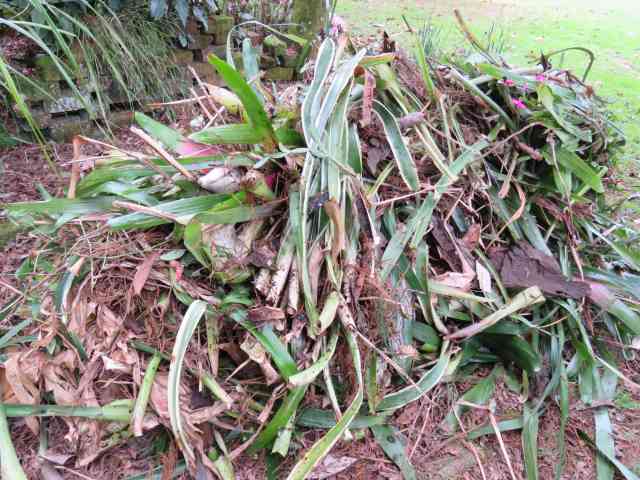
When I say mountains of debris, I mean that Lloyd is removing about two packed wool bales a day of my prunings. We used to dump it in our bush across the road to rot down in its own time but this year, Lloyd has been putting it through the mulcher and then using it in compost which is more labour intensive, but we get to use the end result. You can never have too much weed-free compost.

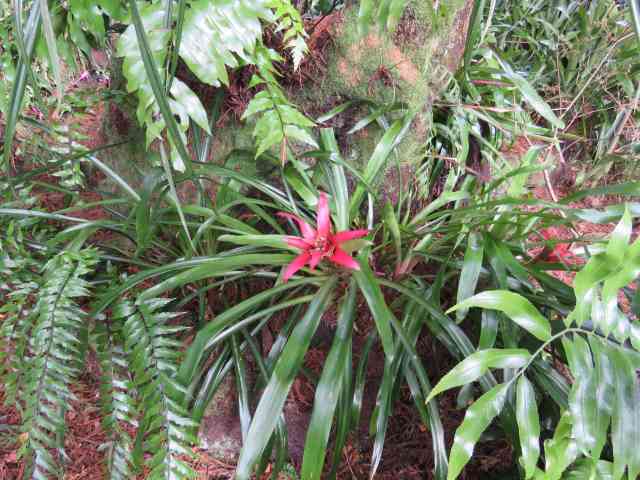
It is the bromeliads that generate most of the waste. Almost every bromeliad only flowers once and then the centre dies off – although the dying process can take more than a year or even three. While this is happening, the plant puts new shoots or pups out from the base of the old crown, or adjacent to it, and it is those new growths that will flower in the future. You can leave them to their own devices and the oldest parts will eventually die, dry and become dislodged but the clumps can get very congested and messy. I go through and remove the crowns that flowered last year.
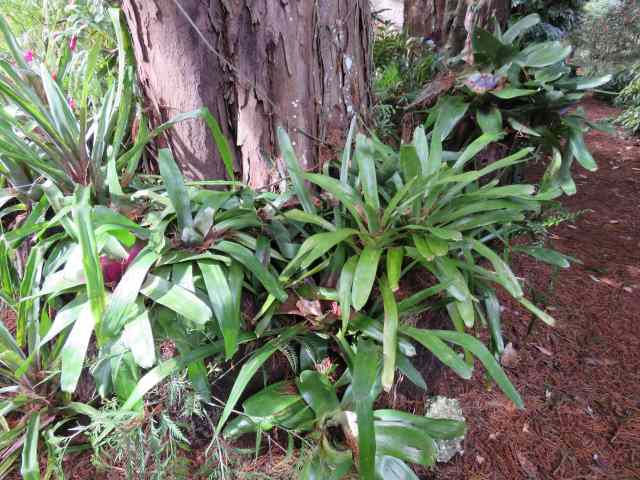
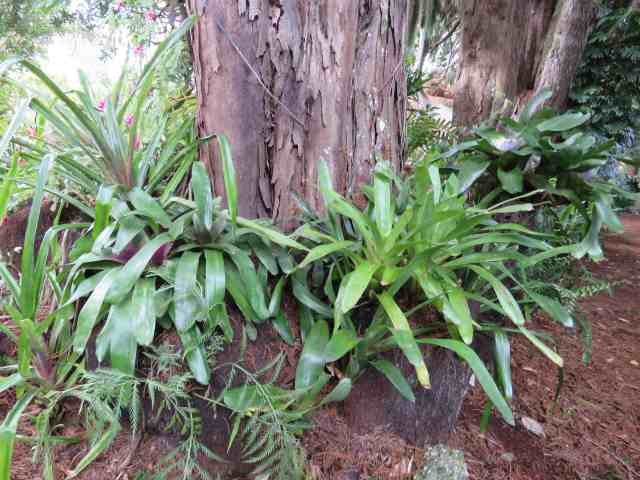
The strategy to removing them is to take the time to look at each variety to see where the new shoots are coming from. Some appear from inside the bottom layer of leaves so if you just cut through the base of the rosette, you are cutting off all the replacement young growths. Every variety is a bit different but that is also what keeps the task interesting. They will all be shooting from somewhere near the base if the time is right to remove the old crown.
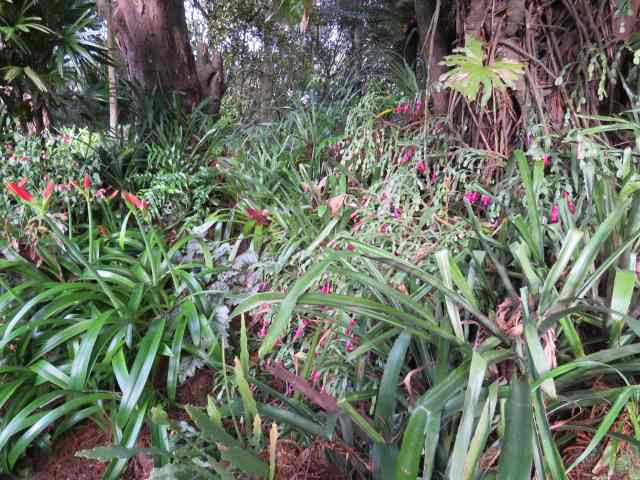
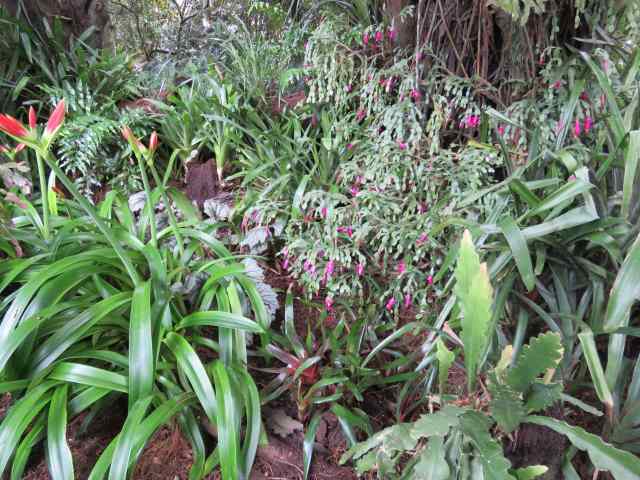
Even though we have been doing this for years, it never fails to amaze us just how much volume is removed and yet the remaining planting never looks bare. It just looks fresh. It is one of the more rewarding garden maintenance tasks on our gardening calendar.
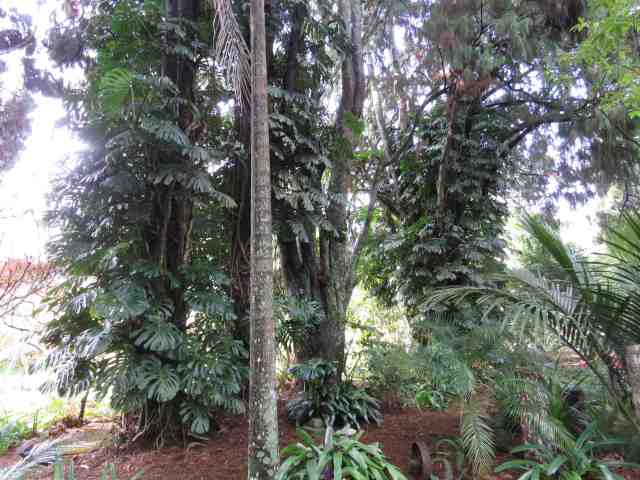
It wasn’t just the bromeliads. Zach and I removed huge amounts of Monstera deliciosa which had become monstrous indeed. We are fine with them climbing up; they add to the tropical look. Spreading outwards was another issue and removing most of the stems from the lower two metres opens up the views through which gives the feeling of more depth and distance in the garden. As he hauled out large amounts for mulching, many with aerial roots, Zach was musing how appalled plant sellers on Trade Me would be to see the wanton destruction of plant material they could sell at exorbitant prices!
 Tikorangi The Jury Garden
Love those rimu.hope you have listed them as a protected tree.bro s look good
We haven’t because we would then get tied up in red tape but it is only an issue if the property gets sold and we have no plans to move. Mark’s mother used to want one felled to let in the late afternoon sun but nobody ever obliged her on that issue.
I remember my father had one of the pink cantered bromeliads as a pot plant in his office, I always thought it was a bit ugly. However they look so much better in your Rimu walk, I also noted a Christmas cactus with a great mass of flowers!! Such an interesting combination, rimu and subtropical plants I wish I could see it all, in great detail. Thanks for the photos Abbie a lovely start to Sunday as always! Elizabeth
Thanks, Elizabeth. I am not sure I would appreciate a bromeliad as an indoor pot plant but each to their own! That bright pink chain cactus thrives in those conditions – we have quite a bit of it. I’ve tried other colours but none of them are as at home as the simple pink one.
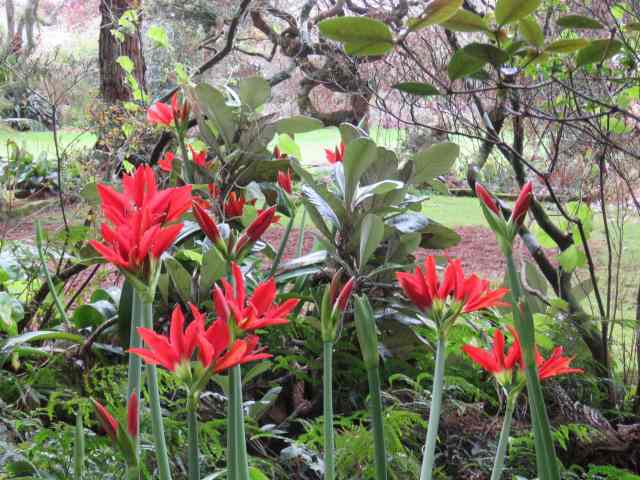
Fascinating account of a different type of garden maintenance to that in the UK. What a labour of love to go through all those bromeliads to take out the flowered centres. I love the amaryllis (hippeastrum) flowering outside whereas we can only grow them inside as houseplant at Christmas time.
It is a bit niche, that style of gardening. We felt right at home in the glasshouses at Kew – so many plants we grow here but all under cover. And yes, the Hippeastrum aulicum is lovely outside – as is H. papilio – and very easy care in our conditions. We only use them in the shade because the narcissi fly attacks them in sunny positions but it seems that pesky fly does not like shade!
I really enjoy learning more about plants.
We’ve always been very taken with your rimu walk on our visits to your garden, but our climate is a bit too cold (still) to use bromeliads in the garden. We have ordered some Hippesatrum papilio to try under a couple of Nothofagus menziesii in our most frost-free part of the garden. I don’t much like Hippeastrum hybrids as indoor plants, but think the flowers of H. papilio would look particularly enchanting in the right garden setting. I also like the way you use the native fern Asplenium polyodon (I think) to set off the straplike leaves of the exotics very nicely.
Basically, the ferns all volunteer themselves, Tim. I just move them around if they are in the wrong place. I am not a fan of the hippeastrum hybrids. They seem tk lack the refinement of the species. Even Mark’s hybrids have the sword of Damocles hovering over them – too much foliage for the flower frequency and the blooms are a bit too large and OTT!
Same here with our ferns: we have a very ferny garden, all free. Some transplant well, some don’t, and trial and error shows which. I’m keeping my fingers crossed about finding the right spot for H. papilio to be happy.
Abbie, what do you use to cut out the old bromeliad? I find myself sawing dismally with a serrated knife, or trying to persuade my secateurs to open wide enough, which they won’t! I don’t possess the right tool.
A flax cutter or flax knife. Widely available in garden centres or online. They have a curved serrated blade. I wouldn’t be without it.
I loathe them also. They perform so poorly here, and no one grooms them adequately. They are so envivable in the coastal Los Angeles region, and even more impressive in the San Diego region. Of course, they are not quite as happy as they would be in more humid climates. Even in San Diego, they are happiest as understory plants within well watered landscapes. Billbergia nutans performs somewhat well, but needs major grooming, and even at its best, does not compare to other bromeliads.
I get you, re the ‘rude’ biddy’! I used to have my garden open at times and the funny thing is you do remember rude, or negative comments, when actually you hear soooo many more positive ones. 🤣🤣
PS I love your articles
I have been at gardener gatherings after open events and the conversation often turns to the rude visitor – the one in a hundred or maybe five hundred who is remembered for all the wrong reasons! Glad you enjoy my articles – thanks for saying so.