
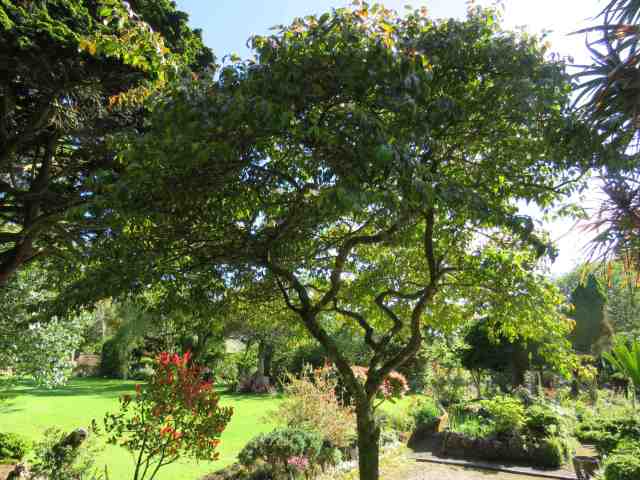
We carry out a lot of pruning in our garden but not a whole lot of drastic, hard pruning to reduce a plant to juvenility. Generally, we like to celebrate maturity in plants and to shape or clip to bring out their natural form if required. But sometimes there are plants that are beyond that and drastic action is needed because they have lost what ornamental merit they had.
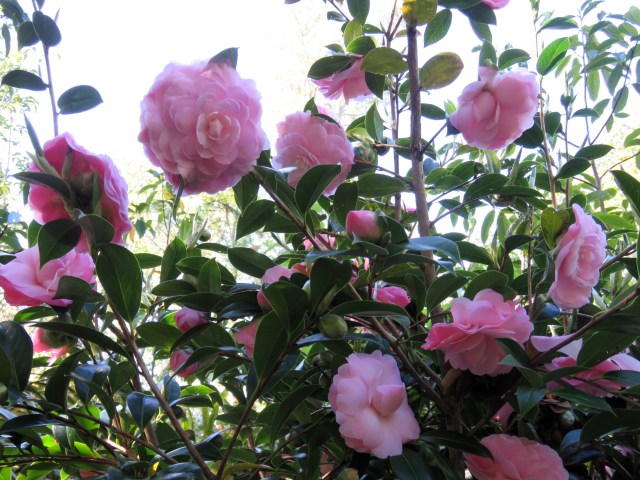
So it is with some of the original camellias bred by Felix Jury, some of which are now household names. We regard the original plants as having some intrinsic value simply because they are the very first one but there comes a time when they can lack any aesthetic merit, especially these days when camellia petal blight has robbed them even of pretty flowers. In particular, ‘Mimosa Jury’, ‘Waterlily’ and ‘Softly’ had reached for the sky and left nothing but bare legs and messy, blighted blooms and aborted buds visible at ground level.

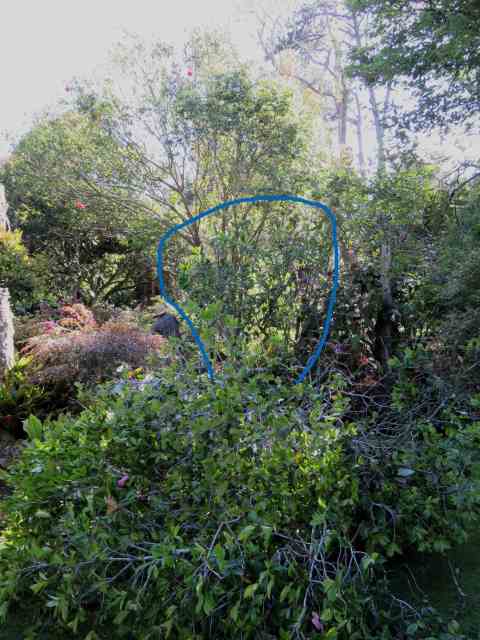
A word of warning: we have a fairly long season when we can do this sort of extreme pruning – late winter through spring is best, so August to October. We can get away with going into November this year because spring has been a little late and we get regular rain. It really is too late and risky for people in climates who are staring down the barrel of a long, dry, hot summer which may start very soon. Your plant may just sigh and die rather than springing into fresh growth.
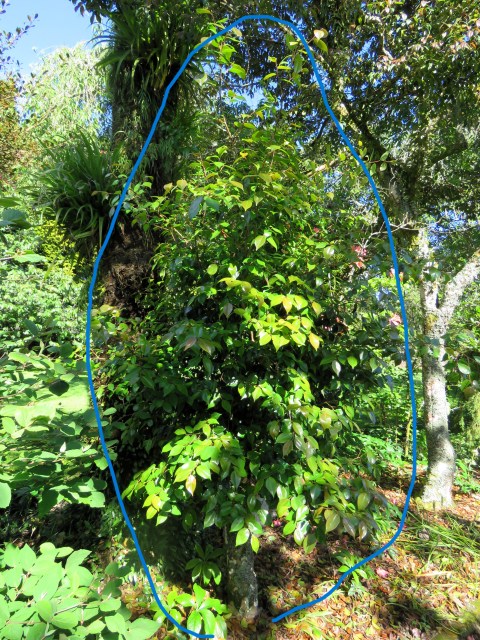
You can cut back to ground level with camellias and they will grow again but you get a thicket of young shoots and no form to the plant. We prefer to cut off to anywhere between a metre up to three metres, depending on the situation, so that the plant will look established again quickly. If we can, we will leave a few wispy branches that still have leaves on them, even if we trim them off later when the new growths have appeared. In this case, ‘Softly’ is back to bare wood while ‘Mimosa’ has a few thin branches with leaves. We shape the remaining trunks and branches, often reducing them to a strong central leader and maybe five or seven branches from that leader.
When I say reestablish ‘quickly’, I mean two years. The plants will push out new shoots this season and bush out again next growing season but they won’t flower and look lush until they have that second growing season behind them so into the third flush of new growth. Patience is a virtue in gardening.
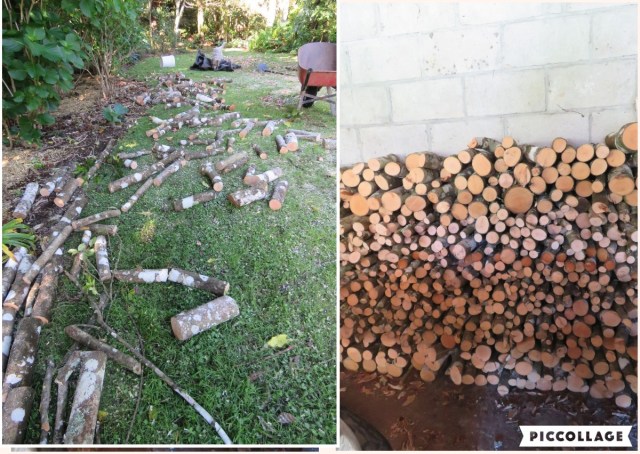
As is our usual practice, we deal with the waste by retrieving what is suitable for firewood and putting the leafy and twiggy remains through the chipper to use as mulch.
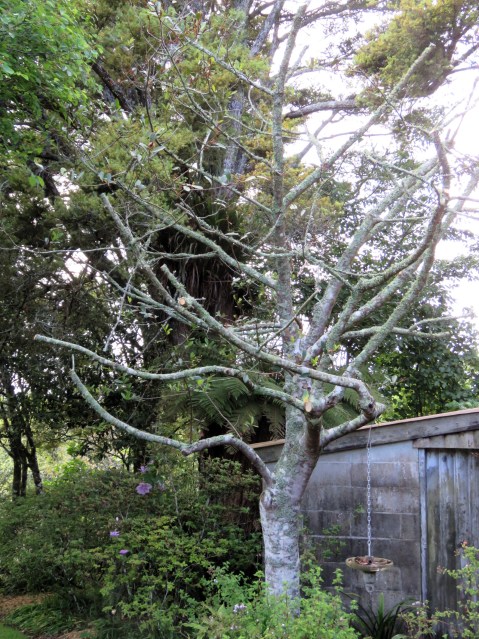
You can do this style of extreme pruning on michelias, too and we have reduced a M. laevifolia ‘Velvet and Cream’ to a leafless frame this week as well but you do need to start with a strong growing, healthy specimen. If it is not growing vigorously, it is may die. If you are wondering about hard pruning a michelia (botanically magnolias these days), there are more before and after photos over time here from an earlier effort on another specimen.
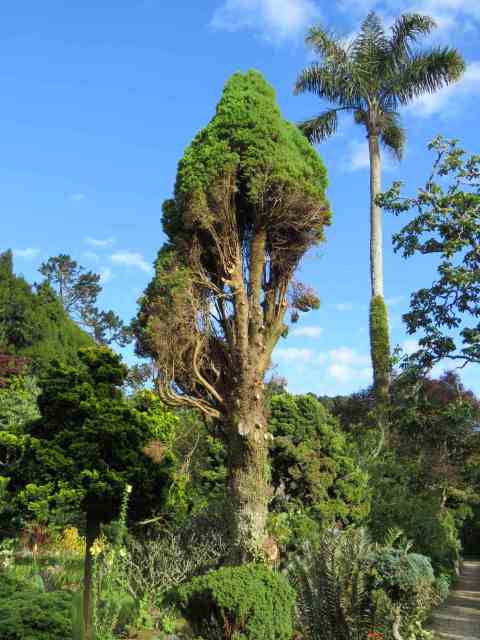
Some plants are beyond rescue. Work has stopped, temporarily, on the Picea albertiana ‘Conica’ in the rockery. It was once a fine specimen of admirable size and form. It was also kept in good health because Mark sprayed it for red spider once a year. As it grew larger, it became harder to spray and Mark – He Who Used To Do All The Spraying here – became increasingly reluctant to routinely spray to keep plants healthy. We decided that good environmental practice was more important than keeping inappropriate plants alive in the garden. In the years since he stopped spraying, the red spiders have pretty much taken over and the tree has gone into serious decline, as well as developing a pronounced lean. Time for it to go.
Cutting down has stopped because what remains houses a bird’s nest with babies. It may just be a common old blackbird but we are not willing to knowingly kill a family simply because we want to finish a task. Completion can wait a little longer until the branches are no longer occupied.
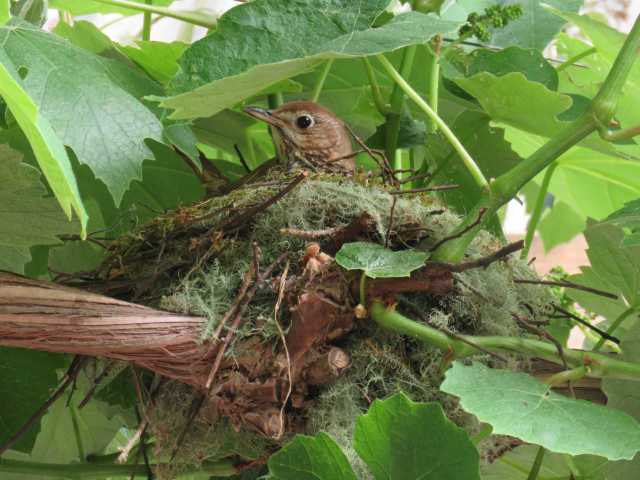
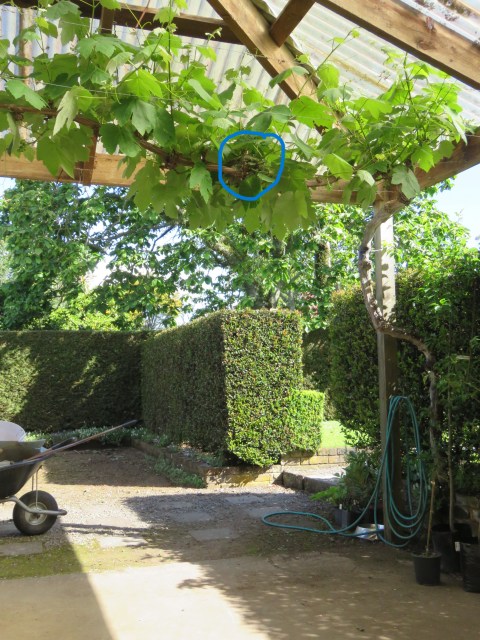
Talking of birds, Mama Thrush is bringing Zach and me delight although Ralph the dog is not so appreciative. She built her nest in the grapevine that grows beneath the verandah on the front of our shed which happens to be our main seating area when Lloyd and Zach are here at work. Her early anxieties appear to have faded and she has become accustomed to humans below. We can co-exist.
 Tikorangi The Jury Garden
Pruning is something that no one wants to do anymore. So-called ‘gardeners’ no longer know how to do it properly. They just want to shear it with their power shears. It is one of the most common problems that I encounter in landscapes. Deciduous fruit trees and roses are the worst. It is gratifying to see pruning done properly nowadays.
Well we will keep pruning here! Generally, we aim tk prune so it is nit obvious to anybody else’s eyes.
Naturally, that is the best way to prune. However, for the deciduous fruit trees, I prune for confinement and fruit production, with no regard for what looks natural. They have been bred so unnaturally that they produce more fruit than they can support if they grow naturally.
Delighted to know the Thrush Family are being so well considered. Birds are such an integral part of our gardens. Camellias respond well to judicious pruning from my own experience. So good to experience their blooms at a human scale
Thank you very helpful
https://www.avast.com/sig-email?utm_medium=email&utm_source=link&utm_campaign=sig-email&utm_content=webmail Virus-free.www.avast.com https://www.avast.com/sig-email?utm_medium=email&utm_source=link&utm_campaign=sig-email&utm_content=webmail <#DAB4FAD8-2DD7-40BB-A1B8-4E2AA1F9FDF2>
I have always had instinctive “kill or cure” approach to pruning anything unruly or sickly. From memory, very little didn’t respond well. Harsh perhaps, but plants have to earn a place in our garden and are given the boot if they don’t, particularly with our advancing years.
Our 100 metre photinia hedge has died from 10 months of rain and is destined for the chipper.
I am not a fan of photinia. It harbours thrips in our conditions.
Hi there, Please unsubscribe me from your mailing list..just too many notifications. All the best, Robyn
To unsubscribe, scroll down one of the unwanted notifications and press the unsubscribe panel. You are in control of your subscriptions, not I. Best, Abbie.
Nice job Abbie – your trees/shrubs look balanced and happy!!
Thank you Abbie, I’ve really appreciated your recent columns. I was totally inspired visiting Te Henui Cemetery several years ago and have been trying to encourage locals in ‘adopting a grave’ scheme at Karori cemetery (but lots of red tape). I so related to the quote you provided and have printed it out.
I was also encouraged by your reporting on excess rain causing rhododendron deaths as I’ve been feeling totally downcast by the loss of at least half a dozen mature and much beloved trees in our garden. (Mark at Crosshills had suggested it might be phytophora.)
Finally, after camellia pruning, have you written anything similar on magnolias? We have an enormous Charles Raffill which obviously should have been attended to some time ago.
Sorry I didn’t mean to be so long winded, but about this time of year I’m always referring a friend or two to your article on Nativity sets – which still makes me laugh!
Thank you.
Ruth-Mary James
Ruth-Mary – such a lovely comment to read. Thank you. So glad my nativity post continues to amuse you.
Mark at Crosshills is also correct – excessive rain and warmer temperatures can cause an explosion of phytophthora.
I would suggest getting a professional in to tidy up your Charles Raffill if it is a large plant. But I mean a professional who understands about shapes of trees and health, not a gung-ho chainsaw operator who only knows how to cut down. Magnolias can be pruned hard but best done in early spring – in the case of Charles, immediately it finishes flowering.
Kind regards,
Abbie
Abbie – I think pruning to reshape or to enhance is one job I enjoy the most for the satisfaction it gives. Balance & symmetry.
Most satisfying when carried out so that the results are immediate and nobody else can see how much has been removed because the plant looks so good. There is a bit more patience required when pruning has to be so major that it takes two years to see the improvement.
None of our Camellias are anywhere near old enough to need such drastic pruning to contain them yet, but it is good to know that they can be cut back to that extent if it is required. Interestingly we’ve found that ‘Mimosa Jury’ is consistently the least affected by petal blight of all the larger-flowered Camellias we grow. As I was reading your post I dashed outside to check our shrub to make sure my memory wasn’t failing me. At present it has the best part of 100 open flowers on it and a couple of hundred more buds that are yet to open and I was only able to find one small brown spot on a single petal. Even spent flowers have fallen off without any signs of blight on them. Camellia japonica ‘Dahlonega’, which is next to it in our border and also in flower at the moment, is not doing so well, with a lot of brown in evidence. We planted both of them in 2004. This year the petal blight affected our garden less than it has for many years, and it has been nice to see the Camellias looking more like they used to. The other interesting thing about our ‘Mimosa Jury’ is that it almost always has one or two flowers open from June onwards, but then as the weather starts to get a little warmer in October the flowers start to open in profusion and it keeps going like that well into December. This year spring has been at least 2 weeks later than normal for us and I suspect it could still be flowering on Christmas Day.
Hi, Tim. That is really interesting about Mimosa. Alas our main plant was flowering so high in the sky we could not longer see the blooms except as a blob of colour! We rated Mimosa as probably Felix’s best selection, well, that and Itty Bit. It was a revelation to me when I realised that Zach, our apprentice, had never actually seen camellias in their former glory because he has only ever seen blighted camellias – sasanquas excepted.