

This is my new mantra. We have always had some level of self-seeding in the garden, some more desirable than others. We are fine with desirable plants like Scadoxus multiflorus ssp katherinae and the Himalyan lily, Cardiocrinum giganteum, deciding where they are happiest growing and gently settling in by spreading seed; we call that naturalising. Similarly, when the plants are natives, we don’t worry about them spreading around and we just decide whether we want them where they appear and weed them out if not. Nikau palms, tree ferns, kowhai and the like fit into that category.
Then there are the invaders, of whom our worst offender is Prunus campanulata. At the moment the parent plants have a stay of execution but we aim to remove every seedling we see. We cut down the parent bangalow palms (Archontophoenix cunninghamiana) because of their rampant seeding. It may be we reach a day when the prunus suffer the same fate.
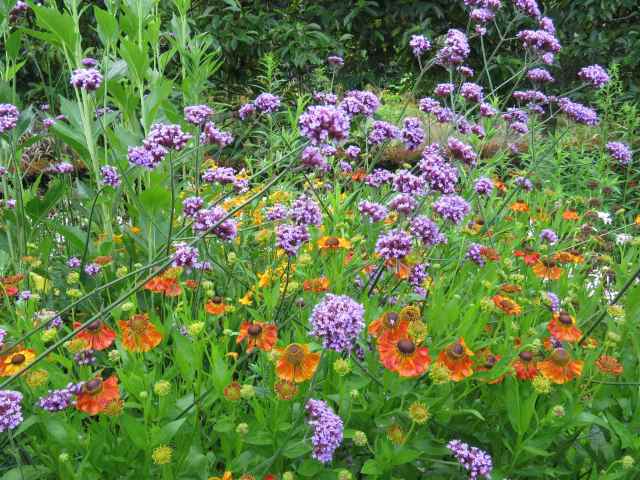
Establishing the summer gardens has added a whole new range of plants that want to expand their territory beyond their allotted area – not for nothing are they called colonisers. The reason is that plants growing in well-cultivated soil in sunny conditions can multiply and spread exponentially, both from below ground and by airborne seed.
When I planted the summer gardens in the years between 2017 and 2019, I made it a priority to use different plant material in each garden. While they are adjacent to each other, I wanted clear differentiation between the Wave Garden, lily border, Court Garden, back border and the twin borders while anything and everything that was left over was fine in the wilder Iolanthe Garden. I avoided repeating plants because as soon as your start using the same plant palette, they all end up losing definition and looking the same. I was pretty disciplined about it and there are only one or two repeats.
Many of the plants have different ideas and that is escalating. Which is why I find myself saying often, “It is a good plant but we don’t need it everywhere.” I mentioned mondo grass in last week’s post. It is very handy, both in black or green but it also sneaks all round the place both by seed and by spreading below ground. Too much. We will have much too much mondo if we don’t take charge now. Besides, it doesn’t look that great when it gets very thick and it is not easy to thin without a major effort on lifting, dividing and replanting. It needs restricting and reducing right now.

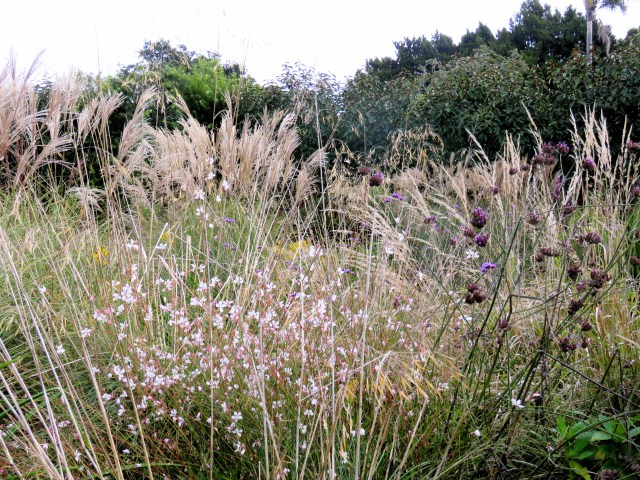
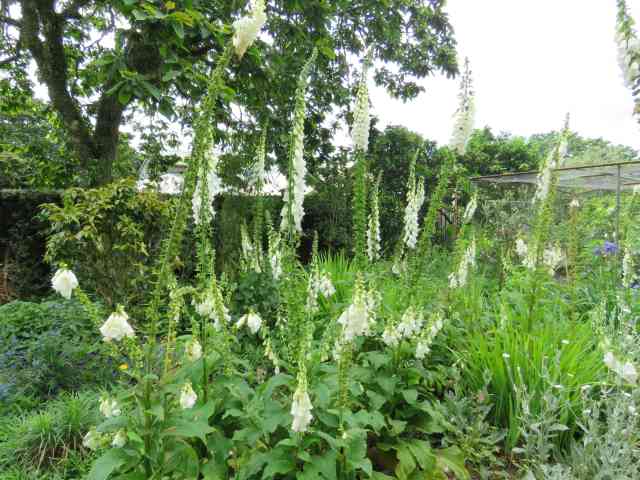
But there are so many more spreaders. Perennial lobelias, tigridias, verbascums be they chaixii or virgatum, Verbena bonariensis, crocosmia, scuttellaria, lychnis, gaura (so much gaura…), gladiolus and more. I have been gently restricting Gloriosa superba but I now think I have been too gentle and I need to get them out by the barrow-load and confine them to just two or three areas. And white foxgloves. I went to quite a lot of trouble to get a pure strain of white foxgloves established but now they want to be everywhere. Knowledgeable visitors from Europe last spring were astounded by the size of my white foxgloves, declaring that they have never seen them so large in Europe. Therein lies the problem: foxgloves are thugs that smother their neighbours and they seed far and wide. They need to be kept to a limited number of places where they can star but not smother.
Where we are, there is little to no danger of these plants escaping into the wild but I can see how we have arrived at a situation in this country where many, possibly most, of our environmental weeds are escapees from gardens. Pretty escapees they may be, but it does not stop them being weeds when they spread uncontrollably in the wild.
We gardeners need to take responsibility for our plants.
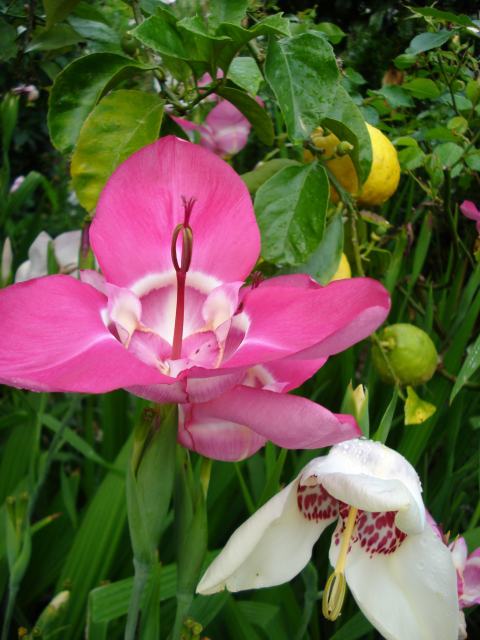
I do a lot more deadheading these days than I ever anticipated but that is basically short-circuiting what will be an even larger task if I don’t. A stitch in time and all that. We don’t generally compost seed heads. While we make hot compost, it is not always hot enough to kill off seeds and we certainly don’t want to be spreading viable seed right through the garden in the compost. Mostly, we dump them in piles in deep shade out of sight, which is possible in a large garden but not always practical in small, urban gardens.
The retired nurserywoman in me feels bad about wasting so much good plant material that has commercial value, but not to us. When we had the nursery, we mainly grew woody trees and shrubs which generally take a whole lot more skill, specialised facilities and time to get to saleable size. We used to question how some perennials could be sold at a similar price to a shrub or tree. Now I have a whole lot more experience gardening with sunny perennials and realise how easy it is to multiply most of them, I am even more amazed at the prices I see in garden centres.
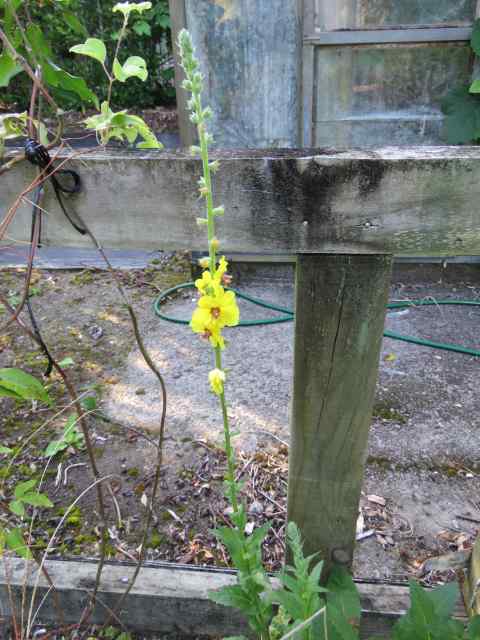
One of the interesting parts of gardening is deciding plant combinations and it is certainly easier when you have too much plant material rather than too little so that, at least, is a good problem to have. Verbena virgatum can go entirely though. It is way too enthusiastic and if I turn my back it will have infiltrated everywhere. It is pretty enough but not a good plant when it comes to behaviour. Keep to Verbascum creticum, I say. Similar large yellow flowers although in spring, not summer, and while it seeds, it has never been a problem for us.
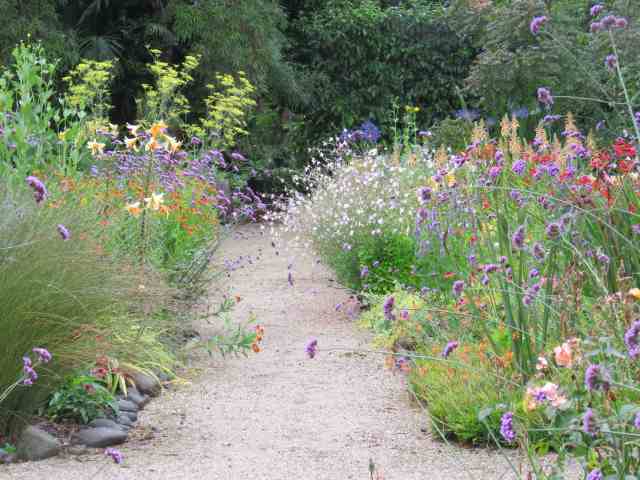
 Tikorangi The Jury Garden
As is so often the case, your weedy plants would find a very welcoming home here. Of course, we also have our crosses to bear.
Well, yes. Although I think of these plants as over- enthusiastic rather than weedy. In most cases, at least.
The issue for me is where these plants decide to grow – giant verbascum always seems to plant itself in my tiny dianthus bed. Christopher Lloyd said something about it being like a big friendly lion which absently puts its paw down on a neighbour, and this is exactly what it’s like.
Verbena bonariensis does seed everywhere and can look very repetitive, but I wouldn’t want to be completely without it. Knifophia the same – but for now it seems willing to grow in wild places where other plants don’t want to grow.
Another plant I bought at a show garden in Taranaki a few years ago spreads scarily quickly by runners in good soil. It’s tall with pale yellow flowers, like a coreopsis but not delicate like coreopsis moonbeam. I have pulled it all out in a few places, but it’s an ongoing effort. In wilder areas, it doesn’t do so well, but makes a low mat which holds its own against weeds in winter, and looks pretty from a distance.
Sometimes it seems like if I get callous about one of these enthusiasts and start removing them, they suddenly disappear, all of them. Especially some of the big salvias which seem to want to either go wild or die out completely.
I see we are on the same page on this matter.
There was much nodding of heads as we read this post Abbie. Given how much Verbena bonariensis we weed out of beds where we don’t want them these days, I have to smile when I remember how we cosseted the first three we managed to buy. We had no idea they would colonise our garden so readily and we find seedlings by the hundreds in gravel paths, baking in no soil at all on the driveway, as well as in wet areas of the bog gardens and in pots. Like you we spent many years establishing white foxgloves and some grow over 2 metres. The tallest this year was 2.5m. Ammis majus, Orlaya grandiflora and Asters have joined our list of welcome plants that we struggled to get going initially and now pop up all over the place and have to be ruthlessly thinned out on a regular basis.
It is almost unfortunate that some of the aggressively invasive naturalized exotic species are as pretty as they are. It would be easier to combat them if they were less appealing. I happen to like Acacia dealbata, which is one of the worst locally.
I fell in love with Gaura too but soon learnt to use some discipline, or tough love, on it. Because my small garden is not, imo, set in true North I ended up with the Gaura reaching out & creating an effect that I like.
Tried to send a photo with this to show you what it looks like but alas! Not as straight forward as in msgs or email. Sorry 😏
Pingback: Summer gardening | Tikorangi The Jury Garden
enjoyed reading this (belatedly). I am coastal Illawarra NSW. so many plants in our bushland are self sown or bird dropped introduced weeds. alas some of your over enthusiastic plants I would love to be able to just keep growing for more than one season!! eg the tigridias