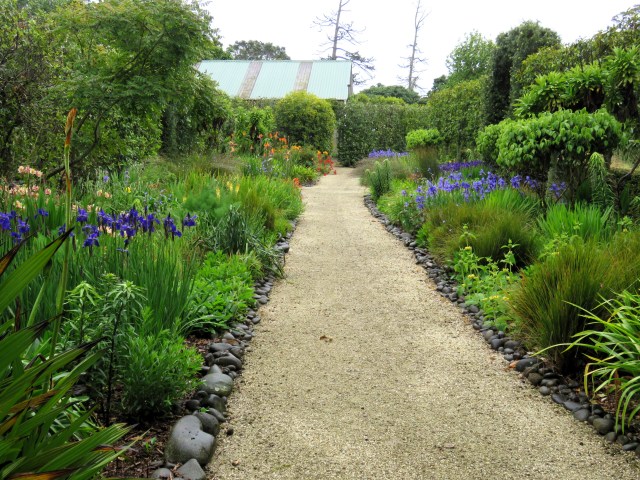
Oh my, but the summer borders are looking pretty. From being fairly empty and dull a few weeks ago, they have sprung back into life. When I planted them back in 2016, I remember muttering words like ‘rhythm’ and ‘echo’ as I was placing plants, with English designer, Dan Pearson, firmly at the front of my mind. I see I once recorded that I was working with about 120 different plant varieties in that area, starting with a blank canvas, so placing plants to achieve some continuity of rhythm was important in avoiding a mishmash. It is only this spring that I looked at it and thought, ‘yes, that continuity makes sense’.
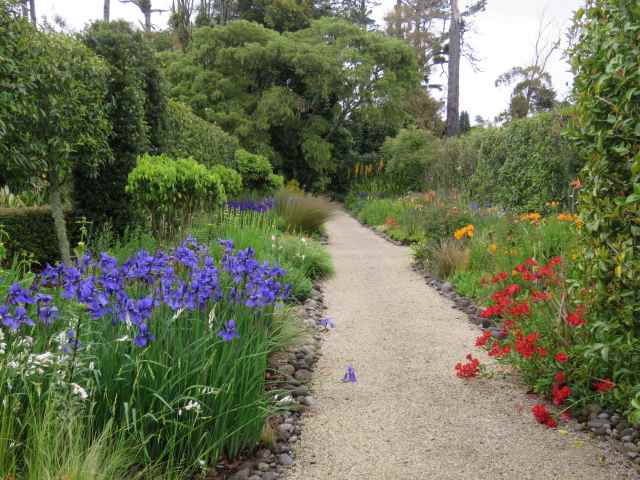

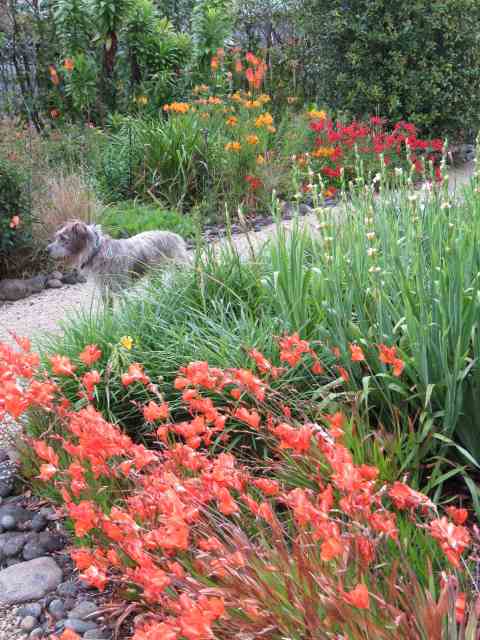
It is the repetition of a colour, not so much the same plant, that made the whole visually pleasing. At this time of the year, it is patches and threads of blue down the length that lifts my heart. Later in summer, it will be more about orange and yellow with splashes of purple leading the eye down the full length.
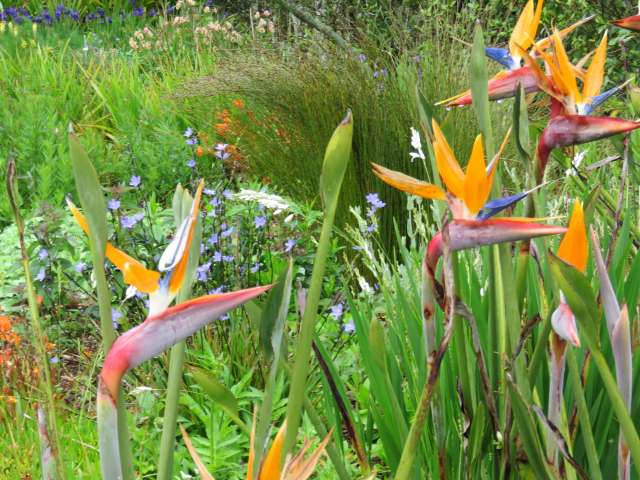
Years ago – at least twenty years, maybe longer – the oft-repeated mantra of planting was to unify a garden by repeating plants throughout. I see in 2012, I wrote a piece querying this common wisdom and asking whether in fact that repetition just makes a garden downright dull. If you are using renga renga lilies (Arthropodium cirratum), or even clivias, then yes, it will look dull and repetitious. It is not that simple.

If you are going to use a lot of just one single plant variety repeated or threaded through a larger area, it needs to be very carefully chosen, not just what is cheap, available and easy to grow. It needs to be bold and strong enough in its own right to work visually and not just when it is in flower. I have seen it done with euphorbia which has good foliage, reasonable form and flowers that can smack you in the eyeballs. It is not my choice because I find the acid yellow a bit too strident and that is a matter of personal taste. But it can indeed keep a big perennial planting knitted together as a cohesive whole.

I have seen tightly clipped shrubs used amongst perennials – usually tightly clipped buxus mounds and that can work well – better scattered randomly in my eyes than placed with mathematical precision. We have used the lesser-known Camellia yuhsienensis down one side of the borders – but only five of them. I clip and shape them but not to a uniform shape – more to keep them to a certain size and they give some winter interest when there is not much happening at ground level.
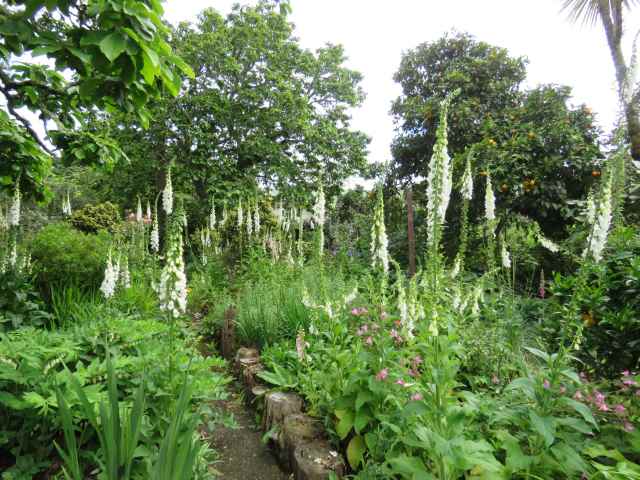
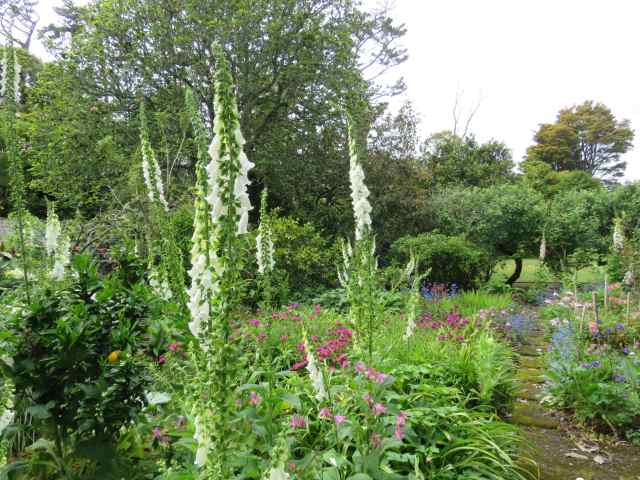
At this time of the year, it is the over-the-top white foxgloves that keep the loosely ordered chaos of our Iolanthe garden working visually. They are thugs, more perennial than biennial in those conditions and some are towering clumps over two metres tall, all in pure white. I need to thin them (‘edit’ them in modern parlance) because we are getting too many but those tall spires randomly spread through the area hold it all together visually. I admit the foxgloves are serendipity, not forward planning.
We watched an old documentary on the UK’s royal gardens earlier this week, and King Charles’ plant choice was tall delphiniums which are equally seasonal, a whole more work and arguably classier than my white foxgloves. He had them as the bold statement plant in many areas at Highgrove.

It is the repetition of colour that is working in our twin borders and that comes down more to rhythm than simply repeating the same plant. True, it is the bold blocks of Iris sibirica that give the mass of blue at this time of the year but they not the same variety of that iris and there are also blue bearded iris in flower and plenty of the dainty blue Orthrosanthus multiflorus, which is an Australian native that looks like a blue flowered libertia.

If your garden is very small, then you treat the area as a whole and picking one bold plant to thread through can certainly hold it all together visually. In a larger garden, it can make it all look the same if you insist on repeating the same plant on a much larger canvas. It is a lot more interesting to ring the changes and create different atmospheres in different areas. You can also achieve unity by repetition of form, not necessarily the same plant.

Or you can do it by colour and that is what is giving me joy. I did plan it, though in my mind and not on paper, so it is not by chance or good fortune. It is even more pleasing to see a plan coming together and for me, it is about rhythm and harmony, rather than controlled repetition.
 Tikorangi The Jury Garden
Loving the inspiration of the unexpected – knifophia hitting the button in that respect plus doing a great job of bringing together the blue and orange. The airyness of the fennel foliage mixed with delicate blooms is delightful – as are the large population of foxgloves. It could look too much but personally I enjoy a bit of over the top let loose. That to me is what brings the charm – – gone wild, grew itself into something unexpected.
Lovely views of your garden. Do enjoy the colours you use and inspiring to try in our small plot here in Taupo 😊
This comment is why I keep writing and posting. Thank you.
You have achieved your aim so very beautifully.
Thanks Paddy.
I am sitting up in bed reading this with a cup of coffee early on a beautiful morning. I feel inspired to get dressed and get gardening! Thank you for your always enjoyable and interesting writing and photos.
A beautiful morning here too, Robyn. We are flat tack preparing for a tour on Thursday – Michael McCoy’s travelling masterclass from Australia. As he has described us as being ‘like Ninfa but without the ruins’, we are madly Ninfa-ing.