It is unusually dry here. In fact our province of Taranaki went into official drought declaration some weeks ago. I was woken yesterday morning by the sound of rain and my instant response was relief but it stopped and I see it was only about half a millimetre so that did absolutely nothing.
People who live in habitually dry areas may scoff at what we declare as drought but it is all relative. For many years, I have been cheerfully declaring that we get around 150 cm of rain a year (1500mm or about sixty inches) fairly evenly distributed across the year. We might complain about the dryness if we get several weeks without rain in summer but we are generally confident that the rains will arrive in time. Our prevailing westerly weather patterns tend to mean that we get moisture-laden air coming in from the ocean. High sunshine hours and relatively high rainfall is the norm. Currently, we are about 60% down on our normal rainfall in the first months of this year.
Fortunately, we source our water from our own, private bore so we are not in danger of running out. The water delivery businesses must be booming with urgent calls from those rural folk who rely on rain water tanks or surface water sources. Stream and river levels are uniformly low.
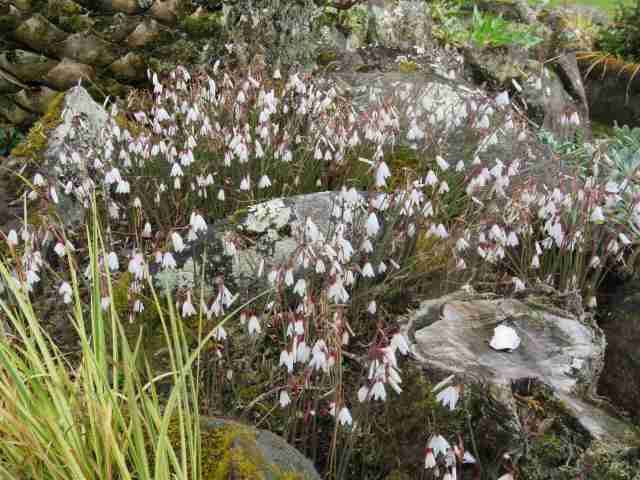
When it comes to gardening, because we live in a climate with consistent rainfall, we have no irrigation system and we can only reach a few, small areas with a hose. Extended dry periods are a good test for us. When the hydrangeas planted in shade start to wilt, we know we are very dry.
We are not unduly worried yet. The rains should come. It is frustrating though, for people who garden every day. It feels as though much is on hold, waiting for rain. We can’t plant anything much or dig and divide. But at least Zach and I got onto a messy border immediately behind the house. There is a water tap close by so we could do more.
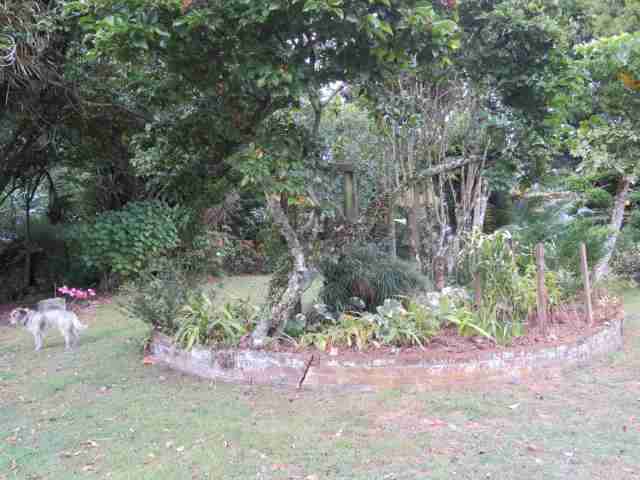
One might describe it as an historic but unremarkable border, most of the permanent trees and shrubs having been planted by Mark’s father, probably back in the 1950s and 1960s. Over the years, it has received little intensive care or love, confined to weeding, removing dead plants, a bit of pruning and filling bare spaces but little else. The swathe of auratum lilies were crying out for some love.
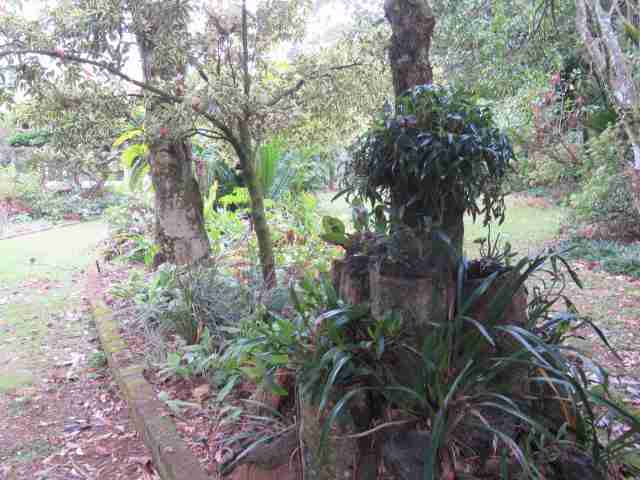
I haven’t counted the plant varieties but there must be at least 50 or 60 different ones in a curved area measuring up to three metres across and twenty five metres long. We pruned almost all the trees, shrubs, cycads and the like – a tidy-up really. The work came on the under plantings – the lower growing perennials and bulbs.
My mantra is that when there is a diverse top tier planting of trees and shrubs (like, one of each specimen), bottom tier plantings need to be simpler to give some cohesion. Our idea of simple may not be the same as many gardeners, let alone designers, but what Zach and I did was to consolidate the different ground level plantings into bigger blocks, rather than drifts or random placement. We removed some entirely (yellow tigridias and every last bit of green mondo grass), reduced some (it is very nice of Geranium madarense to seed down and naturalise but we only need four full-sized ones to make a statement next spring and a few younger ones for the year following – not 40), divided hostas and farfugiums and consolidated other plants into blocks.
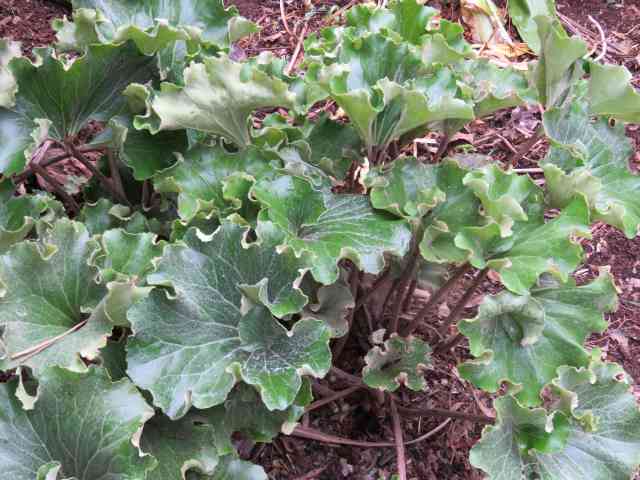
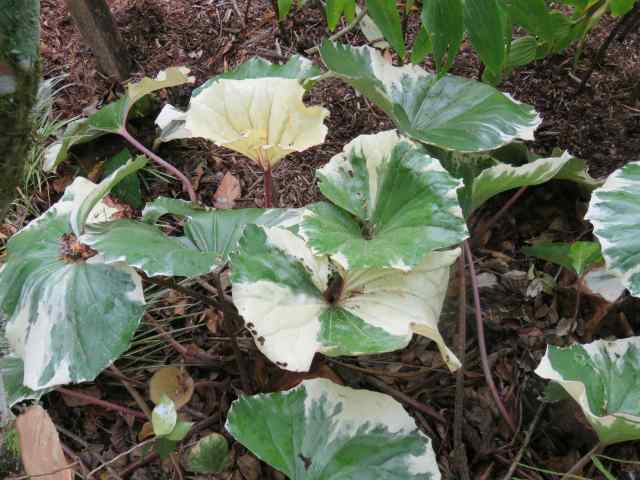
All plants that were lifted were plunged into buckets of water, replanted into holes enriched with compost, thoroughly watered and mulched. If we don’t get enough rain in the next week or two, we can easily reach them with the hose.
Just a reminder not to lay mulch when the ground is bone dry. It will act as a barrier to moisture entering the soil. Mulch needs to be laid to protect existing moisture levels in the ground before it dries out.
May the autumn rains arrive soon.
 Tikorangi The Jury Garden
No drought declared for us, but it has been very dry since early January and some of the plants are looking a bit sad. Our situation is a bit different from yours. We get more rain, nearly 2000 mms per year on average, but it isn’t evenly spread. Summers are usually much drier than winters, but even so every month averages over 100 mms. It means when we get a really dry summer, like this one, many plants have never needed to get their roots deep to search for water and suffer as a result. We don’t have a bore and have to rely on rainwater collection in tanks for most of our watering and have 7 tanks of various sizes dotted about the garden. All watering gets done by hand. This summer we have pretty much only watered plants in pots and those growing under cover, plus trees and shrubs that were only planted in spring.
We have slowly been revamping older beds and borders in the manner you and Zak are doing, grouping the plants a bit more for better impact and reducing some that are a bit too enthusiastic in self-seeding. We still have lots of colour in most parts of the garden, especially down in The Swamp, which retains moisture better than other parts of the garden, and has late Heleniums and Asters in full flower amongst the grasses.
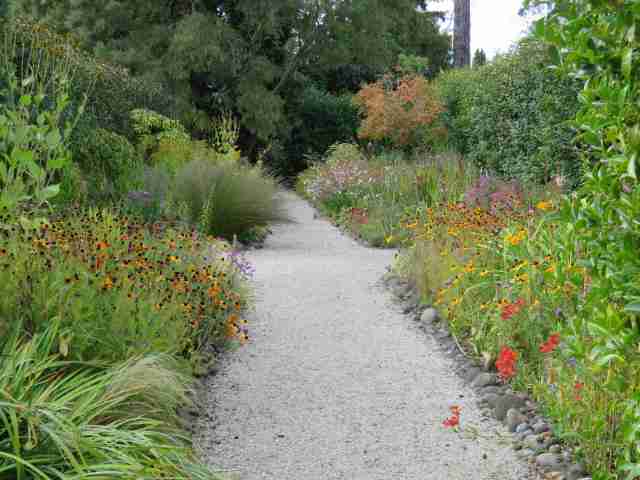
We’re wondering about the pink froth of flower in your first photo in the Court Garden. It looks like it could be Calliandra ‘Blushing Pixie’, which has just started to flower for us in the last week or so. If so, ours has never been as floriferous, but it gets shaded by big trees for many hours of the day, so that may be why.
It is indeed a pink calliandra. They like hot summers and full sun. That one flowers at least three times a year for us. I want the white one that is apparently around.
I guess ours isn’t in the best spot then, but it is too big to move. A white one would be nice, but I never seem to see any Calliandra in our local garden centres.
Summer without rain always leads to concern here also – we are so used to steady rain here. Nowadays, wetter winters and drier summers are becoming more common.
It will certainly come as a huge shock to us if we start getting very dry summers, Paddy. We don’t even have taps in most of the garden. But light rain today damped down the dust and it us forecast to rain tomorrow. We will see if that eventuates.
Similarly, no taps in the garden here. We water potted plants and those newly planted but nothing else.