

Or Merry Christmas from New Zealand. Although, as one who favours ‘seasons greetings’ for those of us who are not affiliated to any church, maybe it is time I worked on committing “ngā mihi o te wā” to memory.
The flowers are what is often referred to as the New Zealand Christmas tree (on account of it blooming around Christmas), known here as the pōhutukawa (botanically Metrosideros excelsa).
Given its natural distribution is roughly a west-east line from where we are in North Taranaki across to Gisborne, I sometimes wonder how people in more southerly climes feel about it being the designated national Christmas tree. It is a remarkable tree with its capacity to grow in perilous positions on windswept coastlines. Being an archipelago of fairly small islands set midst vast oceans, we have pretty wild coastal areas. Our nearest small town of Waitara is right on the coast and there are two trees that dominate that urban setting, two trees that will not just survive, but thrive in that exposed situation. One is the pōhutukawa, the other is the Norfolk Island pine (Araucaria heterophylla).
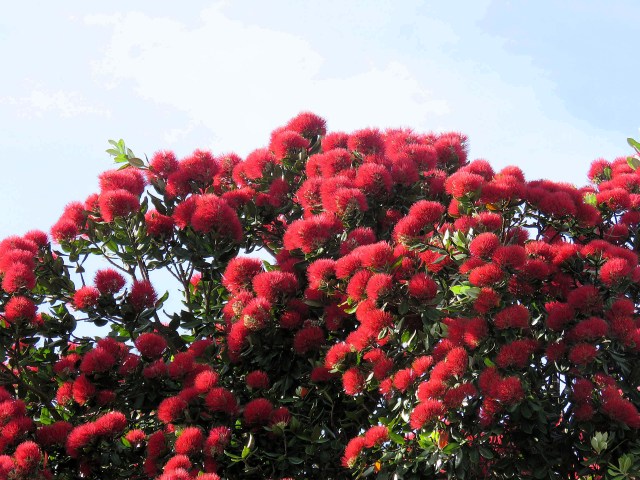
I set out to find a good specimen of the pōhutukawa in Waitara to photograph. I don’t want to burst sentimental bubbles, but this is a variable species. Not all pōhutukawa are equal when it comes to blooming. They all seem to grow well enough but quite a few flower more brown than red, some have but a sparse display of blooms and some don’t seem to flower at all. Also, maybe I had better whisper that its season in bloom is but short. I had to pass a lot of trees on the waterfront and on streets to find this one that stood out for its floral display.
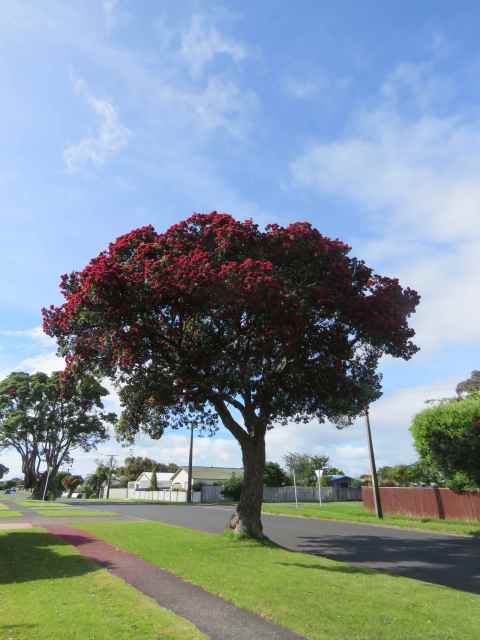
I am sure I have noted before that many, if not most, pōhutukawa that are sold are seedlings. They will be variable and looking at the make up of the ones in this area, the majority will vary to the less showy side. If you are going to plant a single specimen, buy a named form because it should have been selected for its good flowering and propagated from cutting so will stay true. If you are going to plant many, find a good seed source because the percentage of better forms in the seedlings will be higher.
Go well. Stay safe. And may 2026 bring at least some of what you hope for.
 Tikorangi The Jury Garden
Merry Christmas and thank you for all your interesting articles throughout the year. They are much enjoyed and appreciated.
Merry Christmas to you. We don’t have pohoots (as I nickname them) here in Central, but the rata must be due to flower sometime soon … Thanks for another year of interesting and amusing hort-talk – always much appreciated!
Usually pohoots here too but I aim for a higher technical standard in writing! Thanks for your kind words of appreciation.
My mother planted a pohutukawa on Scarborough hill in Christchurch about 60 years ago and it appeared to thrive in the bitter southerlies. I have a seedling of this plant in my collection (in the Waikato). All my pohoots are flowering early and well this year; they must have enjoyed the cool wet spring. I’ve heard talk that others are generally early too.