

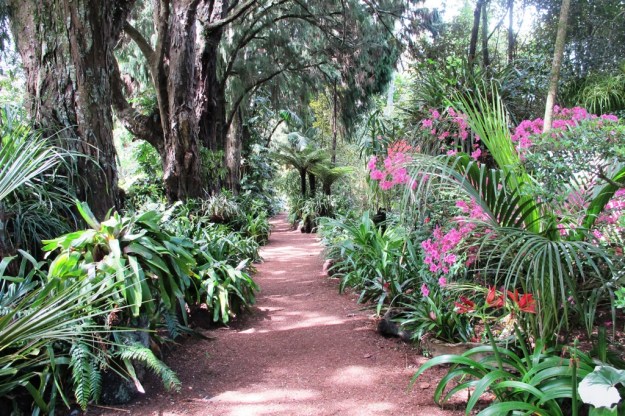
Shade gardens we have a-plenty
Glory be, but I do love spring. This month subtropical bulbs and orchids shout out to be noticed.
We have extensive shade gardens. It is an inevitable result of a large, mature garden with many evergreen trees dating back as far as 1870. We do a lot of what we call lifting and limbing – taking off lower branches and keeping areas open to the light, for there are not a lot of plant options when it comes to deep, dark shade. Beneath the mighty tree canopy, it is dry but frost-free with dappled light. Over the decades there has been much trial and error to find what will thrive in these conditions and the plantings have become increasingly complex.

Dendrobium Bardo Rose
By this time in spring, we are over peak season for cymbidium orchids but the Australian dendrobiums are a delight. These are much smaller and more mounded or clumping in appearance and they take care of themselves. We have found the Bardo Rose group to be particularly obliging and free-flowering in woodland conditions. Ours all came from the local Orchid Society, an organisation that we have found combines generosity with superior technical knowledge.
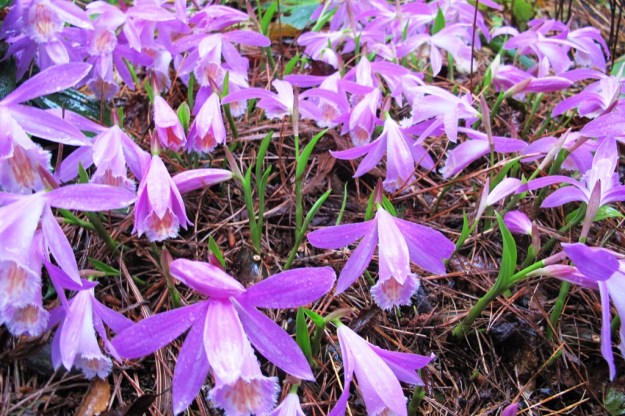
Pleione orchids in the woodland
Pleione orchids do not last as long in bloom as many of the other orchids. Their flowers are soft rather than waxy but oh my, they make such a pretty carpet. It is easy for them to get swamped so we try and keep the area around them open but beyond lifting and dividing every few years, we just leave them alone. In our experience, the lovely yellow varieties do better in a climate where they get more winter chill. I think all our yellows have died out now but we have plenty in shades of lilac, purple and pure white. Most of our successful varieties came from the late George Fuller, orchid expert and former curator of Pukekura Park, and seem to have formosana in their parentage. If you want to build them up, a single bulb will usually set 2 offsets each season so you can double them every year.
 The calanthes are ground orchids and we have big clumps now because these obliging plants can just be left to quietly increase in size. These are fully evergreen and somewhat frost tender but they are a delightful sight through spring and they combine very well with clivias, ferns and even hostas.
Hippeastrums are a plant family that has been much hybridised but I am not entirely convinced that has been to their advantage. It is two species that we rely on, both South American. It was by chance we found they settled happily into woodland conditions. In full sun, they were ravaged by narcissi fly but in high shade they are fine. Apparently nazi flies, as they are often called, don’t like shade. H. aulicum is one of our early to mid spring mainstays, flowering consistently year in and year out while multiplying most satisfyingly. To me, they look like beautiful Jacobean lilies in the woodland.

Hippeastrum aulicum, one of our woodland mainstays
Hippeastrum papilio has been a more recent acquisition for us and it is certainly spectacular, looking more like an orchid than the butterfly for which it was named. It is offered for sale but be prepared to pay a lot for a single bulb – maybe $30 if it is flowering size – because it takes several years to get to that point. I can’t think that we would have started with more than just one or two bulbs at that price. I see with a bit of dividing and replanting we now have about sixty but not all are flowering size yet. Mark has done some hybrids of aulicum x papilio to increase numbers and get some variety, but they have yet to bloom.
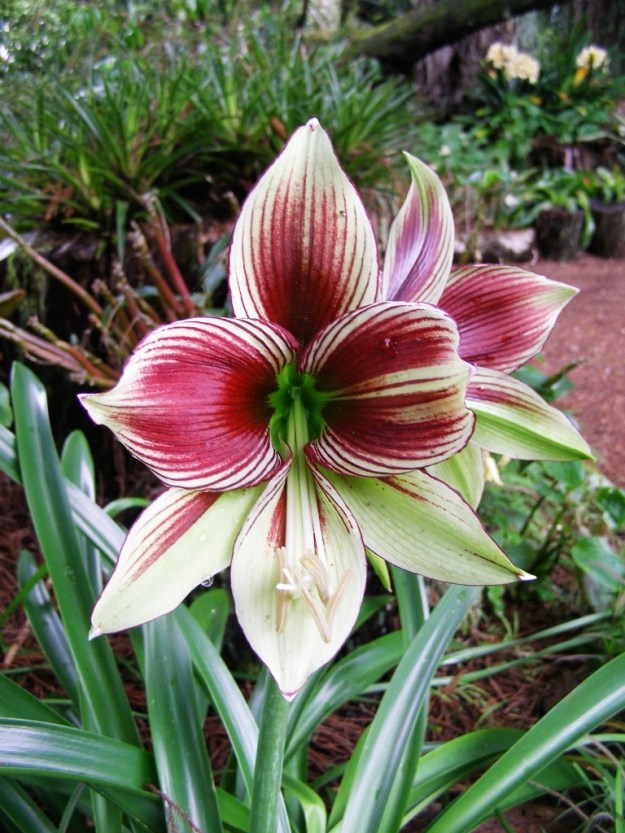
Hippeastrum papilio
I will have to leave the arisaemas, trilliums and the Paris polyphylla for another time but will finish with Scadoxus puniceus from South Africa. Many readers will be familiar with the summer flowering red S. multiflorus ssp. katherinae, especially in the Auckland area because it was, and maybe still is, much beloved by landscapers. It is a mainstay of our summer woodland, but in spring it is the lesser known S. puniceus that is the showstopper. Growing from large bulbs which are slow to increase, the foliage is lush and the large blooms are curious rather than beautiful. S. puniceus is not widely available, but if you can find somebody with it, it is easy enough to raise from fresh seed as long as you are willing to wait quite a few years to reach flowering size.
The rewards are there for patient gardeners.
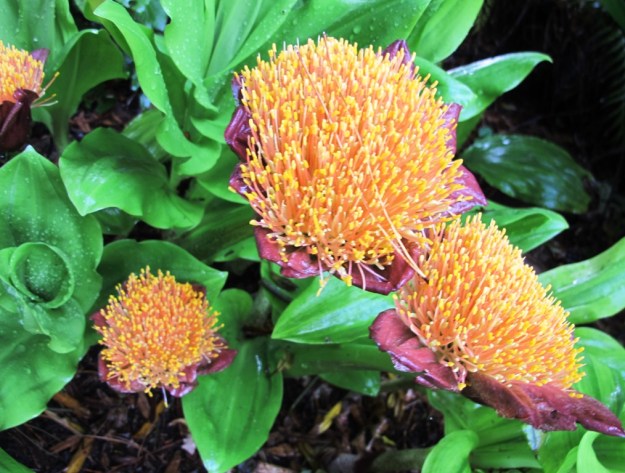
The lesser known Scadoxus puniceus
Text first published in the October issue of NZ Gardener and reprinted here with their permission
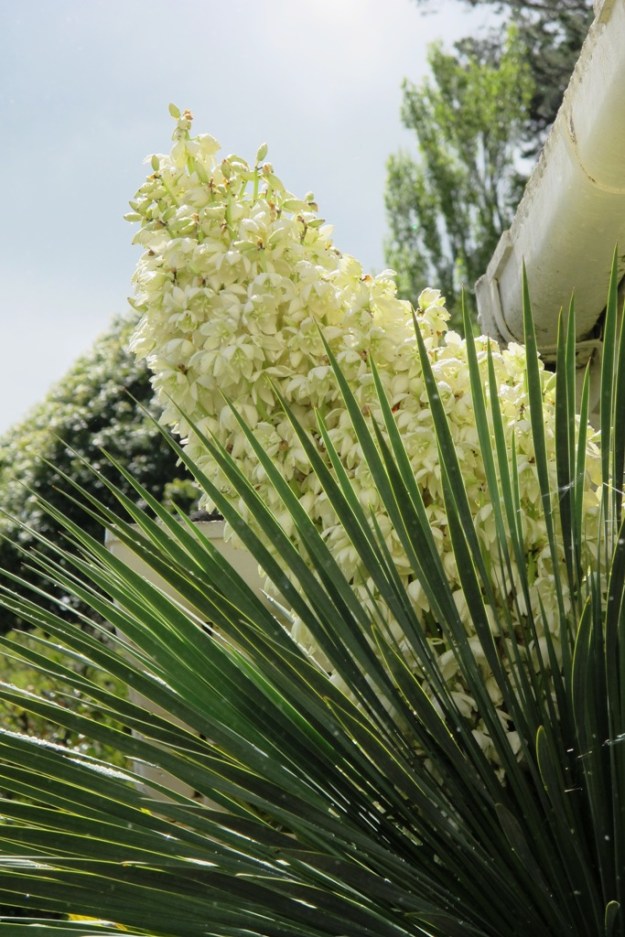
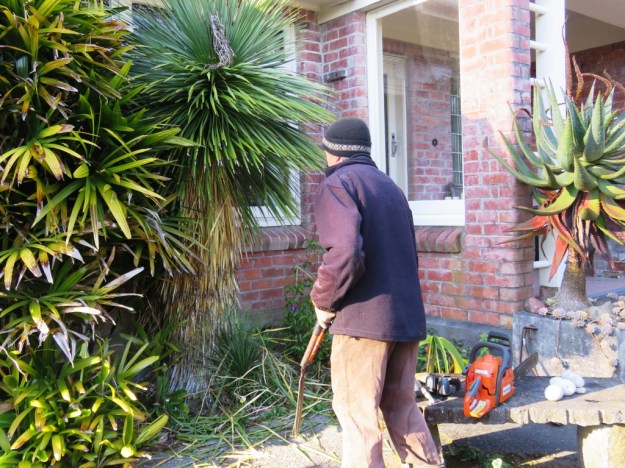 But other needs were always more urgent so the moving of the yucca had not taken place. Nor had the windows to what is our TV room been cleaned for many years. But yesterday the day came, forced by the arrival of the glaziers to install retro-fitted double glazing in our wooden window sashes. It was not an easy task. Mark had thought he could probably chainsaw the top off but the fibrous nature of the spent foliage merely jammed the chainsaw. At this point it is in two pieces. The top will be replanted on the sunny bank in the north garden where it will likely recover. The base, with a new rosette well-formed already, will be dug out and also relocated. It will, I tell you it will. I like the garden view out of the windows which is now visible again and while cleaning windows is not my favourite activity, I do like to be able to do it when necessary.
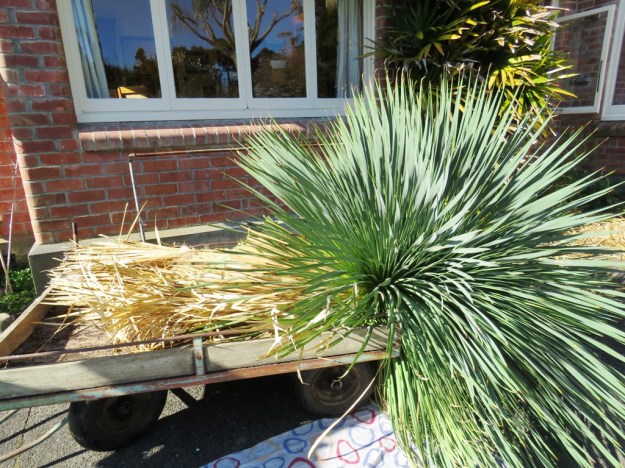 As far as we know, this is Yucca whipplei, also known as Hesperoyucca whipplei, chaparral yucca, Our Lord’s candle, Spanish bayonet, Quixote yucca or foothill yucca. So Wikipedia tells me. Apparently the most common name is Our Lord’s candle. It being native to southern America from California through to Mexico, it clearly felt right at home in the bone dry conditions of the house border beneath the eves. In the meantime, Our Lord’s candle is no long alight at our place.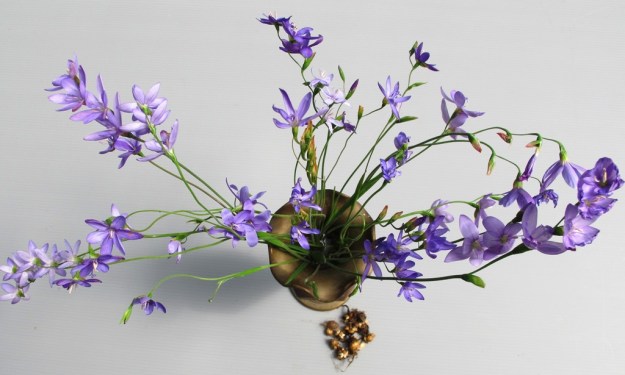
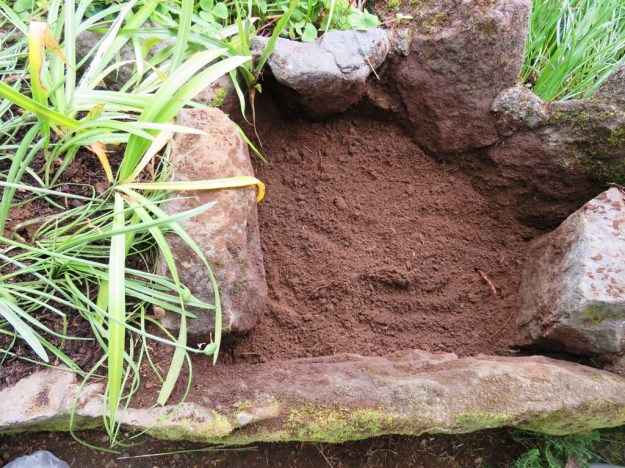
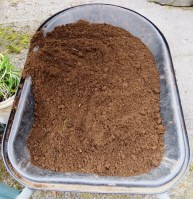 I have been forced to extreme remedial action in the rockery in the Battle of the Geissorhiza. Such a pretty weed and so dreadfully invasive. Each bulb is surrounded by many little baby bulbs that peel off as soon as you look at them, ready to grow into the future. In the worst affected pockets of rockery, I am lifting everything and washing the roots to make sure no dreaded geissorhiza bulbs are lurking in there hiding. Then I dig out all the soil and replace it with clean soil. I was surprised that one pocket generates almost a full barrow of soil. The contaminated soil is being dumped in the deepest, darkest shade where I hope nothing will germinate and if it does, as a last resort it can be sprayed. This somewhat extreme and labour intensive treatment should, I hope, get me closer to victory and the extermination of this pretty but hideously invasive bulb.
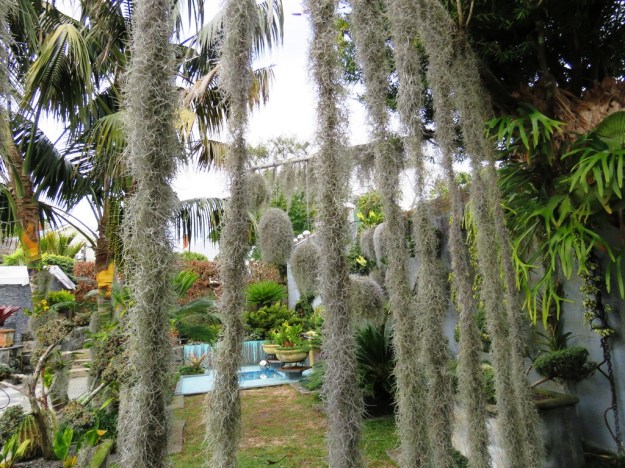 I visited a most interesting private garden in Auckland earlier this month. Industrial, urban chic, I would call it.




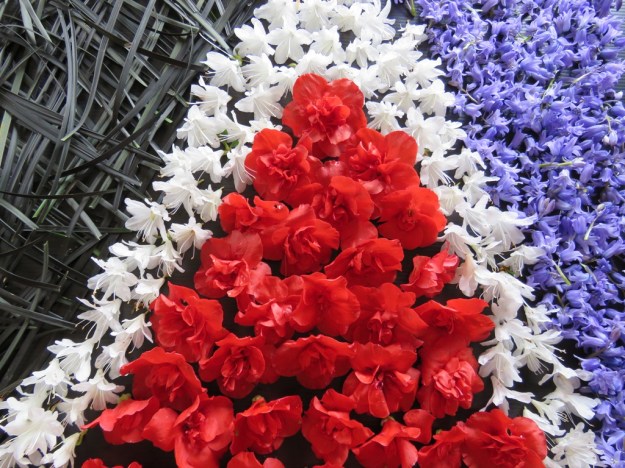
 It may be a surprise to you, as it was to me, to learn that “say it with flowers” did not orginate as Interflora’s slogan but was in fact a 1934 British musical film. Faced by the many memes associated with the Red Peak flag in New Zealand, I felt I could reinterpret it with flowers. First up was the one in the style of floral clocks, perhaps.





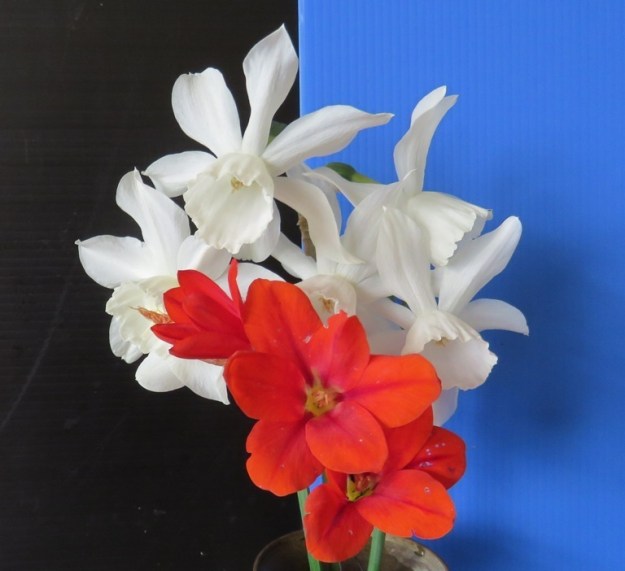
 When all is said and done, we’d have had a lot more fun with the wild card, Lazer Kiwi though I feel this may be better rendered in the style of a vegetable animal, such as our children used to create for the annual Show Day at primary school.
 Tikorangi The Jury Garden