
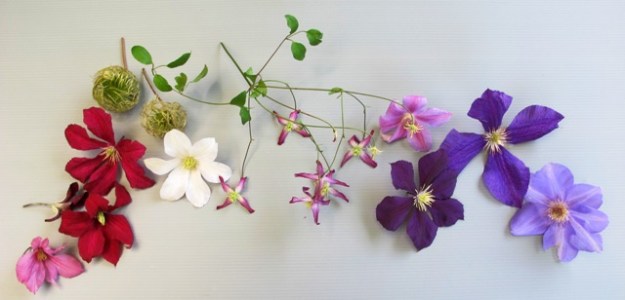
A selection of clematis which are still flowering in the garden, including two of the decorative seed heads
Clematis. I have not written about clematis before. This is in part that there is clematis specialist living around the corner from us and my technical knowledge on the genus is so sparse that I am worried about betraying my ignorance. I am terrified he will come and set me right. But they are such a lovely addition to the summer garden.
When I looked up clematis, I didn’t feel quite so bad about my botanical ignorance. It is a huge family with hundreds of different species (somewhere between two and three hundred or even more). Add to that the thousands of different hybrids that have been named. While ignorance may not be bliss, it is at least understandable in the face of such complexity. At least I found out that they are buttercup relatives – members of the Ranunculaceae family.
There are clematis and there are clematis. Some are altogether too vigorous. Who can forget “old man’s beard must go” on the telly? Clematis vitalba is such a strong grower that it threatens our native forest and can kill established trees. It is one garden escape that cost this country dearly. C. vitalba is not alone in its strangling and invasive personal habits but one hopes that somebody will have made those decisions long before you look at a pretty plant in the garden centre.
Clematis are equally notorious for karking it when planted out. That magnificent specimen in a pot with a frame covered in flowers can disappear before your very eyes when transferred to the garden. The problem is usually “clematis wilt”, reportedly a fungal affliction. If you spot it, cut back to healthy leaves, or even to the base of the plant if the whole thing is affected. Remove the diseased sections, cross your fingers and wait. Often, the plant will shoot again but it can take a while and the clematis roots can survive a year or longer without shoots above ground.
These are the only plants I know where the advice is to plant deeper in the ground than in the pot – around 8cm deeper is good. This is largely protection against the dreaded wilt, as far as I can see, so follow the advice. Like most climbers, they prefer their roots in cool, humus rich soil with adequate moisture levels but their heads in the sun. This is not always that easy to find, especially as you have to combine it with something for them to climb up. Once away, they can get purchase and twine onto surfaces that are not smooth – their instinct is to reach for the sun so most will climb if possible.
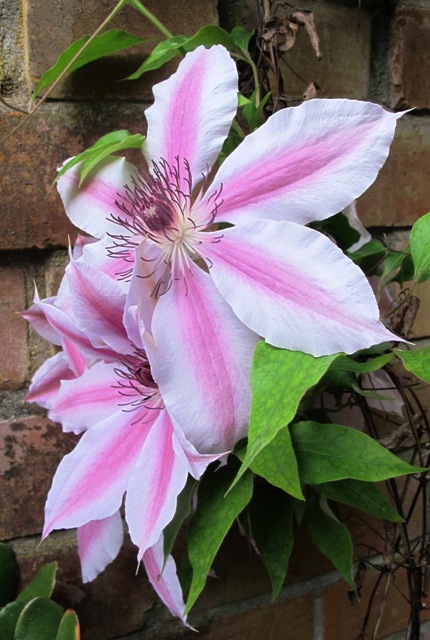
What we have as the tried and true “Nellie Moser” although it may be a seedling rather than the real thing
As garden plants, I favour the hybrids and the viticella types. We have a fair number twining their way through shrubs in mixed borders and they never fail to delight when they flower. You need to make sure that you don’t have overly rampant varieties when they are expected to co-exist with other plants. I took out what I think were texensis types – given to me as ground cover but distinctly shy on flowering, bell-shaped which I was not so keen on, and given to choking habits. I did not think they justified their position but there may be better texensis varieties available.
We have several growing under cover. Everybody admires “Niobe” in bloom. She has large flowers in deep burgundy but she proved damn difficult in the garden and it has taken several attempts over a fair number of years before we had a plant performing well, scrambling through evergreen azaleas. Planted in the ground but under cover with just some rain run-off to keep the roots moist, she has been much more reliable.
At the opposite end of the scale, the lovely, late-flowering yellow C. tangutica threatened a takeover bid in the garden but when relocated to a trellis under cover, behaved perfectly in comparative isolation.
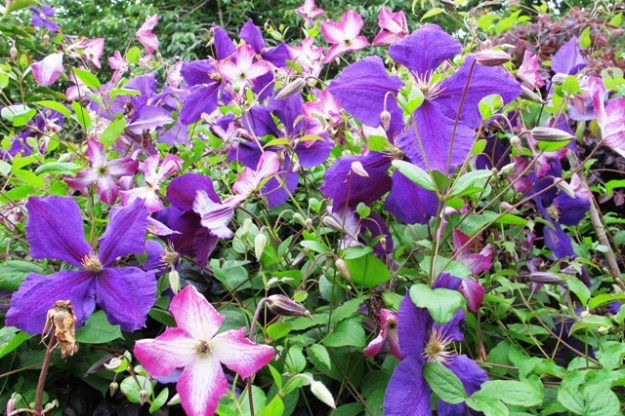
Two named varieties. I just don’t have the names any more.
Often they can be combined with other climbers to extend flowering interest. We have clematis planted successfully with wisteria, Trachelospermum jasminoides and schizophragma. The latter two plants, for those who struggle with plant names, are a garden-friendly jasmine-type plant and a variation on the climbing hydrangea.
If you cut back most of the hybrids to just above ground level after flowering, feed and water them, you can encourage a second coming about six weeks later. Now is the right time to try this if you have some that have, as we say, ‘passed over’. However, it won’t work with the early spring flowering Clematis montanas. We don’t have C. montana any longer (it is a bit rampant for the garden, being better at covering old water tanks or sheds. It is once flowering only and needs different pruning treatment, if any. Most of the others I cut back to maybe 30cm above ground in winter and they are fine. Once established, they are easy and reliable and bring delight in spring and summer.
We have some lovely native clematis in this country but they are a story in their own right for another time.
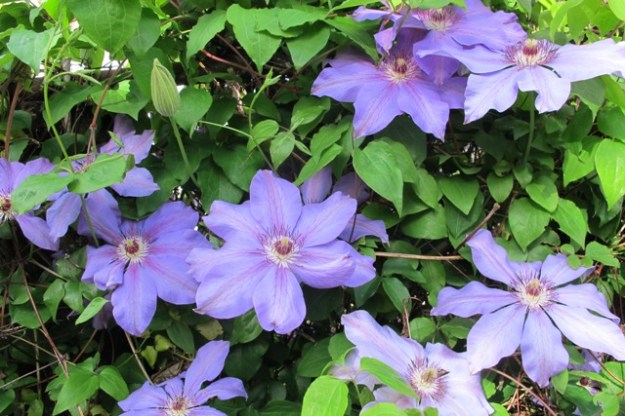
An unnamed blue seedling that has settled down happily in a mixed border
If you want to know more about different types of clematis or maybe even buy mail order, my neighbour is http://www.mrclematis.co.nz/ (email: yaku@xtra.co.nz). He produces a phenomenal range and has a passion and knowledge for the genus way beyond mine.
First published in the Waikato Times and reprinted here with their permission.

 This is Kowhai C site as seen from Mangahewa E site. These sites belong to two different companies drilling right on their boundary which happens to cut through Tikorangi.
 Here we have Kowhai C site – the one this community said it didn’t want but got anyway. This photo was taken 150 metres to the side of Kowhai B site in order to get a clear view. Both sites belong to the same company – Greymouth Petroleum. Kowhai B is consented for 8 wells. Only one has been drilled so far. Close by, so very close that one wonders why the company needed a second site, Kowhai C is consented for 4 wells.
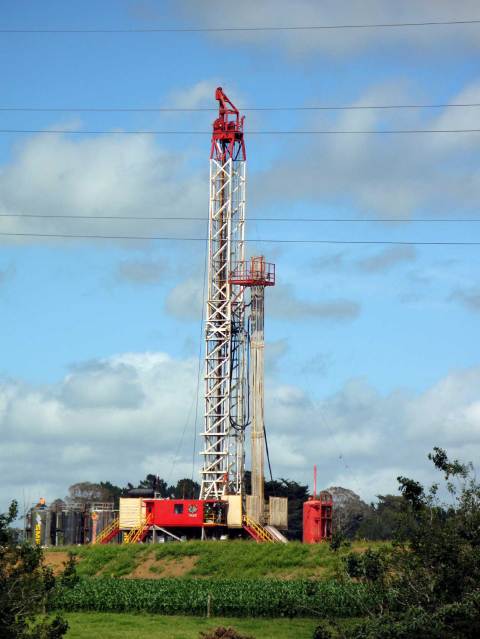 Kowhai C again, this time from Otaraoa Road. It is one of about 10 well sites Greymouth Petroleum has in Tikorangi. I know of 9 that have been consented – I am not sure of the current status of Urenui A (which is not in Urenui but is in Tikorangi).
 This photo taken about August last year – the rig has now gone but it was on Mangahewa C, as photographed from Kowhai C. It is like a quadrilateral of sites, already. These two belong to separate companies again.
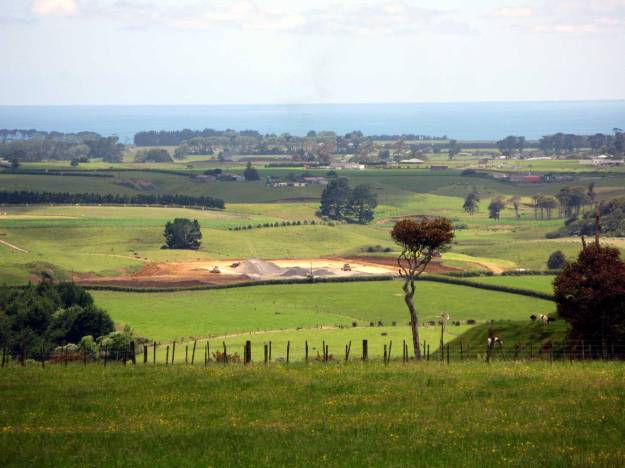 Mangahewa E site from Stockman Road (near Mangahewa C site). These two Mangahewa sites are Todd Energy’s but, to be fair, it should be pointed out that Mangahewa C site has 8 wells drilled on it so is at capacity on its current consent.
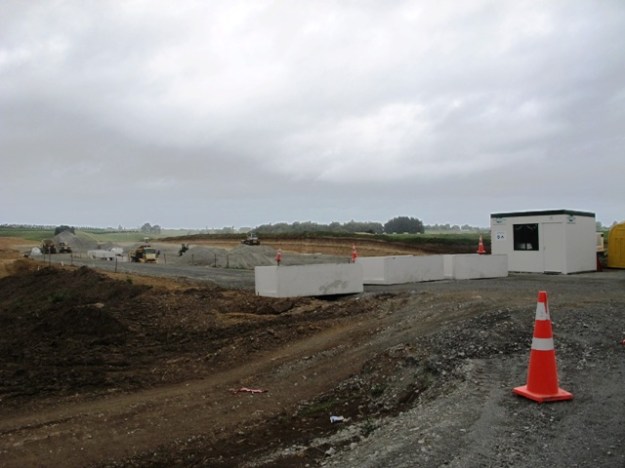 Work progresses on the new Mangahewa E site.
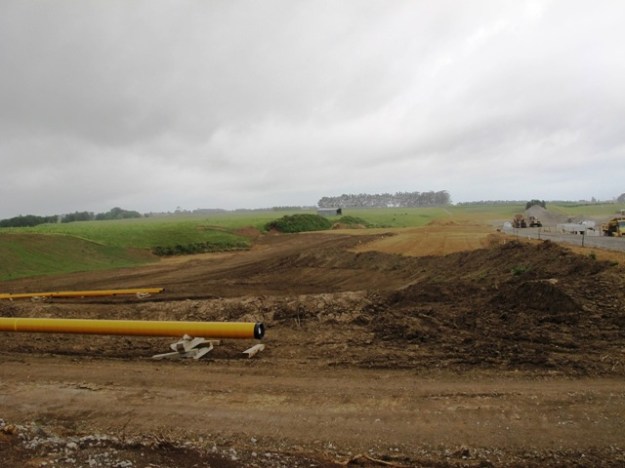 Mangahewa E site again. It is often stated that this petrochemical development (still called “exploration” but they are long past exploration in Tikorangi where it is decades since a dry well was drilled) is “temporary”. Does this look temporary? How can these developments be temporary when the majority of consents are open ended with no expiry date? Only the most recent three sites have a time limit on the consents – 15, 20 and 30 years. In whose books is this “temporary”?
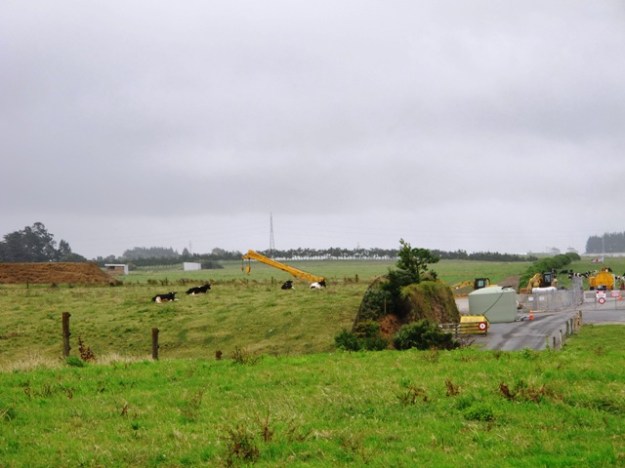 And work progresses on extensions at Turangi A site. These are the other company’s sites (Greymouth Petroleum).
 But wait, there are more. Turangi C site is, according to the company (Greymouth Petroleum) “about” 850 metres from Turangi A site. It can’t be any more than that from Turangi B site, in that case, because it is pretty much set back between the two. Neither Turangi A nor Turangi B have been drilled to capacity. So why does the company need a third site and could they not have deviation drilled from one of the other two sites? Who knows? Only the company and neither New Plymouth District Council nor Taranaki Regional Council seem inclined to ask them why. It looks mighty like speculative consenting to some of us – described by the company rep to me as “future proofing”. Right-o then. That is future proofing the company, not Tikorangi.
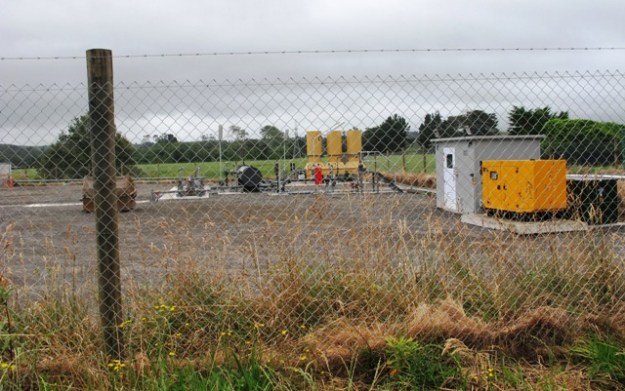 And Kowhai B site with one hole drilled, as viewed from the neighbour’s property. It doesn’t look “temporary” and it was anything but silent on the day I took this photo. It has a significant impact on the neighbour’s adjoining paddock and could well affect his future property options but he was never deemed an “affected party”. I think, to the right of centre at the front of the photo, that is an example of the screen planting done by the company. It’ll be quite a few years before anything is screened by that sort of planting.
 Tikorangi The Jury Garden