Author Archives: Abbie Jury

Unknown's avatar

About Abbie Jury

jury.co.nz Tikorangi The Jury Garden Taranaki NZ

Garden Lore

103
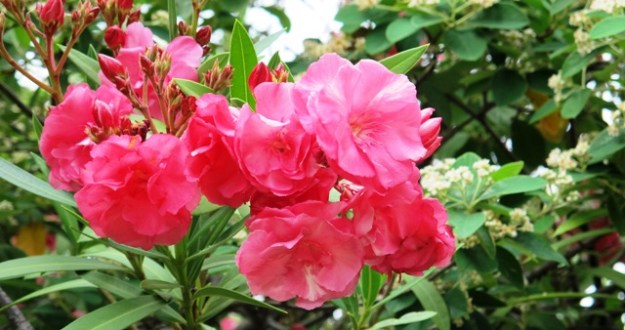
“This morning Thea saw to her delight that the two oleander trees, one white and one red, had been brought up from their winter quarters in the cellar. There is hardly a German family in the most arid parts of Utah, New Mex­ico, Arizona, but has its oleander trees. However loutish the American­-born sons of the family may be, there was never one who refused to give his muscle to the back-­breaking task of getting those tubbed trees down into the cellar in the fall and up into the sunlight in the spring. They may strive to avert the day, but they grapple with the tub at last.”

Willa Cather The Song of the Lark (1915)

Garden Tools

Is it worth buying expensive garden tools? A top of the range garden implement can cost as much as 10 times the price of the cheap alternative. I know this, having bought my Canberra daughter a pruning saw for Christmas. I doubt that it is worth buying the best for beginners. Maybe go a step up from the absolute bottom end price on the display stand, but just as you wouldn’t buy a Porsche or a Volvo for a learner driver, the beginner doesn’t need the top of the range.

For genuinely enthusiastic or experienced gardeners, yes. It is worth every cent to buy the best. Expensive garden tools are generally better designed, better constructed, hold sharp edges for longer and are more efficient to use. A good pair of secateurs will last for many years, beyond a decade even if you don’t lose them, whereas a cheapie pair will deteriorate badly after just a few months. Quality trowels don’t bend out of shape when put under a bit of pressure. Quality spades and shovels don’t bend at the stress point where the shaft is attached. Nor do good quality tools rust.

It should go without saying that if you happen to have some good quality tools in your possession, you should treat them with respect and look after them. After struggling to prune my daughter’s camellias with her cheap and nasty pruning saw, I bought her the very best and it cost about $A120. I have told her that it must be put back in its sheath every single time, even between cuts, to keep it sharp.

First published in the Waikato Times and reprinted here with their permission.

Rich Fruit Wreath – Alison Holst’s super Christmas wreath recipe

In response to Twitter requests: this recipe dates back to the 1980s when it was possible to buy a modest cookbook for $2.95 – Alison Holst’s Kitchen Diary Volume 8. I have made it every year since. I am a big fan of Alison Holst’s Christmas cakes. The other two I sometimes make are also her recipes but the Rich Fruit Wreath does not appear to be on the internet.

Ready for the oven, in duplicate.

Ready for the oven, in duplicate.

Rich Fruit Wreath
1 cup Brazil nuts
½ cup almonds
½ cup cashews
1 cup mixed glace fruits (glace pineapple, mango, papaya, ginger, mixed peel, strawberries or similar – I use a mix of 3)
1 cup dried fruits (I like dried pears, peaches and nectarines. Dried apple slices work as do dried apricots, prunes, sticky raisins or similar. I use a mix of about 3)
½ cup glace red cherries (reserve a few to decorate the top)
½ cup of glace green cherries (I subbed glace kiwifruit this year)
¾ cup of flour
½ teaspoon of baking powder
½ cup of brown sugar
1 teaspoon cinnamon
½ teaspoon salt
2 eggs
½ teaspoon vanilla essence

Set oven to 130 degrees Celsius (120 on fanbake). Grease and line a standard ring tin. If you don’t line it, you run the risk of the cake breaking when you turn it out.

Nuts do not need to be blanched (you can substitute different nuts if you prefer). Cut up fruits to almond size and combine with nuts in a bowl. Add all the dry ingredients and make sure everything is coated. Beat the two eggs and vanilla with a fork and tip into the bowl. Use your hands to coat everything. Pile it all into the cake tin and press it down a bit. It will look like a whole lot of fruit and nuts with very little cake mix.

Bake for two hours. Remove from the oven, let it cool in the tin before it tipping it out. Apply brandy or other spirits if you wish.
It needs to be kept for a few days before cutting. Just make sure you cut it in very thin pieces with a very sharp knife.

Notes:
• I always have too much in the way of dried and glace fruits and I tend to use closer to three cups than two and it still works well.
• This year I used self raising flour as a shortcut and can’t see any difference. I imagine this cake would work equally well with gluten free flours but I haven’t tried it.
• I usually add some small chunks of good chocolate to make it even richer. Not cheap chocolate buttons – Whittakers’ dark, or this year I added some white Callebaut chunks.

The call of gardening in less hospitable situations

Indubitably Australia

Indubitably Australia

I went to Australia last week – Sydney and Canberra. We have a daughter in each city and both are putting roots down across the ditch. Literally. It is very interesting watching one’s children become inspired by gardening.

Sydney daughter is the younger of the two and still in rental accommodation. But having lived in upper floor apartments before, she is now adamant that she needs outdoor space, be it ever so compact. Her current garden is not much larger than our dining room at home. I recall her growing huge and productive Sweet 100 tomatoes when she was a student at Waikato University. In an upper floor apartment in London, she acquired small window boxes to grow herbs. The current space, be it ever so modest, is palatial by comparison.

As the space also accommodates the accoutrements of modern life (outdoor dining table and chairs, barbecue and sun umbrella), her actual gardening space is limited to two narrow, raised beds along the perimeter and an assortment of pots. But she has made space for the two critical requirements for the hipster urban gardener – a worm farm and a covered compost box. She is limited to growing herbs and a few vegetables at this stage but I can see the makings of a lifelong gardener.
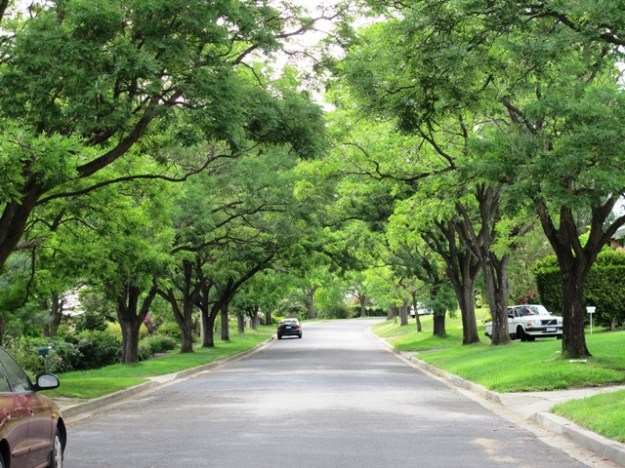
We could learn a thing or two from street trees in Australia - this pleasant leafy road is in in Canberra

We could learn a thing or two from street trees in Australia – this pleasant leafy road is in in Canberra

Elder daughter is now a proud home owner and that is an entirely different kettle of fish. She too started gardening as a student and is a reasonably competent vegetable gardener with over a decade of experience behind her. But now that she has some security and stability in her life, she is looking to expand beyond the quick turnaround of veg and herbs. She was after ideas to develop the ornamental garden.

Canberra is not the easiest of places to garden. Not at all. She commented it is not possible to put plants or seeds in with a reasonable expectation that they will grow and flourish. It takes hard work to get plants established. I walked around her pleasant, leafy suburb to get a feel for the place and it was clear that gardening was a challenge and it was the street trees that gave the area its appeal. We could learn a thing or two from street plantings in these Australian cities.

I realised, however, that this was not a place where that tenet of modern living applies – the indoor/outdoor lifestyle. That is because the winters are cold. I have visited in winter and I doubt that many people sit out in their gardens drinking their morning coffee, even on a fine winter’s day. The summers, on the other hand, are hot. Very hot, even as November became December. It was too hot to be outdoors after 10am and temperatures will rise considerably. So for a good six or maybe seven months of the year, it is an indoor lifestyle.

Then there is the dry. There has been a great deal more rain this spring than usual so the grass (one hesitates to call it lawn) is still green rather than dead. This is unusual.

There were clearly many who found the call of gardening too difficult so they just kept to a few trees and shrubs, mostly in hedges. Nandinas grow well, as do oleanders, crepe myrtles, camellias and pittosporums. The ornamental plum (a selection of Prunus cerisifera) is widely grown with its striking deep burgundy foliage which looked particular fetching with a white cockie feeding in it.

My advice to daughter was pragmatic. Because they have two small dogs (fur grandchildren, Mark and I call them), they only use the fenced back section, which now has a fine veg bed and a well organised compost alley. Concentrate her efforts there, I suggested, and indulge her interest in prairie gardening. It suits the climate.

What to do with a front yard which is merely access to the house?

What to do with a front yard which is merely access to the house?

The front can then become low maintenance window-dressing for kerb appeal. I suggested they get rid of all but one of the finicky garden beds and all the plant containers out the front. These need watering every day. What is more, the beds are raised which means they dry out even faster. Drop the level of the one remaining bed to ground level to reduce watering and the constant spillover of garden mulch. Plant that one remaining bed in easy care, shade tolerant plants – hydrangeas and hellebores – and retain the boundary hedges. Mow the rest. They only have to mow for four months of the year. I bought her my favourite tool for digging out the flat weeds. If you are stuck with fairly rough grasses, it looks much better without the flat weeds.

The same advice may well be applicable for people in coastal situations here. New Zealand lacks the extremes of temperature, but people gardening on sandy soils will experience similar problems. Emulating the lush growth more commonly prized in most gardens is fighting nature in such conditions. It is better to work with what you have.
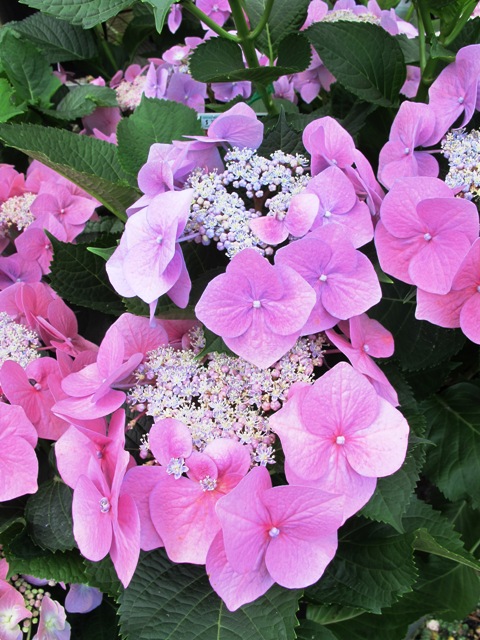
Hydrangeas - easycare plants. They are all pink in Canberra.

Hydrangeas – easycare plants. They are all pink in Canberra.

First published in the Waikato Times and reprinted here with their permission.

Plant Collector: Swainsona formosa

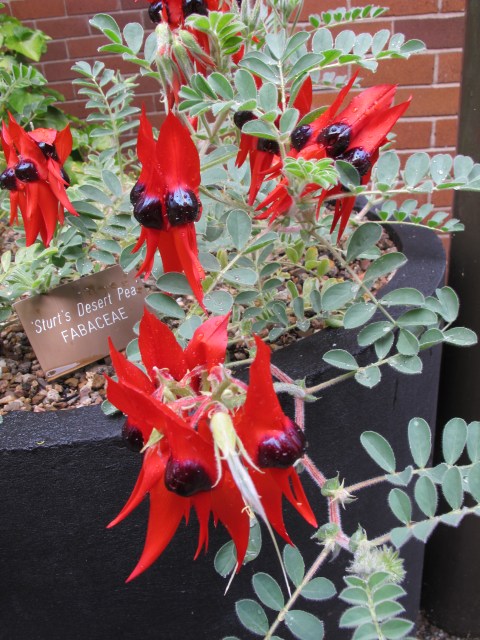
The remarkable Sturt Desert Pea or Swainsona formosa

The remarkable Sturt Desert Pea or Swainsona formosa

Continuing the Australian theme this week, I was very taken by this striking flower, commonly referred to as the Sturt Desert Pea, after Charles Sturt who recorded it flowering extensively in central Australia during his 1840’s explorations. This particular plant was in a tub outside the bookshop at Canberra’s botanic gardens. The scant foliage was visibly leguminous but it was the flowers that were spectacular. They are up to 9cm long and bright scarlet with a showy black boss in the centre, held in clusters. They a little pea-like (as indeed wisterias are) but more distinctive than any pea I have seen before.

It is regarded as one of Australia’s showiest wildflowers. While native to the central and north western areas, it is found throughout much of the country so maybe it is worth a try here in a sunny, dry position. Generally it is a low growing annual, flowering in spring though to early summer before setting seed and dying off.

I bought a packet of seed, unsure on whether I could bring it in to NZ but figuring it was only $4 lost if it was confiscated at the border. There was no problem. It is on the list as being here already so is a permitted import. In fact doing it all properly and declaring it got me through customs faster than had I lined up with everybody else for baggage x-ray. I have seen enough to be a strong supporter of good border control.

First published in the Waikato Times and reprinted here with their permission.

Garden Lore

“I am sensibly obliged, my dear Lord, by your great goodness, and am most disposed to take the gardener you recommend, if I can…. I have a gardener that has lived with me above five-and-twenty years; he is incredibly ignorant, and a mule. When I wrote to your Lordship, my patience was worn out, and I resolved at least to have a gardener for flowers. On your not being able to give me one, I half consented to keep my own; not on his amendment, but because he will not leave me, presuming on my long suffering. I have offered him fifteen pounds a year to leave me, and when he pleads that he is too old, and that nobody else will take him, I plead that I am old too, and it is rather hard that am not to have a few flowers, or a little fruit as long as I live.”

Horace Walpole, Letter to the Earl of Harcourt, October 18, 1777.

007 - CopySummer pruning

Pruning time is over for most woody plants because cutting back is best carried out in winter and spring but there are a few exceptions. Cherry trees (prunus) are one. These are best pruned in mid summer (so January or early February). This greatly reduces the likelihood of the dreaded silver blight getting in through the wounds. There is no differentiation between fruiting and ornamental varieties when it comes to timing of pruning. Other close relatives which are best summer pruned include plums, peaches, nectarines, apricots and almonds.

Wisterias will need pruning, probably right now. This is not complicated. Just trim back the long growths at this time to keep them under some semblance of control. Hedgeclippers or secateurs are fine. The winter prune is the important one to manage flowering. Remove any growth around the base or it will escape and layer, forming roots as it slithers along the ground.

Roses can be gently summer pruned as you deadhead, to keep a good shape. Take the time to gather up any diseased leaves while you are about it and burn the lot if you can. Keeping up the water and nutrition levels encourages roses to keep growing so new leaves will continue to form, along with more flower buds on repeat flowering varieties.

Hybrid clematis can be cut back very hard after their flowering flush has finished – and by hard, I mean to about 20cm. Feed them and keep them watered and most will reward you with another flush in about six week’s time. This works for most large flowered types and the advice came from a clematis specialist.

First published in the Waikato Times and reprinted here with their permission.