Author Archives: Abbie Jury

Unknown's avatar

About Abbie Jury

jury.co.nz Tikorangi The Jury Garden Taranaki NZ

Plant Collector: Dendrobium Bardo Rose

Dendrobium Bardo Rose

Dendrobium Bardo Rose

Out there in the world are legions of orchid aficionados who are typically possessed of technical knowledge about this plant genus, the most complex and varied of all plant groups. I take one peek in to the details of orchids and get completely lost. But when it comes to orchids suitable for the garden, I can recommend the dendrobiums from Australia. There are many different dendrobium species. Some are tropical and only suitable for glasshouse culture here. But the obliging ‘Aussie dendrobes’, as we refer to them, sit happily in woodland conditions needing no care or attention at all. In early to mid spring, they spark into flower and this pink one has nigh on fifty flower spikes. The flowers are much smaller than cymbidiums and the whole clump only stands 30cm high at the most.

Bardo Rose is the grex name (more or less a collective noun) for all dendrobium hybrids which are falcorostrum x kingianum. We have both those species growing here as well but this pretty pink one is a hybrid between the two. Each flowering spike has 20 or more perfect little orchids which measure about 3cm x 3cm. Other dendrobiums we grow are in pure white (including the aforementioned D. falcorostrum) and shades of yellow.

I do not know if dendrobiums are sold commercially. All ours came from the Orchid Society who are renowned for their generosity. These folk will also be able to advise which ones are fully hardy – and some are. Critical issues in growing these plants include excellent drainage, good light levels but dry in winter so under evergreen trees seems to be a good location.

First published in the Waikato Times and reprinted here with their permission.

Better in theory than practice – planting street berms in edibles

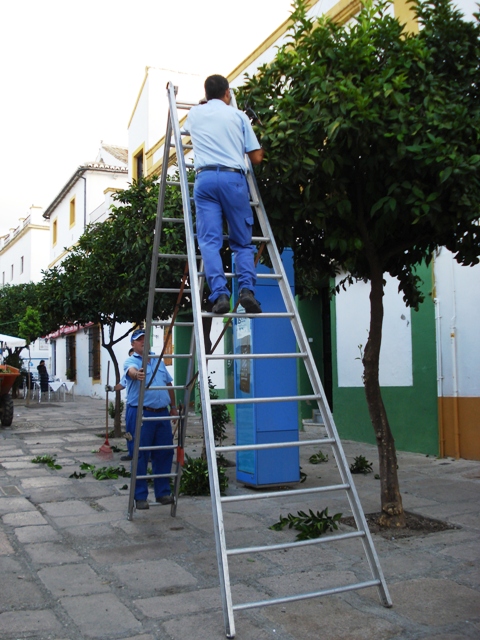
Street plantings of orange trees in Cordoba

Street plantings of orange trees in Cordoba

I have been following with some interest the debate about Auckland’s road berms and the transfer of mowing responsibilities to the closest house occupants. I can’t think that I have ever lived anywhere with road berms that Council mows so my sympathy is limited for those who are railing against having to take responsibility. Road berms are community spaces that stop our urban areas from being too grey and congested.

The debate about alternative uses was more interesting. I was amused by the wit who suggested that a creative approach could solve the lack of new housing space in Auckland. Indeed, if you look at contemporary Japanese domestic architecture, I feel sure there is potential for space-saving apartments to be constructed on some of the wider berms. Though I can already hear the cries of protest from the adjoining landowners.

Often I hear the claim that berms should be planted out as community vegetable gardens and that all street trees should be fruit trees for the benefit of residents. It is so easily said and on the surface it sounds such a good idea but there are reasons why this is not so popular with powers that be.

Starting with the vegetable garden berm idea – how are you going to stop every passing dog from urinating on your plants? Or worse. Just watch a dog being taken for its walk and you may lose enthusiasm for growing vegetables out in a public space very quickly. Is the berm to be fenced to keep out wandering dogs? This rather defeats the whole notion of common space when ownership is claimed by way of a fence.

Unless your berm is at the end of a very quiet cul de sac, there are issues with automotive pollution, not to mention road splash. Okay, the lead content of our petrol has dropped dramatically from where it used to be, but I am not too sure about wanting to eat plants which are grown with full exposure to petrol and diesel fumes. And road spray on wet days is likely to be introducing more contaminants.

Then there are all the issues of ownership of the produce when it is on public land. How happy would you be if somebody came along and harvested your entire potato crop just as it hit its peak – or worse, before it has? And if one or two key individuals do not take ownership of the garden and manage it, soon it will descend into an unsightly mess which is a great deal worse than a bit of rank grass.

Vegetable gardens on the berms are not that easy. This is not to say it can’t be done, but it is not a universal panacea and it will take a lot more individual effort than mowing.

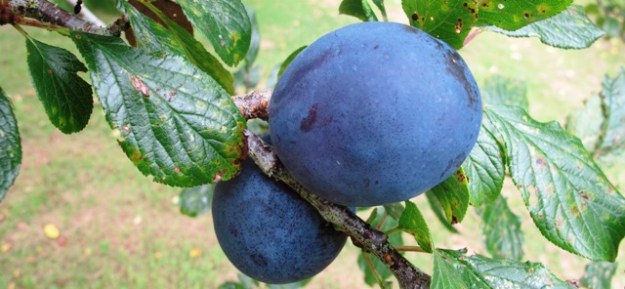
Plums - more likely to feed the birds than the human populace

Plums – more likely to feed the birds than the human populace

So, fruit trees as street trees? I really do not envy any Council staff who are faced with decisions on street trees but I applaud their valiant efforts to plant up our urban areas. Street trees have to be able to grow in exposed conditions, sometimes highly polluted. They need to have small leaves which decompose quickly so they don’t block all the drains. Their root systems are vitally important (don’t want to break up sewers or sealed areas but they need to be sufficiently well rooted not to blow over) and so is the ultimate shape of the tree. They need to be more upright than wide spreading. On top of that, if they are too desirable, they are vulnerable to theft when young and they need to be able to grow with a minimum of attention and no spraying.

That is a pretty big list already and that is just off the top of my head. There are probably more criteria than that. So tell me which fruit trees match those sorts of criteria. If it was easy, I am sure we would see it done more.

I have seen oranges used as street trees overseas – table oranges in Sorrento in Italy (tourist town, though, so maybe less inclined to be nicked) and bitter Seville oranges on the streets of Cordoba in Spain. The ones in Cordoba were harvested commercially, I found out. Citrus are not high maintenance trees but they still need spraying with copper and they are vulnerable to borer.

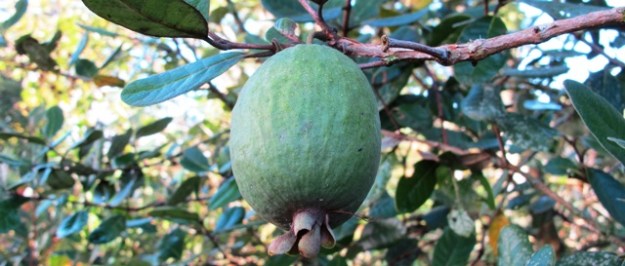
Feijoas! Definitely an option for road verge plantings

Feijoas! Definitely an option for road verge plantings

The best option I could come up with here is feijoas. They require next to no care and are reasonably wind tolerant. The fruit is peeled before eating so street pollution is not such a problem. Apples, pears, plums – all need care and are more utility than attractive. They are not even utility if they are uncared for and don’t crop. Plums are more likely to feed the birds than humans.

I think street trees are street trees. It is not a situation that lends itself to an ill-thought out philosophy that they should all be fruit trees in suburban areas as a matter of principle. I can only see it working where an adjacent householder takes responsibility for the trees and that includes dealing with theft and vandalism. It’s a nice idea in theory.

I admit, however, that I yearn to live somewhere with street plantings of oranges.

First published in the Waikato Times and reprinted here with their permission.

Garden lore

“I am very fond of the Spring-flowering colchicums, but unfortunately slugs are also, and those greedy gastropods and I have a race for who can see the flower-buds first. If I win I go out after dark with an acetylene lamp and a hatpin and spear the little army of slugs making for a tea-party at the sign of the Colchicum.”

Edward Augustus Bowles My Garden in Spring (1914)

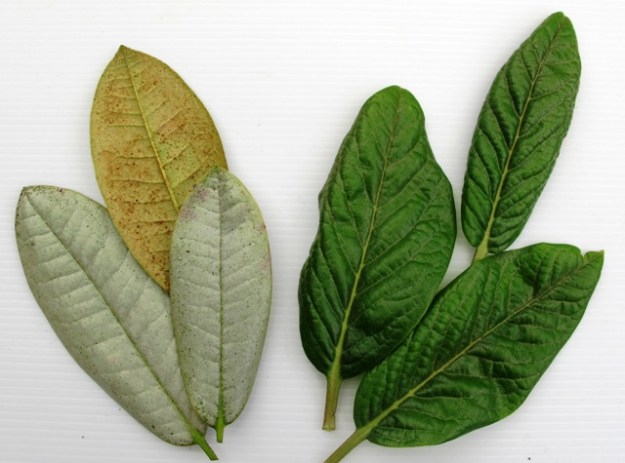
Thrip infested leaves to the left, healthy to the right.

Thrip infested leaves to the left, healthy to the right.

Thrips galore

Clearly last summer’s drought stressed some plants more than we realised at the time. Thrips. We have thrip infestations on plants which do not normally suffer. Plants show the damage as silvering on the leaves. It is common in many rhododendrons but bay trees and photinia are also prone to infestations, along with other plants. You can’t turn the silver leaves green again. Turn over the leaf and you will see rusty looking spots behind. This is the residue of the thread-like thrips which suck the chlorophyll out of the foliage. The damage is done.

Prevention is better than a cure. A strong, healthy plant with plenty of air movement around it and good light levels is better able to withstand attack. There are systemic insecticides you can use which the plant absorbs into its system, killing the thrips from the inside out but you have to wait until the critters are active again – usually late November. The bands sold that you wrap around the trunk of the tree will either be soaked in systemic insecticide or in Neem oil. We have never tried Neem and are surprised if it works as a systemic, but others say it does.

Contact insecticides don’t work unless you can saturate the underside of every single leaf so most organic remedies won’t work. The fresh spring growth will hide a multitude of sins and we are hoping that the thrippy plants will look fine again. Some varieties are much worse affected and generally we choose to remove those and replace with better performing varieties because we do not want to have to use systemic insecticides just to keep plants healthy.

First published in the Waikato Times and reprinted here with their permission.

Low(ish) maintenance shade gardening

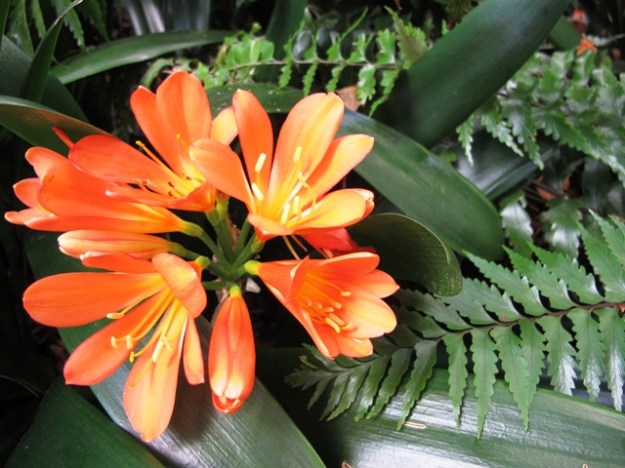
016 (2)It is clivia season here though it may not be clivia season for those who live in colder areas. Despite being much favoured by modern landscapers, these plants do not like more than a light touch of frost at most.

There are reasons why clivias are loved by landscapers. Of all the options for shady areas, they must be one of the most tolerant, forgiving and easy-care there is. For the better part of the year, they sit as a tidy clump of strappy foliage requiring little or no attention and when they flower in spring, the showy blooms last for many weeks. Plants can be left for years requiring no attention.

I looked at a photo of a property where the owners had used a reputable landscaper and the shady side of the house consisted of an access path with two narrow borders either side bounded by a solid fence. Both borders had been planted with clivias in single file, surrounded by bark chip as mulch. It is a very tidy, utility solution which, if the fence and path are smart, can even look stylish. If you like that sort of look.

Everything looks better with ferns, in my opinion. Ligularia reniformis.

Everything looks better with ferns, in my opinion. Ligularia reniformis.

Clivias are not a great choice for inland areas unless you are confident that you are frost free, which most of Hamilton and the Waikato won’t be. Sometimes such borders are beneath the eaves of the house and that will afford protection. But you will often see the same look achieved with, maybe, the tractor seat ligularia (L. reniformis), Ligularia ‘Desdemona’ or a similarly reliable, evergreen perennial.

It will come as no surprise to regular readers that it is not a look I favour, personally. While I can see the logic to keeping clean, crisp lines and some degree of simplicity, I just think it would look so much more interesting with the introduction of another one or two types of plants. They don’t have to be expensive or choice plants but what they add is textural interest, variation in height and sometimes the bonus of seasonal flowers.

Most gardens have a shaded area – at least that narrow side that runs alongside the bathroom and laundry and is on the other side from the sunny living areas. If it is a little-used area which is primarily access and has no house windows that look out to it, then it hardly warrants great expenditure of either money or ongoing effort. But a small amount of effort can make it so much more attractive and the beauty of shade gardening is that it tends to be much lower maintenance.
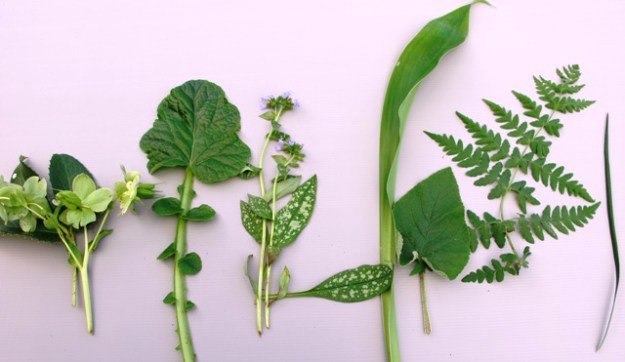
left to right: Helleborus x sternii, Francoa ramosa, pulmonaria, arthropodium (renga renga), phlomis, random fern and mondo grass - all cheap, reliable options for low maintenance shade gardening

left to right: Helleborus x sternii, Francoa ramosa, pulmonaria, arthropodium (renga renga), phlomis, random fern and mondo grass – all cheap, reliable options for low maintenance shade gardening

I headed out to the garden to look for options to add interest to a shade garden. There are plenty to choose from – just don’t choose them all if you want a clean look. Keep it to a maximum of three. Ferns. Pretty much everything looks better with ferns in the shade. They add a lightness of texture and detail of leaf to solid plants like clivias or ligularias and it is that contrast that can add interest.

Renga renga lilies are happy in more shaded areas and have the bonus of spring flowers. We have a lot of success with phlomis (P. russeliana or Turkish sage) with its yellow tiered flowers in summer. Similarly, the bridal wreath flower – particularly Francoa ramosa – is easy and obliging with summer flowers. The unattractively named lungworts or pulmonaria family combine very well with bigger, chunkier foliaged plants and add detail with their gentle variegation. Even common old mondo grass, be it black or green, can add a different texture. Helleborus x sternii is a reliable shade option with lime green flowers in winter.

If you keep to evergreen perennials which don’t require much more than an annual clean-up and which can be kept for several years without having to dig and divide them, you can make a low maintenance shade garden. Take care to plant them well in soil you have dug over, add plenty of humus or compost, mulch after planting and generally they can look after themselves.

It does not have to be expensive or difficult. If you can get simple combinations that are compatible, look good together, are happy in the conditions and meet the requirements of the gardener, it is a great deal more interesting than looking at a single plant variety en masse.

But that is the voice of a gardener, not that of a landscaper.

First published in the Waikato Times and reprinted here with their permission.

Plant Collector: Trillium sessile

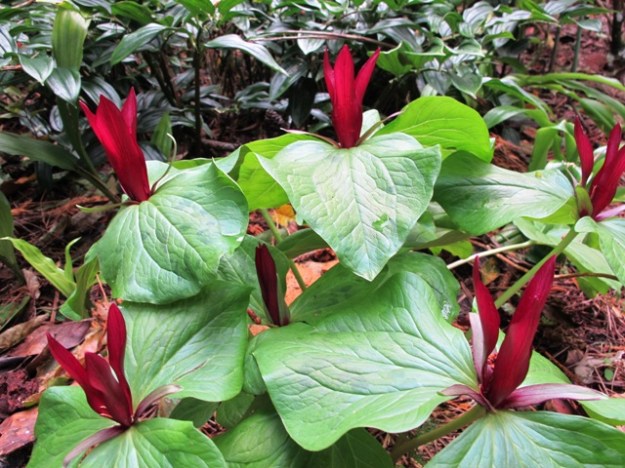
Trilliums! Not common in gardens in our area. T.sessile

Trilliums! Not common in gardens in our area. T.sessile

In the world of status plants for the garden, trilliums are right up close to the top. I am not entirely sure why. They certainly have a quiet charm and are a delightful addition to the spring woodland garden. They are not at all easy for most people to grow and are hard to source, but even that combination of factors does not explain the reverent awe accorded to their presence in a garden.

There are a relatively large number of trillium species (somewhere over 40) and most are native to North America, with just a few from Asia. They are deciduous perennials forming rhizomes below ground. The foliage dies down each autumn, to re-emerge the following spring (one hopes – it is not guaranteed) with fresh leaves and flowers – hence their common name of ‘wakerobin’. At times they are also referred to as ‘tri flower’ on account of their wonderful symmetry of threesomeness. Three heart shaped leaves hold three narrow sepals in the centre which surrounds the three petalled flower which has six stamens. How perfect is that? The dark red trilliums (usually T. sessile or descended from that species) are usually the most highly prized as garden plants, although different species introduce white, pink and yellow to the range.

Being woodland plants, trilliums want ground rich in humus and leaf litter which never dries out. They tend to do better in inland areas with colder winters where the clumps can get more size to them than we see in our coastal conditions. They can be raised successfully from fresh seed if you find a friend with a plant.

First published in the Waikato Times and reprinted here with their permission.