Author Archives: Abbie Jury

Unknown's avatar

About Abbie Jury

jury.co.nz Tikorangi The Jury Garden Taranaki NZ

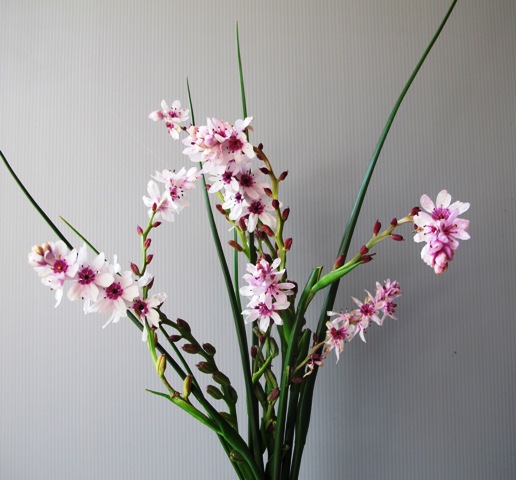
Plant Collector: Onixotis triqueta

Now Onixotis triquetra, no longer a dipidax

Now Onixotis triquetra, no longer a dipidax

It used to be a Dipidax and is still widely known under this name but I have never heard of a common name in this country. In its native habitat, the bulb wonderland of the Cape Province in South Africa, it is apparently sometimes called the waterflower, on account of its ability to grow in damp ground. In fact it will grow pretty well anywhere as long as there is reasonable sun.

At a quick glance as one passes by, the tall stems of many flowers look almost orchid-like but second glance will show you that they are closer to daisy-like with a dark eye. It flowers from late winter through spring but I see seed is forming already on these heads. The foliage is narrow and tallish, almost like a reed.

Onixotis are really easy bulbs to grow, though we fear they may have slightly invasive tendencies and prefer to keep them in designated areas. Seed is set freely and the bulbs themselves multiply readily so it is probably better not to have them growing through small shrubs or perennials.

Some bulbs have the weird ability to pull themselves down to greater depth in the soil, no matter what level you plant them at (others crowd themselves upwards). Onyxotis are burrowers so you often need to dig quite deeply if you want to lift them. Raised from seed, they reach flowering size in their second season.

First published in the Waikato Times and reprinted here with their permission.

Pruning and shaping

Ulmus Jacqueline Hillier after pruning. For the avoidance of confusion, this plant is only 3m by 3m, not a forest giant.

Ulmus Jacqueline Hillier after pruning. For the avoidance of confusion, this plant is only 3m by 3m, not a forest giant.

I am married to a master pruner. I recognise his skills are hugely greater than mine. This was reinforced when he pruned the Ulmus Jacqueline Hillier at the weekend. This plant is meant to be a dwarf but it is looking less and less dwarf-like in our rockery and needs attention most years to keep it to a suitable size for that location.

At the end of the better part of half a day, he asked me how I thought it looked. In fact it looked very similar to how it had looked when he started. It is a plant with a lovely characterful shape and fan like sprays which hold the tiny leaves. There was close to as much lying cut off on the lawn as there was left on the shrub but you would not pick that. It had been reduced considerably in size and scale but had lost none of its form or shape. That is good pruning, dear Readers, as opposed to the butchery carried out by lesser mortals.

There was almost as much on the ground as left on the plant but you could not tell that by looking.

There was almost as much on the ground as left on the plant but you could not tell that by looking.

Such dedicated and meticulous pruning takes time, skill and sharp hand tools.

We joined a garden tour in the north of Italy some years ago and anyone who has visited those grand Italian gardens will know that most are clipped and shaped to within an inch of their lives. In fact they are so heavily clipped and groomed that plant health is often not that great. It is all about form and shape and very labour intensive.

Similarly, we have looked at the meticulous bonsai specimens in the Chinese gardens in Singapore. These are tended constantly by people with nail scissors, I kid you not. It may not be nail scissors exactly, but they were definitely nipping and snipping with scissors of some description. Surgical precision and detail. Again, labour intensive.

We lack the personpower here to carry out that sort of heavy clipping and shaping. Oh, to have a small army of serfs that we could upskill and then reward with a hovel in which to live and the occasional sack of spuds. But even then, we would not want a heavily contrived and clipped garden, preferring instead to go with some degree of natural harmony. It is all about degrees, however. Gardening involves a whole lot of management and manipulation to get desired effects.

Once the initial shaping and training is done, it does not take huge skill to maintain it. These are just camellias used as shapes in the garden.

Once the initial shaping and training is done, it does not take huge skill to maintain it. These are just camellias used as shapes in the garden.

Getting the initial shaping on plants is the skill, or bringing an over-sized specimen back to a more manageable size and shape. Once it is done, it only takes a moderate level of skill and care to maintain it.

I have watched Mark bring a wayward plant into line and that is why I am happy to concede his skills are so much greater than mine. He takes his time and he concentrates. He is up and down the ladder repeatedly (despite this playing havoc with a dodgy knee joint), viewing the plant from all angles at all stages. Major cuts are very carefully considered because you can’t glue a branch back on if you make a mistake. It is all about finding the natural shapes within the plant and highlighting those.

Frankly, it would often be faster to cut a plant out, even if it then involves major work removing stumps and roots. But if one forever removes plants when they get some size and maturity, then there is never a chance for them to develop character and the garden will remain perpetually juvenile.

All this comes back to the fact that we use plants as features and focal points in our garden, not ornaments. We prefer to clip a strategic plant here and there than to paint the outdoor furniture a different colour or place an urn.

First published in the Waikato Times and reprinted here with their permission.

Garden lore

“When Lord Teviot had despatched his letters, he found her in her garden,,, [it was] a first-rate gardener’s garden, every plant forming part of a group, and not to be picked or touched on any account; all of them forced into bloom at the wrong time of the year; and each bearing a name that it was difficult to pronounce, and impossible to remember.”

Emily Eden The Semi-Attached Couple (1830)

Dealing to wandering jew

Of all the pesky, invasive and difficult weeds to eradicate, wandering jew – also known as wandering willie or tradescantia – is right up there with the worst. It is usually impossible to eliminate in one hit and every single bit you miss or drop will grow again. Turn your back, and you will have a carpet of smothering foliage returning. It takes great persistence – either the removal of every single piece for alternative destruction or repeated chemical nuking.

Whether you are spraying or hand pulling, rake the top layers off first and remove. I hesitate to say send to landfill because I do not think that is what landfill is for. Piling it into black rubbish sacks, sealing them and then laying them on concrete under hot sun will kill it. Then you can compost the remains. If you are confident that you make a hot compost, you can put it straight into the heap but a cold compost mix won’t kill it. If you are not going to spray, then you just have to keep repeating this process.

If you are willing to spray, the bad news is that glyphosate is largely ineffective. You need a spray with the active ingredients of either triclopyr or amitrol. Grazon is probably the best known triclopyr brand but your garden centre will have other commercial sprays with these active ingredients. It will take at least two or three applications over several months to get rid of the regrowth.

Apparently this weed can cause terrible skin irritation to dogs and cats which is another good reason for eradicating it. Just don’t ever do it by chucking the bits over the fence. They will grow and return to your place to reinvade as well.

First published in the Waikato Times and reprinted here with their permission.

Tulips, but not from Amsterdam

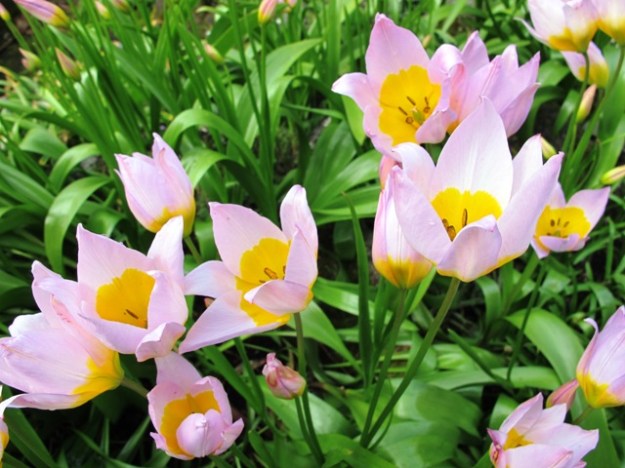
Tulips from Crete - T. saxatilis

Tulips from Crete – T. saxatilis

Tulips. They are Dutch in origin, aren’t they? Well no. The original tulips are no more Dutch than I am, but the modern hybrid tulips largely originate from the flat home of dairy, dykes, windmills and clogs. And in a love affair spanning 450 years, the Dutch have made this plant family their own.

We don’t grow many tulips in our own garden. The showiest by far is a tulip from Crete – T. saxatilis. Most people are surprised to find that there is a tulip from that Greek island because, after all, tulips come from Holland, do they not? In fact the species in the wild – and there appear to be somewhere between 70 and 100 different species recorded – do not originate from anywhere in Northern Europe. Instead, stretching from Southern Europe, through Northern Africa, the Middle East and spreading overland from Turkey to north western China, tulips have a wide territory. Many of them favour mountainous areas with hot, dry summers and cold winters and therein lies the hint to the problems people can have with getting the modern hybrids to flower past the first season in their garden. Most need a much greater winter chill than we can give them here.
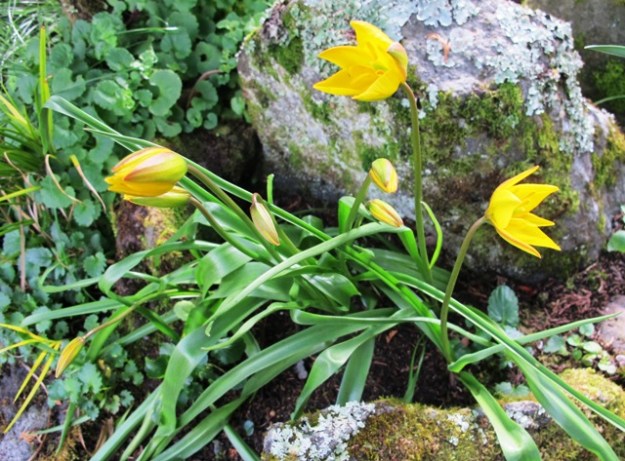
Some species - we just don't know which one

Some species – we just don’t know which one

We have three different tulips in the garden. The Cretan species is wonderfully easy-care and increases gently and reliably. I love the unlikely contrast between the lilac pink and bright gold. Then we have a pure yellow one which is inclined to nod its head. Mark thinks it may be a hybrid, not a species, though I am unsure of how he reached this conclusion. It never increases but it does at least return each year. And we have a small flowered, small growing species of unknown origin. Charmingly understated, might be the descriptor.
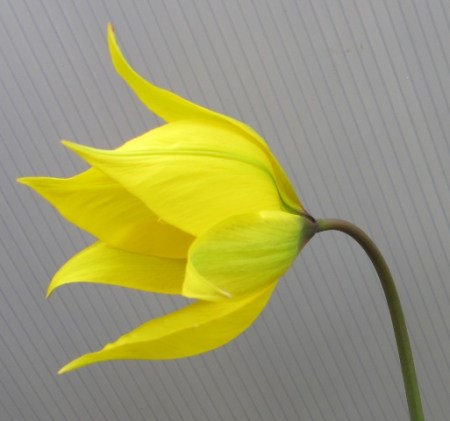
Indubitably tulip, but we have no name on it and it never increases.

Indubitably tulip, but we have no name on it and it never increases.

I am not the world’s greatest fan of modern tulip hybrids but concede I am in a minority. I have toyed with the idea of bulk buying bulbs of one or maybe two selected cultivars to drift through areas of the garden. A swathe of pure white tulips or maybe clusters of a deep wine colour might add to the early spring herbaceous plantings even though they may be a little clichéd. But I prefer to spend money on bulbs which have a life-span beyond just one season. I can’t bring myself to treat tulip bulbs as a disposable commodity. It seems a shocking waste of money, resources and effort.

I was a bit surprised to find that even in the UK, tulips are often treated as annuals because their repeat performance is patchy at best, despite the fact that their winters are much colder than ours. Tulip bulbs are much cheaper to buy there which may be a factor.

It is not that these hybrids all die after flowering for the one season. They just decline and flowering diminishes considerably in subsequent years unless you go to the trouble of lifting them, separating the offsets, chilling them and replanting in fresh ground. That is a lot of effort. Holland apparently produces fresh tulip bulbs by the billions each year, so I guess there is an insatiable demand from people who do keep replenishing supplies.

The early variegations and novelty breakthroughs were almost certainly caused by virus which, while giving variety, also weakens the plants over time. Nowadays, the variegations are the result of genetic breeding and selection, and considerable effort has been made to get rid of the debilitating viruses. Most of the modern hybrids descended originally from T. suaveolens, which we do not have in our garden here.
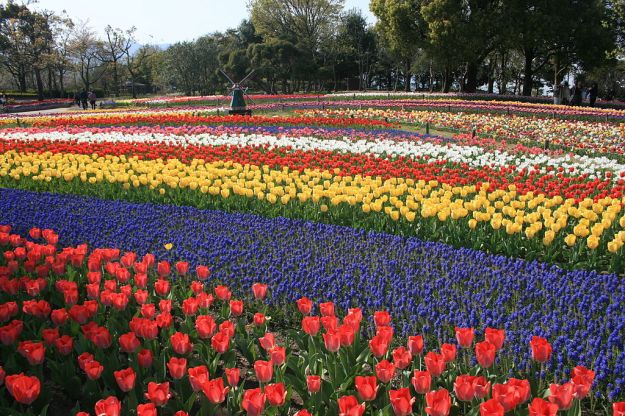
I went looking for a photo of tulip fields in Holland and found instead this one of tulip fields in Japan, pretending they are in Holland!

I went looking for a photo of tulip fields in Holland and found instead this one of tulip fields in Japan, pretending they are in Holland!

The history of tulips is fascinating but not without debate. The earliest cultivation of tulips was apparently recorded 1000 years ago in Persia. How and when they arrived in Northern Europe is disputed, but they appear to have been taken there in the mid 1500s. By 1637, what is now called “tulip mania” had hit Holland. Single bulbs could command fabulous prices – reportedly as high as 10 times the annual income of a skilled craftsman. But it was not just the wealthy plant collector who coveted these flowering plants. They had become an investment commodity, priced way beyond their actual value. This extraordinary situation has received a lot of attention because it was the first recorded instance of rampant, economic speculation on a product but there is ongoing debate about the extent and the detail. Economic data from 1637 is always going to be a little sparse and sometimes unreliable. Whatever, it makes a good story and “tulip mania” has entered the lexicon as a term for a freakish economic bubble, such as the sub-prime mortgage bubble in most recent times.

Going back to garden plants, in their simplest form tulips are generally cup-shaped and can face upwards or downwards. Essentially they all have strappy foliage and while it looks as if they have 6 petals, botanically they have 3 petals and 3 sepals. Ten times an average income seems an awful lot to pay for one of those.

First published in the Waikato Times and reprinted here with their permission.

Plant Collector: Daphne genkwa

Daphne genkwa - as lovely as a flowering shrub can be

Daphne genkwa – as lovely as a flowering shrub can be

We only grow a few types of daphne in gardens although there are many more known species. Most are grown for their fragrance, rather than any spectacular display. D. genkwa is different. Once established, it is as spectacular as any flowering shrub in the garden and in a most unusual hue of lilac blue. Because it is deciduous, all you see in late winter or early spring are arching branches smothered in the prettiest of displays. The individual flowers don’t even look like the usual daphnes, being larger, more delicate and of different form with a long corolla or tube.

What it lacks is a strong scent. In fact I didn’t realise it had any scent at all until I put my nose right amongst the flowers. This one is grown for its looks. Genkwa is renowned for being difficult to propagate so is not widely available. It is generally done from root cuttings. If you can find one, plant it somewhere with plenty of space to grow – maybe two metres all round to accommodate its arching growth. I killed an established specimen by trimming it after flowering one year so the replacement plants, bought at some expense, will be left entirely to their own destiny. It has fine, light foliage so when not in flower, is just an anonymous border shrub.

First published in the Waikato Times and reprinted here with their permission.