Author Archives: Abbie Jury

Unknown's avatar

About Abbie Jury

jury.co.nz Tikorangi The Jury Garden Taranaki NZ

Garden lore

[My garden] is a confusion of kitchen and parterre, orchard and flower garden, which lie so mixt and interwoven with one another, that if a foreigner, who had seen nothing of our country, should be conveyed into my garden at his first landing, he would look upon it as a natural wilderness, and one of the uncultivated parts of our country.

Joseph Addison, The Tatler (1710)

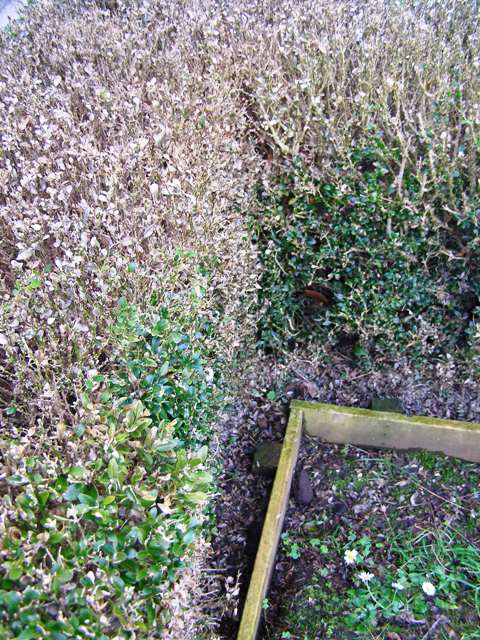
The dreaded buxus blight - but not in our garden

The dreaded buxus blight – but not in our garden

Buxus blight
Judging by all the search engine terms I see leading people to my website (www.jury.co.nz), buxus blight is currently running rampant. In summary, if your buxus has turned brown all over, it is dead. If it has big dead patches and some green left, odds on you have buxus blight. All species of buxus get it but it is worst on the most common ones we use here – B. sempervirens and var. suffriticosa. It is a fungus – cylindrocladium – and it is a problem throughout the world where buxus is grown. Being a fungus means that it is spread by spore and these light little packages of blight can be spread by wind.

You can treat buxus blight but you can’t cure it. As soon as you stop treating it, the dead patches will start again. Untreated, you are likely to lose the lot eventually and it will look most unattractive in the process. I know of people who are keeping it at bay by using copper sprays and there will be fungicides that will knock it on the head for a while. The trouble is that the repeated use of copper sprays is not good for the environment (eventually you can get a build up that kills earthworms) and fungicides are not the nicest of sprays. It is unlikely that natural sprays using baking soda are of sufficient strength to be effective.

In the end, the decision really is whether you are willing to spray your buxus from here to eternity. Be grateful if you do not have the blight.

First published in the Waikato Times and reprinted here with their permission.

Tropical gardens re-created in Asian hotel-style

The distinctive spindle palm or Hyophorbe verschaffeltii at Kota Bharu airport

The distinctive spindle palm or Hyophorbe verschaffeltii at Kota Bharu airport

I mentioned I had been to the tropics. It was Malaysia and included the magical Perhentian Islands which were pretty much a perfect tropical hideaway. Waving palm trees, golden sand, warm sea with coral reefs just off the beach, no roads, so no vehicles, not even motor bikes. All transportation was done by small boat and wheelbarrows. What they did have was a sewage system and a daily rubbish collection (by boat) which is always reassuring.

The wheelbarrow as the main transporter of freight

The wheelbarrow as the main transporter of freight

Did I come home with a yen to re-create my holiday experience by building a tropical garden? Well, no. See, there is something missing here. The temperatures in the tropics are consistently in the 30s. Soggy, cold tropicalia in winter does not seem so evocative of warm holidays, in my opinion.

Many others do not share my reservations, however, and the tropical garden has become increasingly de rigueur, particularly in Auckland but also in points further south where the folly is magnified by even cooler temperatures.

It occurred to me that we may have evolved our own tropical gardening style in this country. It is perhaps best described as “cool climate Balinese-hotel-style” or, if you have been to Bali, even more specifically as “Ubud hotel-style”. I have never seen that garden genre beyond a hotel environment in the tropics and it does not reflect the wider environment.

In Malaysia, the closest I saw to domestic gardening was more akin to a food forest. The focus was on production, not aesthetics, so tended to feature a mango or two, coconut palms, plenty of bananas and maybe a breadfruit. Ornamental gardening is more likely to be limited to a bonsai bougainvillea in a pot.

Nor does the forest resemble a tropical garden as we understand it and our domestic, cooler climate version cannot be seen as an interpretation of that. Besides, we lack the monkeys (big, long-tailed ones ripping the beachside abutilons apart when I saw them).
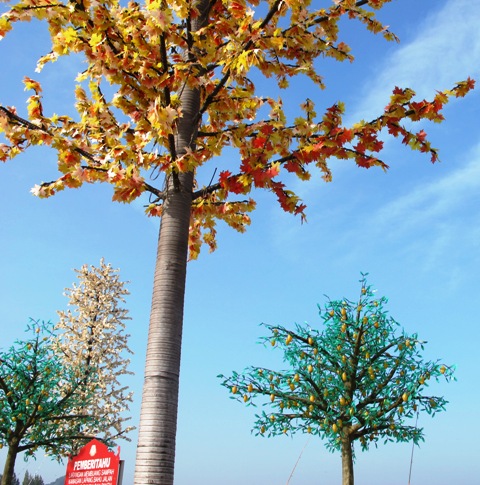
Fake trees in Kuala Terengganu

Fake trees in Kuala Terengganu

Plantings for beautification are clearly the domain of the public sector and commercial entities (hotels, in particular). Growing conditions are pretty forgiving in the tropics. They can often cut things off and stick them in the ground with no special preparation and a reasonable expectation that they will grow. I saw Cordyline terminalis treated in this very fashion, growing in pure sand. So it was a puzzle to me as to why the riverside in Kuala Terengganu was furnished with fake trees. Fake trees designed to look like Norfolk Island pines and oak trees colouring up for autumn, in fact. Bizarre. Yet the street trees included the much favoured and very fragrant Michelia alba which is devilishly difficult to propagate in this country.

Blocking off a street in Kota Bharu

Blocking off a street in Kota Bharu

As in so many Asian countries, it is possible to beautify cities with planters, often ceramic. Indeed, I saw a row used to temporarily block off access on a road in Kota Bharu. Anyone want to take bets on how long these would last in any New Zealand city? It is just one of those unspoken reminders of the vandalism and theft we live with. No council is ever going to contemplate using something as easily destroyed, let alone putting little clipped topiaries into them.
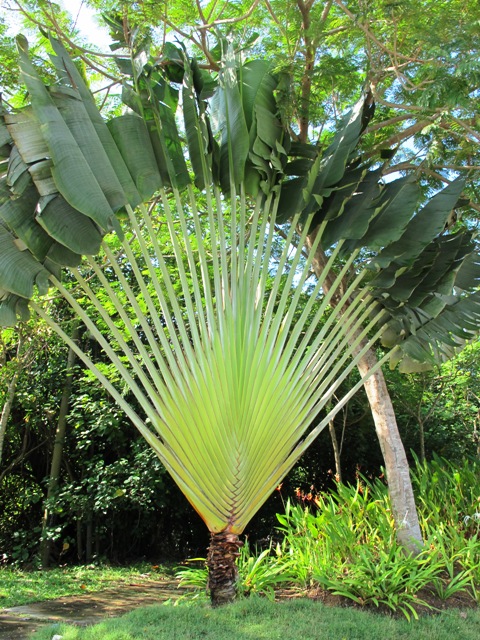
The two dimensional traveller's palm is in fact not a palm at all (Ravenala madagascariensis,)

The two dimensional traveller’s palm is in fact not a palm at all (Ravenala madagascariensis,)

Palms are planted everywhere and the public plantings go well beyond the ubiquitous coconut palms and the utility monoculture of the palm oil plantations. The beautiful bismarckias and curious two dimensional traveller’s palms (which is not a palm but actually related to strelitzia) are certainly stand-out plants.
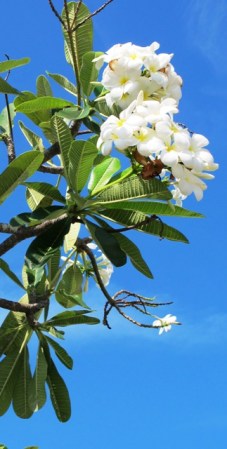
Frangipani - usually seen as a hotel garden plant

Frangipani – usually seen as a hotel garden plant

Underplanting? The only places I saw underplantings were on roadside verges and in hotel gardens. These are commonly the tropical crinums and ornamental gingers. The gorgeous frangipanis which we associate strongly with the tropics are mostly in hotels. Of course these are Central American plants, not Asian. Mind you, so too is the bougainvillea and it has done pretty well in establishing itself as a first choice plant in warmer areas across the globe.

All of this made me realise that the many “tropical gardens” in tropiNZ are eclectic mixes of plants from around the world put together in the classic layered style, but tidy. We won’t accept the wild abandon of tropical growth, the droop of scruffy banana leaves, the debris and litter of the forest floor. No, this is warm climate plants put together with a little tasteful Asian ornament or two, straitjacketed into suburbia.

In fact the model is those immaculately groomed gardens you find throughout Asia in better quality hotels. Presumably for many such garden owners, the evocation of happy, holiday memories centres primarily on their hotel and the hotel pool. It does not have a whole lot to do with the wider environmental or actual gardening in the tropics. As I said, Ubud hotel-style, but without the warm temperatures.

First published in the Waikato Times and reprinted here with their permission.

Plant Collector: Rhododendron ‘Pukeiti’

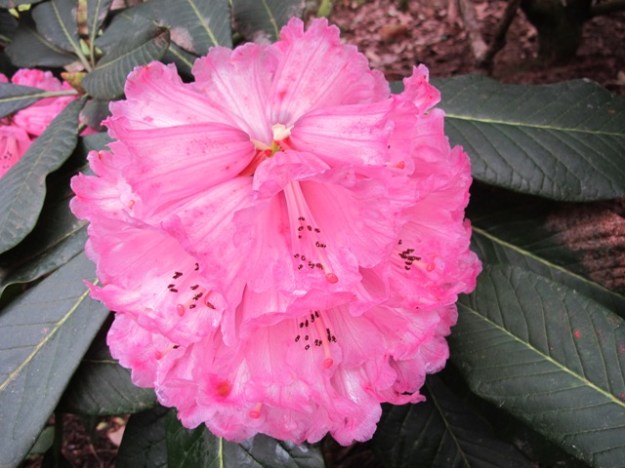
One of the big leafed rhododendrons, "Pukeiti" (otherwise known as R. protistum var. giganteum)

One of the big leafed rhododendrons, “Pukeiti” (otherwise known as R. protistum var. giganteum)

This is the iconic plant of Pukeiti, the rhododendron gardens set near Mount Taranaki. It is one of what is widely referred to as the big leafed rhodo group, grown in those gardens in the Valley of the Giants though this plant is on the cold hillside of our park here at Tikorangi. In the rhododendron world these are big – big leaves can be up to 50cm long and big flower trusses on large growing plants which, over time, can reach 5 metres tall by about 8 metres wide. These are not plants for the urban garden. While the plant itself is hardy, an untimely frost can turn the blooms to something resembling caramel icecream.

“Pukeiti” is a selection of R. protistum var. giganteum which itself a straight species. It was grown from seed collected by the intrepid plant hunter, Kingdon Ward, in the highlands of North Burma in 1953. It has a deeper colour than most of the other big leafed types we grow, with a big full truss of 30 individual blooms. These are described as funnel shaped and campanulate in form – slightly flattened, tubes which flare out to a frilly edge in non-technical language. The display this year is particularly good. We are hoping we don’t get a late frost.

First published in the Waikato Times and reprinted here with their permission.

Garden lore

“What a pretty flower, I’ve never seen one like it; there’s no one like you, Oriane, for having such marvellous things in your house,” said the Princess de Parme, who, fearing the General de Monserfeuil might have overheard the Duchess, sought now to change to the conversation. I looked and recognized a plant of the sort that I had watched Elstir painting. “I am so glad that you like them; they are charming, do look at their little purple velvet collars; the only thing against them is – as may happen to people who are very pretty and nicely dressed – they have a hideous name and a horrid smell. In spite of which I am very proud of them. But what is rather sad is that they are dying.”

Marcel Proust, Remembrance of Things Past (The Guermantes Way, 1920).

??????????????????????????????? Moving rhododendrons

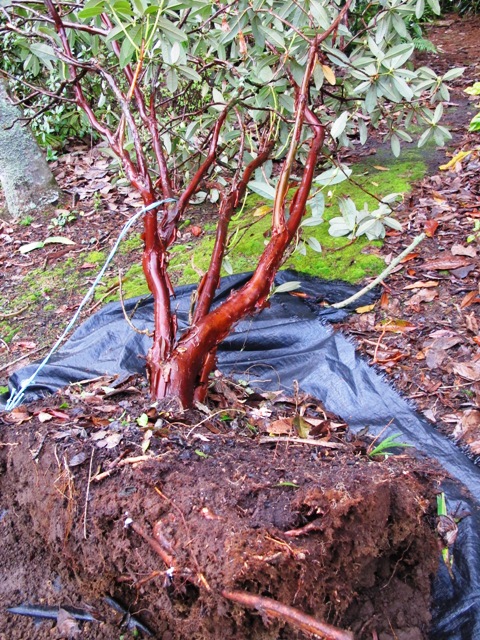
While some plants put down huge, deep root systems, rhododendrons are surface rooting. This means they have a large, fibrous root system close to the surface which makes them relatively easy to move. This plant is getting on for twenty years old. Its root system is over a metre across but only 20 to 30cm deep. It has been moved on a large piece of weedmat to keep the roots and dirt intact. We will prune the top after replanting to compensate for the stress and shock, reducing it by at least 25%. Because it is going into a sheltered position, it should not need staking but it would if it was going into the open because it will take a year or two to anchor itself securely again. Mulching it with compost after planting will protect the roots from drying out and give a gentle feed to the plant.

Now is the time to move large plants so they can settle in before summer. Plants with a tap root – a strong central root which goes straight down into the ground – are usually impossible to move successfully unless they are wrenched well in advance.

First published in the Waikato Times and reprinted here with their permission.
The Winter Garden

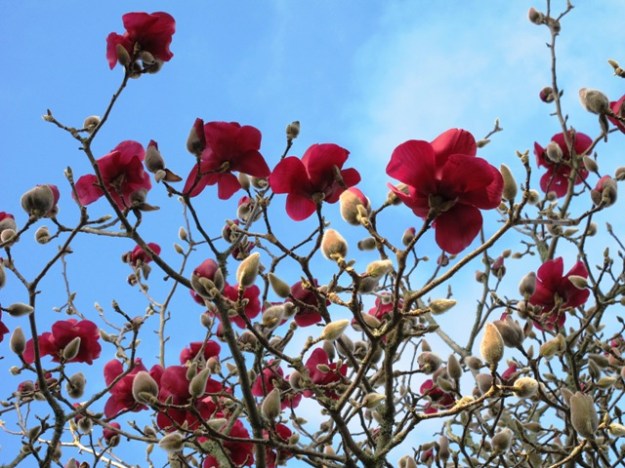
Magnolia Lanarth has a short but glorious season

Magnolia Lanarth has a short but glorious season

I have been away for a couple of weeks. To the tropics, no less, but I need to let the experience percolate in my brain a little longer before I can translate it to anything of relevance for gardeners in our temperate climate.

What amazed me was coming home to our winter garden. When I left in mid July, the earliest magnolias were just showing colour and the first blooms, along with some of the narcissi. By early August, we have trees full of bloom. The garden is awash with scores of tui as the campanulata cherries flower. I briefly thought of writing about plants for winter colour but there is just so much in flower that it would quickly descend to a boring list.

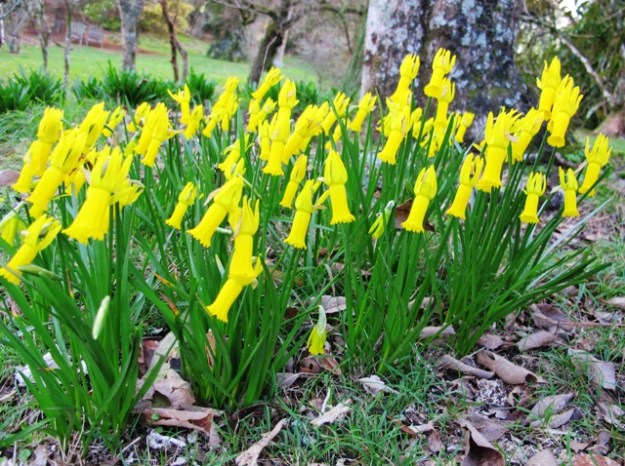
If narcissus could look startled, these cyclamineus  growing in the park certainly do

If narcissus could look startled, these cyclamineus growing in the park certainly do

This is our winter, dear readers. Technically spring does not start until September 1. Gardening is different here to many countries.

If you have looked at British and northern European gardens, there is a long spell in winter when nothing happens. People basically put their gardens to bed and retreat indoors. A heavy dependence on deciduous perennials means that gardens which are full of foliage and bloom in warmer months look dead in winter. The majority of their trees are deciduous so become bare skeletons. It is why the definition of form becomes hugely important because that is all there is to look in the depths of winter. Hardy plants like buxus, yew and conifers give accents which are often the only statement plants in those cold months.

The same is probably true of many inland areas in the world (outside the tropics) where temperatures plummet. My Canberra-resident daughter is always astonished when she comes home in winter to see how lush and colourful we are compared to her arid, hard conditions.

Those who shun deciduous plants miss out on the wonder of plants like Magnolia Vulcan

Those who shun deciduous plants miss out on the wonder of plants like Magnolia Vulcan

For starters, our native plants are all evergreen. So too are most of the ornamental plants we favour in our gardens. Over the years, I have met a swag of customers who point blank refuse to have anything deciduous in their garden, which I think is a bit of a short sighted view. Some of the showiest plants of all are those which go dormant in the colder months and then leap into spectacular display – magnolias, for example. To my mind, there is a place for both evergreen and deciduous plants in gardens.

I do, however, find it curious when I see people unquestioningly grabbing the fundamentals of garden design from other climates without considering the application to our conditions. Most of us like some element of design and definition in our gardens, though there are looser styles which don’t rely on these – meadow, woodland, prairie and food forests are examples. But that definition is not essential to give us something to look at in winter.

Similarly, I am inclined to silently snort when I hear people pontificating that foliage and form are the most important elements in plants because flowers are but transient (or worse, vulgar). I think we should celebrate living in a climate which is so temperate that we can have flowers and seasonal colour twelve months of the year, that we don’t need to put our gardens to bed for winter (or indeed for hot, dry summers) and that the clarity of light and the brightness of the sun seems just as great in July and August as it is in January. We just have shorter daylight hours, lower temperatures and a few more storms.

Being so temperate, few gardeners in this country have conditions where there is a sharp seasonal change. Most of us just drift imperceptibly from one season to the next with flowering extended over longer periods. The mid season camellias are at their peak here – more winter than spring flowering in this country. The snowdrops are passing over, but the dwarf narcissi are flowering all round the place and many of the lachenalias are blooming. Daphne scent hangs heavy in the air. The earliest rhododendrons are blooming already, michelias are opening.

And the magnolias. Do not forget the magnolias. Lanarth has a short but spectacular early season. M. campbellii is at its peak, red Vulcan is opening more flowers every day. The most spectacular time of our gardening year is upon us already, and it is still winter.

I rarely complain about the winter garden here.

While not usually fans of variegated flowers, The Czar var on the back lawn is an exception

While not usually fans of variegated flowers, The Czar var on the back lawn is an exception

First published in the Waikato Times and reprinted here with their permission.