Author Archives: Abbie Jury

Unknown's avatar

About Abbie Jury

jury.co.nz Tikorangi The Jury Garden Taranaki NZ

Food forests – fashion trend or sound option?

Mark's recent directions in the old vegetable garden may unwittingly be well down the food forest track

Mark’s recent directions in the old vegetable garden may unwittingly be well down the food forest track

Food forests. Trendy. That was enough to make us raise our eyebrows and sniff, even more so when we saw a patently absurd attempt on an earlier series of BBC Gardeners’ World to plant a so-called food forest. But we realised that they were in vogue. It was time to have a closer look.

If you are into raised vegetable beds, ultra-tidy gardens, mown lawns and general orderliness, the food forest concept will not appeal. It is not going to be an easy fit for somebody who buys their veg seedlings by the plastic punnet and on the way out, picks up a heavy grade plastic bag of compost. Nor is it overly practical in a tiny back garden.

In its simplest form, the food forest is modelled on the tropical forest and traditional methods of achieving ongoing food production with fewer inputs and less hands-on work. In a forest, you have three layers. The top canopy is the tallest trees (maybe mango, coconut palm, avocado). Beneath that are the mid canopy plants like the banana palms, maybe citrus trees or figs. At ground level are the crops that will grow in semi shade and with root competition – the likes of cassava, yams and physalis. Clambering up the trees are the climbers – think passionfruit.

The whole thing about the tropics is that you get fantastic rates of growth because of the warmth and the moisture. It is a bit different in a colder climate and, to be honest, the more temperate food forests I have looked at on line are somewhat less purist with the layers. That is because, the colder the climate, the more important sun, warmth and light become. We just won’t get the food production without them.
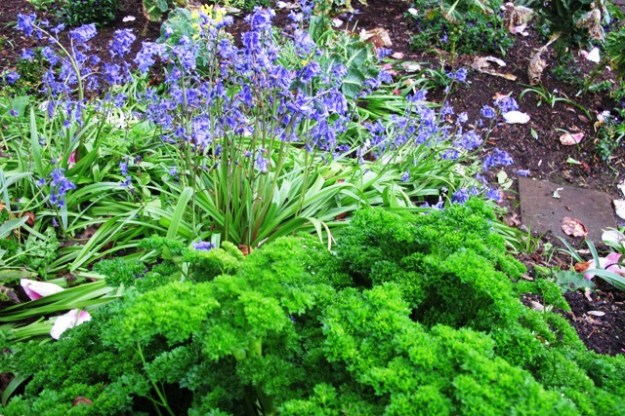
Parsley, bluebells and self-seeding brassicas. Why not?

Parsley, bluebells and self-seeding brassicas. Why not?

The contemporary, temperate food forest appears to be more about building a sustainable ecology. So the top layers of maybe the walnut tree, the pear, the olives and plums get pushed back to the boundary where they become a productive shelter belt, rather than a canopy.

In appearance it may look somewhat chaotic, untidy even, maybe unkempt. Crops are not usually put into tightly managed rows. Garden beds and edgings disappear. Plants are placed where they will grow best and often dotted around in a visually random manner. There is a heavy emphasis on permanent plants and on varieties which will seed down to regenerate themselves. Ornamentals and vegetables are often inter-planted, though the ornamentals will usually be there for a purpose other than aesthetics – maybe to provide food for the bees or the native birds or to contribute as a green crop.

Traditional practices of crop rotation don’t feature in this style of food production. As far as we can see, the range of plants that can be grown also contracts. You are not likely to get marginal crops through. While pumpkins may seed down and adapt, the rock melons probably won’t. Aubergines will want more hands-on management and for much of the country, tomatoes are not going to be a reliable crop in such situations.

But neither will you be working as hard (a good, traditional vegetable garden takes a lot of work and time) and the environment you have created is going to be a great deal sounder ecologically. Maybe those positives make up for any drop in range or volume of produce.

If you like rules and a tightly defined philosophy, look into permaculture. It will give you a great deal more detail. It is a recent movement, founded on principles of sustainable and ecologically sound food production and ways of living. It still sits outside the mainstream as a somewhat fringe movement, even though the driving principles are very hard to fault.

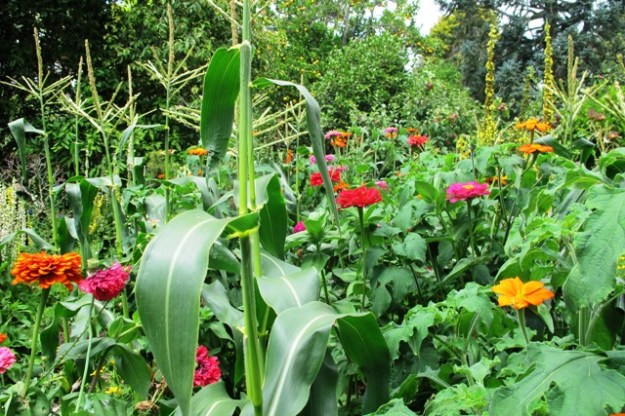
As we talked through the whole food forest concept here and peeled back the layers of romanticism, of philosophical purity, the higher moral ground and the occasional flaky spirituality, we came to the conclusion that Mark’s efforts on the old vegetable garden here probably qualify. He has relocated the pickier crops to his sunny terrace gardens as increasing shade has created problems. There is the top canopy of assorted citrus, a side dressing of espalier apples of venerable vintage (including a Golden Delicious, no less), banana palms, a feijoa. Self seeders include yams, Cape gooseberries and parsley and there is a rich middle layer of plants grown predominantly as butterfly and bee food. Not to forget the sugar cane. It is all a bit chaotic but largely sustainable and very pretty in summer.

Mostly the food forest concept is about finding a balance in producing food and sustaining nature – about not stripping so much goodness from the soil that you have to keep bringing in fertilisers and soil conditioners, about not growing crops that need spraying and intensive care to get a harvest while keeping labour to a minimum.

It is mighty hard to argue against those principles. This might be a garden trend to be considered with an open mind.
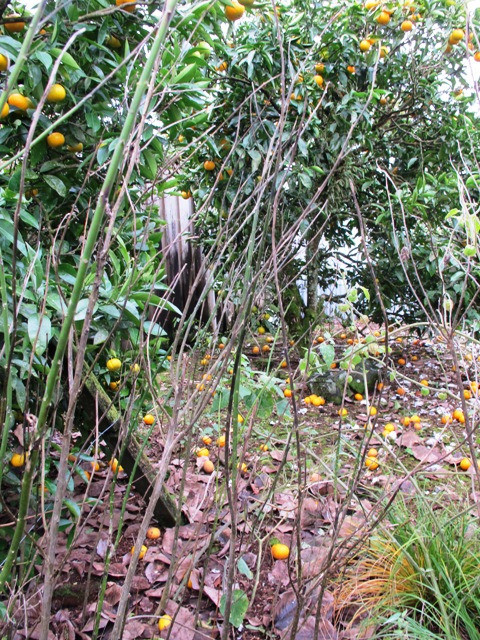
Not such a great view in winter, but what can we expect? Navel orange trees. swan plants (for the monarch butterflies) and physalis

Not such a great view in winter, but what can we expect? Navel orange trees. swan plants (for the monarch butterflies) and physalis

First published in the Waikato Times and reprinted here with their permission.

Plant Collector: Daphne bholua

Daphne bholua - oh the fragrance

Daphne bholua – oh the fragrance

It is a rare plant that can stop you in your tracks from several metres out and have you sniffing the air to locate the source of scent. The Himalayan D. bholua is one of those plants. In our experience it is the strongest and sweetest of any of the daphnes and it has a very long flowering season because it sets buds down its stems. It is also very hardy. That is about the sum total of its merits.

As a garden plant, it becomes leggy, scruffy and untidy with age. It seeds down too freely and suckers around the place so when you think you have dug out one plant, it is just as likely that the suckers will pop up all around to confound you. It is semi deciduous. In cold conditions, it will drop all its leaves. In temperate conditions it drops some and of those it retains, only half look healthy while the other half look as if they are dying. Its natural form is upright but twiggy and untidy. Even the named cultivars we have tried are no better.

But we would not be without it. Oh, that scent. It all comes down to placement. Basically, you need to hide the plants behind something more attractive so you enjoy the scent while not expecting to admire the plant. I cut back and try and shape some of our larger plants from time to time, but it does not make a lot of difference to the overall appearance. You can never have too many fragrant daphnes in a garden and the narrow, upright habit of bholua means those plants are not going to hog too much space.

First printed in the Waikato Times and reprinted here with their permission.
Garden lore

“Of all the ugly things, nothing is worse than the variegated conifer, which usually perishes as soon as all its variegated parts die, the half dead tree often becoming a bush full of wisps of hay.”

William Robinson ,The English Flower Garden (sixth edition, 1898).

Crop rotation

Crop rotation has been followed for many hundreds of years for good reasons. Those medieval agriculturists knew a thing or two when they practiced crop rotation, including a fallow year – one in seven, if my memory serves me right. Planting quick maturing green crops and using compost can remove the need for the fallow year (which was all about returning fertility to the soils). The crop rotation part remains important because if you keep planting the same type of vegetables in the same place every year, you will get a build up of pests and diseases.

There is a wealth of information on crop rotation, but in its simplest form, think about plant families, not individual vegetables. There are the solanums (potatoes, capsicums, aubergines, tomatoes), the brassicas, (cabbage, cauliflower, Brussel sprouts, many of the Asian greens and broccoli), legumes (peas and beans), other leafy greens and beets, alliums (onions and garlic), the carrot, celery and parsley family of Apiaceae (or Umbelliferae), and the cucurbits (pumpkin, cucumber, courgettes, melons).

There are six families above plus a few like sweet corn which don’t fit anywhere. Rotate them round the veg patch every year and you will get a break of several years (minimum of four is desirable) before they end up back in the same spot. That simple process will greatly reduce your need to resort to intervention with sprays and powders.

If it all sounds too complicated, just keep the brassicas and the solanums moving. They are the most vulnerable crops.

First published in the Waikato Times and reprinted here with their permission.
.

Fruit hedges

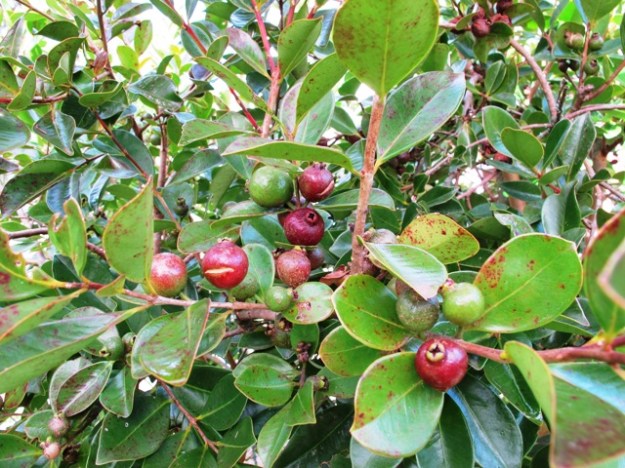
Psidium littorale or strawberry guava

Psidium littorale or strawberry guava

“Write about fruit hedges.” That was a request that had me thinking but good options are not that easy.

You can plant anything in a row and call it a hedge. If you live in the country and it gets tall, it is then called a shelter belt. If it is a double row it becomes an avenue. A grid-planted orchard with social pretensions is a phalanx. If the hedge is comprised of all the same plants and clipped at least once a year, it is a formal hedge. If it is comprised of different fruiting plants it becomes (drum roll), a contemporary food forest. All the rage in some circles, are food forests.

As the enquiry came from a gardener on a very small town section, I think it likely that she wanted the formality of a smaller hedge combined with the function of an edible crop. There aren’t many candidates for that. The problem is that if you clip hard, you will frequently be trimming off next year’s fruiting stems. Added to that, most fruiting plants thrive best with maximum sun, plenty of air movement and away from root competition. That is pretty much the antithesis of a hedging situation.

The other issue is to consider how many of a particular plant you want. It has to be delicious to warrant having a whole hedge line in one fruit though it is more likely that most people chose on criteria of being edible and tolerant of conditions, rather than hugely delectable.

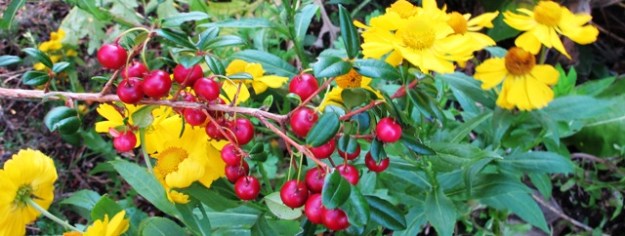
Ugni molinae or NZ cranberry

Ugni molinae or NZ cranberry

If you live way down south, you could probably hedge gooseberries (a bit prickly) or currants but these are not happy or rewarding crops in the more temperate north. Some swear by Ugni molinae (also known as Myrtus ugni, the NZ cranberry or the Chilean guava). I love the sweet little fruit and think every family garden needs a plant. A plant, singular. But as a hedging option, you would have to keep working hard to have it looking good. It is a bit sparse and twiggy and is prone to infestation from thrips.

The other guava (Psidium littorale, also known as the Chilean guava or the strawberry guava) is probably the single best evergreen, fruiting option we can think of for hedging. It is a lot more forgiving when it comes to clipping and pruning and could be kept to a tidy hedge below 200cm. The problem with it is that you want to grow one (or maybe two – a red one and a yellow one) to feed browsing children, attract kereru which love the fruit, and to make the odd jar of jelly. But few of us would think they are sufficiently delicious to want a whole row of them.

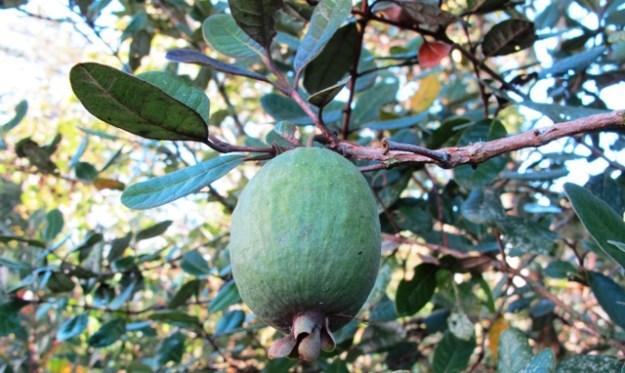
The ubiquitous feijoa

The ubiquitous feijoa

Feijoas, I hear some of you saying. Yes, feijoas make an excellent hedge but if you keep them well clipped you will be cutting off next year’s fruiting stems. These are plants which are best grown with plenty of space, just given the occasional light thinning or pruning and left to their own devices. That is not hedging. When our children were small, we owned a property with a row of four mature feijoas. They ripened in succession so we had fruit for months and the children would head outside with a teaspoon each in their little hands and sit beneath, scooping out the pulp to eat. They also occupied a space that probably measured close to 10 metres by 4 metres. As a productive road boundary planting, they were great. But a hedge, they were not.

If you follow English garden trends, you may have seen step-over espaliers. They appear to be a hot ticket addition. Generally apples or pears, these are beaten into submission by training along wires at knee height. Being deciduous trees, there will be no winter foliage but apparently you can get a worthwhile crop if you manage it right and you can ring your productive garden with these step-overs which therefore function as a type of hedge.

Do we think this is a good idea? Not really. For starters, the fruit is going to be at just the right height for the dog to cock its leg and pee on it. Or the neighbour’s dog, if you don’t have one. It is also a dry climate technique. With the relatively heavy rains most of us experience in the mid north, soil splash is a problem and will spread disease. Good air circulation, full sun and being above the splash zone will reduce problems. We are certainly not rushing into trying step-over espaliers.

In the end, fruit trees are probably most productive and healthy when grown as individual specimens. Fruiting hedges? Not such a practical option, in the greater scheme of things.

First published in the Waikato Times and reprinted here with their permission.
Plant Collector: Galanthus S Arnott

What can be prettier than snowdrops in the depths of winter?

What can be prettier than snowdrops in the depths of winter?

Are there any bulbs more charming than proper English snowdrops? Except that they are not English at all, having been introduced from Europe where they have a wide distribution. I had thought they were called ‘snowdrops’ because they often peek through snow (a light covering, I assume because they only grow about 15 to 20cm high) to herald the coming of spring, but I see the botanical name translates from Greek as milk flower. Because we lack the chilly temperatures and snow here, we are limited in the range of galanthus that we can grow well. There is such a word as a “galanthophile” – one who is obsessed with the genus but you would have a hard job earning that epithet here in the mid north. Easily the best performing snowdrop for us is Galanthus S. Arnott which never fails to delight and increases satisfyingly well. We keep gently increasing its spread around the garden and that also staggers the flowering because it will come in later in colder parts.

You don’t get a long flowering season but oh they are so very charming. The proper snowdrop has a little inner trumpet of three petals surrounded by a skirt of three outer petals which look like little wings. Sometimes people refer to the stronger growing snowflake, often seen in paddocks, as a snowdrop. But it is not. It only has the inner trumpet of petals and lacks the delicate charm. It is also a different genus, being a leucojum.

First published in the Waikato Times and reprinted here with their permission.