Category Archives: Abbie’s column

Abbie’s newspaper columns

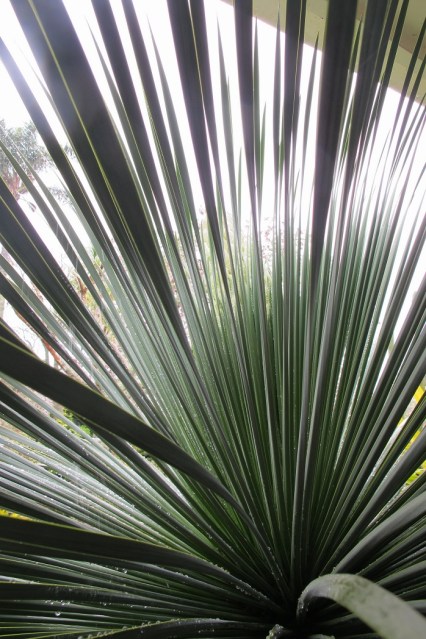
The saga of Yucca whipplei

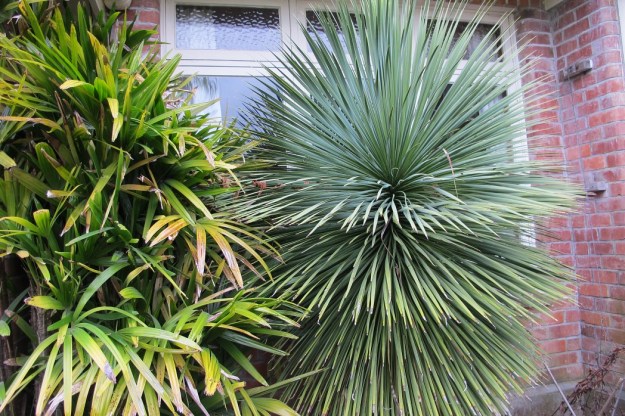
Yucca whipplei did at least give total privacy from garden visitors when sitting indoors

Yucca whipplei did at least give total privacy from garden visitors when sitting indoors

It was a bit of a milestone here last week as we completed the task of Moving Yucca Whipplei. This has been such a long story that I even have a folder of photos on my computer devoted to the move. When we planted the yucca in the narrow border by the house getting on for 30 years ago (I am pretty sure Felix was still alive at the time), I guess we figured it would be a tidy mound of grey foliage in that difficult dry border. Obviously neither Mark nor I looked it up and this would have been prior to the age when it was easy to do a quick net search.

But Yucca whipplei grew. And grew until it blocked almost the entire window of our TV room. While not as fiercely prickly as some members of the yucca family, it was not a plant with which you would want to tangle. I stopped cleaning the outside of that set of windows. A few years ago I declared I wanted it gone, which to Mark meant it had to be moved, not destroyed.

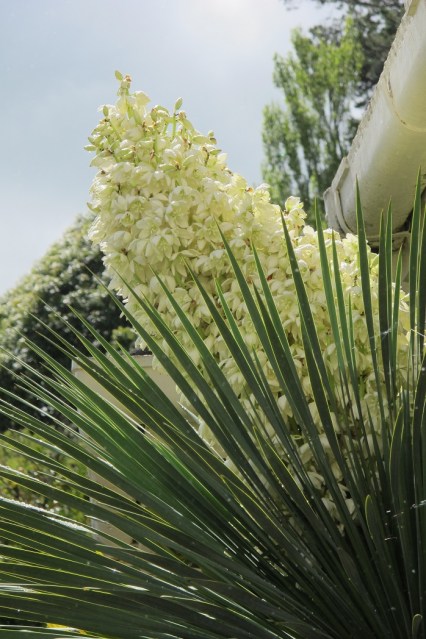
After more than 25 years, it flowered

After more than 25 years, it flowered

005Our ever handy man on the spot, Lloyd, cut back the concrete in anticipation of the move. That was on June 14, 2012. But time passed and other jobs always seemed more urgent. Towards the end of 2014, we spotted a flower spike forming. That was pretty exciting, given that the plant was over 25 years old and had never bloomed before. Moving it was out of the question.

The flower was a delight. Spectacular, even, as it grew ever bigger – reaching past the roof on the lower storey of the house. The flower passed and still the yucca remained.

Peaking above the roof on the first storey

Peaking above the roof on the first storey

Come September last year, the men were coming to install double glazing on that window so the main spike was cut down and removed. This was no mean feat. Mark had hoped he could chainsaw it off but the leaves just chewed up and choked the chainsaw. There was no alternative to clippers and a hand saw.

Removing the main stem last year

Removing the main stem last year

The remaining stump sprouted most enthusiastically and this year, I created the ideal spot out of the way on a sunny hillside where it could be relocated to its forever home. Fortunately, a yucca is not like a tree where the root system is critical but even so, it was a fairly major exercise to dig it out and then lift it away. It is now safely planted well away from any windows and we hope to see it flourish. The hot, sunny, protected position left vacant outside our TV room windows is destined to be the new home for a frangipani that has been waiting in the wings (which is to say, in Mark’s covered house). We are extremely marginal for a frangipani, but I have my fingers crossed.

The final removal was no small task and involved two men, a tractor and a heavy chain

The final removal was no small task and involved two men, a tractor and a heavy chain

I see I wrote in October last year: “As far as we know, this is Yucca whipplei, also known as Hesperoyucca whipplei, chaparral yucca, Our Lord’s candle, Spanish bayonet, Quixote yucca or foothill yucca. So Wikipedia tells me. Apparently the most common name is Our Lord’s candle. It being native to southern America from California through to Mexico, it clearly felt right at home in the bone dry conditions of the house border beneath the eaves.”

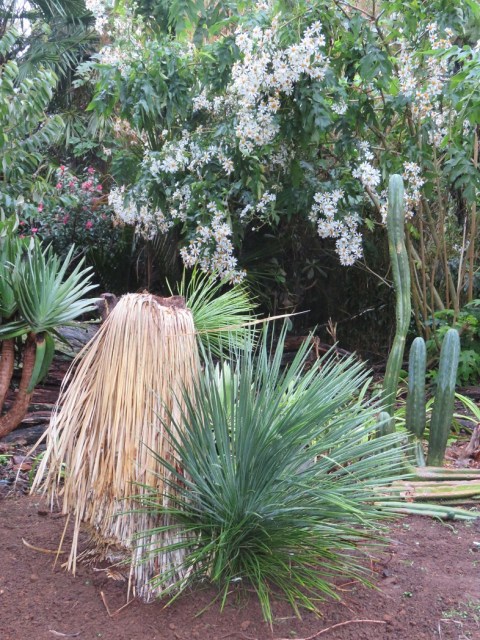
Yuccan whipplei in its 'forever home"

Yuccan whipplei in its ‘forever home”

That chapter has closed. Our Lord’s candle is set to burn with renewed vigour over on the sunny hillside.

009

The Golden Camellias of China and Vietnam

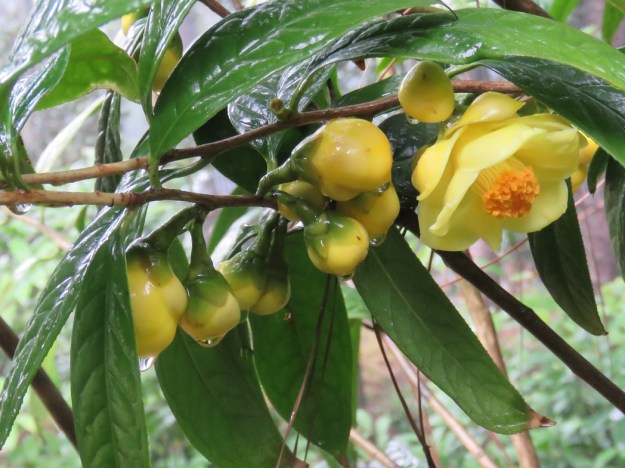
It was raining at Foshan Institute of Forestry Science where they have extensive plantings of yellow species, mainly C. nitidissima. It is thought that the flowers face downwards and are nestled beneath the foliage to protect them from the heavy raindrops they would receive in their forest habitat.

It was raining at Foshan Institute of Forestry Science where they have extensive plantings of yellow species, mainly C. nitidissima. It is thought that the flowers face downwards and are nestled beneath the foliage to protect them from the heavy raindrops they would receive in their forest habitat.

There was a fine specimen of C. nitidissima in the Confucian temple gardens in Dali. The heavy textured buds look more like hanging fruit than emerging flowers. Our plant at Tikorangi has never bloomed this freely.

There was a fine specimen of C. nitidissima in the Confucian temple gardens in Dali. The heavy textured buds look more like hanging fruit than emerging flowers. Our plant at Tikorangi has never bloomed this freely.

While we talk about yellow camellias, in China they refer to golden camellias, often in tones of reverence and awe.

Camellia Jury's Yellow on the honours table at the national camellia show in Dali

Camellia Jury’s Yellow on the honours table at the national camellia show in Dali

By the time Mark Jury (yes, my Mark) started breeding camellias, his renowned camellia-breeding uncle, Les Jury, was quite elderly and happy to share his experience and goals. It seems remarkable that 45 years after he first registered ‘Jury’s Yellow’, it is still widely grown and sold and we even saw it on the honours table at the National Camellia Show in China in February. ‘Gwenneth Morey’ and ‘Brushfield’s Yellow’ are Australian camellias of that era also heading down the yellow camellia path, but it seems that Les’s version is the one with staying power.

None of these breeders of the 1960s and 70s had access to yellow species. They would not even have known of their existence, but always there is that quest to extend the colour range. Les explained to Mark that he thought it might be possible to get the golden stamens to bleed colour into the petaloids (the tiny petals that comprise the centre of an anemone-formed camellia). It worked. These early three yellows all have pale lemon coloured centres with the outer circles of petals remaining white. They were colour breaks in their time but they all originated from white japonicas. The trouble was that there really was nowhere else to go from there, in breeding terms, to try and intensify the yellow.

Enter the yellow species. Even I can remember the waves of excitement in the camellia world when C. chrysantha became available. Suddenly it appeared that there would be a huge range of new directions in camellias. Don’t hold your breath. It ain’t that easy and it is not for want of trying. After maybe fifty years and probably hundreds of thousands of crosses, there haven’t been many encouraging results out of China. Japanese breeders have been very active without many results and we have never heard of anything coming from other international breeders.

The Best in Show award went to a yellow hybrid
The Best in Show award went to a yellow hybrid

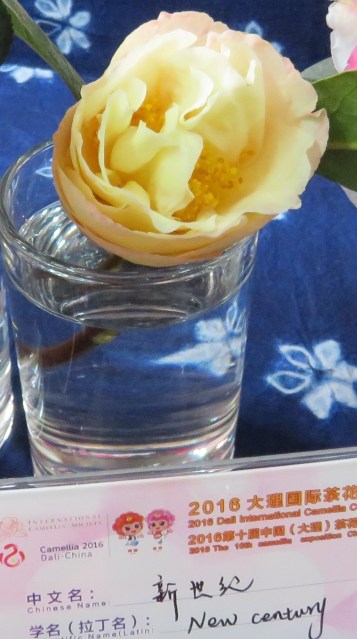
‘New Century’ shows good colour but it was not possible to tell if the bloom opens more than this specimen in the show

‘New Century’ shows good colour but it was not possible to tell if the bloom opens more than this specimen in the show

True, the Best in Show award at the Chinese nationals went to a fine yellow hybrid and there was another promising yellow coloured bloom called ‘New Century’ on the table. But those are cut flowers looked at in isolation. There are many other factors to be taken into account to determine garden worthiness. We also saw a few other results from breeding programmes – one flushed palest yellow with pink on the outer petals. It was a hybrid but not of great note. Others just seemed to throw to the japonica parentage. Kunming camellia breeder, Shen Yunguang, said that she was crossing the yellows with a white japonica – the latter will be to get greater size and floriferous characteristics – but the yellow species do not appear to be keen to cross with other types.
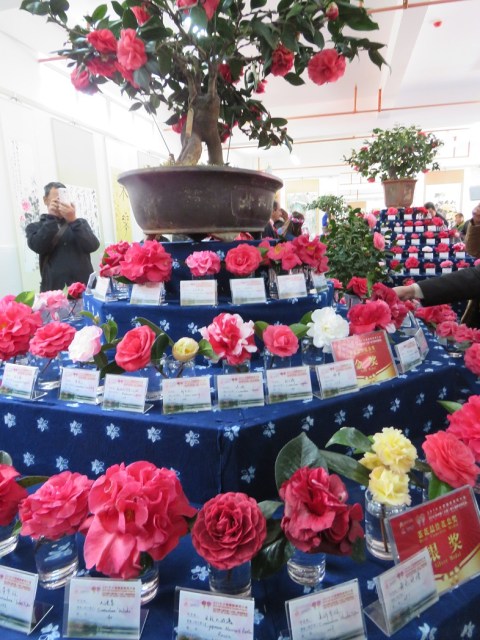
The Chinese national camellia show was staged in a temple in the heart of Dali Old Town. The yellow cultivars stood out amongst the more usual pinks, reds and whites

The Chinese national camellia show was staged in a temple in the heart of Dali Old Town. The yellow cultivars stood out amongst the more usual pinks, reds and whites

If it is possible to get a range of good yellow hybrids, the Chinese will do it but I doubt that it is imminent. What about orange ones? Can the next generation look forward to yellow camellias being crossed with red ones, to give a new colour altogether? International yellow camellia expert, Dr George Orel is pretty sure it can’t happen because of the incompatible genetic codes between the yellows and the reds. I am sure it is not for want of trying but the yellows are notoriously difficult in hybridising.

I asked Mark if he saw breeding potential in the new species that are still being discovered. He shrugged his shoulders and said, from his point of view, no. They are tropical, too tropical for New Zealand. He is also realistic enough to know that if the Chinese and major international breeders from other countries have found them hugely difficult to cross with other camellias, it will be a fluke if a minor breeder in another part of the world comes up with something worthwhile. It is just as well he doesn’t want the newly discovered species because with our closed borders, bringing in a new species of anything is devilishly expensive and difficult.

Camellia nitidissima (or chrysantha) – the one good flowering we have had on our plant in 2011

Camellia nitidissima (or chrysantha) – the one good flowering we have had on our plant in 2011

Chrysantha or nitidissima?
The most common yellow species in the west and, I understand, the one widely used for flower tea in China was originally distributed under the name of Camellia chrysantha. It is now more usually named as C. nitidissima syn chrysantha – in other words, you can use either name but nitidissima has precedence. We bought it from Neville Haydon at Camellia Haven as soon as it became available. It has handsome bullate foliage – heavily veined and textured leaves – but in all the years since we have had it, I think it has only flowered well once. It wasn’t helped by a pear tree falling upon it but it has reached quite a large size and is now at least 20 years old, if not more. The other yellow species we have here have never bloomed. This is not to say that they won’t bloom in other parts of the country, at least further north.

Collectors’ plants vs good garden plants
The yellow species are what I would call collectors’ plants – really interesting to have and exciting when they flower. But good garden plants? Not so much. All the species I saw had small flowers and not that many of them at any one time. The flowers usually face downwards and are on the underside of the branches. They are also quite picky about growing conditions and many were sparse in foliage. A good garden plant is a reliable performer that will delight your average home gardener and, with camellias, that means a reasonably long season of mass blooming. This is why there is so much interest in creating good hybrids. If you want to grow any of the yellow species, remember that these are understory plants of the forest, growing in humus-rich soils. They need overhead shade but also sufficient light to enable them to set flower buds.
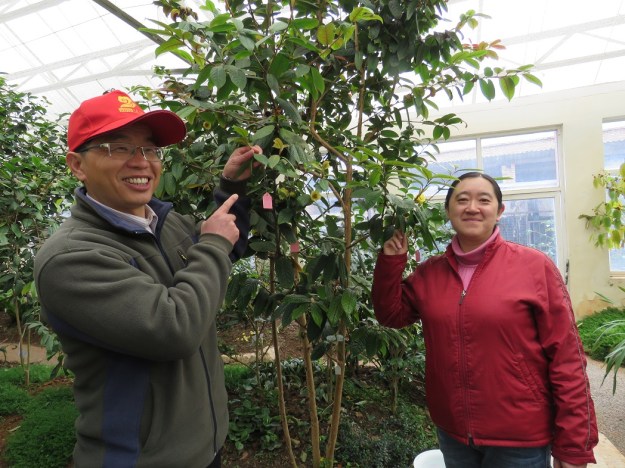
Shen Yunguang is responsible for managing the covered house that contains the yellow camellia species at Kunming Botanic Gardens, where it is too cold to grow them outdoors. While it appears more usual to use the yellow species as the pollen donor, she is also trying to cross using them as seed setter. The hanging pink labels mark her crosses. To the left is Professor Wang Zhonglang from Kunming Botanical Institute

Shen Yunguang is responsible for managing the covered house that contains the yellow camellia species at Kunming Botanic Gardens, where it is too cold to grow them outdoors. While it appears more usual to use the yellow species as the pollen donor, she is also trying to cross using them as seed setter. The hanging pink labels mark her crosses. To the left is Professor Wang Zhonglang from Kunming Botanical Institute

C. chuongtsoensis (photo by Tony Barnes)

C. chuongtsoensis (photo by Tony Barnes)

C. longzhouensis (photo by Tony Barnes)

C. longzhouensis (photo by Tony Barnes)

C. impressinervis (photo by Tony Barnes)

C. impressinervis (photo by Tony Barnes)

Camellia nitidissima was first described and named in 1948. In 1960, a wild population was found growing near the southern border of China with Vietnam and it was named C. chrysantha (hence the two names). It wasn’t until the 1980s that the west realised there was a yellow camellia species and it remains the only one commercially available in any significant numbers.
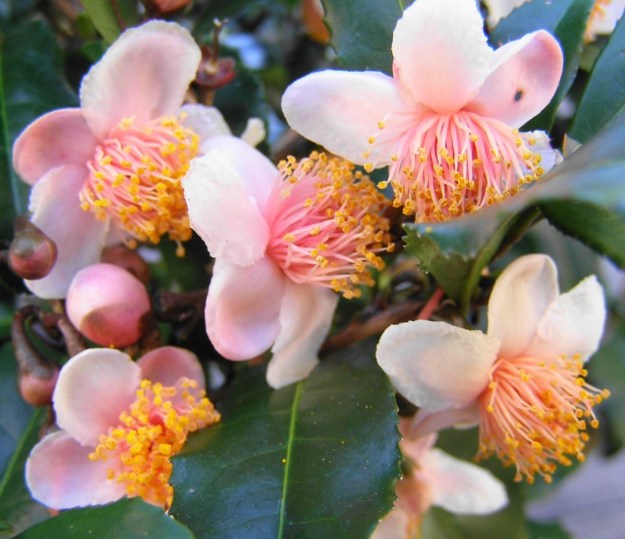
However, since the 1980s, there has been an explosion of interest in yellow species and modern day plant explorers are continuing to find new ones, particularly in Vietnam. It is a fluid situation. There appear to be anything between 28 and 60 different yellow species. It is likely that some will be reclassified as variants on existing species while new ones will continue to be identified. There are at least six notable public collections of yellow camellias in Chinese institutions. I visited the one at Kunming Botanic Gardens where they are grown under cover. We also saw extensive outdoor plantings in Foshan near Guangzhou. The differences in flower form between species are not great to the untrained eye. All appear to have small blooms around 4cm across, usually semi double (two rows of petals) with a large boss of golden stamens in the centre. The heavy substance of the petals is remarkable, making them look waxed and solid.

 Tea made from the golden flowers was served to us on a number of occasions and is very pretty


Tea made from the golden flowers was served to us on a number of occasions and is very pretty

Drying the flowers and buds for tea in Foshan

Drying the flowers and buds for tea in Foshan

When we talk about new species being discovered, we should remind ourselves that this is being discovered by botanists. Local residents will have known about these plants throughout history. Tea made from the golden camellia flowers is widely served on ceremonial occasions and is now a commercial venture. It seems unlikely it only dates back to the 1980s.

What does golden camellia tea taste like, you may wonder. Subtle, is all I can say. Beautiful to look at, with a subtle floral aroma and taste.
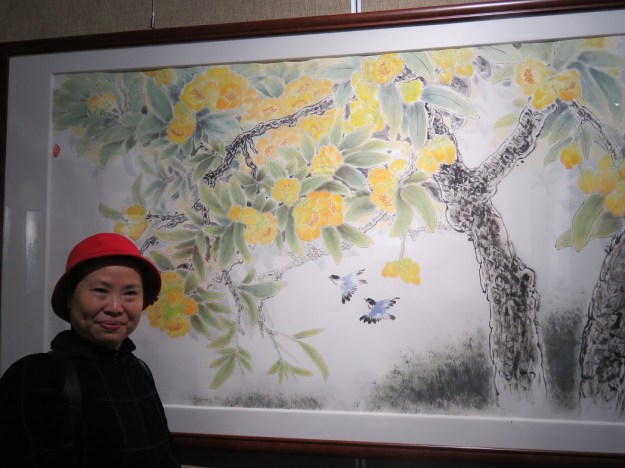
Artist Xinger Li with her lovely painting titled (in English) ‘Chinese Camellia with Dense Dew”
Artist Xinger Li with her lovely painting titled (in English) ‘Chinese Camellia with Dense Dew”

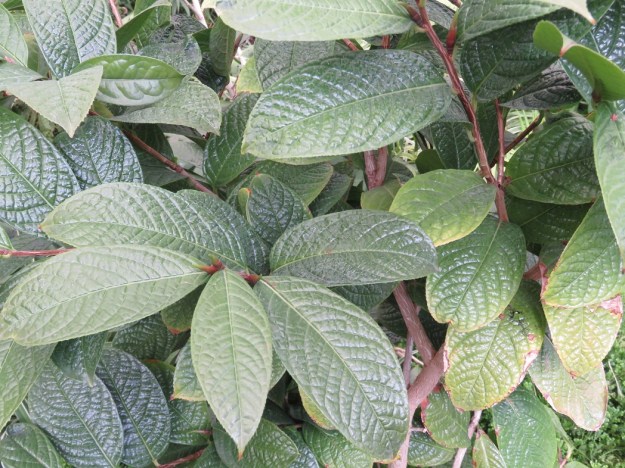
 The foliage on C. impressinervis, as on C. nitidissima and some of the other species, is heavily veined and textured (called bullate)

The foliage on C. impressinervis, as on C. nitidissima and some of the other species, is heavily veined and textured (called bullate)

First published in New Zealand Gardener and reprinted here with their permission. 

Stop press: one of our other yellow species in the garden here has set flower buds for the first time, after maybe fifteen or twenty years. We will be watching it closely and now we just have to try and unravel which species it is. The label has long since gone. 
Camellia stars

China (4)

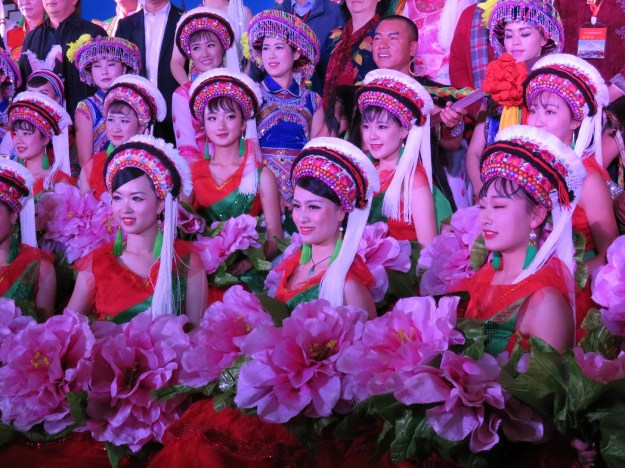
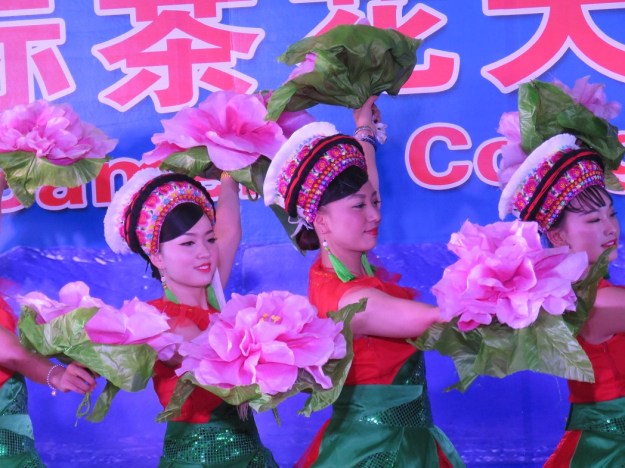
Camellia heartland in Dali with cultural performances. The dancing girls are holding oversized camellias


It is looking as if this is to be the year of the camellia for us. We went to China in February, to join the International Camellia Society’s biennial congress and it has been non-stop camellias since.

Camellia High Fragrance  (photo by Tony Barnes)

Camellia High Fragrance (photo by Tony Barnes)

While the congress in Dali was wall to wall reticulatas (more on these in my August NZ Gardener column), one New Zealand cultivar has made inroads to the heady world of Chinese camellias where they otherwise show complete loyalty to their own. The late Jim Findlay from Whangarei spent many years working on scented camellias and it would not be exaggerating to say that his ‘High Fragrance’ is a sensation in China – regarded with reverence, even. It is a shame Jim is not still around to enjoy the accolades and honour from the home of camellias.

Dali prides itself on being camellia heartland.  Even aside from the colourful displays and ceremonies associated with hosting what was seen as a highly prestigious congress, it was clear that the camellia is a cultural icon unmatched by anything I can think of in New Zealand, except perhaps rugby. It was celebrated in song, dance, art, branding, decoration and, above all else, in plants by the thousand, nay, tens of thousands, grown in containers and displayed everywhere.

Pink form of C. sinensis

Pink form of C. sinensis

Travelling across hemispheres, we arrived home in early March to find our earliest camellias already in bloom. C. sinensis is the proper tea camellia and one form we have has the daintiest and earliest little pink blooms. It is, of course, primarily grown for its young foliage which we sometimes harvest for the freshest green tea experience possible. Lightly crushing the leaves and leaving them to ferment overnight in a warm place gives a stronger flavour, reminiscent even of our favoured Earl Grey. Inspired by our Chinese experience, I am determined to be more organised and consistent in harvesting the foliage in spring this year though we are not going to reach self sufficiency.

Camellia brevistyla

Camellia brevistyla

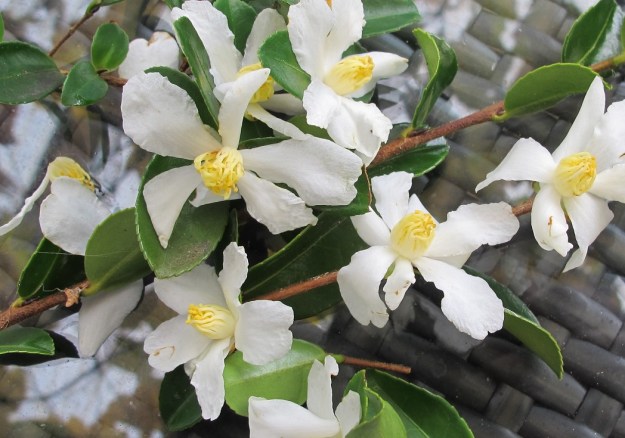
The other very early bloomer for us is Camellia brevistyla, with its dainty white flowers. It is a bit ephemeral with its flowering season (the extremely similar C. microphylla lasts longer) but its small leafed, compact form lends it to clipping so we are happy to let it keep its little space in the garden.
sasanqua camellias (2)

Sasanqua camellias in autumn

By mid May and into June, it is the sasanqua camellias that take centre stage as the dominant flowering shrubs in the garden. Most of the sasanqua species originated in Japan and in the camellia heydays through to the early 1990s, they were often seen as the utility relative – good for hedging and sun tolerant but lacking the substance and flower form that were prized in the japonicas and hybrids. Fashions change with time and these days I really like the softer flower form and the smaller foliage which is usually a good dark green colour and ideal for clipping and shaping. Also, the early bloomers of the season lift the spirits on grey days of late autumn going into winter.

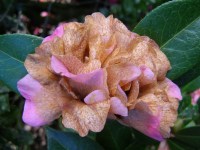
Camellia petal blight

Camellia petal blight

The other huge bonus of the sasanquas  is that they do not get petal blight which has cut the display of later flowering types. The ravages of petal blight (technically Ciborinia camelliae) have been a huge disappointment to us and pretty much stopped the inter-generational Jury camellia breeding programme in mid stride. It was particularly interesting in China to see blight and discuss it with professionals from other countries. Australia is still free from it (a good argument for tight border control), but Asia, Europe and the USA are all afflicted.

I spoke to an Italian researcher who gave hope. They have found a biological cure (another fungus, in fact) which is working well in laboratory conditions but not yet in the field (or garden). Maybe over time, there is light at the end of the blighted tunnel. In the meantime, what struck us was that while we saw it through the areas of China we visited and discussed it with Europeans, it was nowhere near as bad as we get here at home. Mark ruefully commented that maybe we have the worst blight in the world. While our coastal Taranaki winters are mild and we get bright sun, we also get a lot of rain and high humidity – optimum conditions for anything fungal, really. China was dry. Maybe gardeners in dry parts of New Zealand like Hawkes Bay and Central Otago are correspondingly less affected?

Camellias continue to play a valued role in our garden but the nature of that role has changed in response to  wretched blight.

IMG_2845First published in the June issue of NZ Gardener and reprinted here with their permission. 
China (3)

The Final Postcards of China – a land of contrast

I guess every country is a land of contrast but it seemed even more so in China. Maybe the larger the country and the more diverse its history, the greater the contrasts?

Take these two – the man in a working village (as opposed to the tourist village experience), was making traditional brooms. Mark looked at the photo and commented that they may very well be one of the most efficient brooms around and we should maybe have brought one or two home with us. I am sure he was referring to bringing home brooms and not the very modern young woman with the selfie stick who was completely absorbed in her own imagery.

The hotel display of mandarins and bedding plants (there appeared to be an unwritten understanding that helping oneself to a mandarin in passing would be Very Poor Form) was notable for its unabashed vulgarity. We anticipated a display of great exuberance at the National Orchid Exhibition in Dali but instead it was marked by the most exquisite refinement and restraint. There were plenty of colourful cymbidiums in bloom at the time but clearly this orchid show was not the place for them.

The contemporary sculpture was in the Xishuangbanna botanic gardens – a worthy commemoration of recent history, styled on heroic lines?  The wall painting is typical of the domestic decoration seen in Bai Villages around Dali and probably dates back a long time.

I loved the wall painting, both external and internal, on the Bai houses. So evocative of classical Chinese art. I photographed this one inside a private house that welcomed us in Longxiadeng Village. The contrast to the modern hotel in Jinghong could not be more extreme. This was only a four star hotel, for goodness sake, though considerably better appointed than the modest hostelries Mark and I usually choose when travelling on our own.

China is renowned for the amount of litter and rubbish but the urban areas seem to be heavily endowed with street cleaners doing it the old fashioned way – and very effectively too. The city areas we frequented were cleaner than New Zealand cities. Sure, there was plenty of litter in the countryside but as we regularly pick up litter from our own roadsides, we are not at all convinced that New Zealanders are any better with rubbish – there are just fewer of us to litter. I was interested in the juxtaposition of the street cleaner with the ultra modern architecture of Foshan, a city just outside Guangzhou. We were told Foshan had been almost entirely rebuilt in very recent times and it was hard to spot anything that may have existed prior to the recent construction and development frenzy.

The three pagodas in Dali are old, very old. The front one dates back to the ninth century, the other two are newer by 100 years. When you come from the so-called New World, it is hard to comprehend the age and the respect conferred on these religious icons down the centuries.

The new buildings are by the Mekong River in Jinghong City – another symbol of modern Chinese affluence and development. The slowdown in the Chinese economy that is having a major effect on other economies around the world was evident. We saw many major new projects where work appeared to have halted in mid flight.

On the left we have a Dai village where it appeared that life was continuing in a pretty traditional manner. This was an unscheduled stop at a village off the tourist trail and was all the more interesting for that. Our translator told us that this was an official census being taken of all the residents. On the right is Bai hospitality in Longxiadeng Village which has tapped into the huge tourist market in the Dali area. It was a very polished operation at the most local level – full of colour, courtesy and friendliness but nowhere near as personal. They are clearly set up to deal with large numbers of visitors and to ensure that a quality experience is provided.

What can I say about the left image? That must be Confucius in the background. The scene is at the Confucian Temple in the very heart of Dali, where the National Camellia Show was staged. There was a magnificent display of bonsais, including some astoundingly old camellia plants being reinvented as bonsai specimens. To be honest, I am not at all sure what the lady in purple was there for – simply temporary decoration, I guess. The golden spades were lined up for an official camellia planting ceremony in Yu Er Park. Mark spends some time linseed oiling tool handles at home and at times he crafts new handles from scratch so the timber handles caught his eye. Closer inspection revealed that they are coated in woodgrain stickon plastic similar to kitchen drawer lining. It was all about the look for this ceremony.

On the Baotai Mount in Yongping at the forest administration station, the facilities were geared to the local market and a pretty astounding number of people turned out to witness the ceremonies on the day we were welcomed there to unveil a stone monument, enjoy lunch and walk amongst the wild reticulata camellia forest. There were times I felt that we were the exhibit, as much as the camellias, but always we were treated with great courtesy and kindness.

On the right is one view of the magnificent new glasshouse at Kunming. It has not yet been fully completed and opened but it is pretty amazing. It appeared they were giving the new glasshouse at Wisley in the UK a run for their money in the Grand Glasshouse Stakes. We were surprised how cold Kunming was, having understood it to have a similar climate to ours at home. Certainly the spring had been unusually cold, but it was clear that they have much colder winters than we have, though dry. Our winters are neither particularly cold nor at all dry but we grow many plants from this area of China.

The old and the new in Xizhou Old Town, snapped in a moment of time (which is why it is a little fuzzy). The gentleman on the right appeared to be at home there – not a visitor – though he greeted us in English as he strode purposely on. He was one of the very few Western faces we saw not attached to our group. Visiting the areas we went to was a total immersion experience.

The fence on the right had me briefly fooled. From a distance, I thought it was a beautiful example of an old technique using tree branches. No. It is actually a fine example of what you can do with concrete. The shade of green new paint is a bit of a giveaway but I imagine it may age quite gracefully.

021

A Red Letter Day

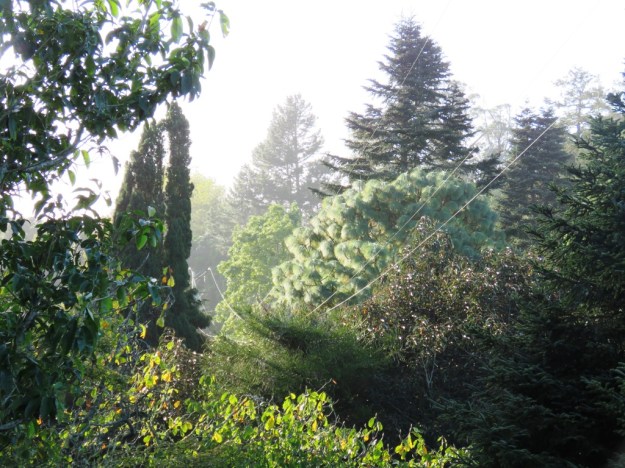
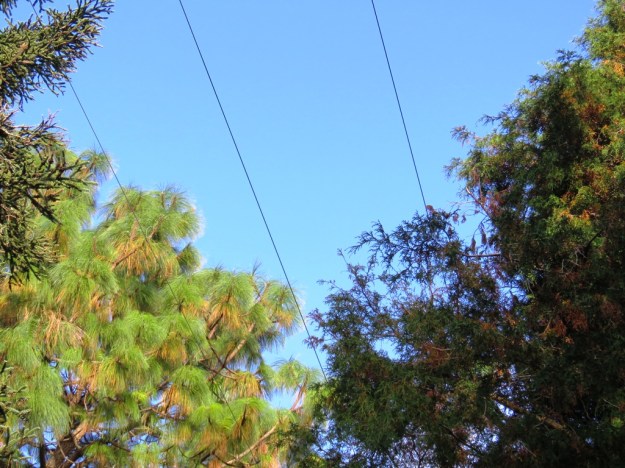
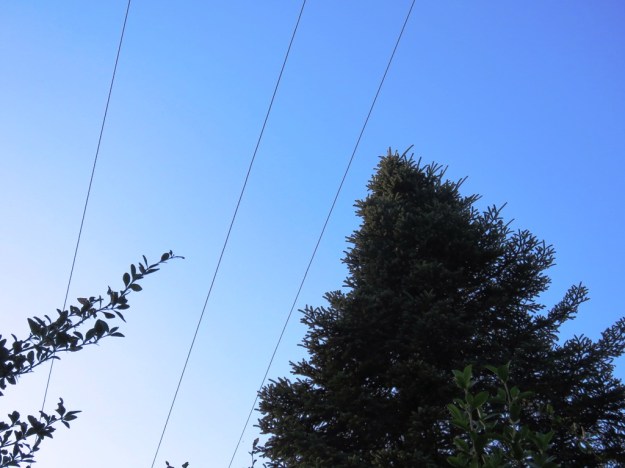
The wretched power lines draped across our park

The wretched power lines draped across our park

Yesterday was a red letter day here. The electricity lines that crossed over the area we call the park were removed. Those lines had nothing to do with us. Our power comes from another line. Back when electricity was first laid on for the district, the publicly owned supplier took a shortcut across our property with a very long span between poles. When there is a long span, the lines get far more of a sway on them. In the decades since, the lines were sold to a private company and our trees grew. And grew. Most of the problem trees were planted by Mark’s father, Felix, who seriously miscalculated how tall they would grow but left the problem to the next generation.

Mark had been getting increasingly anxious about the trees and the power lines. Some trees, like the magnolias, could have branches removed without destroying the tree but we are talking about the upper reaches of an extension ladder to access those branches.

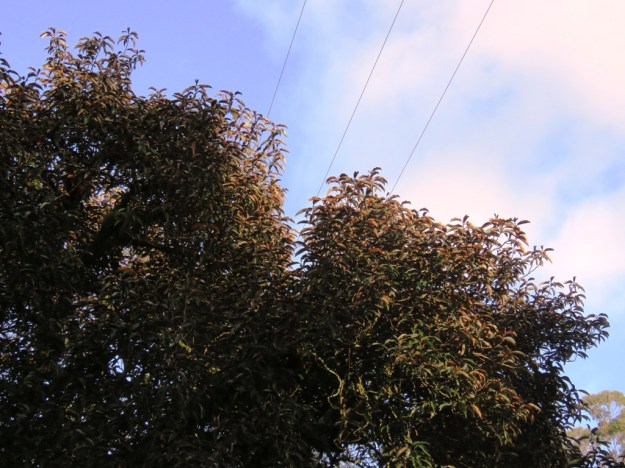
Michelia doltsopa 'Rusty' reaching into the wires

Michelia doltsopa ‘Rusty’ reaching into the wires

Even Magnolia doltsopa ‘Rusty’, though planted on the lowest point, was into the wires. This is a grand specimen and we were reluctant to start interfering with its magnificent stature.  I see I calculated in the past that ‘Rusty’ takes up around 300 square metres of ground area, growing from a single central leader. It can now attain its potential mature size and height.

Pinus montezumae has had a reprieve from its death sentence

Pinus montezumae has had a reprieve from its death sentence

More problematic were the conifers. It is not possible to take the central leader out of a conifer and keep a good tree. Indeed, Pinus montezumae was going to have to be removed entirely. Then there were the next trees just out from the lines but at risk of downing them should they fall. The handsome metasequoia or dawn redwood is about 30 metres high but still a juvenile at only 65 years or so. We were always worried that its grip on the ground may not be that good and, should it fall the wrong way, it would bring down the wires. Indeed, the wires have been brought down twice in our time here – both times by falling poplars that were planted long before electricity lines were strung through the area.

IMG_8367But no more. Yesterday the lines were removed as part of an upgrade on that particular section. We could not be more delighted. And relieved. At least some of the trees should now be free to grow to their maximum size and maturity long past our lifetime.
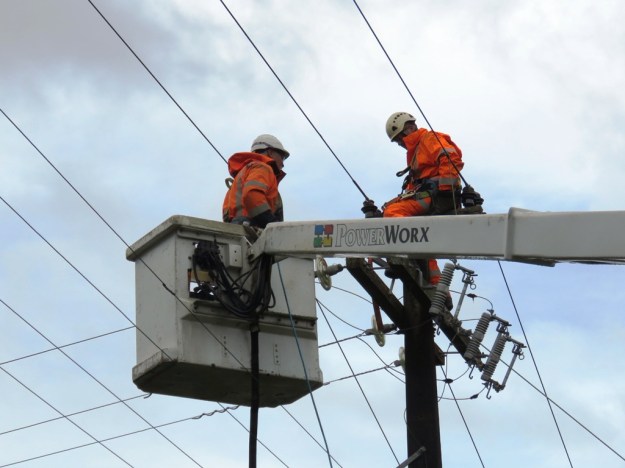
Dropping the lines yesterday

Dropping the lines yesterday