Category Archives: Abbie’s column

Abbie’s newspaper columns

The answer, as they say, lies in the soil

What is visible above ground is entirely dependent on what is happening below

What is visible above ground is entirely dependent on what is happening below

A reader took me to task for last week’s column, objecting to my careless use of dirt as a synonym for soil. I would argue that “dirt” is merely the vernacular and in no way demeans the gravitas of soil, but it did get me thinking about the natural growing medium beneath our feet. I also found a wonderful throwaway comment in the same book that gave this week’s gardening quote – The Curious Gardener’s Almanac.

Following on from the old adage of “look after the soil and the soil will look after the plants” was a variation on the theme: “Feed the soil, not the plants”. Yes, I thought. That was a message that spoke to me. We swim against the modern tide and rarely use garden fertiliser here, preferring instead to rely on home-made compost.

Garden soil must be the least sexy and interesting part of gardening for the novice. Yet every single experienced gardener, without exception, will tell you that the state of your garden soil is critical to the end result with the plants. It is just that the plants are a lot more interesting so beginner gardeners start with them. There can be an awful lot of fatalities before they work out that the state of the soil may need some serious attention.

The current craze for no-dig gardening is another issue altogether which I may return to in the future. But whether you opt to plant in the ground or on top of the ground, the growing medium that houses the roots of all your plants is critical.

We are in-ground gardeners here and are lucky to be on free draining, fine, volcanic loam which is one of the easiest natural mediums of all with which to work. Others are nowhere near as lucky.

The aim is to develop friable loam

The aim is to develop friable loam

At the ends of the spectrum are the fine, sandy soils (predominantly in coastal areas) and heavy clay. The former is lacking in humus and does not retain moisture or nutrition. The latter holds too much moisture in wet times but can take on a concrete-like consistency in dry times. Clay lacks aeration, making it difficult for plant roots to function well.

Often new housing subdivisions end up with deeply inhospitable soils. In the past, developers were renowned for removing the top soil and then selling it back later when the home owner wanted to start a garden. I have no idea if that is true but where excavation has been necessary, developers are unlikely to understand the need to set the top soil layer aside in order to replace it in its rightful place on top when the site is finally levelled again. They are more likely to mix it all up so you end up with the sub stratas (often heavy clay) dominating the top layers.

If you are new to gardening and are not at all sure what your soil is like, take up walking around your neighbourhood. If you have neighbours, you are sure to find one out in their garden and most will be glad to give you advice. Soil types can vary widely, though if you are in dairying territory, you are likely to have better soils.

If your soils are less than ideal, set aside the prepackaged or processed fertilisers. They are a short term fix for short term plants but won’t do anything at all for your soil structure.

Sandy soils which dry out very quickly lack humus and sustenance for plants. There are probably very few worms, yet these wrigglers play an important role in mixing up and aerating the soil. You can alter the structure, but it takes work and time. You need to load in the compost, leaf litter, grass clippings, seaweed and any other natural material which will add substance to the soil. Keep at it over time too. It is not a one-off task.

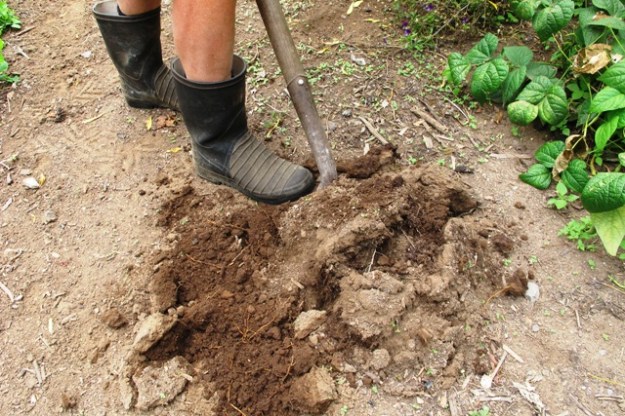
Animal manures should be left to age before you bury them in the soil. They are too strong when they are fresh and can burn plants. You can dig a trench and bury your kitchen scraps directly in to the ground. You are just trying to get as much organic material into the soil and then the worms will start arriving along with all the other natural microbial action and insect life of healthy soils.

Clay soils also suffer from a lack of worms but they are not lacking in nutrients as a rule. Basically, the aim is to break up the clay to allow for better drainage, increased worm activity and aeration. Adding gypsum is one strategy. Bringing in very fine gravel or sharp river sand is reputed to help but you are likely to need several centimetres of it to make any difference and it will need to be dug through the clay. Otherwise, do the same as for sandy soils and bring in mountains of humus. Build up your layers on top. The worms will arrive and start to do some of the work for you.

You are trying to speed up a natural process where top soil builds up closest to the surface, giving you friable and fertile conditions in which to grow plants.

None of this is rocket science. It just takes time, effort and a strong back if you are starting with impoverished soil conditions. You often have to take the longer term view in gardening.

First published in the Waikato Times and reprinted here with their permission.

Cover the ground

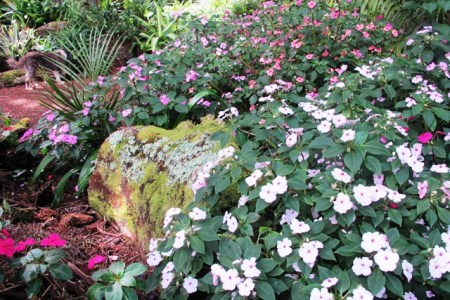
Happy and easy care perennial impatiens

Happy and easy care perennial impatiens

I mentioned last week about my mother’s gardening mantra being ground cover which focussed my mind on the case for ground cover plants. Surprisingly, this preoccupation is a relatively recent phenomenon.

Back in the 1950s and 1960s ground cover plants hardly featured. It was all about trees and shrubs with little under planting. Now it is often regarded as a hallmark of good gardening to have no dirt showing at all – except in the vegetable garden. Mostly it is about packing the garden with layers of plants, each lower layer masking the stems and trunks of the taller ones while down the bottom is some low but strong growing ground hugger.

There is good sense to not having exposed dirt in a garden. Keeping it covered stops dirt splash in the rain, wind blown top soil in the wind and erosion in torrential downpours. A good thick layer of something, be it plant or mulch, can cut down on the germination of weed seeds lurking in the soil because it reduces the amount of sunshine and light that most need. It is also a great deal more attractive than the liverwort that colonises uncultivated ground in shaded areas.

There are ground covers and there are G-R-O-U-N-D C-O-V-E-R-S. Some modest little ones never get ideas above their station and just gently colonise an area, spreading in a quiet and acceptable manner. In this class, I would put the unassuming but pretty little scuttelaria which we have in both white and blue or the obliging corylopis and a number of the ajugas.

Then there are the rampant ones which, given even a hint of an invitation, will spread at an alarming rate. I once bought a punnet of such a plant which looked promising. I have long since lost its name but it had pretty white cup flowers and good green, fine foliage. That punnet held six plugs, each measuring about 2.5cm across. Within one season, each of those plugs measured a metre across. I have never seen anything spread so alarmingly. It took me two years to get rid of it entirely, all the time muttering that the people who propagated that plant for sale should be lined up and shot. For the same reason, I have eradicated the Orangeberry plant (Rubus pentalobus) and rampant violets. I don’t want lemon balm either. It stages a takeover bid, choking everything in its way. And the ornamental tradescantia is pushing its luck.

Zephyr beside the Acanthus mollis

Zephyr beside the Acanthus mollis

We are extremely cautious about the triffids too. These are the large growing perennials which spread and choke out much in their path, seeding their way through the garden. Acanthus mollis or bears’ breeches springs to mind as a good example. One can be striking but don’t turn your back on it and allow for the fact that every one needs at least a metre and a half of space. Too many and your garden looks as if it is full of cheapie plants as bulk fillers. We call it the ABG syndrome after we heard somebody’s garden described as being a case of Another Bloody Gunnera. Those particular triffids are now on the banned list in this country, as far as I know – the enormous rhubarb plants.

Endless plant lists without photos make dull reading, but I will offer up a very short list of recommended, well behaved ground cover plants which have proven their worth here and should be readily available. In shade areas, it is hard to go past hostas, farfugiums and ligularias but also the francoas (sonchifolia and ramosa- the Chilean bridal wreath flowers) and phlomis. We have a wonderful swathe of old fashioned perennial impatiens (busy lizzies) which have kept on keeping on for decades in frost free woodland conditions. They flower for 10 months of the year and require next to no attention.

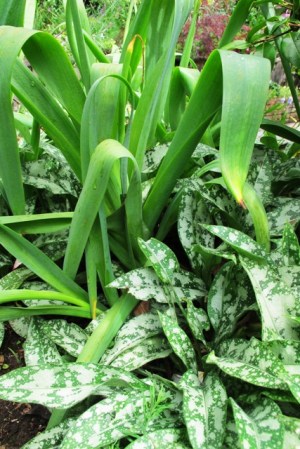
The mottled foliage of pulmonaria (with the unromantic common name of lungwort)

The mottled foliage of pulmonaria (with the unromantic common name of lungwort)

In sunnier conditions, the sedums work well, as do coreopsis, smaller growing campanulas, phlox, asters – there is an endless list of possibilities. I am less keen on the widely used catmint (nepeta) which I regard as too strong a grower and essentially boring. I much prefer the mottled foliage and pretty flowers of the pulmonaria which fill a similar niche.

For those who find using perennials offputting, the permanence of ground cover shrubs sometimes appeals, especially flowering shrubs. We used to sell pretty little weeping camellias (Sweet Emily Kate and Quintessence) which, if not trained upright, would become ground cover. And somebody has apparently released a “ground cover” michelia. I know this because I have been asked for it but have not seen it yet.

But, ground cover shrubs in a mixed planting? I don’t recommend them. We tried Sweet Emily Kate and very soon discovered the drawbacks. There is nowhere for the spent flowers to drop to so all that happens is that slushy blooms and other garden debris sits on top of the plant, needing frequent picking over by hand.

If you want ground cover, keep to perennials or seasonal bulbs and annuals is my advice. If you want to reduce maintenance, mulch with something anonymous like compost or bark chip instead and bypass the ground cover altogether.

First published in the Waikato Times and reprinted here with their permission.
Cicely’s gardens

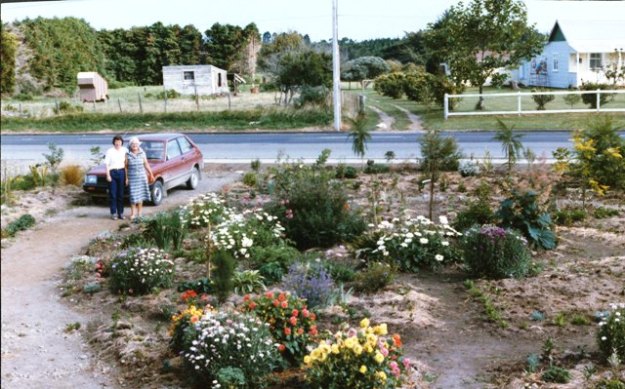
My mother and sister at the start of another of her gardens

My mother and sister at the start of another of her gardens

I have been thinking of my late mother, Cicely Denz, this week and realised I have never paid tribute to the fact that I, as well as Mark, grew up in lovely gardens. The difference is the plural – Mark grew up in the one garden that is now our home at Tikorangi. I grew up in multiple gardens, mostly around Dunedin.

She was a fine garden maker, my mother, though the gardens were distinctly clonal. She worked from the same plant list of favourites and she never stuck around long enough to see them mature. I am sure it would have been different had my father lived longer and she had her lifelong love next to her in body and not just memory. She would have put down roots and may well have earned a place in the modern garden history of this country.

Instead for a woman of her generation, intelligent but under educated with no recognised career, lacking a man at her side when solo parents were almost unknown, leading a distinctly precarious financial existence and lacking the usual anchors in life, my mother turned her gardening into her public face and her claim to status.

She was always a gardener. Her first was an acre in size. When my father was demobbed post WW2, he went to work at Porton Down in Salisbury. As that place was a military scientific research facility, this may well have contributed to his premature demise (think nerve gas research, organophosphates and other agricultural chemicals). With the shortage of housing in bombed Britain, they relocated two military huts and my mother built her first garden around them. Despite extensive reading of the major English garden writers, she never deviated from the romantic English country cottage style of gardening of that era.

By the time I was born, my parents decided to return to New Zealand with the four children in search of the traditional NZ family life and employment opportunities meant Dunedin. That English style of gardening translated well to Dunedin which may never get as cold as most of the UK but has similarly low sunshine hours, never gets hot and is characterised by a soft light unknown to most of us north of there.

Every garden had Prunus Kanzan

Every garden had Prunus Kanzan

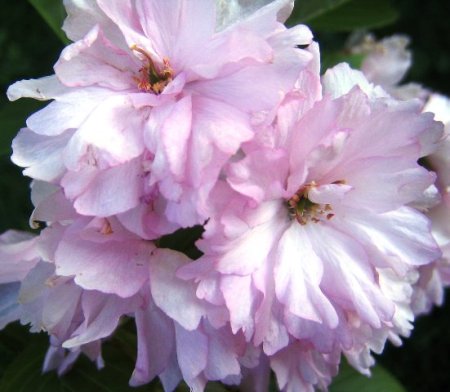
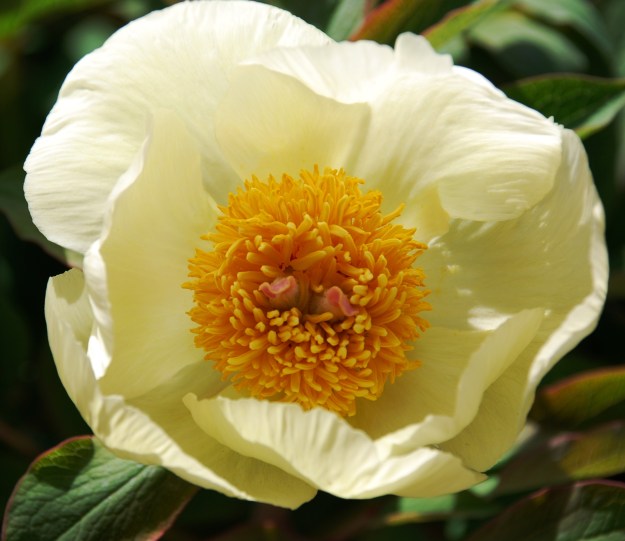
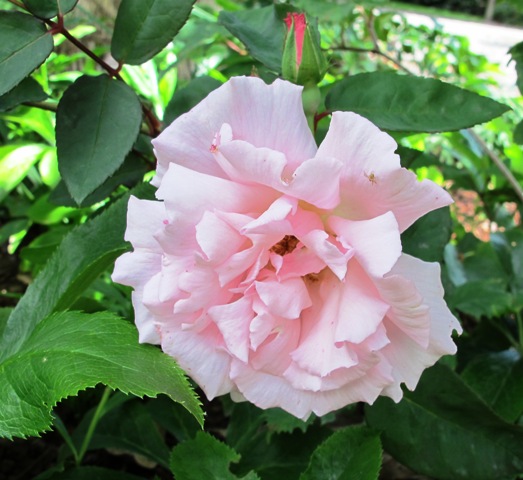
She was always renowned for her proper English primroses. They will grow here in more northerly climes but they hardly flower whereas my childhood was spent with vases of them in season. Along with violets, hellebores and London Pride. Roses were always of the old fashioned variety, not a vulgar hybrid tea in sight. And herbaceous paeonies, big clumps of these spring delights. We all grew up knowing the name of Paeonia mlokosewitschii – she was a demon for botanical names. Every garden had at least one Prunus Kanzan (in pink) and one Prunus Tai Haku (in white).

The paeony with the impossible name

The paeony with the impossible name

Lawnmowers were not her friend. She attempted to pressgang any passing young male into using the push mower on grass which tended to be overgrown. At one stage, she decided that a brand new motor mower might do the trick. This required site visits from the poor young salesman, whom she probably reduced to tears with her complete inability to start the engine and her tendency to blame the machine. The shop took the mower back.

In due course, Cicely gave up on all lawns. She figured that it cost money to maintain a lawn (it does) and she would rather have gravel paths and garden.

Not only did she not have lawns, there was a total lack of hard landscaping. Good gardener she may have been and certainly she had no fear of hard work, but she lacked any home handywoman skills and she rarely had sufficient money to pay for someone else to come and install anything like fencing or paving. Garden ornaments were completely absent. Mind you, this was in the days before it became fashionable to adorn your garden like an overstuffed display cabinet.

I quipped many years ago that all she needed to keep her happy were five plants, a spade and a wheelbarrow. She could then move the plants like chess, as she was wont to do. But she was a garden maker at heart. The joy for her lay in breaking in a piece of ground and planting it up, garnering much admiration from passersby and neighbours. She had little interest in maintaining the garden once established so soon became bored, finding some compelling reason to move. I kid you not. In my lifetime, I can recall about ten gardens she made. There may have been more.

Her mantra was ground cover. She firmly believed that if you plant ground cover densely, it suppresses the weeds. Well, no. She didn’t like weeding and ground cover plants mask the weed infestations, rather than suppressing them. It also makes weeding more difficult because the weeds and plants become deeply intertwined. Her style of gardening was hugely labour intensive and generally involved lifting all the ground cover perennials once a year and dividing them so the weeds did at least get dealt to annually. She spent pretty much every single day in her garden.

Cicely’s style of gardening was transient. These gardens lacked the bones to carry them through the decades. There was a lack of good long term trees and a lack of structure or form. I doubt that any survive now. She never went back to look. But for the few years of their glory, they were a delight and a fine example of that particular garden style.

First published in the Waikato Times and reprinted here with their permission.
Lower maintenance gardening

Do away with island beds in the midst of the lawn if you want to reduce maintenance

Do away with island beds in the midst of the lawn if you want to reduce maintenance

I thought I would spare readers from the New Year’s gardening resolution column. Most will resolve to weed more often and keep their garden looking tidier, only to fall by the wayside very quickly. So it is onto lower maintenance gardening this week.

Note the qualifier – lower maintenance. I don’t think there is any such thing as low maintenance gardening. These are mutually exclusive concepts. The only way to eliminate gardening altogether is by living on the upper floor of an apartment block.

You can do away with plants and pave, seal or turf your entire section but that should not be confused with gardening. Nor does it eliminate all maintenance. Paved areas need attention. Weeds will forever pop up in any cracks or gaps. Dust and grit accumulate and need to be swept or blown away. Shaded areas will grow moss and lichen and may become slippery. There is nowhere for the family pet to do its business.

You can grass out your section but it will need mowing. It will need a whole lot more than just mowing if you want a proper lawn. Maintaining even a half way decent lawn takes a surprisingly large amount of time and effort. But at least you can get a lawn mowing contractor in and trust him or her to get the grass down. But that is not a garden, either.

Gardens have plants and plants are tricky, messy and unreliable living organisms. They grow. They drop bits. Some grow too well, others not well enough. They also have the capacity to delight and to surprise, to soften a view and to blur the hard edges, particularly in an urban environment. It is about much more than just feeding the body by growing edible plants. You can wrap it up in a spiritual framework if you wish or you can be more prosaic in your terminology but the bottom line is that it is a rare person who remains oblivious to the beauty that is in nature and plants are integral to that. Most of us are driven to recreate some of that nature in our immediate environs. And if you want to stay on good terms with neighbours, an ugly wasteland is not going to do it.

So, to dispute some common myths about low maintenance gardening.

  • Evergreen plants are not low maintenance. They still drop a full set of leaves every year. They just do it gently all year round rather than in one big hit like deciduous plants.
  • Vegetable gardening is probably the highest maintenance form of gardening there is. Forget any advice that you can have a low maintenance yet productive vegetable garden.
  • Similarly, you can’t just plant an orchard and leave it, expecting to harvest fruit in season. Most fruit trees require regular attention; some require a great deal of care.
  • Simple gardens or formal gardens defined by sculptured plants (hedges and the like) are not easy care. They depend on pristine maintenance for their effect. It is like doing the housework but outdoors and no sooner have you done it than the wind will blow or the plants will grow. You can’t keep the outdoors static.
Roses need more care than many other plants if they are to look good

Roses need more care than many other plants if they are to look good

If you want to reduce your workload however, there are certain things you can do.

Shun plants which need staking each season if you want an easier care garden

Shun plants which need staking each season if you want an easier care garden

  • Don’t have island beds and specimen trees or shrubs sitting in the middle of the lawn. It is easier to do a clean sweep with the lawnmower than to be weaving around curvy obstacles. It also cuts out the potentially messy edges you get around island beds.
  • Reduce the number of itsy bitsy little beds and plantings that you have. Keep the lines simple.
  • Reduce the number of plants you have growing in pots and containers. These take quite a bit of effort to keep them looking good, as evidenced by the number of sad, neglected, even dying plants you can see all round different gardens.
  • Weed thoroughly and then lay a weed free mulch to suppress further germination. Try and get weeds before they are large enough to set seed and remember the old adage: “one year’s seeding, seven years’ weeding”.
  • Leave enough space around plants to be able to use the push hoe and if you haven’t got a push hoe then get one, learn how to use it and keep it sharp. You can then do the summer weeding without bending – but only if you do it before the weeds set seed. There is no point in hoeing out weeds and then leaving them lying on top if they are going to spit out their seeds on the spot.
  • Do away with plants which require frequent attention to keep them looking good. The prettiest but worst offenders are probably roses and wisterias. Most plants will need a little attention once a year, but some plants need much more than that. Similarly, do away with plants that need to be staked to stop them flopping all over the place.
  • Do not garden in such a manner that you have to water frequently in summer.

When I used to pay someone to do my housework, I felt privileged but not ashamed. The same goes for gardening. If you don’t get pleasure from doing it yourself and you can afford it, pay someone else to come and do it for you. A lovely garden is a joy to all, but getting there is not always fun.

First published in the Waikato Times and reprinted here with their permission.

Meadows, prairies and wildflower gardens

041
We gave our eldest a particularly good book on American wildflower and prairie gardens for Christmas and her eyes lit up. It seemed a moment of triumph in parenting which I have not seen recorded before – the age when children of gardening parents are delighted to be given such a gift. There was a touch of envy from us. It was a lovely book but also a gardening genre which is largely beyond our reach.

Prairie gardens and meadow gardens are not compatible with good dairy country so this garden style is likely to be unattainable for a fair swag of readers too, but it doesn’t mean we can’t admire it elsewhere. Dairy country by definition has high fertility and good rainfall along with temperatures that are mild enough to grow grass strongly all year round. That is not prairie territory.

Our eldest lives in Canberra which offers perfect conditions. It has low rainfall, low fertility and is very cold and dry in winter (which stops pretty much all plant growth) and very hot and dry in summer. Pasture grasses and weeds will not overtake the chosen plants. Annuals and perennials will not romp away with lush growth that gets flattened here by frequent heavy downpours. Instead, plants will hang in and grow slowly, tenaciously putting down roots in search of elusive moisture and sustenance and flower stems will be much shorter and sturdier. Prairie conditions, in fact. So it is perfectly realistic to think that one can create a garden sward of tough perennials and ornamental grasses which will sway in the wind and put up a succession of blooms over a period of several months.

074

Essentially a meadow garden is made up of wild flowers as close to their natural form as possible, often natives. This means shunning modern, sometimes over-bred hybrids which tend to go for much larger flowers and compact, bushy growth. A meadow garden is simulating the wild but modifying it to a garden setting. There is a long tradition in English gardening and the routines are well known. It relies on low fertility to keep down competing grasses and the parasitic plant referred to as Yellow Rattle is often introduced because it weakens the roots of grasses.

At the end of the season in autumn, the meadow is mown and left to lie for a week or maybe two. This allows the seed to fall out of the spent plants. After 10 days, the mown area is raked free of the cut vegetation to keep fertility low. The area is then left to come again the following spring.

Can you imagine doing that in dairy country? It will not work.

076The advice I saw in a NZ magazine, which I will not name here, to sow your wildflower garden into an area which you have cultivated and fed to the max with proprietary fertilisers and then to sow again in mid season if it starts to pass over is not a wildflower garden at all. It is simply mixed annuals.

Introduce grasses to the mix along with at least some North American native flowers and your meadow garden becomes a prairie garden, more or less. Cone flowers (echinacea), ox-eye daisies (Heliopsis helianthoides), monardas, Californian poppies (properly called eschsholtzias but I have to check the spelling every time) – North America is rich in wildflowers. The prairie garden has been embraced by contemporary European and UK gardens and designers and I can see why. Clumps of grasses are deathly dull when planted in groups or when mass planted to achieve the motorway embankment look, but take on huge charm in the company of a wide range of flowering plants, both perennials and annuals.

What characterises both meadow and prairie gardens is an absence of woody plants, an absence of layers (plants tend to be of a similar, low height), a higher tolerance of weeds and seasonality – in winter there is no garden at all to speak of. It is a much more relaxed style, hugely different to how many of us choose to garden. It can also be environmentally sound, especially in harsh climates, because it provides food for birds and insects while anchoring the soil in windy conditions with no fertiliser inputs or spraying.

In season, such gardens are infinitely charming in all their manifestations. It has a lot to do with the simplicity and the relaxed style. We are still wondering whether we can manage something similar here in a new garden we have planned but we are fighting nature and will have to choose plants carefully as well as overcoming our ingrained antipathy to weeds and a belief that gardens should look good for all twelve months of the year.

045

Earlier last month, I visited a field of bearded iris in flower. I don’t want to overstate the case. It was a nursery (http://www.theirisboutique.co.nz/) growing the iris rhizomes in rows in a field and there were a fair number weeds, to the embarrassment of the owner. It was also an absolute delight which made me smile.

It is the simplicity of an expanse of flowers in a field situation which appeals. Gardens do not have to be heavily designed and intensively maintained with high quality permanent plantings of trees and shrubs to make one’s heart sing.

First published in the Waikato Times and reprinted here with their permission.