Category Archives: Abbie’s column

Abbie’s newspaper columns

A Garden with a View (in Italy)

I would like to say I am fresh back from the south of Italy, but fresh might be slightly overstating the case. Safely back perhaps. I have never been to this southern area before. We didn’t find anybody who spoke English in Palermo (Sicily), either local or traveller. No English at all and no understanding of any English which gave some impetus to learning a few basic words and phrases in Italian from the back of Lonely Planet Guide.

On a previous visit, Mark and I tripped around the lakes district in the north and saw grand established gardens in the Italian tradition. I had been anticipating similar evidence of great wealth in pockets of the south at least, but if they are there, we did not find them. Sicily, it must be said, has a much hotter and drier climate, more akin to its close neighbours in North Africa, which makes gardening difficult and it remains an area of considerable poverty.

I photocopied the relevant pages from renowned garden writer Charles Quest Ritson’s weighty tome, Gardens of Europe, and following his advice, we sought out Orto Botanico di Palermo (the Bot Gardens). I had thought to find a little more than we did in terms of style and presentation. They hold a notable collection of cacti and succulents which was displayed with all the panache of a working nursery. All plants were in matched terracotta pots serried along wire shelves. If you have a passion for cacti and succulents, there may have been much of interest but I find them distinctly less than riveting.

Plants in serried ranks at Orto Botanico

Plants in serried ranks at Orto Botanico

The glasshouses were sparsely furnished with more plants on wire shelves. There were some fine trees growing amongst the dry dust outside but most looked a little hard done by. A recent planting of cycads in the tough kikuya grass was just getting established, although there were more mature specimens of both palms and cycads. A most remarkable plant was a fig tree (ficus macrophylla). Now over 160 years old, it was of enormous proportions and clearly working on a bid for total domination. It puts roots out from on high (known as aerial roots) and when they reach the ground, they bed in giving a multi stemmed effect on a rather intimidating scale.
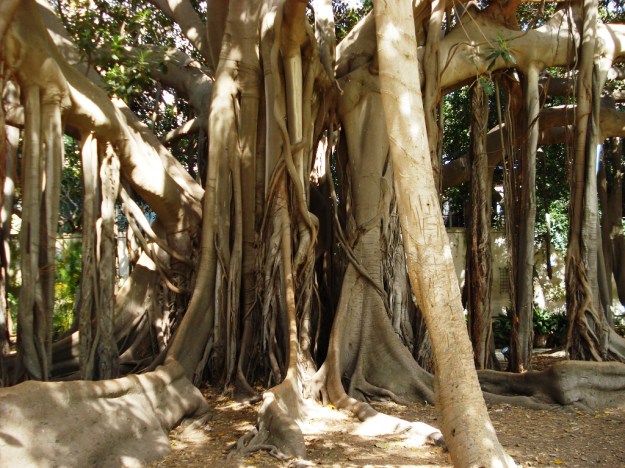
The ficus bid for total domination at Orto Botanico

The ficus bid for total domination at Orto Botanico

The avenue of false kapok trees (Chorisia speciosa) was attractive but overall I was a little underwhelmed by Palermo’s Orto Botanico.

On the mainland, we sought out Villa Cimbrone in Ravello on the Amalfi Coast. It was a slight mission to get there. The public transport is frequent and cheap, but not for those of a nervous disposition. In this area, the roads are extremely narrow, bordered on one side by an unprotected drop of hundreds of metres to the sea, extremely winding with corners so tight that at times the buses have to reverse up and make more than one attempt to get around, all the while being challenged by speeding Vespas, Fiats and Smart Cars driven by fearless locals.

Villa Cimbrone was actually landscaped by an Englishman at the turn of the twentieth century on the site of a neglected Roman estate and is still hailed as a significant garden in the English-Italian style. Now a hotel, I can only say that it must have been grander in its early days. The Avenue of Immensity formed the central axis and it was certainly impressive. It was an extremely long and wide sweep which led us down under festoons of wisteria, flanked by pinus pinea and platanus orientalis, statuary and terracotta pots. It culminated in an open Doric temple leading to the Terrace of Infinity. This was a large belvedere balcony adorned by eighteenth century marble busts, with an astounding view of the Amalfi Coast and the hugely charming villages and citrus groves which tumble down the near vertical hills.

The Terrace of Infinity at Villa Cimbrone

The Terrace of Infinity at Villa Cimbrone

But that was as good as it got. The brochure claimed “an infinite variety of exotic flowers and plants” beside the Avenue of Immensity – but these were mostly agapanthus, with, from memory, some cleomes. The Seat Of Mercury, a large bronze statue of the gods’ messenger at rest, was set in a dirt bowl. The rose terrace was so poor it was ludicrous. Even allowing for the fact that it was only late spring, I could not believe that the roses were ever going to impress and row upon row of pink and red bedding begonias are too municipal altogether.

The gothic crypt (now a functions centre) was magic. I do like the gothic style. The cloister was attractive – a Norman-Sicilian-Arabian courtyard. The traditional Italian statuary fitted right in to the whole environment and gave me cause yet again to reflect that it is no wonder that it looks so out of place in New Zealand gardens where we lack the history and the tradition which anchors this ornamentation in context. But it is the architecture and the setting which are the redeeming features of this garden, certainly not current gardening practice.

In terms of gardening, the most charming sight I saw was a simple scene of wildflowers at the Palatine in Rome and that was clearly serendipity.
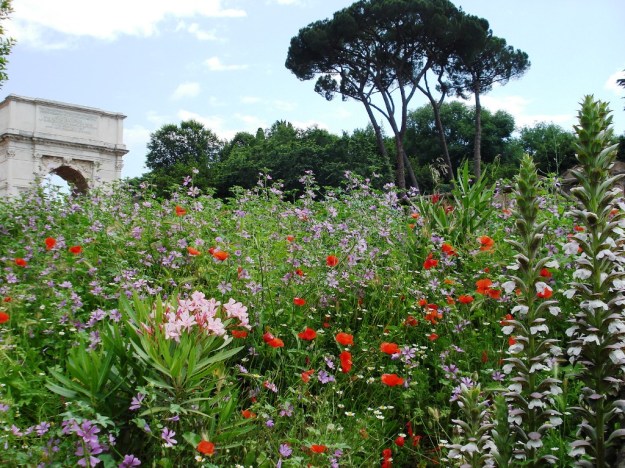
Serendipity at the Palatine in Rome

Serendipity at the Palatine in Rome

I did feel a little vindicated on another score. A month or two ago, I wrote a column debunking the myth of Marlborough’s vineyards being romantic and evocative of rural Italy, an opinion which caused a colleague to take umbrage. The vineyards, olive and citrus groves I saw in Italy bore no resemblance at all the sterile mono culture of Marlborough with its rows of tanalised posts and wires and not a single stray plant allowed to creep into the environment. Italy does not appear to have our obsession with Round Up so there is a profusion of growth and the vineyards and orchards are small, mixed and cheek by jowl. Instead of milled, tanalised timber, supports were crafted from branches which looked similar to our native manuka. While I may not have been impressed by the formal gardening efforts I saw on this visit, the agriculture and rural landscape were impossibly romantic and about as far from New Zealand practice as you can get. Given that Italy has been that way for a very long time, I suspect that their approach is considerably more sustainable than the green desert technique we favour in our own countryside.

Earl Grey or Assam?

Elder Daughter gave me a pedometer one birthday and I was a little surprised to find that in the course of a normal day, I cover around 8km. When I come to London, I am deeply grateful that I am used to being on my feet. It prepares me in some way for the great distances I end up walking.

With a few days before London daughter and I brave Ryan Air (even more budget than EasyJet) for a flight to Sicily, I decided to follow up some of the private gardens open under the National Gardens Scheme. We have followed this with interest on the Living Channel, where the programme Open Gardens charts the process of assessment, selection and open day.

There is real status in being accepted by the NGS, even though it is entirely charitable and garden owners may open for as little as three hours on one particular day of the year. On Sunday afternoon, I braved pouring rain and shoes that leaked to find my way to Chiswick on the banks of the Thames where there was a cluster of four gardens open for the afternoon. I think this enclave of antique real estate is referred to as a mews. Highly valued terrace houses. Terraced housing means that the only access to the rear garden is … through the house. Fortunately the rain stopped. It certainly gives opening one’s garden to the public a new dimension, having a few score of people tramping through your home. This being London, the gardens are the width of the house – in other words, as little as one room and a passageway wide or maybe five to seven metres. One garden was serving teas in a miniscule back plot where six people were a crowd. But old style. Nobody asked here if you wanted gumboot tea or Earl Grey. No, in a line which I must store away for future use, I was offered Earl Grey or Assam.

Earl Grey or Assam?

I was interested in the whole process of assessment and selection of the NGS gardens (it can be a bit of a thorny issue, that one, as some of us know well in Taranaki) and also to set benchmarks and establish points of comparison for our festival gardens, both on that Sunday and the following day when I travelled to another small garden which opened by appointment. As a garden visitor, I certainly felt privileged to gain entry to private gardens which would otherwise be closed to me. These are domestic gardens which don’t even pretend to sit up alongside the renowned top end UK gardens of private origin, such as Sissinghurst and Great Dixter. And what can I say? It was a privilege. They are different to gardens at home. Our Rhododendron Festival gardens can hold their heads up high. I will say no more.

I had planned to finally make my pilgrimage to Wisley, the Royal Horticultural Gardens south of London. Their website showed much improved public transport links but once here, I realised that even so a day visit was going to involve five hours of travel and multiple changes. I was not that determined after all. Fortune may favour the bold but I am not suicidal so I won’t drive in London and from the tranquillity of home in Tikorangi, I tend to underestimate the effort it takes to travel across and through this city, let alone heading out to farther reaches. So I compromised with a return visit to Kew, the Royal Botanic Gardens which are easily reached by public transport.

I doubt that Kew could ever disappoint. They are botanic gardens on a grand scale. The British were great collectors and while I feel uncomfortable at some of the museums which represent acquisition and at times pillaging and theft from around the world on a scale which defies comprehension, the plant collecting and botanical classification work is much safer territory.

Walking in the tree tops at Kew

There is something for everyone at Kew. On an early summer’s day when the forecast was for temperatures around 25 degrees, it was in fact closer to about 12 degrees but the place was still teaming with people, including many children (it is mid term here) most of whom seemed to be called names like Oscar, Imogen and Henry and who were extremely well behaved. However, Kew is very spacious and can accommodate large numbers of people, although I probably met a goodly proportion of them on the newly opened treetop walkway. Treetop walkways are remarkable feats of engineering and Kew’s one has apparently been installed with minimal damage to the environment, avoiding even the visually polluting oversized pylons which seem to be a feature in others. For mild sufferers of vertigo such as me, they lose a little impact because one avoids looking straight down, preferring instead the safety of long views, and they are perhaps more novelty than revelation. But Kew must be leading the way in making public gardens and parks educative and everywhere the drive to inform and to conserve is threaded through the garden visitor experience. I can understand the use of some novelty and gimmickry if the outcome is positive. The importance of places such as Kew, set in incredibly overcrowded and hyped cities, can not be overstated, let alone the contribution to global conservation through the botanical research and collections.

The Kew experience

I was most delighted by the woodland plantings of herbaceous material, by the alpine gardens and, surprisingly, by an open air photographic exhibition. The International Garden Photographer of the Year is available at www.igpoty.com if you want to see some lovely imagery. The alpine gardens are interesting because our climate at home is just too warm and humid to manage this restrained style of display but the woodland and herbaceous plantings are an area where I gathered ideas and learned from established practice.

And nothing to do with gardening, but I was amused to see Harter and Loveless Solicitors on Caledonian Road. I wonder if Mr Harter does matrimonials while Mr Loveless is forever destined to do neutral conveyancing?

In Praise of Trees

Autumn is a time to look at trees even if we can’t compete with the seemingly endless blazing colour of countries like Canada. A friend from Te Popo Garden, inland from Stratford, commented in passing that it didn’t get much better than last weekend with the sun streaming through the autumn leaves on the trees. We have had remarkably little wind recently and a sharp drop in temperatures from the Indian summer straight into winter chill, so it is shaping up to be a splendid display.

It should not be necessary to point out that you only get spectacular autumn colour on deciduous trees which shed all their leaves each year. I thought everybody knew that, just as I thought that everybody knew that our native flora is pretty well all evergreen. Ergo, we do not get autumn colour from our native plants. This did not stop an enquiry a couple of months ago about whether we have places noted for autumn colour in Taranaki and (wait for it) were any of these native trees, for example a grove of kauris. I could accept that the enquirer did not know that kauris do not occur naturally this far south, but I did wonder what had happened to general knowledge that nobody in the chain of this particular organisation had picked up on the fact that our native plants do not colour up in the way that some deciduous plants do. There are subtle seasonal colour changes at best in our native flora but for the golden leaves or the fiery reds and oranges of autumn, you must look to imported deciduous trees and shrubs such as maples, poplars, parrotias, gleditsias and cornus.

It is the sharp drop in temperatures which triggers the plant to stop feeding its leaves and let them die and drop. Inland areas are colder at night so they get significantly more impressive autumn colour than those of us closer to the coast who just gradually drift from one season into another. And coastal points northwards (Auckland and Northland) get even less autumn colour. Travellers in the tropics will know that you don’t get autumn colour at all in hot climates.

That said, Prunus Awanui has been a vision of golden leaf this past week. The wisterias and rugosa roses always surprise me with their autumn colour and the grape vine which covers the large verandah out from my office is a delight every year. It looks as if the sun is shining on even the greyest of autumn days.

But while admiring the trees in autumn, gardeners may also like to do some critical analysis on the merits of the different trees in their garden. We have been talking recently about the failure to differentiate between short term nurse trees and long term trees.

In our windy country, we need nurse trees. They are a quick and cheap option to grow in order to provide some protection so that longer term, quality trees (which by their very nature tend to be slow growing) can get established. And because nurse trees grow quickly, they can give height and impact in a garden in a surprisingly short space of time. But few nurse trees in our climate age gracefully and there comes a time when decisions need to made about which are worth keeping and which have frankly passed their use-by date. Not all trees are equal and not all trees improve with age.

Many gardeners make one of two mistakes. They either overplant badly and then fail to discriminate a few years down the track as to which are the good long term trees worth looking after, even if it means cutting out the filler trees. Or they plant specimen trees out in exposed areas in solitary confinement.
In using nurse trees, you are learning from nature. When bush regenerates, the nurse plants are the first to get established and to create some cover. In that protected environment, the longer term trees come through and are forced up in search of light. In due course they supersede those nurse plants. Without the protection and microclimate of nurse trees, they can be too exposed, stunted and often multi trunked because they do not need to shoot up in search of light.

Trees are going to become a great deal more important in the immediate future. The talk about carbon footprints, climate change and sustainability is not just a fad which will fade away in a few months. We are in a time of radical change and long term trees will be part of our future and quite possibly part of the survival of our planet. The day may not be far away when we are shamed by our outdoor furniture made from Indonesian hardwoods.

While tiny town sections are not going to accommodate forest giants, neither is an espaliered apple tree going to save the planet (though it might help feed the family and taste better than cool store apples). But gardeners with a bit of space (or non gardeners for that matter) could and should be thinking about planting long term trees and treasuring existing trees which have the potential to outlive most of us. By long term trees, I mean those with a lifespan which will be fifty years at least, maybe a hundred and some have the potential to live many hundreds of years if they are planted in the right position. In New Zealand we have a tendency to think in terms of ten or twenty years and far too few trees are allowed to ever reach maturity.

So by all means plant pretty flowering cherries, albizzias (though I think I have seen those on a banned list somewhere), gleditsias, paulownias and birches. But see these for what they are, which are short term trees and look to using them as cover to get some good trees of potential longevity established. It doesn’t have to be a mighty kauri, rimu or totara though goodness knows, we plant too few of our majestic native trees. There are some magnificent members of the conifer family which are not native – the sciadopitys or Japanese umbrella pine is a gem and the somewhat maligned Norfolk Island pine is a great statement of form on the landscape. Magnolias can live a very long time and are unparalleled for splendour in flower. Liriodendrons give brilliant autumn colour, as do scarlet oaks, ginkgo biloba and even plane trees. All get more impressive with age.

If you are unsure what you are doing, seek out advice and never plant any tree anywhere near power lines. It will come off second best in a tangle with the lines companies. The challenge is to make sure that you plant some good, long term trees in your lifetime. What better legacy to leave?

Wildflowers and Meadow Gardens

We had cause to go to Auckland last week and were reminded once again of the charm of the wildflower plantings down the centre of the motorway. Driving out of the city on Saturday morning, we slowed to the expected crawl. Auckland can lay claim to having the most expensive stretches of motorway built for moving high volumes of traffic at reasonably high speeds but in fact accommodating vehicles which are relatively frequently travelling at 10 km an hour. In this case, workmen were repairing a central crash barrier and this necessitated closing one lane entirely despite the very wide median strip. But it did mean we could enjoy the wild flowers at a crawl. It was the cosmos that dominated this autumn, both cerise and white along with a sprinkling of yellow daisies and something blue (we couldn’t stop to do a full identification). Wildflower and meadow plantings are exempt from the modern requirement for colour toning.

Many years ago when the children were little, we took them on a camping trip around Nelson and were enchanted by a meadow garden we found. It was a field of mixed annual flowers up to waist height and the charm lay in the simplicity and nostalgia, not in design, form or plant composition. We came home inspired and did a bit of dibbly dabbling and research before we came to the conclusion that this is a garden style best suited to harsher climates. The Auckland motorway median strip represents pretty harsh conditions.

USA is renowned for its prairie gardens where mixed grasses and wild flowers can co-exist and return every year to delight afresh. North America has many native wild flowers so these are growing in their natural habitat.

Similarly, Britain has long established meadow gardens where native wildflowers can live in amongst the grasses and meadow gardening is recognised as being of both ecological and aesthetic merit. Western Australia is known for its spectacular wild flower season and parts of Southern Africa must put up splendid seasonal displays with the wealth of different bulbs which are indigenous to that area.
New Zealand lacks most of the native wildflowers and bulbs which give rise to natural meadow gardens and the imports that have thrived here don’t quite cut the mustard. Arum lilies and agapanthus can not foot it with Britain’s ground orchids such as the dactylorhiza. Anything that naturalises in this country is more inclined to be a thug than a treasure. It is possible to manage a perennial meadow garden here but it is not the easy care style requiring minimum labour that it is in other countries. And wildflower meadows are even more difficult to manage, having to be treated as an annual labour of love rather than a self seeding, ongoing venture with just a once a year mow required.

I suspect that anywhere that is good dairy land is not going to be good wildflower or meadow country. The reliable rain, good soils and benign temperatures mean that we get rampant grass growth for most of the year. So the grasses choke out the wild flowers and discourage them from gently self seeding. And every gardener knows that weeds are thugs. Left to their own devices, the law of nature says the thugs will dominate and it only takes a year before the undesirable weeds have such a hold that the charm of the wildflower field or meadow has been swamped by dock, dandelion and hawkweed and you are faced by a paddock of out of control weeds.

Internationally, these wildflower displays occur in areas where summers are dry and often hot and where winters are very cold. Thus the plants stop growing in both summer and winter. The triggers for plants to grow in these conditions are either autumn rains or the rise in temperatures in spring. Plants under stress will often respond by putting on splendid floral displays (it is the survival urge to flower and set seed before they die) and the harsh conditions of summer drought can trigger flowering. In Taranaki, the message to most plants is just to keep on growing so we can end up with disproportionate amounts of green foliage instead of blooms.

All of this means that if you covet a field of charming, summer wild flowers, you are probably wasting your time unless you live in an area such as Pukearuhe or coastal Waverley where the poorer and drier conditions will accommodate them better. And you will have to create it with imported flowers. New Zealand evolved as forest in the main, so we lack the pretty seasonal annuals.

Meadow gardens can be managed here, sort of, though it is much easier to do it with bulbs that with annuals. By definition, a meadow garden should be low maintenance so you want to keep the thugs right out of it from the start. And if you are thinking of planting intensively with herbaceous perennials such as primulas, essentially you are creating an informal herbaceous drift rather than a meadow garden. A meadow garden is a mix of grasses and naturalised plants. In spring, many of us do it with daffodils, bluebells, snowflakes or, if you are Mark, proper snowdrops but really, a meadow garden should have a much wider range of plants all co-existing in a gentle sort of way. All we are doing with the bulbs is naturalising them rather than creating a self sustaining mixed habitat.

A wild garden is often included in large English gardens and it can sit quite happily alongside more formal areas of topiary or well tended borders. Sadly, we are resigned to the fact that this is not a technique readily transplanted here and the wild garden is almost guaranteed to look like an unloved and unkempt wasteland. But then we do have compensations. Here the impending winter is not a sign of low light levels, abominably short days, general greyness and a complete lack of flowers. The sasanqua camellias are already in flower and we will continue to flower different plants all through autumn and winter. It is probably only eight weeks or so until the magnolias in Powderham Street next to the radio station start to flower and then we can feel spring is imminent.

DEBBO

After my garden visiting weekend in Marlborough, I came home feeling that I was suffering from DEBBO. That is Death by Buxus Overload. You can have too much of a good thing.

I will admit that we have the odd metre or two of buxus hedging ourselves and it certainly makes a tidy little hedge but the bottom line, as Mark is inclined to observe, is that box hedging is grossly over used and is basically boring and clichéd. He has never been a buxus fan.

I have been told by overseas visitors that in New Zealand we use clipped hedging a great deal. If that is the case, it probably started for two reasons. One is that we live in a windy country and most gardeners need to establish wind breaks. The second reason is that plants in this country are ridiculously cheap by international standards and planting a long hedge is usually a great deal cheaper than using permanent materials such as brick or stone and we can do it ourselves in an afternoon. It is this second reason that is probably responsible for the cumulative hundreds if not thousands of kilometres of low clipped hedges, mostly buxus, that we feel driven to plant to define the bounds of individual gardens.

Buxus is an infinitely handy little plant. It is so easy to strike from cutting that it is within the reach of even novice gardeners. And because it is so easy and so common, if you decide to buy it, the plants are cheap as chips. It does not grow too fast so you can get away with clipping just twice a year. Even if you cut it back to bare wood, it will shoot again and bush out. It will grow in harsh conditions (though it can get a bit yellow-ish at times) and tolerates rough treatment. Its main problem is the nasty fungus which is attacking and killing plants in warmer areas but has yet to be a major problem locally. All of which means we probably have our share of buxus kilometres in Taranaki gardens too. Even the lake in Pukekura Park has a buxus hedge which has always struck us a little redundant.

We have not yet felt such dislike of buxus that we have ripped out our modest metreage but at the first hint of buxus fungus we will be reaching for the saw and spade, not for the sprayer. And for some years we have been reviewing other options for neat clipped hedges. The big problem is that there is nothing that roots as easily and is therefore as cheap as buxus let alone its fine, small foliage. But there are options with better coloured foliage which will take cutting back hard and form dense little hedges.

Top of the list are some of the small leafed camellias. We have trialled various options here and our short list of suitable camellias for dense, clipped, small hedges includes brevistyla (which also suckers a little which is no bad thing for a hedge), microphylla and minutiflora (all species with small white flowers. Some of the very slow growing miniature camellias could also be used for clipping in to tidy hedges. Others, like Fairy Blush, Night Rider or transnokoensis can make great intermediate sized clipped hedges.

Some of the species camellias will set seed relatively freely so if you are patient, you could raise the seed to get cheap hedging. Seedlings are not identical (unlike cutting grown plants which carry all the same genes as their parent) but for a clipped hedge they should be close enough.

If you feel compelled to have buxus hedging in your potager (though why anyone wants to eludes us because it takes up valuable space, sucks nutrients and moisture out of the soil and provides a perfect hiding place for snails) you may like to consider a clipped edging of Camellia sinensis instead. If you gathered the clippings and fermented them, you could even aim to be self sufficient in tea. I saw cranberries pruned hard in a Blenheim potager. In that case they were lollipops but there is no reason why they could not be hedged. Locally, Te Popo Garden had hedged cranberries last time we visited. The ripe fruit has a wonderful aroma.

My short hedge of loropetalum chinense (the green form; we are conservatives here and rather of the view that hedges are best green, not in-your-face burgundy or chocolate or even grey) is thickening up well and only needs a passing trim twice a year.

In frost free areas, compact little vireyas Saxon Glow, Saxon Blush and Jiminy Cricket (all sister seedlings) make a tidy and attractive little hedge. Vireyas root easily so you could buy one and try your hand at cuttings.

Totara can be clipped heavily and becomes more dense, sprouting even from bare wood and forming a really classy indigenous hedge. It is a bit prickly when it comes to clipping and the prunings are not exactly ideal in the compost heap but because of that, it is also a burglar and child proof hedge. It is extremely hardy and long lived. Our remaining length of tightly clipped totara hedge dates back to the end of the nineteenth century and it is still dense and only two metres high. Some of the fine leafed coprosmas and corokias are other native plants which lend themselves to clipped hedging. The Aussies love our pittosporums for hedging but you need to be selective about the colour of the pitto you chose as some can be rather pale.

We are very lucky here to have an in-house hedge trimmer who takes great pride in getting them looking sharp, to the extent that he uses string lines and a spirit level. But we certainly would not contemplate planting a hedge that needed trimming more than twice a year. For that reason, we shun the popular teucrium and lonicera which certainly make good, quick and cheap hedges but need your attention a great deal more frequently than twice a year. In fact to keep those two looking good, it can be closer to twice a month in the peak growing season.

Next time maybe : NAB C BAT. That stands for Not Another Boring Clipped Bay Tree. And yes I do have a large lollipop bay tree (laurus nobilis) but it is in the vegetable garden where it is acceptable (it is the culinary bay and belongs in the herb garden) though it does get thrips in our climate. There are other plants besides buxus and bays that you can topiary as punctuation marks in the garden. Seeing some originality and flair in plant selection can be like a breath of fresh air for garden visitors who will often see the same plants used in similar ways in multiple gardens. Deliver me, please, from any more buxus and bays.