Category Archives: Garden book reviews

Grow it Yourself Fruit and Nuts by Andrew Steen

There is a clear gap in the market for an authoritative modern reference book on growing fruits and nuts in this country, so does this new book fill the niche? Hmm. It is like the curate’s egg – good in parts. It is worth buying for the fertiliser chart on page 111 – the best representation of this information we have seen. The chart on common pesticides is also very good as is the attention to pest and disease management, giving different approaches and addressing the issues. At last we are not seeing everything dumbed down and made simple when it is not, based on the assumption that the average home gardener has a mental age of about eight. If you want to be successful at growing these plants, you do need to get to grips with some of the details regarding pests and diseases. The range of fruits covered is appropriate and the information on recommended varieties is up to date, appears to be comprehensive and very useful. The author is credible. You may know his name from the Weekend Gardener – he is a keen gardener, backed up with professional qualifications and experience.

So what lets it down? The photography is not good enough. Amateur photography is not a suitable replacement for good diagrams when it comes to pruning and shaping and too many of the photographs fail to tell any story at all, let alone save words. The text is too wordy and would have benefited from tighter editing. Magazine writing is different to books. It is much more transient by nature and a looser organisation of ideas is acceptable because it’s all in shorter pieces. Much of the information is here but it is a little too loose and wordy, ranging rather too freely at times without a clear sequence. A greater use of tables and charts would have helped reduce the verbiage. Peer review prior to publication might have plugged a few of the gaps where the author was beyond his own areas of expertise.

For all its faults, it is a better reference than other recent offerings on the topic.

Grow it Yourself Fruit and Nuts by Andrew Steen (David Bateman; ISBN: 978 1 86953 789 0) reviewed by Abbie Jury.

First published in the Waikato Times and reprinted here with their permission.
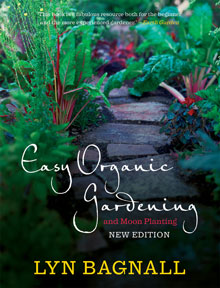
"Easy Organic Gardening and Moon Planting" by Lyn Bagnall

Easy Organic Garden

Easy Organic Garden

This is organic gardening as carried out by a dedicated moon planter but easy it is not. The author subscribes to the why-use-one-sentence-when-you-can-use-ten school of writing. It is very long and wordy, filled with so much detail that even the experienced and knowledgeable gardener can end up seriously baffled. You need to be a believer to want this book. As it is in its second edition, there are either a fair number of believers out there or there is a thirst for knowledge on the topic of organic gardening. I suspect the latter but I am not convinced this book will give the answers.

I am very keen to see books which will separate the organic gardening concepts from faith and mystique. Psuedo science does not do it. Nor do sweeping statements. When I read statements like: “I must confess to not fully understanding the science behind this particular portion of moon-planting principles, but I do know it works in practice,” I start to worry. The author is referring to the changed polarities of yin and yang in Virgo and Libra. I get irritated by the careless use of the word chemical as a synonym for all that is bad and destructive in gardening. A chemical is simply a substance or a compound. In itself it is neither good nor bad. I raised my eyebrows at the claim that synthetic fertilisers lock up essential nutrients in New Zealand soils. Really?

I am all for sustainable gardening practice and I think it is all to the good that we are questioning some pretty dodgy habits. If you are willing to drill down into this book, it promotes good environmental practice, aimed at the author’s homeland of Australia. It covers both ornamental and productive gardening and even has a helpful section on bushfire season. There is just an awful lot of smoke and mirrors to get through first and the husband still doubts that it is possible to get a tomato crop through in our climate without a little non-organic intervention.

(Scribe; ISBN: 9781921372605)

First published in the Waikato Times and reprinted here with their permission.
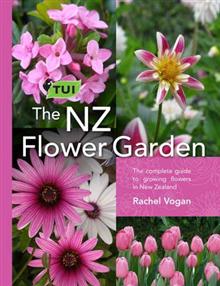
The Tui NZ Flower Garden by Rachel Vogan

Tui NZ Flower GardenSigh. Another joint venture infomercial from Penguin Books and Tui Garden Products whereby you, the customer, get to pay about $50 to be told what Tui products you need to buy in order to grow lovely flowers like the ones in the photographs. That is about it in a nutshell. On the plus side, this book does at least have an index and, hallelujah, it actually gives the botanical names in small print of the main plant families. It is just a shame that neither author nor editor understand the conventions of plant nomenclature. Common nouns like daffodil, magnolia, lily and bluebell do not have a capital letter every time they are used.

The bulk of the book is alphabetical listings of flowering plants (trees, shrubs, climbers, bulbs, perennials, annuals – yes, apparently you can cover the greater part of the plant kingdom in just one book) and it appears completely random as to whether the plant will be listed under its botanical name or its common name. Recommended varieties are equally random.

I am afraid the author lost us when we read the page on magnolias. It was bad enough to mislabel a photo of our Magnolia Vulcan as Genie, let alone misspell our famed Magnolia Iolanthe as Lolanthe but when we got to read that the evergreen Magnolia Little Gem is a small growing form of the aforementioned deciduous Lolanthe, we threw our hands up in despair. And we have actually managed to grow quite a few magnolias here without planting them into Tui Garden Mix and fertilising them each year with Novatec.

When the recommendation came that you plant anigozanthus (kangaroo paws – Australian plant that thrives in marginal desert conditions) with Saturaid, we worried about the advocacy for routine use of a soil wetting agent. There is no faster way to kill a woody plant or a dry loving plant in humid areas with high rainfall.

By the way, Penguin, it is time you dispensed with the auto spellchecker. The author of this book winning prizes for exhibiting her Gladys rivals a previous author counselling readers to throw out their Algarve. The author may have been using the colloquial term of gladdies, but even that is inappropriate for the text on page 164 and 165 where poor Gladys has her name taken in vain repeatedly. Gladiolus stands for one, gladioli for more than one. Gladdie is the vernacular, not the common name. Gladys is somebody’s grandmother.

Otherwise, it is a typical Penguin/Tui book which sits alongside its three sister volumes on vegetables, kid’s gardening and the infamous fruit one. I am hoping they have called it a day and don’t plan to inflict further volumes (maybe on organics or natives?) on the buying public.

The Tui NZ Flower Garden by Rachel Vogan (Penguin; ISBN:978 014 356553 6) reviewed by Abbie Jury.

First published in the Waikato Times and reproduced here with their permission.

Fruit by Mark Diacon

Presumably the average British gardener is either more intelligent or better educated than here. Which is to say that the Brits don’t feel the need to dumb down gardening books to the level of a novice 12 year old and pad them out with lots of super size glossy photos. What is more, they are even allowed an index. This is River Cottage Handbook No.9 – which means it is from the machine behind Hugh Fearnley-Whittingstall. This modest handbook has a mass of good information on growing and caring for fruit trees. The problem is that it is for England which means hardy crops, a reversal of seasons and recommended varieties which are entirely different to here. Common crops here like feijoa, persimmon and citrus are not included at all. So it is not a complete reference for this country but it will tell you a lot of what you need to know about some mainstream crops and the technical information is underpinned by that charm of River Cottage, including a recipe for classic Eton Mess (mashed fresh berries and meringue pieces in sweetened cream).

Fruit by Mark Diacono (Bloomsbury; ISBN: 978 1 4088 0881 8) reviewed by Abbie Jury.

A New Zealand Guide to Growing Year Round by Dennis Greville

Same author-photographer, similar content but different publisher to last week’s book “Salads Year-Round”. This one is more encyclopaedic in range but certainly not in detail (there is not even an index at the back of the book which seems a major oversight), the writing is a little more personal and the photos are a little smaller and more illustrative rather than sumptuous. But it is another of the style of edible garden book we have come to expect in this country – encapsulated in the bold claim on the front cover: “self sufficient in no time”. Yes folks, you too can be self sufficient in fruit and veg with next to no experience and very little effort – it is all so easy peasy. Just buy these books that NZ publishers keep churning out for you. A low grade, lightweight cover, allied to the lack of index, means that this one was clearly never destined for longevity on the gardening bookshelf.

A New Zealand Guide to Growing Year Round by Dennis Greville (Hyndman Publishing; ISBN: 1877382 68X) reviewed by Abbie Jury.

First published in the Waikato Times and reprinted here with their permission.