
Category Archives: Garden lore

Wisdom and hints

Garden lore

“Some ladies asked me why their plant had died. They had got it from the very best place, and they were sure they had done their very best for it… They had made a nice hole with their new trowel, and for its sole benefit they had bought a tin of Concentrated Fertilizer. This they had emptied into the hole, put in the plant, and covered it up and given it lots of water, and – it had died! And yet these were the best and kindest of women, who would never have dreamed of feeding a new-born infant on beefsteaks and raw brandy.”

Gertrude Jekyll, Wood and Garden (1899).

Cutting back to bare wood

Cutting back to bare wood

Renovating old camellias
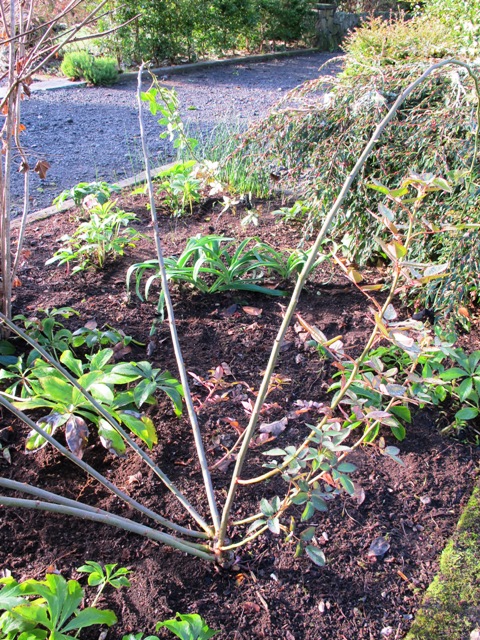
Not all big old camellias are things of beauty. But they are one of the easiest plants to renovate and now is the right time to carry out drastic pruning. If you cut a camellia off at ground level, most will resprout and come again. Even glyphosate doesn’t kill them. However, if you want to keep the plant, don’t cut it back to the ground because what you will get is a thicket of new shoots in spring. Look for the natural shape of the plant and cut off just above where the branches are well formed – usually about a metre up on an old plant. This means that when it flushes into growth, you will have an attractive and established shape already.

You can cut right back to bare wood with no foliage left at all. It is only the very occasional, contrary camellia that will die instead of rushing into growth.

The plant will respond by pushing out a mass of new leaves and you should have reasonable cover by the end of the first summer and a lovely bushy specimen which is flowering again a year later. If you can see mottling or variegation on the leaves, make sure you disinfect your pruning tools before you touch any other camellias. Camellias are susceptible to virus but that is not necessarily bad. It is what gives variegated blooms. However, you don’t want to transfer virus to specimens that are free of it, hence cleaning your tools. Household bleach will suffice as a disinfectant.

First published in the Waikato Times and reprinted here with their permission.
“The other kind of boundless garden is not a geometrical figure at all. This English kind has no obvious beginning or end and the bounds are confused on all sides, so that for this garden an un-wall had to be invented, which performs the physical functions without having the visual value of a wall. The ha-ha or sunken fence is an English joke on law and order that exercises real constraint with the English deviousness and we can almost imagine a simple person stumbling into these sophisticated gardens without realising that he is in a garden at all, like someone who misses an irony.”

Eccentric Spaces by Robert Harrison (1977).

Garden lore: Friday June 28, 2013

Hooping roses to maximise flowering

Hooping roses to maximise flowering

Hooping roses to maximise flowering is a technique I first saw done in Ayrlies Garden when Neil Ross was head gardener. If you have a rose which puts out long, whippy growths, arching those growths over and tying them down hugely increases the number of flowers. This is because it encourages all the leaf buds along the length of the stem to set flower buds as well by dispersing the hormones which trigger flowering, rather than concentrating them at the top. I insert wire hoops and tie the runners down with stockinette. The ground cover plants will hide the wire hoops by spring time. It takes a bit of space – a metre or more on each aspect. In a narrow space, you can do it to either side only in a free form re-creation of espalier. It does work, I can vouch for that. The wire hoops are easy to relocate each season as required though I sometimes leave the long runners in place for more than one season, pruning back all the side growths.

I am pruning roses now, but those gardeners in more frosty conditions usually leave it later in the winter. Pruning encourages the rose into growth and that fresh growth is particularly vulnerable to getting burned by frost. Rake out all the fallen rose leaves while you are about it. These can harbour disease and, like spent brassicas, should not be put through the compost heap unless you make hot compost to kill off the nasties.

For more information, check out my earlier post: a short lesson in hooping.

First printed in the Waikato Times and reprinted here with their permission.

Garden lore

“Now that all the other many-hued flowers have scattered without a trace, the dead white heads of the miscanthus remains alone in the fields until the end of winter. As it stands there so gracefully, not realising that it has entered its dotage, and bending its head as if in memory of past glories, it looks exactly like a very old person, and one cannot help feeling sorry for it.”

Sei Shonagon , The Pillow Book of Sei Shonagon (tenth century),
translated by Ivan Morris (1967)

???????????????????????????????
Pruning wisterias
Winter is the pruning time for many plants, but none more so than wisteria. The most common reason for their failure to flower in spring is savage pruning. Don’t cut them off at ground level because they flower from last year’s growth so you will be cutting off all the potential flower buds which form on the spurs. Think of them like an apple tree. Find the main stems which give the framework or shape to the plant. Shorten all the other whippy growths to between 3 or 4 leaf buds from the main stems. Thin out the ones at the base by cutting them back flush to the trunk. You don’t want the growths which sneak along at ground level because they will put down roots and your one plant can become many.

At the same time, deal to borer where you spot it. You will find the borer holes in the older wood. I tend to reach for the CRC or cooking oil to spray down the holes. It smothers them. Or you can use fly spray. None of these seem to harm the plant whereas the borer can ruin entire sections over time. It pays to keep replacement leaders coming through in case your main stems get too badly damaged.

Wisteria whips are very flexible when first cut and can be used for weaving in a similar way to basket willow.

Step by step instructions for pruning (with photos) here.

First published in the Waikato Times and reprinted here with their permission.

Garden lore

“In fine weather the old gentleman is almost constantly in the garden; and when it is too wet to into it, he will look out of the window at it by the hour together. He has always something to do there, and you will see him digging, and sweeping, and cutting, and planting, with manifest delight…; and in the evening when the sun has gone down, the perseverance with which he lugs a great watering-pot about is perfectly astonishing.”

Charles Dickens, Sketches by Boz

???????????????????????????????

Dealing with large container plants

Woody trees and shrubs cannot be left permanently in tubs and containers and expected to prosper. At some point they will start to go back badly because you have put them into an artificial, controlled environment. While you can extend by regular feeding, there comes a time when you have to repot, which is easier said than done with large plants and heavy pots. Get a large piece of plastic and gently tip the pot over on its side. You may need to support the plant to prevent damage. Then with an old carving knife, start excavating the old potting mix, rolling the pot as you go. This is not usually a three minute job.

Once you can get the plant right out of the pot, remove all the old potting mix that you can. I finish off by using the hose to wash out more. If it is going back into the same pot, you will probably have to trim the roots. Make sure you trim the top as well, to reduce stress on the poor plant. Repot using a good quality potting mix, making sure you get mix all through the plant as well as underneath and around it. Most mixes come with slow release fertiliser already added, in which case don’t add extra. Keep the final level about 2.5cm below the rim of the pot to make watering easier.

First published in the Waikato Times and reprinted here with their permission.