Category Archives: Garden lore

Wisdom and hints

???????????????????????????????

Garden lore

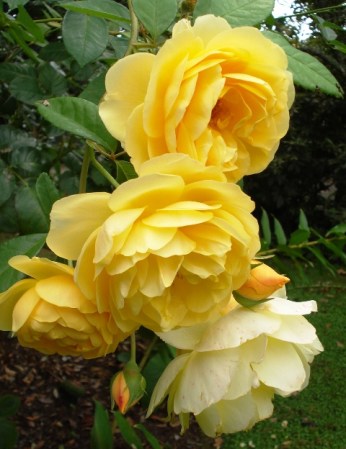
“As for roses, you could not help feeling that roses are the only flowers that impress people at garden parties; the only flowers that everybody is certain of knowing.”

The Garden Party by Katherine Mansfield (1922)

The value of growing your own veg

In strictly economic terms, the costs of growing your own vegetables can exceed the money you will save, particularly if you are buying plastic bags of potting mix and compost, fertilisers and sprays. Add in an hourly value for your labour and the economics look even more questionable. But of course the pleasure of harvesting your own vegetables and fruit, as well as the taste, the freshness, knowing what has been used on both the ground and the crops and the better nutritional value of eating straight from the garden far outweigh economic considerations.

That said, one of the predicted outcomes of the current drought is that the cost of buying fresh vegetables will skyrocket so it will be more economic now than before to grow your own. That is as long as you have water to spare for the vegetable garden. Asian greens will give you a very quick turnaround and you can be cutting tender young leaves in a matter of a few weeks. You can also be sowing salad greens and now is the time to get winter vegetables into the ground. They do their growing before winter and then hold in the ground when temperatures are low so that you can harvest when required. It is a bit late for root vegetables, though fennel is worth a try. The classic winter veg are the brassicas (cabbage, cauli, broccoli or cavolo nero for the sophisticates), winter spinach, silver beet and the like. Just remember, you are going to have to water thoroughly and often until the rains return.

First published in the Waikato Times and reprinted here with their permission.

Garden lore March 8, 2013

Lawns tell lies. The grass will almost certainly survive the current drought

Lawns tell lies. The grass will almost certainly survive the current drought

Surviving the drought
As the drought conditions bite deeper, keep to priorities for water use. Vegetables have the greatest need. Dry conditions can force plants to bolt to seed early (their instinct under stress is to survive by ensuring seed set) and in some cases the produce becomes bitter or woody. Water the soil, not the plant because it is the roots that achieve the best uptake. Watering in the evening reduces how much will evaporate immediately and when you are not watering the foliage, it won’t encourage diseases. If you overhead water by sprinklers, do it early in the morning to give the foliage time to dry.

Most of our common herbs are Mediterranean in origin so are well used to being dry in summer. Don’t waste time and water on them.

Lawns can survive a remarkably long time without water, despite their appearance telling lies. Annuals will bolt to seed early and perennials will pass over more quickly. Trees, shrubs and hedges should all be fine unless they were recently planted from mid spring onwards, in which case you may wish to give them a drink.

Do not mulch your garden now. It will slow down the absorption of water when good, steady rain arrives – which it will at some stage. Mulch can keep water out as well as keeping it in. Just take heed and get a good layer of mulch on at the right time next spring.

First published in the Waikato Times and reprinted here with their permission.
Garden lore

“ My garden is an honest place. Every tree and every vine are incapable of concealment, and tell after two or three months exactly what sort of treatment they have had.”

Journals by Ralph Waldo Emerson (published 1909-1913)

??????????????????????????????? The very hungry monarch caterpillars

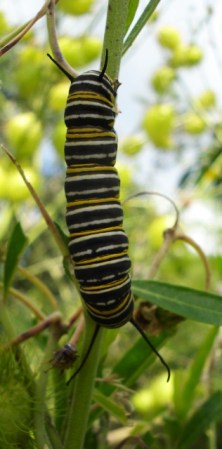
There is something bravely optimistic in the sight of a diaspora of monarch caterpillars heading away from a swan plant they have totally stripped, in search of another food source. This is even more so if you know there are no more swan plants around and judging by online searches and discussions, the state of the monarchs’ food supplies at this time of the year is causing a great deal of angst.

Do not panic. Reach for slices of pumpkin instead. We have done it here in one crisis year with good success rates. The NZ monarch butterfly website (www.monarch.org.nz) tells me that you can also use cucumber and courgette. But these options are not a complete diet and are only suitable for caterpillars which are already half grown, or about 10 days old.

What we did was to confine the caterpillars to an extremely large carton (so they didn’t head off looking for swan plants) with plenty of twiggy sticks so they could pupate and hang as cocoons successfully. We replaced the sliced pumpkin every day or two. Being caterpillars, they feed constantly from one end and excrete from the other – their poos were an astonishing orange.

First published in the Waikato Times and reprinted here with their permission.

Garden lore

“Nature is the gardener’s opponent. The gardener who pretends he is love with her, has to destroy all her climaxes of vegetation and make… an alliance with her which she will be the first to break without warning, in the most treasonable way she can. She sneaks in, she inserts her weeds, her couch-grass, her ground elder, her plantain, her greenfly and her slugs behind his back. The bitch.”

Gardenage by Geoffrey Grigson (1952)

???????????????????????????????

Grooming conifers

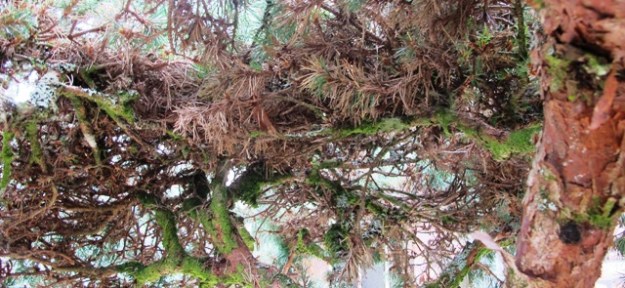
Conifers have had a bad rap in the NZ gardening world since their glory days of the 1970s. We regard this as entirely unfair. It is not the plants that are at fault, it is how we used them. If you are lucky enough to have some smaller growing conifers in your garden, getting in and cleaning them out improves the look, assists plant health by reducing problems with pests and diseases. They can build up an astonishing amount of decaying needles and debris which starts composting over time. What may look like a few brown tufts of foliage from the outside reveals a whole lot more if you part the branches to look within.

I just don gardening gloves and manually dislodge the debris, reminding myself I should start at the highest point I can reach and work my way down, rather than the temptation to do it the other way. I then follow up with secateurs to tidy up dead stems, trimming flush back to the branch. Snails like snoozing out the days in conifers, I notice. All plants benefit from some air movement and few appreciate composting material against their trunks.

First published in the Waikato Times and reprinted here with their permission.

Garden lore

” I had never ‘taken a cutting’ before…. Do you not realise that the whole thing is miraculous? It is exactly as though you were to cut off your wife’s leg, stick it in the lawn, and be greeted on the following day by an entirely new woman, sprung from the leg, advancing across the lawn to meet you.”

Down the Garden Path by Beverley Nicholls (1932)

007 - Copy Leaf drop – evergreen, semi evergreen or deciduous

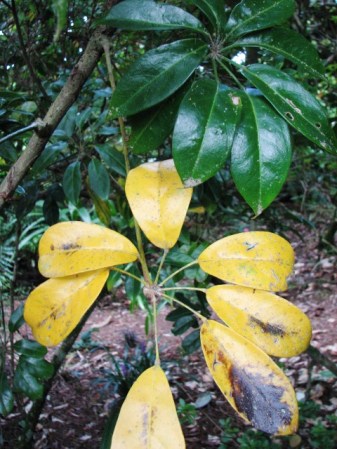
All plants lose a full set of leaves every year so the search engine terms I see like “a michelia that doesn’t drop leaves” shows a lamentable lack of understanding. What varies is how long the plants hold onto individual leaves and when they drop them. Deciduous plants drop them in one hit, triggered by declining day length in temperate and cool climates (ie autumn) or by the dry season in the tropics where day length stays constant. Semi deciduous plants usually drop all their leaves just as the new ones are coming through so the plant has a very short period without full foliage. Some plants will drop a lot of foliage around flowering time – Michelia Silver Clouds is an example of this.

Many evergreen plants gently drop old leaves all the time. It is just so gradual you don’t really notice it but you will see a build up of leaf litter below. The length of time an individual leaf stays on the plant can vary from a few months for bulbs to several years for bushy, dense evergreen plants but sooner or later, every leaf will either fall or wither away. A stressed plant will drop more leaves. It is the plant’s way of trying to reduce evapotranspiration (moisture loss).

If you want a plant which never drops leaves, you will have to keep to plastic or fabric. Living things have to renew themselves

First published in the Waikato Times and reprinted here with their permission.