Category Archives: Grow it yourself

Grow it yourself: spinach

Silver beet and spinach are close relatives. Indeed, somebody very close to me claims they taste the same when cooked, which I can’t argue against because it is so long since I have eaten the former. Texturally, I much prefer the finer, softer leaves of spinach and will happily eat those. Spinach is a winter vegetable. It will continue growing in colder temperatures but as soon as the weather warms in spring, it will bolt to seed. It is not quite as amenable as silver beet to grow and while you can leave plants in the ground and just pick as much as you need, it does not have the same cut and come again characteristics.

Well cultivated, well drained soil rich in nitrogenous fertiliser and full sun are the keys. Spinach is usually direct sown from seed and most of us now know to pick the thinnings and eat them as micro greens in salads or stir fries. The final spacing is in the 10cm range. In the right conditions, it is a quick crop because it will mature within a couple of months and you may have been eating immature leaves all that time. Some gardeners like to sow successive crops every few weeks to ensure continued supply.

There are a number of different spinach varieties, including New Zealand spinach or kokihi which is a different plant altogether (though similar taste and texture) and is our one great contribution to the global world of vegetables. While most spinach are spinacia, it is Tetragonia expansa. We recommend shunning the heirloom strawberry spinach (Chenopodium foliosum), being of the opinion that the reason it has been around for over 400 years is because it seeds so freely it is nigh on impossible to eradicate once you have it. The leaves are pleasant enough but the so-called strawberry seed heads are not.

First published in the Waikato Times and reproduced here with their permission.
Grow it yourself: silver beet

Call it silver beet, chard or Swiss chard. It is what you start planting as space becomes available from now on to offer a reprieve from frozen peas in winter. In fact you can grow it pretty much any time of the year but there are more delicious crops to eat in summer. Some of us think there are more delicious crops to eat in autumn, winter and spring as well but it is the proven ease and reliability which has made silver beet such a longstanding vegetable garden staple. Some people even claim to like it.

Being a leafy green, silver beet likes lots of organic matter, nitrogen and water. This is a crop where you can dig in animal manures, preferably composted first (and definitely composted if it is poultry manure). Sow the seed and cover lightly to a depth of a couple of centimetres. You can eat the thinnings as fresh salad greens when young, achieving a final spacing of around 30 to 40cm per plant. Silver beet can be a handy plant for tucking into odd spaces instead of a uniform row. It will sit there for a long time until it bolts to seed in spring because usual practice is to harvest a few leaves as you need them, rather than picking the whole plant at once. It is that cut and come again ability in cool conditions that makes it so handy. Just don’t cut too much at once or you will weaken the plant.

The rainbow coloured chards with red, yellow and pink stems and leaf ribs may add a decorative element in the garden and to raw salads when young, but they taste no different to the usual white stemmed version and the colour disappears entirely if you do more than the lightest blanching. However, they may encourage children to take a more kindly attitude to what is essentially an obliging but utility vegetable which is dead easy to grow and high in iron.

First published in the Waikato Times and reprinted here with their permission.

Grow it Yourself – Broccoli

Ssh and I will make an admission. I am not keen at all on broccoli despite understanding that it is terribly good for me. There is just something about the taste and texture that does not appeal, though I concede it is acceptable in a creamy soup with blue cheese. But, it is a staple vegetable and so easy to grow that it is a mainstay for most vegetable gardeners. We avoid growing it over summer here because it is a magnet for white butterflies and we don’t want to have to spray it but as the cooler weather of autumn approaches, it is planting time again. The white butterflies peter out when cooler weather comes and in the interim, it is easier to keep small plants insect free.

If you start from seed, it is usual to sow it into small pots or a seed tray to get the plants growing strongly before planting them in the garden. Unless you have a huge family of voracious broccoli eaters, buying an occasional punnet of seedlings is the easy way to go. They need the usual well cultivated soil rich in humus and with plenty of sun. Being a leafy green, they also appreciate fertiliser. We prefer to give this through extensive use of compost (nature’s very own slow release fertiliser) and blood and bone or you can feed with any number of cheap and cheerful proprietary mixes if you prefer. Aim for one rich in nitrogen. Keep the water up to the plants if we get a dry spell – leafy plants need plenty of moisture. Allow about half a metre of space around each plant. It seems a lot when the plants are small but they need room to spread and they don’t appreciate competition from neighbours. Plant them a little deeper than they are in the seed pots to encourage them to develop more roots higher up the stem.

Broccoli is generally cold hardy and will hold in the ground in winter to enable you to harvest as little or as much as you want at a time. Plants may need protecting from birds while they get established.

First published in the Waikato Times and reprinted here with their permission.

Grow It Yourself: Cardoon

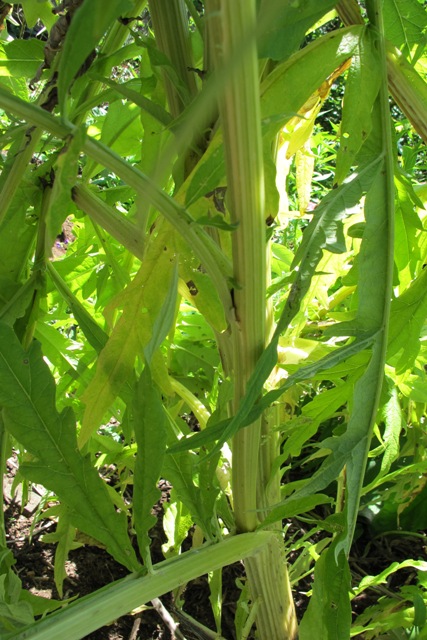
Cardoon stems resemble giant celery but only in looks

Cardoon stems resemble giant celery but only in looks

The edible cardoon is Cynara cardunculus and it is very closely related to the globe artichoke, though less well known. To be honest, it falls into the novelty class of vegetables, to be grown by those with plenty of space and a sense of curiosity though it is a sufficiently handsome plant to justify a place in the summer border. The flower is a good indication that it is a relative of the thistle – all belong to the asteracae family. Cardoon is native to the Mediterranean and North Africa and in the wild is a great deal pricklier than modern cultivated selections. Its homeland and its silver toned foliage both give a hint that it is a plant adapted to hotter, drier conditions though we have found it exists quite happily on the margins of the vegetable garden. It would benefit from being staked in our wetter climate. It is a perennial and reaches over 1.5m high and about a metre wide so it needs space.

Cardoon is a traditional vegetable in its homeland areas. Most commonly eaten are the leaf stems which are harvested in winter and early spring, before the plant sets flowers. These look a bit like celery and are always cooked before eating. The young flower buds are also eaten in southern Italy. I will admit that we have only tried eating it once and we parboiled it. It was not an exciting experience though it was perfectly acceptable in an anonymous green sort of way. I will try again this winter, using it braised and in soups. Its value may lie in giving a fresh alternative in late winter when other greens are sparse. It is also a source of natural, vegetarian rennet and some artisan cheese makers in this country have returned to this traditional usage.

First published in the Waikato Times and reprinted here with their permission.

Grow it Yourself – parsnips

Parsnips are not the most glamorous of vegetables, even less so when old and woody which is usually a sign of being dug too late. But I am very partial to a bit of roast parsnip and they add welcome variety in winter when veg can get a bit repetitive. We are doing a late sowing parsnip seed now for winter harvest. Others will have sown as early as last spring though they are not likely to harvest before winter. They will have considerably larger specimens by then, as long as they do not bolt to seed. From this you can take it that the timing is not critical. They take about four and half months to reach maturity so you can be eating them from July onwards if planting now. It is usual to leave them in the ground and dig as required. They go dormant over winter and frosts are said to enhance the flavour considerably.

The two critical issues are to use fresh seed (parsnip seed does not store well) and to avoid additional fertilisers. Nitrogenous fertilisers will encourage too much top, leafy growth and not enough root development. Fresh manures will cause forked and misshapen roots. Parsnips are a good option where you have taken out a heavily fertilised crop like leafy greens or even potatoes. Don’t add anything extra – there should be plenty of goodness left in the soil. Make sure the soil is well tilled and friable to allow the roots to grow straight. Seed is sown close to the surface and covered lightly. Once it has germinated and is growing away strongly, thin to at least 10cm apart in every direction to allow room to develop. Diseases are not usually an issue and while a few pests can attack parsnips (carrot fly, greenfly and wireworm), this is not usually a big problem.

First published in the Waikato Times and reproduced here with their permission.