Category Archives: Grow it yourself

Grow It Yourself: yams

Clearly an oxalis family member - the New Zealand yam

Clearly an oxalis family member - the New Zealand yam

It is curious that what every New Zealander knows as a yam is only a yam in this country. Overseas, yams are an entirely different vegetable and our yams are called oka or oca. This does not matter unless you are using overseas growing instructions or recipes. Our yam is a member of the oxalis family – O. tuberosa – and we all know they are the reddish thumb-like, nubbly tubers that are delicious roasted but can be a pain to prepare if they are too small.

Our yams are a root vegetable from the highlands of South America. They are not difficult to grow but the yield rates can be disappointingly small. The best ever yams we saw were grown in a neighbour’s garden in Dunedin which is an indication that they are quite happy with cooler temperatures, though frost kills off the foliage. Grow them like a potato. Plant the tuber and as you see smaller nodules forming on the stems above ground, mound up the soil to encourage those nodules to develop into tubers. In warmer areas, they will grow all year and more or less naturalise if you allow them to (great if you are into one of the trendy food forests) but even so, they will appreciate a gift of compost mulch from time to time. They appear to be largely immune to pests and diseases but they do need good drainage.

Yams sweeten up if you leave them in the sun for a couple of days after harvest. Because they are thin skinned and don’t need peeling before cooking, they are vulnerable to damage during harvest and they don’t have the storage longevity of potatoes or kumaras. You can layer them in sawdust or newspaper if you want to hold them longer term.

First published in the Waikato Times and reprinted here with their permission.
Grow it Yourself (or not, in the case of American school lunch pizza)

Yes! Pizza. In honour of one of life’s bizarre rulings of 2011, that pizza counts as a vegetable serving. Here I was thinking that by definition, vegetables are edible plants that one grows but apparently not. Mass produced pizza with a smidgeon of a red substance which once, some time and distance past, had a debt to a tomato, can now officially count as a vegetable. One might not have been quite so surprised had the good gnomes of Brussels made a formal decree. It was the European Community, after all, that passed regulations on how bent a banana was permitted to be and they also addressed the perplexing issue of cucumbers. I can’t recall the details of that but I think it was probably on how far a cucumber was permitted to bend from a straight line. But it was the United States Congress, that fine law making body, which bowed to the pressures of the frozen food industry and reclassified pizza to enable it to remain as a healthy option (ie: counting as a serving of vegetable) on the menu of school lunches for American children.

Our diets in New Zealand may be far from perfect and we have a growing issue with obesity, but I think we have far too much respect for the Heart Foundation and the healthy tick to consider mass produced pizza as a healthy food choice. If you are worried about your weight, just ponder for a moment how many obese vegetarians you have met. I failed to come up with any. Certainly it is not common and while giving up eating meat may be a step too far for many (including me), doubling the fresh vegetable intake might be a good New Year’s resolution to make, along with trying to grow at least some at home.

First published in the Waikato Times and reprinted here with their permission.

Grow it yourself: basil

Was there life before basil? Surprisingly yes, but it probably amounted to soggy sliced tomatoes drowned in salt and fine white pepper with Maggi onion dip in place of pesto. Of all the herbs, nothing shouts summer like basil. In my opinion it is only worth eating fresh so it is very seasonal. It is not difficult to grow in rich vegetable garden conditions (the usual full sun and friable, fertile soils) but it won’t do much until summer is pretty much upon us because it needs warmth even to germinate – about 20 degrees of it. It is not too late to sow it now though you won’t get much to pick until late February. Enthusiasts start it earlier under cover and plant out into the garden as soon as temperatures rise sufficiently.

I see Kings Seeds now offer 17 different types of basil plus a gourmet blend for the indecisive. We have tried some different types but keep going back to the most common variety – Sweet Genovese, or its equivalent. To harvest, just keep picking leaves as required. Keeping the plants well watered encourages them to continue growing rather than bolting to seed early. Caterpillars can take a liking to the leaves but you can generally control these by hand.

The shortcut approach where time and equipment are a problem, is to buy the pot of smallest, least mature basil in the fruit and veg section of the supermarket and to repot these to a larger container with optimum conditions (good mix, full sun, plenty of water and liquid feed) and resist the temptation to start harvesting leaves immediately. The older pots of living herbs in the supermarket are leggy and stretched (reaching for the light) but if you get a fresh shipment they are sometimes a little more squat and juvenile. Elder Daughter used this approach to keep a year round supply going. Others recommend chopping up basil leaves, adding olive oil and freezing in ice cube trays. I have tried this but decided that I prefer to keep basil as a seasonal taste in summer, best picked with sun warmed leaves and eaten very fresh. Try it in a simple salad with slices of fresh, white mozzarella and ripe tomatoes – summer in a salad bowl.

First published in the Waikato Times and reproduced here with their permission.

Grow It Yourself – leeks

Dedicated leek growers (not all of Welsh descent, I am sure) know that if they want a good sized harvest, plants need to be a finger thickness by Christmas. But it is not too late to sow seed now – the plants will just be a bit smaller. Leeks have a long growing season of up to 6 months and because they are a winter plant, they can then hold in the cold ground until you are ready to pick them.

Leeks are not fussy or particular. They grow easily in most soils. Because they belong in the leafy vegetable group, they thrive on nitrogen based fertilisers. This means they are going to be quite happy growing where you have recently dug in a green crop or if you have an area where you have previously added animal manures.

If you are going to sow seed, get it in as soon as possible. As the seeds germinate, you can use the thinnings as salad veg (they are a little like chives with an oniony tang). Final spacing needs to be about 10cm to achieve full sized leeks. If you are using seedling plants, you have a few more weeks up your sleeve and you generally plant them at final spacing. They are likely to need watering for the first few weeks while they get their roots out.

With vegetable gardening, you work one to two seasons ahead. Planting for winter now means you can avoid the hefty prices of bought fresh veg and have a change from interminable frozen peas. And leeks are an easy option. You just have to plant them in good soil and keep them relatively weed free (to stop competition) and in winter they should be waiting for you.

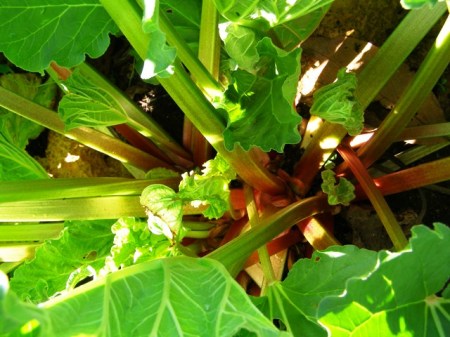
Grow it Yourself: Rhubarb

Rhubarb is one of the few long term plants in the vegetable garden. A clump can last anything up to 10 years, though if you are a rhubarb fan, you are more likely to be renewing your patch more regularly than that to ensure uninterrupted supply. Think of it like a clumping perennial – it grows from a crown below the surface of the ground and makes its own offshoots. Like most perennials, it likes to be planted in ground that has been well dug over with plenty of humus or compost added in. Beyond that, it does not want wet feet in winter (which will kill it) and it is fine in half to full sun. Just feed it or mulch with compost once a year – spring is a good time. An established plant is going to take anything up to a round metre is space (that is, as opposed to a square metre).

Usually the pinker the stem, the nicer they are to eat but apparently there are varieties that stay green so you may be waiting forever with them. The leaves and roots are poisonous because they contain oxalic acid so you do not want to eat them or to eat the closest stem parts. However it is an urban myth that it is not safe to put them in the compost heap. I have yet to meet anyone who eats their compost and the natural toxins break down in the composting process.

It is easy to grow rhubarb but it is only worth the effort if you like its taste and are prepared to cook with it. I like to add a little gelatine to my stewed rhubarb, being a jelly fan. Adding a little grated fresh ginger while cooking takes it up more than one notch and I found the children ate it quite happily when it was cooked with some sago added (check out Alison Holst’s recipes).

First published in the Waikato Times and reproduced here with their permission.