Category Archives: Plant collector

flowering this week, tried and true plants

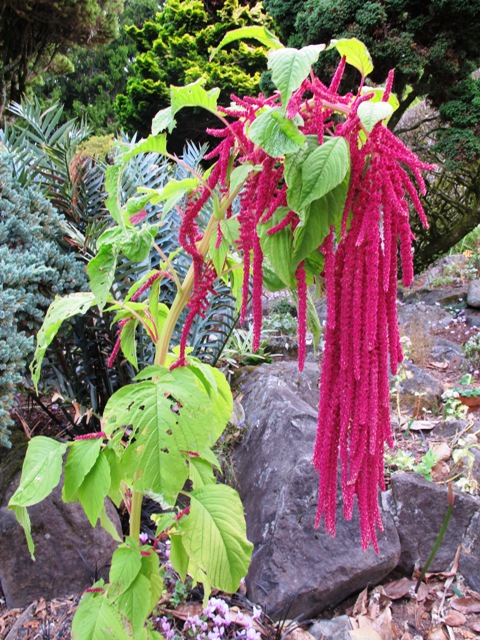
Plant Collector: Amaranthus caudatus

Amaranthus caudatus - Love Lies Bleeding

Amaranthus caudatus – Love Lies Bleeding

There is nothing fancy or special about this amaranthus which bears the unfortunate common name of Love Lies Bleeding. It is just an annual which has seeded down over many years in our rockery, but in early autumn we welcome its return. It grows at a remarkable speed. Throughout most of summer, the tiny seedlings are only a few centimetres tall, taking up next to no space at all. Look away for a couple of weeks and suddenly they have rocketed up to a metre or more and produced these eye-catching red tassels which will last right through autumn. The advantage in our garden situation is that the plants still take up very little ground space so the bulbs that are shooting away in the same pockets of the rockery are not crowded out.

There are many different amaranthus species – maybe 70 of them. Some species are eaten as fresh greens, some are predominantly grown as ornamentals while some provided grain in their native habitats of Mexico and South America. There is some resurgence of interest in amaranth grain, including from alternative lifestylers. It appears that A. cruentus is the main grain species but our A. caudatus also gives edible grain and so does the oddly named A. hypochondriacus. The problem we see in using our Love Lies Bleeding is that, while it sets prodigious amounts of seed, it does not all ripen at once, which would make harvesting difficult. However, should armageddon come, we do apparently have a potential source of grain in our front garden, as long as I leave one or two plants to seed down each year in the interim. In the meantime, they do a great job of feeding the birds.

First published in the Waikato Times and reprinted here with their permission.
Plant Collector: Chaenomeles

022Not quinces, as most people think, but chaenomeles or japonica apples. At this time of the year, the hanging golden orbs are a most attractive feature. I like to bring a bowl indoors because they are scented, in an aromatic apple-y sort of way and they last for many weeks. The plant itself is a deciduous, scrubby shrub, maybe 2 metres tall and, after many years, 4 metres wide. It has burglar deterrent possibilities with its ferocious spines but is not a thing of natural beauty beyond its attractive fruit in autumn and its lovely single, deep pink japonica flowers in spring. It will have been a named form that was purchased but the name is lost in the mists of time. It appears to be a hybrid – a cross between 2 of the 3 different species, selected for both flower colour and fruit and is most likely to be in the Chaenomeles x superba group. We have other forms that flower well but don’t fruit in the same manner.

Chaenomeles are native to Japan, eastern China and Korea. Unsurprisingly, given their long thorns, they are related to roses and in the roseaceae family.

The fruit is far too astringent to eat raw. I have been given a jar of japonica jelly but it was not memorable. Apparently they are very high in pectin so I may try boiling some down to use as a base for orange marmalade. I tried making chaenomeles brandy one year and it was fine, but we are not so keen on liqueurs in this household. I would rather drink the brandy without the year steeping with sliced chaenomeles and sugar.

First published in the Waikato Times and reprinted here with their permission.

Plant Collector: Dietes grandiflora

062There is nothing unusual about the dietes flowering at the moment, but don’t let the fact that it is much favoured by amenity landscapers put you off. The reason it is seen so often in shopping centre garden plots is because it is tough and easy care.
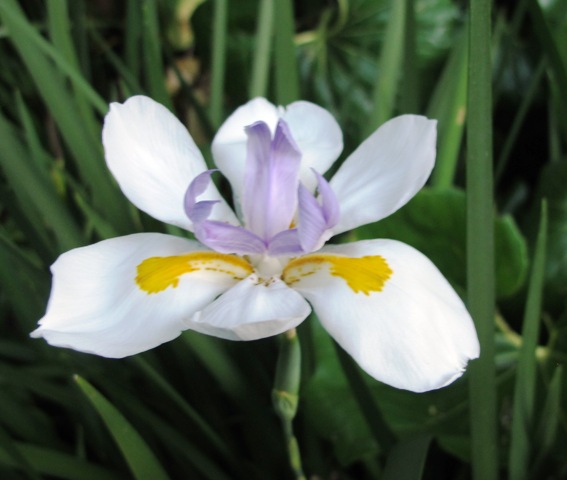
It is a South African wild iris. Originally it was thought to be a moraea – commonly known as peacock irises – but that family grows from corms whereas the dietes forms rhizomes. Its flowers link it to moraeas, its rooting structure to the iris. Apparently the word dietes means ‘having two relatives’. ‘Grandiflora’ just means large flower.

The foliage is narrow, upright and pointed and it is evergreen. For most of the year, it just looks anonymous and not very exciting but it has such pretty flowers at this time. These are short lived but, as with many other irises, there is a succession opening down the stem. If the blooms remind you of an exotic butterfly, you may be pleased to hear that it is sometimes referred to as a butterfly iris. It flowers best with sun. While the plant will grow in relatively shady positions, you won’t get anywhere near as many blooms so try for full sun or somewhat dappled light.

As a garden plant, unless you want your place to look like a supermarket carpark, veer away from mass planting in favour of interesting combinations. I think it looks wonderfully effective planted with the tractor seat ligularia (Ligularia reniformis) but any contrasting big, luscious foliage is going to work.
017 - Copy
First published in the Waikato Times and reprinted here with their permission.

Plant Collector: Corymbia ficifolia

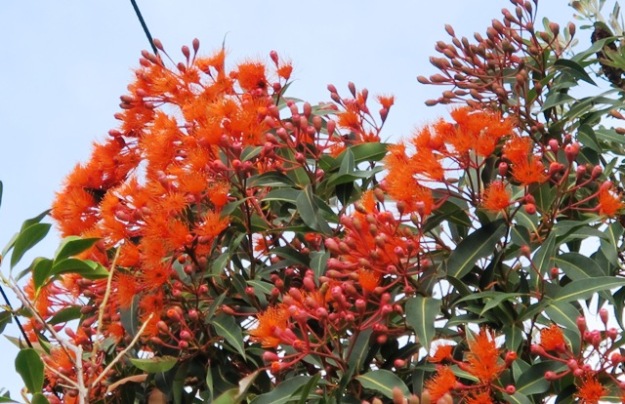
Techically Corymbia ficifolia but more commonly known as the flowering gum

Techically Corymbia ficifolia but more commonly known as the flowering gum

When is a gum tree not a eucalyptus? When it is a flowering gum, apparently. This came as something of a surprise to us. It is no longer Eucalyptus ficifolia but is now named Corymbia ficifolia. It is still a very close relative and will likely continue to be referred to in the grouping of eucalypts or gums. The vast majority of eucalypts are Australian. This one hails from a small area a relatively long way to the south east of Perth. While its natural habitat means it is accustomed to poor, sandy soils it has proven both popular and reliable as a street tree internationally – anywhere which is not consistently humid or suffering from extreme frosts. This specimen is just on the end of one of our shelter belts and remains relatively anonymous until it suddenly bursts into glorious bloom.

As it is notoriously difficult to root from cutting or to graft, flowering gums are almost always produced from seed which means there will be variation. They take several years to flower and it is pot luck what colour they will be. While orange and red shades are the most common, they can also be close to white and the full gamut of pinks. They are rated as small trees, taking a long time to get much past 3 or 4 metres tall. As trees go, these are a pretty easy-care variety and are available for sale in NZ.

According to Wikipedia, Hamilton’s very own Princes Street boasts the largest known single-trunked specimen of Corymbia ficifolia in the world. I could not see it on Google street view so I wonder if it is still there. Did somebody fell the world’s biggest?

Postscript: My Waikato Times features editor sent out a photographer, armed with my photo, and I am delighted to report that the world’s largest, single-trunked specimen is still present and correct.

First published in the Waikato Times and reprinted here with their permission.

Plant Collector: Agave attenuata

Agave attenuata growing in the Auckland Regional Botanic Gardens

Agave attenuata growing in the Auckland Regional Botanic Gardens

I photographed this at Auckland Botanic Gardens because it was such a fine looking clump and not at all like our specimens here. This agave is Mexican so is always going to be happier with brilliant drainage, dry conditions and considerable heat. Our conditions are less than perfect so the plants tend to rot, fall over and resprout. We need to relocate them to an open, sunny, hillside and allow them space without other plants around them.

While now rare in the natural habitat, this is a very popular agave in cultivation partly because it lacks the vicious spines and needle-like tips of so many other members of that family. I assume the “attenuata” refers to the slender, tapering flower spike which starts more or less vertical before acquiring a tilt like a swan’s head, then pointing downwards to the ground from whence, according to the photos, it can then head upwards again. Ours have never flowered, so I have not seen this curious phenomenon in person.

Readers in frosty areas will probably only succeed with A. attenuata in pots and even then, they will need to be brought under some cover in winter. Even without flowers, the clumping, fleshy rosettes of foliage are attractive. Like many succulents, the plant increases by setting pups to the side.

First published in the Waikato Times and reprinted here with their permission.