Category Archives: Plant collector

flowering this week, tried and true plants

Plant Collector: Agave attenuata

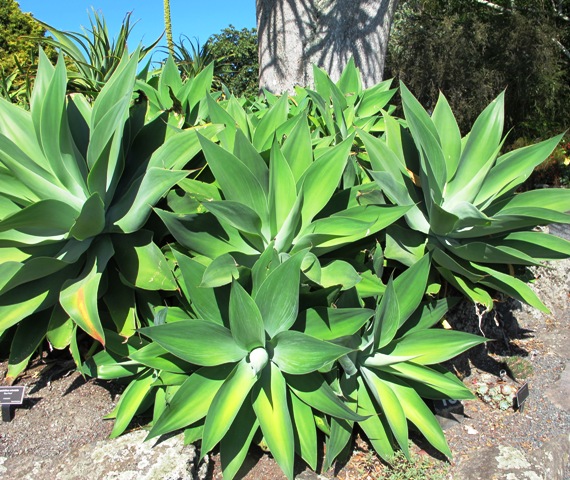
Agave attenuata growing in the Auckland Regional Botanic Gardens

Agave attenuata growing in the Auckland Regional Botanic Gardens

I photographed this at Auckland Botanic Gardens because it was such a fine looking clump and not at all like our specimens here. This agave is Mexican so is always going to be happier with brilliant drainage, dry conditions and considerable heat. Our conditions are less than perfect so the plants tend to rot, fall over and resprout. We need to relocate them to an open, sunny, hillside and allow them space without other plants around them.

While now rare in the natural habitat, this is a very popular agave in cultivation partly because it lacks the vicious spines and needle-like tips of so many other members of that family. I assume the “attenuata” refers to the slender, tapering flower spike which starts more or less vertical before acquiring a tilt like a swan’s head, then pointing downwards to the ground from whence, according to the photos, it can then head upwards again. Ours have never flowered, so I have not seen this curious phenomenon in person.

Readers in frosty areas will probably only succeed with A. attenuata in pots and even then, they will need to be brought under some cover in winter. Even without flowers, the clumping, fleshy rosettes of foliage are attractive. Like many succulents, the plant increases by setting pups to the side.

First published in the Waikato Times and reprinted here with their permission.
Plant Collector: Streptocarpus

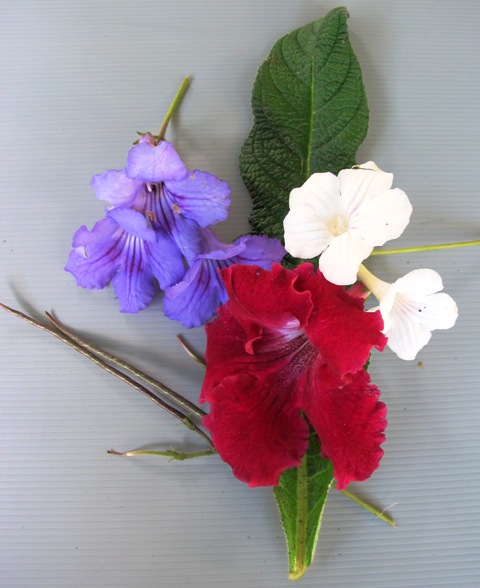
Streptocarpus hybrids - woodland bedding for mild climates

Streptocarpus hybrids – woodland bedding for mild climates

Not much shouts “mild climate” louder than using streptocarpus as bedding plants in shaded areas of the garden. That is because they are seen as conservatory plants in the temperate gardening world and few think to use them outdoors. They won’t take frost or very damp conditions, but they can withstand cooler temperatures.

The flowers are what is described as salver-shaped and sit above the foliage, usually in clusters. These will be hybrids, not the original species which grow in shady spots throughout quite large parts of Africa. A distinctive characteristic is the thin, spiral seed heads. Brittle leaves can get damaged easily, as well as snapping off but they also root easily from leaf cuttings so try replanting entire broken leaves. The root system is small and shallow, which means that it is not difficult to lift and divide established plants.

In a garden situation, we don’t get the quality blooms that are possible under cover but we do get months of flowering. If you don’t have a frost free, shaded garden position, these are still worthwhile plants to try indoors but keep them out of full sun.

Streptocarpus belong to the Gesneriaceae family. The best known members of this family are probably the touchy but very pretty African violets which are widely sold as house plants in this country. You may also recognise a similarity to what we often refer to as gloxinias – though it appears that the common gloxinias are not. Not gloxinias, I mean. They are more likely Sinningia speciosum, which I am unlikely to remember.
061
First published in the Waikato Times and reprinted here with their permission.

Plant Collector: Tigridia pavonia

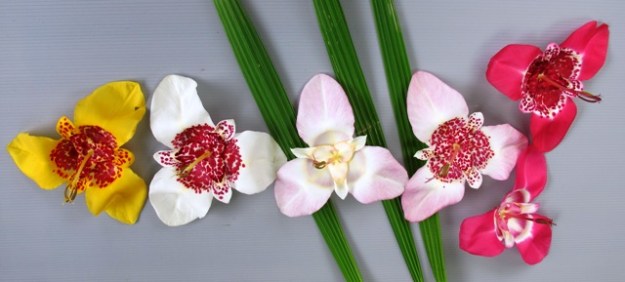
Tigridia pavonia - missing the scarlet red one we have which had no flowers open on the day

Tigridia pavonia – missing the scarlet red one we have which had no flowers open on the day

There is nothing rare, choice or difficult about these bulbs which can border on garden weeds, they are so easy. But in the right situation, they are a delight in the summer melee. Tigridias are from southern Mexico but probably on the road to naturalising anywhere hospitable. They set prodigious amounts of seed and can reach flowering size from seed in two years. Their common name is jockey caps and they belong to Iridaceae (iris) family. The flowers are relatively large – up to 15cm across – with 3 large outer petals and 3 inner small ones, but short-lived. Each bloom only lasts one day, opening in the morning and wilting away to oblivion by evening. However, each stem produces multiple blooms in succession. The pleated leaves are attractive in themselves and both flower and foliage sit around 60cm high. In case you are worried about weed potential, be reassured that they are easy to pull out if they pop up in the wrong place and you can control them by removing seed pods.

Tigridias want full sun and good drainage but also some summer rain when in growth. We find they combine well with larger growing summer plants like dahlias and lychnis in less formal areas of the garden.

Mark’s very late Uncle Les (he who bred such camellia classics as Jury’s Yellow, Anticipation and Debbie) spent some time trying to breed the freckles out of tigridias which always seemed a rather odd track to take, though the freckle-less blooms perhaps have a finer charm of some sort.

First published in the Waikato Times and reprinted here with their permission.
Plant Collector: Crocosmia “Lucifer”

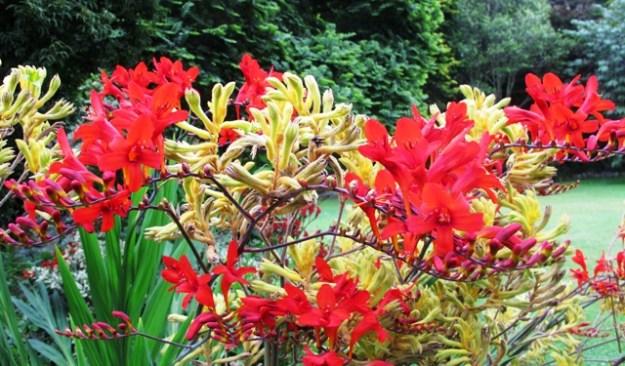
Red Crocosmia 'Lucifer' with yellow anigozanthus

Red Crocosmia ‘Lucifer’ with yellow anigozanthus

When they are roadside weeds, these bulbs are often referred to as montbretia. Treading on thin ice, I admit that we have orange-red ones growing amongst agapanthus on our roadside. At least it is better than the dreaded bristle grass that is the scourge in our area. “Lucifer” is a superior form, a hybrid with bigger flowers and stronger colour, making it popular as a garden plant. It is strong growing and both the pleated leaves and the flower spikes can get above waist height and it is almost indestructible. I like to keep it confined but it makes an attractive display beneath the apple trees and also alongside an equally strong growing yellow anigozanthus (kangaroo paw) which we have at the front of the rockery.

The bulbs are not unlike gladiolus corms and form chains below ground. It is the ability to grow when the chains are separated that makes these both easy and verging on weedy in some situations. We have a much larger flowered golden orange form which may be “Star of the East”. I say we have it, but we are waiting to see if indeed it is still here because it has been nowhere near as vigorous as “Lucifer” and each year we worry we have lost it.

Crocosmias are a small group of South African bulbs belonging to the iridaceae family. They are winter dormant, but their one drawback as a garden plant is that it takes a long time for the foliage to die down and they can be unattractive in autumn. That said, they are such toughies that I often trim the foliage off early to tidy them up.

First published in the Waikato Times and reprinted here with their permission.
Plant collector: Aurelian lilies

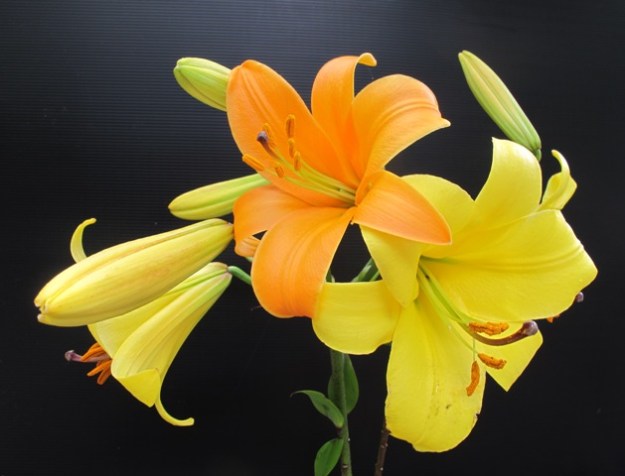
The lovely Aurelian lily hybrids

The lovely Aurelian lily hybrids

‘Tis the season of the Aurelian lilies. These are hybrids (so crosses of different species) and fall within the trumpet lily group. Their blooms are indeed shaped like trumpets which face outwards, often dropping a little with their weight. And sweetly scented, though not with the heady intensity of the auratum lilies which are just starting to open.

Aurelians are all hybrids of Lilium henryii. It is orange with reflexed petals (so they curve backwards) and no scent but it is a tough survivor. The original crosses were with Lilium sargentiae from China which is a trumpet species so brought in the flower form along with the fragrance. Now the Aurelians are pretty mixed in terms of breeding but typically flower in shades of yellow and apricot orange. Most will set seed so if you can’t find them to buy, you can at least raise seed if you know of somebody with them. These are seedlings Mark raised to build up numbers for the garden. It can take from 3 to 5 years for seed to reach flowering size.

Like most lilies, these bulbs like humus rich conditions and plenty of sun and moisture. They are quite tall – up to 180cm – so grow them amongst plants that you can prop the lily stems up against or they will need individual staking. Despite very sturdy stems, the weight of the flower heads pulls them over. The number of flowers per stem can vary from one (often an indication of weaker bulbs) up to full heads. The most I have counted is 18.

Aurelian was a Roman emperor and, of course, aureum means golden in Latin.

First published in the Waikato Times and reprinted here with their permission.