Category Archives: Plant collector

flowering this week, tried and true plants

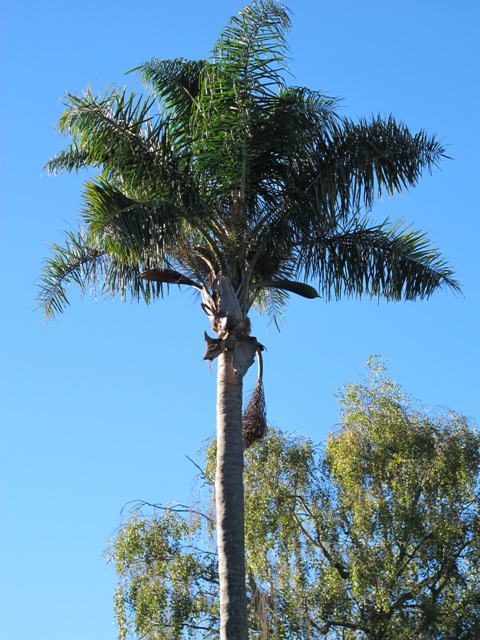
Plant Collector: Syagrus romanzoffiana

The towering Queen Palm, or Syagrus romanzoffiana growing in coastal Taranaki

The towering Queen Palm, or Syragus romanzoffiana growing in coastal Taranaki

I asked Mark how tall he thought our queen palms are. Mentally I was stacking 2 metre men on top of each other which is how I estimate tree heights. “About eighty feet,” Mark replied, “to the top of the crown.” I leave it in imperial feet because it sounds more impressive than 25 metres. They are tall, these handsome palms, and we have three of them. All were planted in the late 1950s by Felix Jury, from seed given to him by one of the Australian botanic gardens. Not that they are an Australian native. These are South American palms, coming from that mid band where Argentina, Brazil and Bolivia meet.

The single trunks are tall and slender and the impressive top knot houses an entire condominium of nesting birds. In spring time, there are often small, lightly feathered corpses at the base because fledglings are not going to survive a fall of that magnitude. It is mostly sparrows with the occasional starling. We often sit in a spot which looks out to one palm and the amount of comings and goings are prodigious.

I read advice on line that said: “the fronds die early and must be pruned to keep the tree visually pleasing”. No, we do not get the extension ladder out to groom our queen palms. Fronds do indeed die but they detach themselves in time and crash to the ground. As the sheaf of the frond is quite substantial, you don’t want special plants beneath and you certainly wouldn’t want one of these beside a building or near the car.

S. romanzoffiana is a suitable substitute for the common bangalow palm. While there are reported incidents of it escaping into the more tropical wilds of Australia, it has nowhere near the weed potential of the bangalow and we have never heard of it being a problem in NZ.

First published in the Waikato Times and reprinted here with their permission.
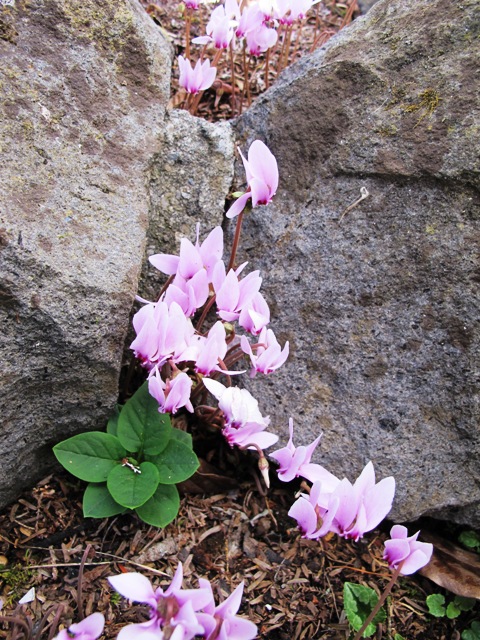
Plant Collector: Cyclamen hederifolium

???????????????????????????????
As early as January the first flowers on Cyclamen hederifolium start to appear on parched soils, though they are just coming into their own now. Some of you may know C. hederifolium by its earlier name of neapolitanum. It is the easiest of the dainty species to grow with one of the longer flowering seasons. The heart-shaped leaves, usually mottled and marked with silver, appear towards the end of flowering and make an attractive ground cover through until early summer.

Hederifolium comes in a range of pinks from light to mid, as well as in pure white. It hails from southern Europe through to Turkey and grows in hard, poor conditions, tolerating both heat and cold. What it doesn’t want is wet ground. We use it in open sun to semi shaded woodland margins where drainage is good.

Cyclamen grow from tubers which can develop to large, flat discs. Over the years, some of ours have reached up to 20cm or more across.

If you can’t find C hederifolium for sale, it is easy to grow from fresh seed and gently seeds down in the garden. If you know of somebody who already has it, the seed forms later in the year as a fleshy capsule at the end of a corkscrew stem. The secret is to sow it immediately and not try and store it.

The species cyclamen have a gentle charm which I personally find lacking in the big flowered hybrids which are sold as house plants. However most of those will survive as garden plants and live on if you find a suitable spot where they won’t get outcompeted by overhanging plants.

First published in the Waikato Times and reprinted here with their permission.
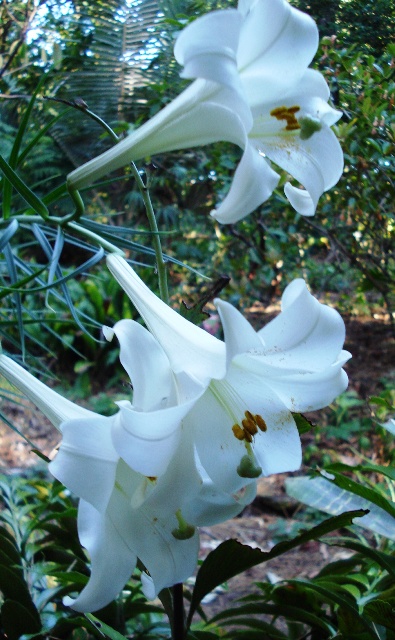
Plant Collector: Lilium formasanum

An update on this story is in Banned Plants. Somewhat to my embarrassment, it appears that Lilium formasanum is on the pest plant list in NZ and banned from sale.

The last of the lilies to flower

The last of the lilies to flower

The last of the lilies for the season is flowering now. Lilium formasanum hails, as older readers and plants people will know, from the island of Taiwan, which was formerly known as Formosa. It is another trumpet type of lily. Ours are all seedlings scattered through parts of the garden now and essentially white. Some forms have more of a pink to purple flush or streaking on the backs of the petals. The stems can be tall at up to 1.8m so it is easiest to have them growing amongst other plants which can give some support. I admit our self sown seedlings tend to flop around and need to be leaned up against nearby shrubs where there are some available.

As with lilies in general. L. formasanum prefers full sun but is not fussy about soil types. In fact it is not fussy about much at all and gently seeds down through our open woodland areas, flowering freely in late summer. By open woodland, I mean a high leafy canopy which allows good light levels but no direct sun. Unlike many other bulbs, formasanum does not take long to flower from seed. Where it has seeded down naturally, we think that it flowers two years from seed but according to bulb expert, Terry Hatch, if you gather the seed when it is ripe in autumn and sow it in early spring, you can get it flowering by late summer. That is a quick turnaround though you will only get a single flower, not the cluster in that first year. Its light foliage means that it will die down gracefully in autumn and yes it does have a scent, though only a light one.

First published in the Waikato Times and reprinted here with their permission.

Plant Collector: Calliandra, probably eriophylla

Calliandra (probably eriophylla) - like a strawberry pink starburst

Calliandra (probably eriophylla) – like a strawberry pink starburst

Oh my but the calliandra has been putting on a wonderful impersonation of candy floss (fairy floss) in recent weeks. What is more, this is its second flowering for the season. We are impressed. This plant is in the never-never land of our former nursery area where it has survived on complete and utter neglect, having rooted through from its pot. It is beyond transplanting out to the garden but fortunately we have a few grown from cutting which we will be rushing out to prime spots after this summer’s performance. We just don’t have too many areas in the garden which are hot, dry, desert-like even, frost-free and bearing much resemblance to its homelands of Arizona, Texas and Mexico.

If we are right and it is C. eriophylla, its common name is Fairy Duster, though it is sometimes referred to Mock Mesquite. The flowers are clusters of stamens almost like starbursts. Calliandras are members of the legume family (peas, please) which is evident when you look at the fine, leguminous foliage. They are apparently most attractive to humming birds which is not a lot of help to us here, though we wouldn’t mind some exotic humming birds added to our list of introduced species. Some calliandras are herbaceous (leafy, clumping plants) but this is one of the woody shrub types. It is probably our long, hot, dry season this year which has seen it flower so very well in both spring and again in summer.

First published in the , and reprinted here with their permission.
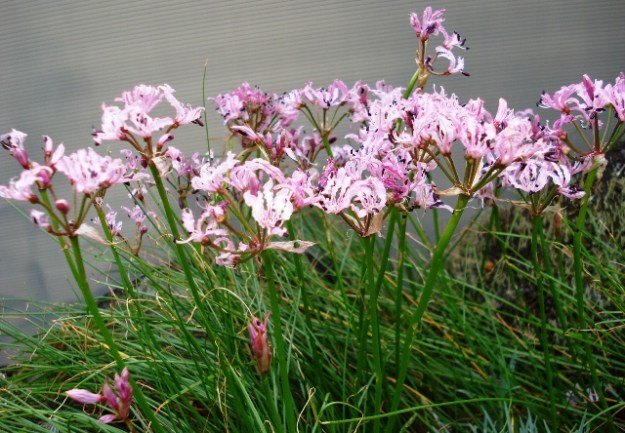
Plant Collector: Nerine filifolia

The daintiest of nerines - N. filifolia

The daintiest of nerines – N. filifolia

Nerines are a star of our autumn garden so the appearance of N.filifolia always arouses that slight sense of autumnal melancholy in me, coinciding as it does with the realisation that the days are getting shorter again. But the references tell me that in fact it is summer flowering and certainly it is always the first nerine to bloom here. It is also the daintiest member of that family that we have. It is tiny. While the stems can be about 25cm long, individual flowers are only a cm across at most with particularly frilly, waved petals in deep pink and nine flowers to each head.

The filifolia part of the name means fine foliage, grass-like in the vernacular. With us it is evergreen. In harder climates, it may lose its leaves. Like all nerines, it is a South African bulb, from the Eastern Cape area. It builds up easily and is not fussy in the garden, as long as it doesn’t get swamped by stronger growing plants.

Nobody could call it spectacular. It is just one of those little treasures that adds detail and seasonal interest to the garden. The problem will be sourcing bulbs. You will probably only find it from bulb specialists or other gardeners, though Trade Me is always worth watching for odd plants that are not widely available these days.

First published in the Waikato Times and reprinted here with their permission.