Category Archives: Plant collector

flowering this week, tried and true plants

Plant Collector: Nolina syn. Beaucarnia recurvata

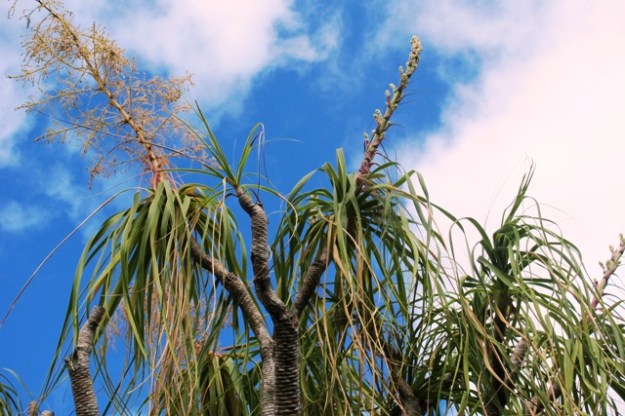
Nolina recurvata, flowering in our rockery
Nolina recurvata, flowering in our rockery

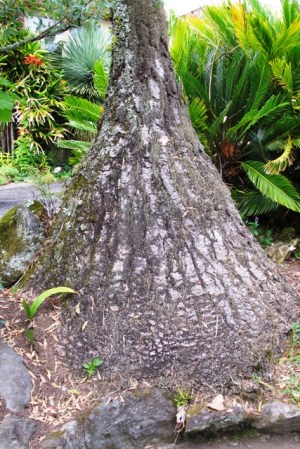
The good side of the bowl on our nolina. There is no bowl on the other side due to rot in our mild, humid climate

The good side of the bowl on our nolina. There is no bowl on the other side due to rot in our mild, humid climate

Most readers will know this as a pony tail palm, usually sold as a pot plant when it is maybe 25cm tall. You will find them in the house plants section in supermarkets, chain stores and garden centres because they are reasonably tolerant of indoor conditions with good light levels. Even as young plants, they start to develop a distinctive bowl at the base with a single stem topped by a tuft of long green leaves. As they come from Mexico where they grow in hot, arid conditions, it is a bit of a miracle that our plant is still alive after fifty or so years in conditions that are anything but.

It is rare to see these plants flowering out of the wild because they need to be quite large and mature before they bloom. Our plant is about 4 metres high. Had one side not rotted out, the bowl at the base would measure well over 4 metres in circumference. However, we have 2 metres of brilliant bowl and a near horizontal line across the back. It is a miracle the plant hangs on and we had thought we might lose the whole thing to rot but it seems to manage. These plants are close relatives of yuccas which makes them members of the Liliaceae group but they are not spiky in any way.

First published in the Waikato Times and reprinted here with their permission.

Plant Collector: Hydrangea quercifolia “Snowflake”

Hydrangea quercifolia "Snowflake"

Hydrangea quercifolia “Snowflake”

That is a real flower, not a silk or paper one and it is a hydrangea. It is often called the oak leaf hydrangea – oaks are quercus, hence the quercifolia. It is native to south eastern USA.

This particular plant, which I photographed in my sister’s garden last week, is surviving on benign neglect. It has its roots in the open but the plant has spread so that the flowers are under the cover of a carport, conditions it clearly relishes. We have it planted in woodland areas here but this plant was more spectacular. Apparently it started flowering in November and has been looking really good ever since. The flower heads are in long cones and while “Snowflake” is described as a double form, in fact it forms multiple layers of petals down the stems ageing from white to antique pink shades. In autumn, the foliage colours up to deep burgundy red shades before falling.

H. quercifolia is not fussy about soil types but it needs to be rich, moist and well drained even through summer. It will grow in sun or shade although it is probably easier to keep those moist conditions in semi shade. There are a number of different named cultivars, but “Snowflake” is probably the most spectacular. If you can’t source it from your local garden centre, then mail order hydrangea specialists Woodleigh Nursery have it available on their website.

First published in the Waikato Times and reprinted here with their permission.
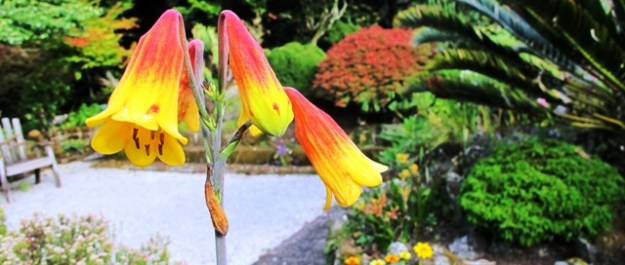
Plant Collector: blandfordia (February bells here)

Blandfordia - Australia's Christmas bells

Blandfordia – Australia’s Christmas bells

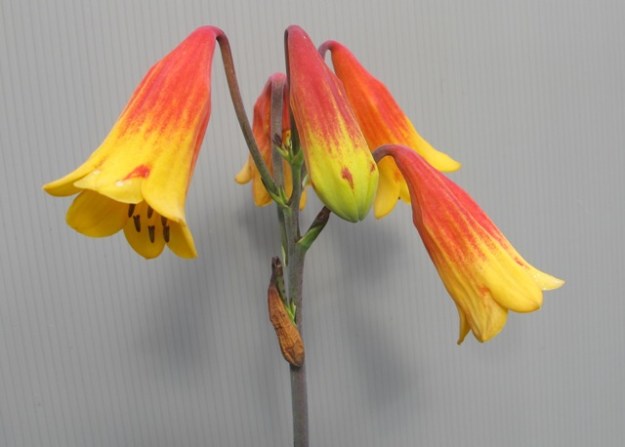
Christmas bells is the common name. Apparently in their homelands of Australia, these bulbs flower around Christmas. They are somewhat later here but the flowering lasts many weeks. It is not that there are large quantities of blooms, just that they come in succession and each trumpet lasts for a long time. These ones are on stems about 30cm high. The foliage is small, anonymous and grass-like at the base.

There are four different species of blandfordia and they have been given a family all of their own. They are hugely variable in colour and flower size, ranging from all red to all yellow, which makes identification difficult. We think this one is most likely to be Blandfordia grandiflora (so-named because it has the largest flowers) which is native to New South Wales and Queensland. There is a slight hesitation, however, between that and the Tasmanian form B. punicea. Unless an Australian botanist arrives at the right time, we may not get a definitive identification.

You don’t see blandfordias around often, or used in cut flower production, because they are slow to establish. Really slow, in fact. The references say up to 7 years to get to flowering size. In our case, maybe add another 7 before we started getting consistent flowering. Ours appears to be largely evergreen, keeping some foliage year round. Blandfordias need excellent drainage but not dry and baked in arid conditions.

blandfordia (2) - Copy

First published in the Waikato Times and reprinted here with their permission.
Plant collector: Jacaranda mimosifolia

The summer delight of the jacaranda

The summer delight of the jacaranda

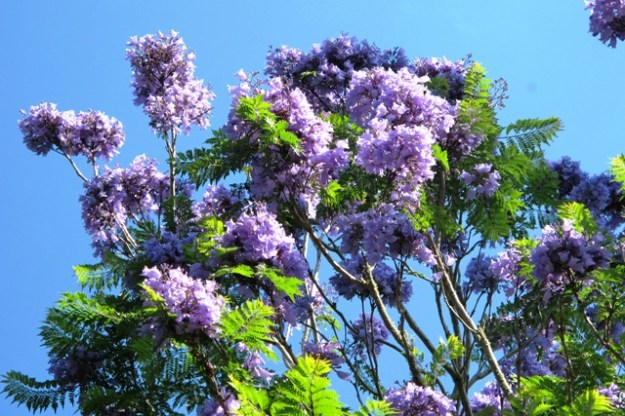
South Africans could be forgiven for thinking that this tree is one of their indigenous species. Pretoria has so many planted that it is apparently a haze of blue in late spring to early summer. In fact it comes from Bolivia and Argentina but is a worldwide hit because blue flowered trees are not common at all when you think about it. Nearer to home, when we last visited Whakatane, they too had used this summer flowering delight as a street tree. But it is nowhere near as common where winters are wet or in inland areas because it is a subtropical plant. Our tree is growing in a protected position, surrounded by other trees, rather than standing in solitary splendour so its blue-as-blue floral display is best seen out of our upstairs windows.

Jacarandas are deciduous and make an airy, open tree. After many years ours has reached around nine metres high, though it will have been stretched up by the trees around it. The flowering season lasts many weeks but it does appear that cooler temperatures delay the season until mid summer. In less than ideal conditions, it will need a sheltered, favoured position with excellent drainage in the warmest possible situation. It is classified as a member of the Bignoniaceae family though most gardeners will just recognise it as a legume.

Plant collector: Eryngium planum

The hazy blue of Eryngium planum

The hazy blue of Eryngium planum

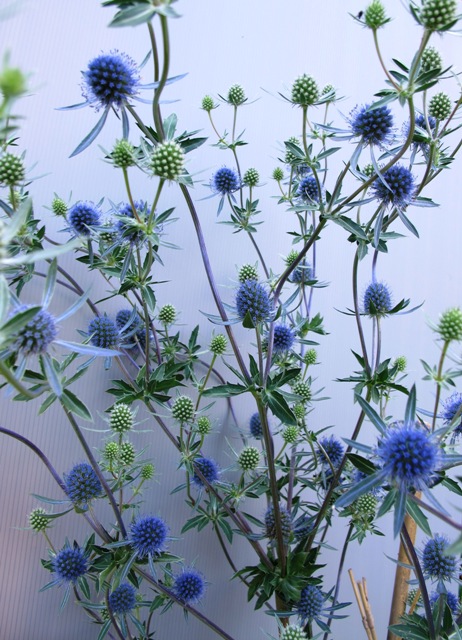
I thought it was going to be easy to write up eryngiums but it transpires that there are a whole lot of different ones from various habitats and climates. So I will confine my comments to the ones we are growing here. I love these ethereal thistle or teasel-like flowers in the prettiest hazy blue. We have had what I think is Eryngium variifolium in the rockery for a number of years. Despite its decidedly prickly habit and its location too close to the path, the flowers are always a summer delight. When I tried to move it back from the path, I found it had a phenomenally long and tough tap root so it defied my plans. That one has never set seed for us. Some eryngiums are propagated by autumn root cuttings so we plan to try that.

Eryngium planum is taller so needs staking in the garden. It flowers earlier in the season and grows easily from seed. We ordered it through Kings Seeds and this is the first summer we have had a good sized planting of it. I am hoping it will set seed because I think I can use lots of this plant in the summer garden. It doesn’t take up much space so can grow through other plants and the flowers last a long time. Both forms we have are perennials. E. variifolium disappears entirely in winter but neither of us can remember whether E. planum does too or whether it retains a smaller rosette of visible leaves.

Eryngiums belong to the Apiaceae family (with carrots!) not the thistle family. They are often referred to as sea holly but that should more correctly be ascribed to E. maritimum which we have seen growing wild on the coast of Cornwall.

First published in the Waikato Times and reprinted here with their permission.