Category Archives: Plant collector

flowering this week, tried and true plants

Plant Collector: Solandra longiflora

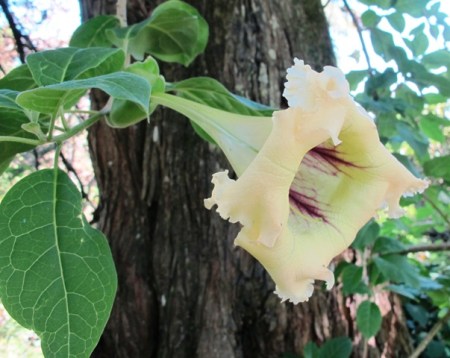
Solandra longiflora or the chalice vine
Solandra longiflora or the chalice vine

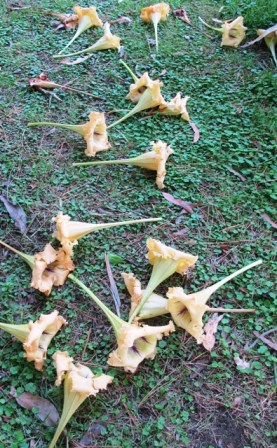
A carpet of spent trumpets

A carpet of spent trumpets

This is not a common plant at all in this country, where it has been identified as Solandra longiflora. All the solandras, of which there are around eight, appear to be variable species so not all longifloras will look the same as ours. However, they all share the common name of chalice vine on account of the large blooms that look like chalices. And they are strong climbers from the more tropical areas of the Americas, in the case of longiflora – the West Indies.

Ours has taken a fair number of years to get a good grip on the large tree we wanted it to grow up and also to produce more than just a few blooms. But this summer it is outdoing itself and we have an abundance of these large trumpets. They are an attractive amber honey colour with dark burgundy striping in the throat. At 25cm long and over 12cm across, there is quite a lot of flower.

The foliage is not exciting and bears some resemblance to woolly nightshade, daturas or brugmansias, this being because they all belong to the solanum family. It also shares some of the chemical compounds of the datura family but this is best left to the indigenous peoples who use it for a variety of purposes. Like datura, it is highly toxic and more likely to cause death in the wrong hands.

First published in the Waikato Times and reprinted here with their permission.

Plant Collector: Cordyline stricta

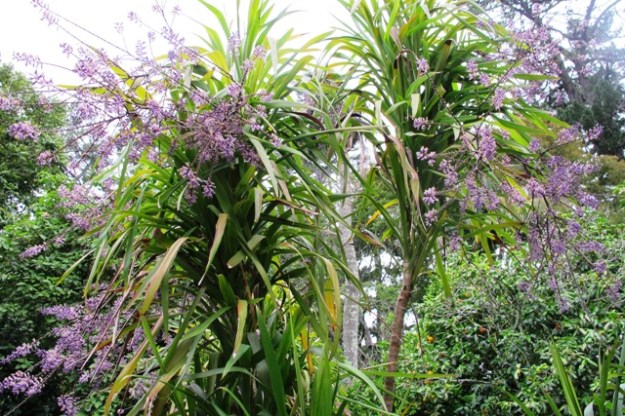
Cordyline stricta - blue flowers but no scent

Cordyline stricta – blue flowers but no scent

Cordylines are commonly known as cabbage trees in this country. Some wit branded them as Torbay Palms for the UK market and we know that most of them are ours, native to New Zealand. Not this one, however. The blue flowers and the unchewed foliage are a hint – C. stricta belongs across the Tasman, native to coastal New South Wales through to southern Queensland. It is a native moth – Epiphryne verriculata – that chews our cordylines but it does not fancy the foreign varieties so C. stricta doesn’t get the moth eaten look.

It is an excellent garden plant, being tolerant of a wide range of conditions and relatively hardy. It will take coastal winds, even dry conditions, grows in sun or shade and is okay with light to moderate frosts. We have never had it reach much over 3m tall and it clumps so if it is getting unwieldy, it is easy to chop out the longest stems. The leaves are a little fleshier than the stringiness of our native varieties so it is more amenable with the lawnmower. Then there are the lovely blue flowers in summer. But it doesn’t have everything – there is no scent and that is one of the hallmarks of our native ones.
Cord stricta - Copy

First published in the Waikato Times and reprinted here with their permission.
Plant Collector: Hydrangea serrata “Preziosa”

Hydrangea "Preziosa" - generally colour stable in all soil conditions.

Hydrangea “Preziosa” – generally colour stable in all soil conditions.

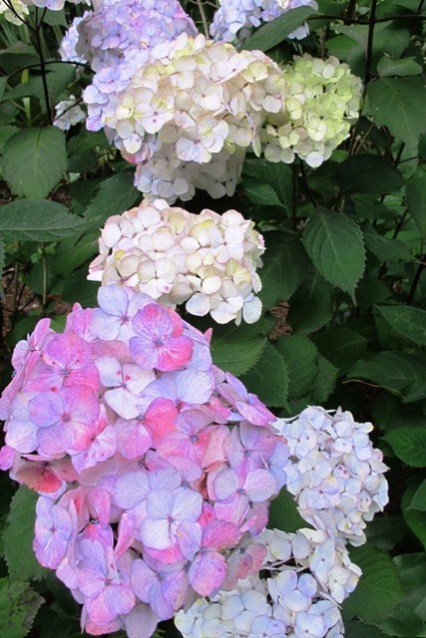
In the world of summer flowering shrubs, hydrangeas are surely king. There are many others beyond the common macrophylla types and the serrata family from Japan and Korea are perhaps a little more refined. Certainly they are smaller growing and perfect for semi shaded positions. “Preziosa” is a hybrid but predominantly of serrata lineage. It is a smaller moptop – the pompom type of flowers. Two factors set it apart from many others. Its colouring is not affected by soil type and its flowers change colour as they age so you get a range of different colours on the one bush. They open green, changing through yellow tones to cream, fading to white with pink tinges on the petals, then deepening to pink shades and ending up dark cherry red. It also has attractive red stems and the foliage is often tinged red.

“Preziosa” is a not happy in full sun and it particularly dislikes hot, dry conditions. I moved these plants from an area where there was too much root competition from surrounding trees and they perked up enormously in well dug soil with plenty of compost added but still in open shade. They reach about 150cm in height and a metre wide, making them a good option for smaller, town gardens.

First published in the Waikato Times and reprinted here with their permission.
Plant Collector: Dicentra eximia alba

Dicentra eximia alba - a modest little plant for semi shade areas

Dicentra eximia alba – a modest little plant for semi shade areas

This particular dicentra hails from USA where it is widespread because it is not at all picky about temperatures. We use it as a ground cover in semi shaded conditions. It is fully deciduous so it disappears in autumn, to reappear with renewed vigour each spring. The foliage is technically described as finely cut and divided which means it looks ferny or maybe feathery. The flowers are little heart shaped pouches and feed the bees, particularly the humble bumbles. We have another form where the foliage is glaucous – in other words, blue-grey with the same white flowers, as well as pale pink forms. It is moderately poisonous to stock which is how it comes by its common name in USA of staggerweed, but that is not a problem in a garden situation. It forms rhizomes at or just below the soil level. Combine it with spring bulbs which flower first and as their foliage gets tatty after flowering, the fresh dicentra will mask it.

The pretty Dicentra spectabilis or Bleeding Heart with its dear little pink to red heart flowers hanging all down the stems is from Northern China, Japan and far eastern Russia – all places where it will get a good winter chill. I remember it as a common garden plant from my Dunedin childhood. Over the years, we have bought fine looking plants in full leaf and flower on several occasions but they fail entirely to reappear the second year. It is available in seed so the plan is to order a packet next season and raise a whole lot to experiment with different locations in the hope we can get it established.

First published in the Waikato Times and reprinted here with their permission.

Plant Collector: Hydrangea indochinensis

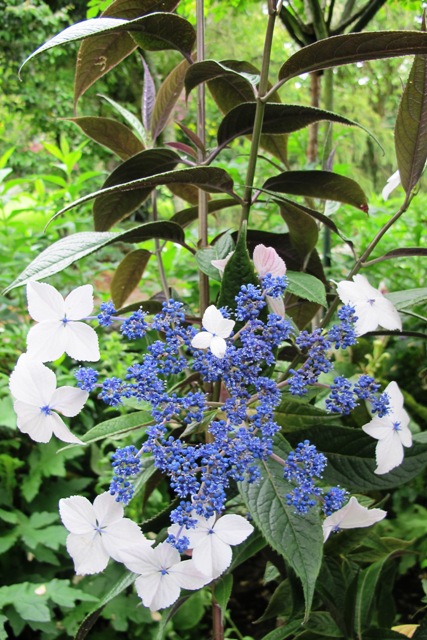
Hydrangea indochinenis - an evergreen lacecap

Hydrangea indochinenis – an evergreen lacecap

The vast majority of hydrangeas are deciduous and not many people realise there are a few evergreen ones. H. indochinensis a relatively recent introduction and has been collected from areas of Vietnam and southern China. It is quite variable but the form we have has lovely pointed leaves with dark maroon on the underside and attractive blue and white lace cap flowers. In these types of hydrangeas, the fertile true flowers are the little ones in the centre whereas the outer layer of larger petals are mere sterile ornamentation.

We have found it quite difficult to grow well and this plant is much happier having been moved to a more hospitable position with plenty of compost. It is not rated as hardy which means that it is unsuitable for cold, frosty situations and gardeners in inland areas will need to find a favoured, sheltered position to grow it. Our plants have never reached much over a metre tall and maybe 50cm wide.

H. indochinensis is available in New Zealand but you will probably have to find a hydrangea specialist because it is not a standard garden centre line.

First published in the Waikato Times and reprinted here with their permission.