Category Archives: Plant collector

flowering this week, tried and true plants

Plant Collector- Lycoris aurea

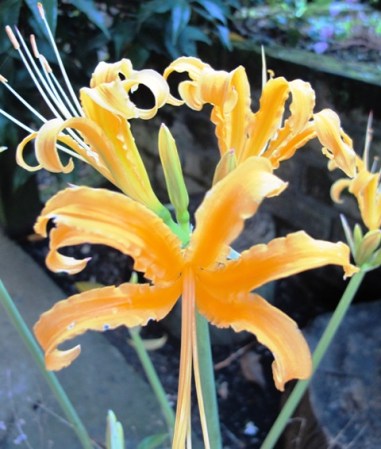
Lycoris aurea - the golden spider lily

Lycoris aurea - the golden spider lily

No, it is not a golden nerine in flower. Nerines do not come in yellow or gold and they hail from South Africa. The lycoris is a close botanical relative (both are from the amaryllidaceae family) but a distant geographic one. It comes from China through to Japan and is sometimes called the golden spider lily. Its native habitat is described as limestone country, which is interesting. Maybe it could be naturalised around Te Kuiti? It is a plant of the grasslands and forest margins in southern China and it has apparently naturalised in California.

The lycoris is not rare, it is just not widely available. But when you think about it, there are not many autumn flowering bulbs available commercially. Along with other members of the amaryllis family, it has a relatively large bulb although it prefers to be fully buried, unlike belladonnas and nerines which like to bake with their necks exposed. The lycoris does like a bit of summer heat to ripen the bulb which springs into growth in early autumn by putting up its flower spikes first. These will be followed by strappy green leaves which stay until the bulb goes dormant in late spring. It is renowned as an excellent cut flower.

It appears that lycoris was named for the Roman woman (not of noble birth) who counted various notable lovers including Mark Anthony. Aurea just means yellow.

First published in the Waikato Times and reprinted here with their permission.
Plant Collector: Clematis tangutica

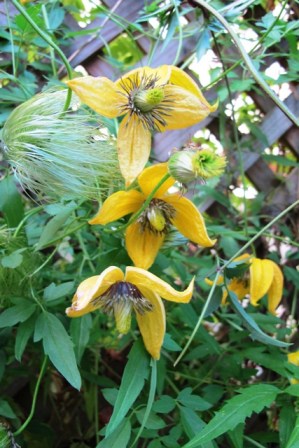
The early autumn charm of Clematis tangutica

The early autumn charm of Clematis tangutica

We have been gently enjoying the bright yellow, hooded bell flowers of Clematis tangutica, one of the later flowering varieties for the season. There may be a mere four petals and some purple stamens in the centre and the flower is only 7cm across, but they are very charming. The silky seed heads are a particularly ornamental addition especially as we have both seed heads and flowers on the vine at the same time.

C. tangutica is one of the very best yellow coloured clematis. It hails from north western China into Mongolia which means it is completely cold hardy. It is a clematis type where all that is required is to cut it off about 20cm above the ground some time during winter when it is dormant and leafless. They don’t come much more easy care than that. It means you can grow it scrambling through other plants if you wish, and it shouldn’t smother them. Ours is growing up a trellis.

We have never noticed our plant seeding down but I see it comes with a warning to weed out seedlings so it must have that capacity. This means that it is highly unsuitable for planting near native bush and reserves and would probably no longer be allowed into the country. We don’t need another old man’s beard smothering our native forests. In a garden situation where we have had it for a decade or so, it has not displayed these wayward habits so we are happy to continue giving it garden space so it can charm us from late summer through to autumn.

First published in the Waikato Times and reprinted here with their permission.
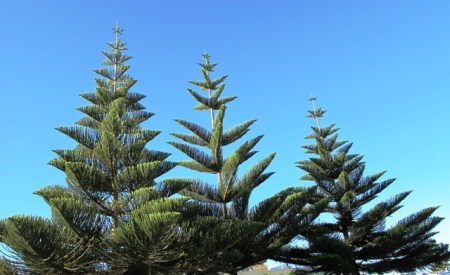
Plant Collector: Norfolk Island Pine (Araucaria heterophylla)

The urge is to put a Christmas star on top - Araucaria heterophylla

The urge is to put a Christmas star on top - Araucaria heterophylla

I am very fond of Norfolk Island pines in the landscape though they should come with a warning not to ever, under any circumstances, plant them in a suburban setting. We once owned a house where the neighbour’s Norfolk Island Pine robbed us of several hours of sunshine a day.

These are not actually members of the pine tree family. They are araucarias and this one is A. heterophylla. That name is used synonymously with its earlier name of A. excelsa but heterophylla is the correct one these days. The best known araucaria is the monkey puzzle tree (A. araucana) and it hails from Chile. At least these are true to their name in that they come from Norfolk Island which gives a hint to ideal conditions – mild and coastal. Last time I was in Napier, I thought their seafront avenue specimens looked a bit scruffy but any tree that can survive and grow in the full blast of salt spray and wind is a bit of a wonder. The tough, tightly whorled leaves encircling the branches will have evolved to cope with salt spray. Even so, any tree is going to look lusher with a smidgeon more shelter or planted a little further back from the seashore than those Napier specimens.

It is that perfect, open pyramid shape that makes it such a fantastic landscape tree where space allows. You just want to put a Christmas star on top every time you look at one. Potentially they can grow huge, up to fifty or sixty metres over time and that is massive. This is not a tree that will look attractive if you try and top it to keep it lower. Its application is probably limited to public plantings and farms but viewed from afar, they make a great visual contribution.

First published in the Waikato Times and reprinted here with their permission.

Plant Collector: Crinum moorei variegated

Fragrant Crinum moorei var.

Fragrant Crinum moorei var.

Crinums are a large family, belonging to the amaryllidaceae group so having some botanical connection to the likes of belladonnas and nerines. But despite there being over 130 different crinum species, not a lot make good garden subjects in this country. Sometimes you will see different crinums being grown in the tropics but the common form in this country is C. moorei which is a South African plant. It has big strappy green leaves, largely evergreen so it can get a bit scruffy, and big, strong spikes of scented flowers in shades of pink. It is a very easy plant, tolerant of woodland shade and near total neglect.

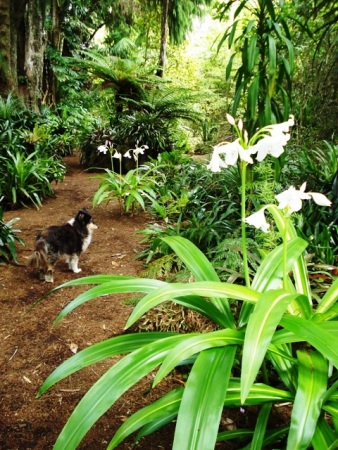
Tall, white punctuation marks in summer along a woodland walk - Crinum moorei var

Tall, white punctuation marks in summer along a woodland walk - Crinum moorei var

This is a variegated form and rather more desirable. It is deciduous which solves the scruffy problems. When the fresh growth comes in mid spring, it lights up a dark area with its bold pale gold and green striping. By mid summer, the variegation has toned down considerably to green which gives a splendid foil for the lovely tall spires of predominantly white scented blooms. These are around 150cm high but so strong, they don’t need staking. They are a wonderful late summer accent plant for shade gardens. The bulbs can reach extremely large proportions and are relatively slow to increase. As with a number of the amaryllis family, the bulbs sit half in the ground with necks exposed. We have never seen this variegated form set seed though the usual green moorei can be grown easily from fresh seed. We have to wait for our plants to form offsets on the bulbs in order to increase them, though enthusiasts could increase them by twin scaling.

First published in the Waikato Times and reproduced here with their permission.

Plant Collector: Lepidozamia peroffskyana

Lepidozamia peroffskyana - an Australian cycad

Lepidozamia peroffskyana - an Australian cycad

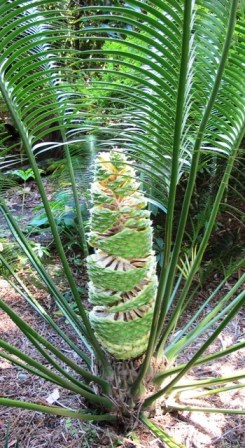
Difficult name, I know, but this plant does not appear to have a common name. It is a cycad and one native to Australia at that. Some mistake it for a palm because it grows a trunk and sprouts it leaves in a palm-like habit, fountaining from the top as it matures. Those leaves can be up to 3 metres long, which is extremely large when you think about it. But it is a cycad which is an entirely different plant family to palms. This particular plant is a seedling from a mature specimen we have and I photographed it because of its spectacular cone which has split open in a wonderful spiral. This split is to release its pollen, rather than to create a perfect pattern.

Lepidozamia peroffskyana cone

Lepidozamia peroffskyana cone

Normally we remove cones to stop the plant putting its energies into trying to set seed. It is suspected that forming the cone robs the plant of too many essential micro nutrients which can lead to yellow banding disfiguring mature leaves. It looks like sunburn. Our mature plant suffered badly in the past from this yellowing but it is still a little early for us to be able to state with confidence that de-coning it solves the problem, though it is looking hopeful.

This is an east coast rainforest plant from northern New South Wales through to Gympie in Queensland (I have been to Gympie though I cannot say I recall seeing lepidozamia there). In our conditions, it will tolerate light frosts and cooler temperatures overall. The natural rainforest habitat gives an indication that it likes fertile soils rich in humus, growing in company and in ground that never dries out. I had to go searching to find out for whom this plant was named – Count Peroffsky, a Russian nobleman and benefactor of the St Petersburgh Botanic Garden where this plant was first cultivated beyond its natural habitat. First in gets dibs on the naming rights even now.

First published in the Waikato Times and reproduced here with their permission.